Search Result For "google"

Alphabet is folding Nest, led by CEO Marwan Fawaz (right), into Google's hardware team, led by former Motorola executive Rick Osterloh (left)
Google is bringing gadget maker Nest back under its control as the search giant battles rivals Amazon and Apple in the rapidly expanding smart home market. A big part of the change: Making it easier to add Google's artificial intelligence technology and Assistant -- a digital helper that competes against Amazon's Alexa and Apple's Siri -- into new Nest products.

The world's largest search engine has staked its future on building Google smarts into devices beyond smartphones. On Wednesday, Google said Nest was part of its plans and would no longer operate as a separate division that lived in the outer orbit of parent company Alphabet's "Other Bets" group of projects.

Watch this:Nest goes back to Google

Instead, Nest rejoins the Google mothership -- the part of Alphabet that houses search, YouTube, Android mobile software and other moneymakers. Nest, acquired by Google in 2014, had been operating outside of Google, the only profitable division of Alphabet, for the past three years.

Under the new org structure, Nest CEO Marwan Fawaz reports to Google's hardware chief, Rick Osterloh, a former Motorola executive who took charge of all Google's consumer devices in 2016. That includes Google Home smart speakers, Pixel smartphones and Chromecast streaming devices.

Nest CEO Marwan Fawaz says the company has shipped 11 million products to date
Nest CEO Marwan Fawaz says the company has
shipped 11 million products to date.
James Martin/CNET
"All of Google's investments in machine learning and AI, they can very clearly benefit Nest products. It just makes sense to be developing them together," Osterloh said in an interview Tuesday, which included Fawaz and took place in a meeting room designed to look like a home, complete with a kitchen and a washer-dryer setup. "It's the natural thing to evolve to."

Nest's brand, known for its 2011 internet-connected thermostat, isn't going anywhere, Osterloh and Fawaz said. In fact, the two drilled home the message that the reunion of the teams will "supercharge Nest's mission," as Fawaz put it. They used the word "supercharge" at least five times during our 40-minute interview at Nest headquarters in Palo Alto, California.

Fawaz said Nest has shipped more than 11 million products since its first thermostat went on sale in 2011. Since it's been part of "Other Bets," Alphabet doesn't call out how much money Nest makes or loses.

The biggest change: Making Google's AI technology a staple in future Nest products. I asked if that means making every new Nest device an access point for the Google Assistant. That integration is "core to the strategy," said Fawaz, but nothing is set in stone. Nest has already begun building the Assistant into devices like its Nest Cam IQ indoor camera.

Nest and Google have already plotted out and finalized their hardware roadmaps for 2018, but in the next two years, they'll start co-developing products. Google also plans to offer more bundled packages for Nest and Google devices, like one deal last year that paired Nest products over $100 with a free Google Home Mini. Fawaz said people could also eventually use their Google accounts with their Nest app.

One thing that isn't changing: Nest, which won't say how many employees it has, will keep its offices in Palo Alto, instead of moving to the Googleplex in nearby Mountain View. The decision to merge Nest with Google comes as tech's biggest companies work to infuse their software into every aspect of people's lives, from their cars to homes. People will spend $1 trillion on the so-called "internet of things" by 2020, according to Gartner. And they'll spend over $50 billion on smart home tech in 2022 -- up from $31 billion this year -- according to Statista.

But right now the gateway drug is smart speakers. Amazon dominates that world with its Echo devices, owning 69 percent of the market. Google is far behind with 31 percent, according to a report by Consumer Intelligence Research Partners. Apple, meanwhile, officially enters the market when its new HomePod speaker goes on sale Feb. 9.

Nest was previously a semi-independent unit of Alphabet, Google's parent company
Nest was previously a semi-independent unit of
Alphabet, Google's parent company.
CNET
Nest's reunion with Google isn't a complete surprise. In November, The Wall Street Journal reported that Google was considering bringing Nest back into the fold. Osterloh and Fawaz said the merger has been in the works for the last few months. Since the two groups already partner on supply chain operations, packaging and event launches, it made sense for them to be one unit, they said.

Being under the same org chart also makes it easier for Nest to use Google's AI technology, the foundation for its Assistant and the key to new products like its Google Lens and Google Photos services.

"We've leveraged AI capabilities from Google in the past, especially in the computer vision space and facial recognition," Fawaz said. "Being part of the Google family, we get closer to that."

'The whole world is shifting'

A lot has changed since Google bought Nest for $3 billion nearly four years ago. That same year, Amazon introduced its Echo smart speaker, a surprise hit and a big slap to Google and Apple, which were already working on voice search. Google followed in 2016 with Home, a smart speaker that promised to put Google's leading search engine a few voice commands away. And this week, reviews went up for Apple's HomePod, a $350 Siri-enabled smart speaker that Apple touts as having better audio quality than its rivals.

Google has bulked up its hardware efforts in other areas too. Osterloh, former president of Motorola, was tapped two years ago by Google CEO Sundar Pichai to create a new consumer device effort. Though Google has always dabbled in hardware -- think the Nexus Q media player or Chromebook laptops -- Pichai wanted to prove the company was all-in this time around. Under Osterloh, Google unveiled its first branded phone, the Pixel, in October 2016 to rival Apple's iPhone and Samsung's Galaxy. It also added a virtual reality headset, a Wi-Fi router and new Chromecast video and audio streamers to its "Made by Google" product lineup.

Maybe the biggest sign that Google no longer considers hardware a hobby is its $1 billion investment in smartphone manufacturer HTC, which brings to Google over 2,000 HTC engineers -- many of whom already worked on the Pixel phone. The deal officially closed last week.

Google also put on a show last month in Las Vegas at CES, the world's largest consumer electronics conference. In past years, Google has typically laid low while its manufacturing partners, including Samsung and LG, made all the noise. But this year, the company set up a massive stage to showcase its gadgets and plastered the words "Hey Google" -- one of the trigger phrases for the Google Assistant -- over the Las Vegas Monorail. White-suited Google workers greeted showgoers in booths across the conference floor with the sole aim of telling them about how Google Assistant worked with various gadgets, from TVs to headphones.

Nest will be joining Google's hardware division, led by former Motorola executive Rick Osterloh
Nest will be joining Google's hardware division, led by former Motorola executive Rick Osterloh.
James Martin/CNET
Meanwhile, after a two-year slump in which it didn't enter new product categories, Nest in September added devices and services, including the Nest Hello smart doorbell and the Nest Secure alarm system.

"It's just a logical move," said Bob O'Donnell, an analyst with Technalysis. "The whole world is shifting. Amazon did a good job of recognizing an opportunity. Others are recognizing it and adjusting accordingly."

Hey, Alexa

When it comes to their smart home rivalry, Google and Amazon haven't been afraid to play hardball -- sometimes at the expense of customers.

Amazon, the world's largest online retailer, doesn't sell Google Home. Instead, searching for that product on Amazon brings results for other products, including the e-commerce giant's rival Echo speaker. Amazon sells some Nest products, like the smart thermostat and smoke detector, but not others, such as the Nest E, a cheaper $170 version of its thermostat, or the Nest Secure alarm system. Also, after banning sales of Google's Chromecast streamers two years ago, in December Amazon agreed to bring them back.

Google, meanwhile, cut off YouTube from working on Amazon's Echo Show video device and Fire TV. And at CES, Google tapped partners including Sony to introduce four new video devices with the Assistant built-in to compete with the Echo Show.

Google has made big investments in hardware with its Google Home line of products
Google has made big investments in hardware with
its Google Home line of products.
CNET
Google, Amazon and Apple know getting adoption for their voice assistants is the key to future riches. Over 5 billion devices that support digital assistants, including Alexa and Google Assistant, will be in use by consumers in 2018, according to IHS Markit, with nearly 3 billion more added by 2021. Of those devices, 39 million will be smart speakers, up from about 27 million units sold in 2017.

That all raises the question: Will Nest's closer relationship with Google mean Nest products stop working with Amazon Alexa?

"This announcement doesn't change that," Fawaz said. "If there are any changes in the future, we'll certainly make sure it's the right decision for consumers."

I pressed them again about the potential for this new arrangement to change the relationship with Amazon.

"I would call Amazon and ask them," Osterloh said. "We don't know. We want to work with Amazon in an open, transparent, symmetrical way. Hopefully they want to do the same. We're continuing discussions with them on that."

(We're checking with Amazon and will update this story when we get a response.)

A rocky tenure

When Nest appeared in 2011, it was a novel enterprise from a leader with a storied pedigree. Nest co-founder and former CEO Tony Fadell became known as the Godfather of the iPod after he played a key role, with Steve Jobs, in developing the seminal music player. Following Fadell's departure from Apple in 2010, he and Nest co-founder Matt Rogers focused on reinventing another market. The answer: a smart remake of home thermostats. The idea was to create a whole suite of forgotten household products that had been reimagined for the internet era. The startup announced its second product, the Nest Protect smoke detector, in 2013. In 2014, Google bought Nest. That was, in part, to inject the search giant with some of the product magic Fadell brought with him from Apple. But Nest's tenure at Google has been rocky. There was public drama after Nest paid $555 million for Dropcam, maker of the security camera it eventually turned into the Nest Cam. After the buyout, Dropcam CEO Greg Duffy left the company and has since called the acquisition a "mistake." Under Nest, more than 50 Dropcam employees resigned. Duffy has said Dropcam's product roadmap was derailed.

When Google created Alphabet in August 2015, Nest became its own division, alongside other units including Google, the moonshot factory X and health tech company Verily.

It was Nest, though, with its own brand, team and offices, that was supposed to be the model for how the new Alphabet structure would work. But instead of becoming the Platonic ideal for an Alphabet company, Nest underwent more scrutiny. Meanwhile, Alphabet CFO Ruth Porat tightened spending at the "Other Bets."

Fadell stepped down in 2016, and Fawaz took his place. Fawaz and Osterloh met in 2012 while both working at Motorola. Google briefly owned Motorola before selling it off to Lenovo for $3 billion in 2012, but neither executive came to Google as a direct result of that acquisition.

Today, all Fawaz will say about Nest's past is that the stories were "a bit exaggerated."

As for the way Alphabet is set up, Fawaz defended it. "Each bet is different. We have different journeys," he said. "In this particular case, Rick and I came together and said, '[Nest rejoining Google] makes sense.'"

"Other bets will have different journeys. They can have a different outcome," Fawaz added. "There's not one size that fits all in the model."

source:CNet

While you can't watch the 2018 Winter Olympics with your Google Home speaker, you can still use it to follow along. Here's how.

With the 2018 Olympic Games officially underway, it can be difficult to keep track of everything that's going on. While you can't necessarily watch the Olympics with your Google Home speaker (you'll need a media streamer or VR headset for that) you can still use Google Home to follow along and test your knowledge. Here's how.

Olympic athlete facts

Some of the Olympic athletes this time around may be new to you. If you find yourself wondering who is representing your country, you can just ask Google Home about them. Say things like:
  • "OK, Google, how tall is [athlete's name]?"
  • "OK, Google, how old is [athlete's name]?"
  • "OK, Google, where did [athlete's name] go to college?"
  • "OK, Google, how many medals has [athlete's name] won?"
  • "OK, Google, how much does [athlete's name] weigh?"
  • "OK, Google, where was [athlete's name] born?"
Google won't always have the answer, especially if the athlete is completely new or relatively unknown, but it's a good place to start.


Olympic facts

You can also ask Google Home for interesting facts about the Winter Olympics themselves. Say, "OK, Google, tell me a fun fact about the games in Pyeongchang."

It explained the term "snurfer," which is a combination of "snow" and "surfer," or what we now call snowboarding. And it told me about Francisco Fernández Ochoa, the first Spanish gold medalist in the Winter Games for giant slalom in 1972, and his sister, Blanca Fernández Ochoa, who became the first Spanish female Olympian to win a medal 20 years later.

Olympic Channel

Olympic Channel is an Assistant app that lets you play Olympic trivia, learn about athletes, and get the latest news.

To get started, just say, "OK, Google, let me talk to Olympic Channel." Follow the prompts (such as allowing Olympic Channel to get your name from Google), and then say something like, "Play a game" or "Tell me about Elana Meyers Taylor."

One feature, called News Feed, is not active just yet (since the games have just started), but should become functional once there's some news to go around, such as gold medals won and other happenings.

NBC Sports Trivia

There is also a Google Home game from NBC made specifically for the Winter Olympics. Just say, "OK, Google, open NBC Sports Trivia." It will ask you a mixture of five multiple choice and true-or-false questions each time you play.

Watch updates on Chromecast

Since NBC is the broadcasting partner for this round of Winter Olympics, you can use Google Home to stream news updates to a nearby Chromecast. Just say, "OK, Google, play NBC Sports on [Chromecast name]." The latest Olympic updates from the NBC Sports YouTube channel will play in reverse chronological order. Just know that you may also get some general sports updates along the way, as well.

Ask who won

The Google Blog also says you will be able to ask who won certain events . Just say something like, "OK, Google, who won the women's 1,000 meter speed skating in the Olympics?" or "OK, Google, who won mixed doubles curling in the Olympics?"

Just keep in mind that no events are over yet, so there are no winners to announce… yet.

source:CNet

Google adds price tracking and deals to Google Flights, Google Trips and hotel search
Google today is expanding its booking features for travelers using Google services including Trips, Flights and hotel search, with a focus on helping people find better rates. For example, Google can now tell you the best time to buy an airline ticket or see when room rates are higher, among other things.
Google adds price tracking and deals to Google Flights, Google Trips and hotel search
These price-tracking features are similar to those that some other travel services, like Kayak, as well as startups, like Hopper, already offer. Now Google is taking what has been a differentiating feature for those services, and making it more broadly accessible to everyone searching for travel information on the web.

With Google Flights, the company is leveraging machine learning technology to analyze historical price data to inform you as to when it’s the best time to book a flight. After entering in a destination, you can receive tips like “prices won’t drop further” or “prices are less than normal,” to help you figure out if you should book now or wait. These tips appear above your search results, and are of more use to leisure travelers whose dates may be flexible.

The flight search price tracking is rolling out worldwide, on both desktop and mobile.

Meanwhile, Google’s hotel search results will offer the same kind of information. After searching for a hotel on Google, you’ll see if room rates are higher or the area is busier than usual due to a local event. You can also opt in to receive email alerts about price fluctuations, starting on desktop early next year.

This price tracking is available globally in all languages on mobile.


The addition of hotel price tracking may be of particular concern to the popular booking app Hopper, which just recently began offering hotel price tracking – but only in limited markets. Now it has to compete with Google in this area as well.

Finally, Google is also adding information about discounted tickets and tours in its Google Trips mobile application for iOS and Android.

The Google Trips app was launched just over a year ago, as a personalized travel planner. But it makes sense that Google would integrate its travel-booking features in here, as well, as opposed to just making it another way to leverage Google Maps’ data.

The new ticket and tour deals will appear in the city you’re visiting within the app, and will be launched worldwide in English, French, Italian, German, Spanish, Portuguese.

source: TechCrunch

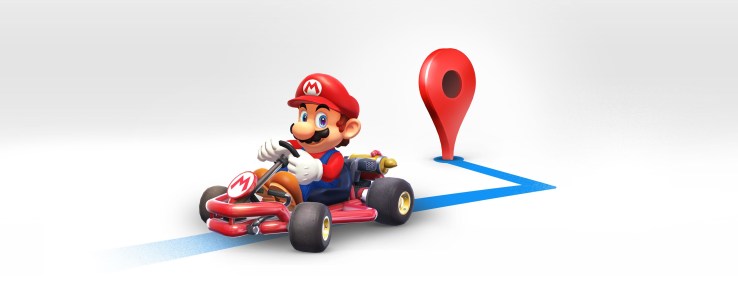
Mario can now guide your route in Google Maps
It’s Mario Time! Beloved gaming character Mario is coming to Google Maps, thanks to a partnership between Google and Nintendo ahead of Mario Day, March 10. (MAR10…get it, Mario?) In addition to the various deals and sales on Nintendo games, the mustachioed plumber will also make an appearance in Google Maps’ navigation, if you opt in to have Mario accompany you on your journey.

The feature, which Google announced this morning, is available in the latest update in the Google Maps app on both iOS and Android.

After entering in your destination, you’ll notice a yellow question mark “?” icon at the bottom right of the app’s screen. Tap this, and you’ll get a prompt to enable “Mario Time.”

Mario can now guide your route in Google Maps
From then on, the navigation arrow in Google Maps will instead be Mario – who, in his little red go-kart, will then be your companion for your entire trip. The integration will be available for a full week, says Google, so you can enjoy using Mario for longer than just on Mario Day alone.

You can also choose to screenshot your route and share it to @GoogleMaps on Twitter and Instagram with the hashtag #MarioMaps, Google suggests. But of course, don’t share personal details like your work or home address, if you do so.

Mario can now guide your route in Google Maps
This isn’t the first time Google has had a little fun with Google Maps, as you may recall.

The company has in the past unleashed Pac-Man on city streets in Maps, let Google Maps streetview users go inside Doctor Who’s TARDIS, and has let you travel by Loch Ness Monster, among other things. Plus, Google and Nintendo have worked together before on silly stuff like this, as with the April Fool’s day prank involving the “launch” of Google Maps 8-bit for NES.

But in this case, adding Mario to Maps feels more like a brand advertisement, rather than just a fun trick. We asked Google if that was the case. However, a company spokesperson confirmed that no money exchanged hands in its business deal with Nintendo.

The Mario feature will begin rolling out today – so make sure you’ve got you’ve got the latest version of Google Maps installed if you want to try it out.

source:TechCrunch

Google’s Big Ad-Blocking Update Comes to Chrome Tomorrow: Here’s What We Know
It’s been in the works for nearly a year and Google’s great ad-pocalypse is now upon us. On Thursday, the Chrome browser will begin to automatically filter out ads that don’t meet certain quality standards. Your browsing experience is about to change a little bit. Here’s what you need to know.

In April of last year, the news first broke that Google planned to integrate some form of ad-blocking into its browser that would be on by default. Since then we’ve seen a gradual rollout of the feature, beginning with the ability to mute autoplay videos with sound on the sites of your choosing. Now, Google going all-in with a set of criteria for what ads will be kosher in Chrome.

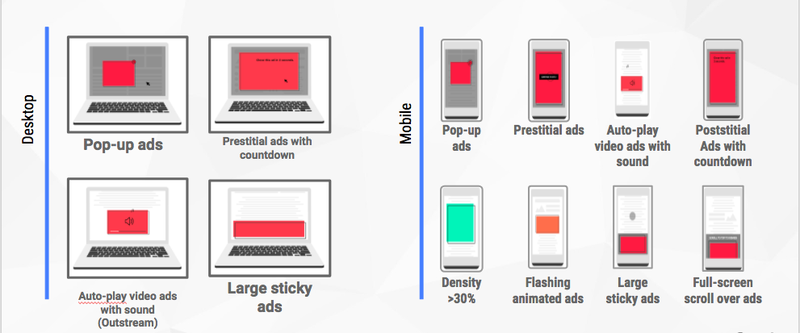
Along with its fellow ad giant Facebook, Google is a member of the Coalition for Better Ads, an industry group that has performed research on what forms of web advertising annoys people the most. It’s created a list of the 12 types of web experiences that should ideally be avoided by advertisers. Now Google is going to enforce that list with Chrome, which is used by over half of all people accessing the web with a browser.

The 12 ad types that Google Chrome will block by default
The 12 ad types that Google Chrome will block by default.
Image Source:Coalition for Better Ads
On Wednesday, the company published a blog post detailing how the system will work. Initially, Google will take a sample of various pages on a specific domain and analyze whether that page is serving any of the offending ad categories. It’ll be given a score of “Passing, Warning, or Failing.” Sites that don’t manage to get a passing grade will be notified by Google and they can review an ad experience report for details on what needs to change. If a site ignores multiple warnings, its ads will be blocked by default after 30 days.

If a user visits a site that’s being filtered by Chrome, they’ll see a message in the address bar that gives them the option to still allow ads—on mobile, users will see a pop-up at the bottom of the screen that will give them the same option. Yes, pop-up ads are blocked, and Google will be informing you with a pop-up notification.

There’s plenty of reason to celebrate this change. The internet is getting harder to navigate, and more annoying with advertisers demanding more obtrusive experiences every day. Google claims that since it kicked off this initiative, “42% of sites which were failing the Better Ads Standards have resolved their issues and are now passing.” So it seems that a lot of site owners got the message before it could even become a problem.

There’s also cause to be skeptical of Google’s altruistic goals. Sure, it’s telling advertisers not to be evil, but it’s also hoping that a better experience will mean fewer people feel the urge to download a third-party ad blocker. That’s good for the internet, which is largely funded by ads. But it’s particularly good for Google, which controls around 42 percent of the US digital ad market and 75.8 percent of the search ad market, according to research from eMarketer. It wouldn’t be so great if Google, with all its power, decided to follow in the footsteps of services like Adblock Plus, which offers companies the opportunity to pay their way onto an acceptable ads list. Representatives for Google have assured us on multiple occasions that the company isn’t offering any kind of paid whitelisting now, and isn’t planning to do so. But things could change.

For now, enjoy the better web before Google fully consumes it all and does whatever it wants.

source:Gizmodo

Ex-Nest CEO Tony Fadell: "Nest was acquired by Google for a specific reason. I pitched it as 'We are the senses and you are the brain.'"

Nest co-founder Tony Fadell says Google hurt its smart assistant efforts when it spun off the maker of net-connected gadgets not long after acquiring it.

Google's announcement this week that it's bringing Nest back under its wing has some former employees of the smart-thermostat maker saying the company never should've been spun off in the first place.

Tony Fadell, co-founder and ex-CEO of Nest, said both companies' efforts in connected gadgets were hurt when Google made Nest a separate business less than two years after acquiring it. Google bought Nest in 2014 for $3.2 billion, and the spin-off happened in 2015 during the restructuring that created the Alphabet holding company.

"From the outside it looked like Nest was the perfect poster child for Alphabet," Fadell told CNBC in an interview Friday, "but at the same time, separating it was undoing the thing that was most essential for both companies -- figuring out how to make them work together."

Watch this:Nest goes back to Google

On Wednesday, Google said Nest would no longer operate as a separate divisionunder Alphabet's "Other Bets" group. Instead, it's rejoining Google as the tech powerhouse looks to work its artificial intelligence technology and smart assistant into new Nest products. That effort comes as rival Amazon unleashes a bombardment of Echo gadgets equipped with its Alexa smart assistant and Apple touts its HomePod smart speaker, which relies on Siri.

But Fadell, who left Nest in mid-2016 amid questions regarding sales goals and workplace culture, told CNBC that bringing Google's AI smarts to Nest gadgets had always been the point.

"Nest was acquired by Google for a specific reason," Fadell told the network. "I pitched it as 'We are the senses and you are the brain.'"

Two other former Nest employees, who wished to remain anonymous, told CNBC that after the Alphabet restructuring, Google and Nest staffers weren't properly encouraged to work together. The two teams were also kept in the dark about each other's projects, even when those efforts were similar, and even after Amazon began gobbling up the smart-home market with its Echo and Alexa products. Google reportedly tried to sell Nest in 2016 but abandoned that effort.

"I think it would have helped had the [mergers and acquisitions] team put something in place in the early days to structure and incentivize Google and us in a way that would have led to more cooperation," one of the ex-employees told the network.

"It was like a soap opera," one of the former staffers said.

A culture clash might have been involved. Fadell, an ex-Apple executive and disciple of Steve Jobs, is known as the godfather of the iPod, and played a key role in the development of the iPhone. His joining the search giant was seen by many as Google co-founder Larry Page's attempt to inject his company with Apple's storied hardware sensibility. But Apple's rigid and secretive culture is a stark contrast from Google's open and experimental one.

On Thursday, Matt Rogers, Nest's other co-founder, said he's leaving the newly reintegrated company to devote more time to a venture firm and lab he helped establish.

Fadell told CNBC he'd like to see Google's effort to marry its AI technology to Nest products succeed this time around.

"For the sake of Nest customers and talent," he said, "I hope they follow through on their commitment they made to us four years ago instead of trying to sell it off like they did just two years ago."

Google didn't respond to a request for comment.

Nest's more secure smart home, in pictures


source:CNet

Google Flights will now predict airline delays – before the airlines do
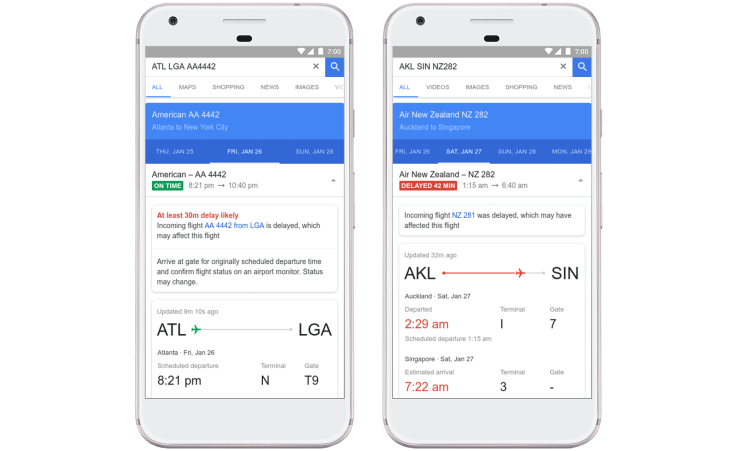
Google is rolling out a few new features to its Google Flights search engine to help travelers tackle some of the more frustrating aspects of air travel – delays and the complexities of the cheaper, Basic Economy fares. With the regard to delays, Google Flights won’t just be pulling in information from the airlines directly, however – it will take advantage of its understanding of historical data and its machine learning algorithms to predict delays that haven’t yet been flagged by airlines themselves.

Explains Google, the combination of data and A.I. technologies means it can predict some delays in advance of any sort of official confirmation. Google says that it won’t actually flag these in the app until it’s at least 80 percent confident in the prediction, though. (Of course, you should still get to the airport on time, but at least you’ll know what you’re about to face once there.)

It will also provide reasons for the delays, like weather or an aircraft arriving late.

You can track the status of your flight by searching for your flight number or the airline and flight route, notes Google. The delay information will then appear in the search results.

The other new feature added today aims to help travelers make sense of what Basic Economy fares include and exclude with their ticket price.

These low-cost fares are often the only option for travelers on a budget, but they have a number of restrictions that can vary by airline.
Google Flights will now predict airline delays – before the airlines do
Google Flights will now display the restrictions associated with these fares – like restrictions on using overhead space or the ability to select a seat, as well as the fare’s additional baggage fees. It’s initially doing so for American, Delta and United flights worldwide.

These changes come only a month after Google Flights added price tracking and deals to Google Flights as well as hotel search features for web searchers.

The additions seem especially targeted toward today’s travel startups and businesses, like Hopper which had just added hotel search, and uses big data to analyze airline prices and other factors; or TripIt, a competitor of sorts to Google’s own travel app Google Trips, whichmost recently introduced security checkpoint wait times. (Given that Google already knows the busy times for area businesses by tracking people’s movement via Google Maps, it wouldn’t be surprising to see it implement security wait times next.)

The features are also a real-world demo of Google’s machine learning and big data capabilities, especially in the case of predicting flight delays. Since you can’t take action on the alerts until the airline makes an official announcement, they will largely just cause more anxiety on top of your already stressful travel experience.

source:TechCrunch

Google needs to give the AirPods better competition
In the race for in-ear AI, Apple has the clear advantage despite the fact that their intelligent assistant is one of the dumbest of the bunch.

Yesterday, reports emerged that Apple was working on a pair of follow-ups to its Airpods headphones that could bring them always-on Siri functionality as well as a splash-proof design. As we think about all the things that Apple could do right with its next set of wireless earbuds, it’s easy to reflect on all that Google did wrong with its Pixel Buds and how much of an opportunity they still have.

Google Assistant lends so much potential to a pair of smart wireless earbuds from Google. The fact is that Siri doesn’t hold a candle to Google Assistant in many ways, and while the functionality of voice control on the AirPods is largely focused on music and calls, the superior intelligence of Google Assistant should make them a much clearer companion for a set of earbuds.

Hardware is still very much a side project for Google, but as the company prioritizes home assistant hardware, it really doesn’t make sense that they’re not putting more resources into a pair of wireless headphones. The Pixel Buds need a more purposeful design that minimizes friction and delivers Assistant insights more effortlessly in a package that feels like more than just a follow-on.

Google needs to give the AirPods better competition
The AirPods are an engineering marvel, and while some of the functionality of the Pixel Buds was interesting — mainly their ability to interface with the Pixel 2 for language translation — they fell flat on design. Google needs to rethink its wireless earbuds from the ground-up and focus more on creating something with the sleekness of the Pixel phones rather than the fabric-obsessed friendliness of their Home devices. Cutting the woven cord and moving to a truly wireless form factor is a necessary step, as is shrinking down the size of the Bud part of the product. It’s really not about the sound quality as much as it is about the connectivity and the lack of friction. While FastPair has been a great step in simplifying the bluetooth pairing, there are still some quirks that aren’t present with Apple’s W1 chip.

While Siri is always quick to refer you to search results when it doesn’t have an answer (a frequent occurrence), Assistant’s optimization for its display-free Home devices has led it to order functionality around the assumption that there’s not always a screen available to default to. Today, Google announced that it was bringing location-based notifications and voice-optimized routine functionality to its Home devices so it could complete regular custom tasks without you having to pepper it with commands, stuff like this would be ideal for earbuds that are always-listening, something that Google could do much more with than Apple.

Even as features take months to roll out, Google has still shown a degree of nimbleness on the voice assistant front that Apple can’t match in annual WWDC keynotes. While Amazon is just as quick with Alexa, Google Assistant’s deepening integration with Android establishes an arena where they should be the clear champion.

AirPods are clearly the best wireless earbud that an Apple user can own and even with the reduced functionality that still might be true of Android phones. People are building tools to bring iOS-only feature sets to Android and that fact alone should suggest Google take a more serious look at its own hardware and the opportunity that it’s losing out on.

source:TechCrunch

Machine learning proves its worth for new video effects tech: distinguishing between faces and backgrounds at 100 frames per second.

Google's AI software can detect the subject of a  video and change the background
Google's AI software can detect the subject of a
video and change the background.
Google
Google's artificial intelligence researchers have a new trick up their sleeves: giving selfie videos a new background the way you can with still photos today.

Switching out background scenery is a decades-old technology, but it's generally complicated and time-consuming -- think of making movies with superheros acting in front of green screens so computers can later replace the uniform green color with digital effects like exploding buildings. Having 3D scene data, for example extracted from newer iPhones' twin cameras, makes the process only a little easier.

Google, though, trained a neural network with lots of carefully labeled imagery that helped it learn how to distinguish facial features -- eyes, hair, glasses, mouths, and so on -- from everything else. The result is a system that can swap out backgrounds fast enough to keep up with video. Digital video frames whip by at 30 frames per second, but Google's technology works at 40 frames per second on a Google Pixel 2 phone and more than 100 frames per second on an Apple iPhone 7.

Want to try it out for yourself? Sorry. For now, only a pretty small number of high-profile YouTubers with access to the YouTube stories service, which offers an ability to share Snapchat-esque short videos.

Google detailed the research in a blog post Thursday.

"Our new segmentation technology allows creators to replace and modify the background, effortlessly increasing videos' production value without specialized equipment," Google programmers Valentin Bazarevsky and Andrei Tkachenka said in the blog post.


Google uses machine learning in its video segmentation technology that can determine background imagery that can be replaced with something funny or eye-catching
Google uses machine learning in its video segmentation technology that can determine background imagery that can be replaced with something funny or eye-catching.
Google
The technology shows how versatile AI and machine-learning technology is for solving complex computational problems. Neural network technology doesn't have to know endless rules, like "faces have two eyes, located above the nose, unless the face is viewed in profile, in which case there may only be one eye visible, unless the subject is wearing dark glasses." It just has to be trained on enough photos, labeled by humans who do actually know what a face is, that it eventually learns the patterns. It's proven a remarkably useful technology for everything from screening out email spam to predicting what word you're trying to type into your phone.

Google already uses AI in a related feature today on its Google Pixel 2 phones. The phones only have single cameras, but AI helps blur backgrounds for portrait-mode photos.

source:CNet News

Google takes AMP beyond basic posts with its new story format
For the most part, Google’s Accelerated Mobile Pages project was about what its name implies: accelerating mobile pages. Unsurprisingly, that mostly meant quickly loading and rendering existing articles on news sites, recipes and other relatively text-heavy content. With that part of AMP being quite successful (if not always beloved) now, Google is looking to take AMP beyond these basic stories. At its AMP Conf in Amsterdam, the company today announced the launch of the AMP story format.

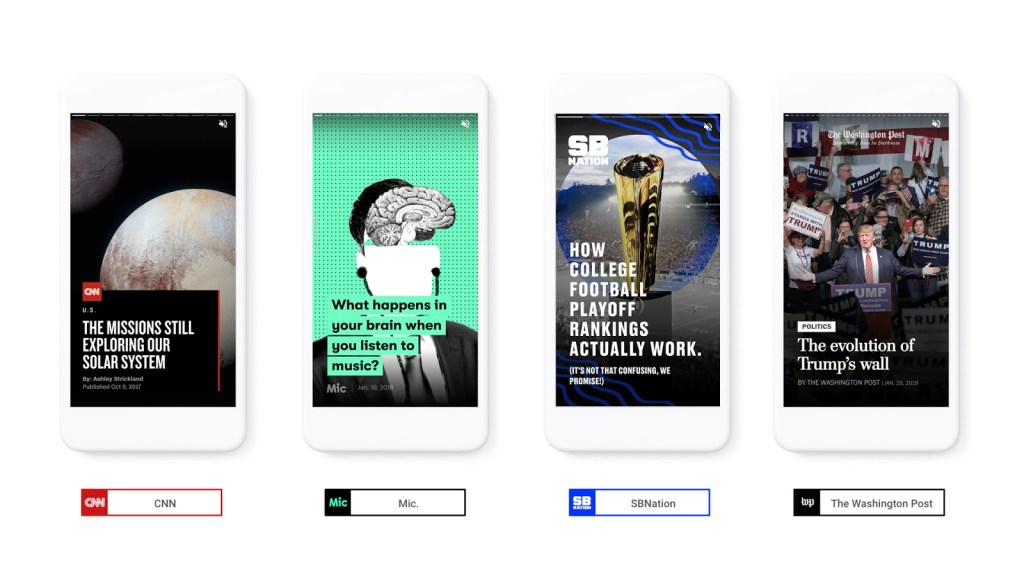
The overall idea here isn’t all that different from the stories format you are probably already familiar with from the likes of Instagram and Snapchat. This new format allows publishers to build image-, video- and animation-heavy stories for mobile that you can easily swipe through. “It’s a mobile-focused format for creating visually rich stories,” as Google’s product manager for the AMP project Rudy Galfi called it when I talked to him last week. “It swings the doors open to create visually interesting stories.”
Google takes AMP beyond basic posts with its new story format
Image: TechCrunch
To launch this format, Google partnered with CNN, Conde Nast, Hearst, Mashable, Meredith, Mic, Vox Media and The Washington Post. Like all of AMP, this is an open-source project and publishers can extend it as needed.

The idea here is to start surfacing AMP stories in Google’s search results over time. For now, though, this is only a preview that is meant to give developers and publishers time to support this new format.

Google takes AMP beyond basic posts with its new story format
Image: TechCrunch
Indeed, the first thing publishers will likely notice, though, is that there’s no tooling yet for building AMP stories. To some degree, that was also the case when Google first showed AMP for regular posts, though developers quickly wrote plugins for all of the popular CMS systems to support it. “Publishers that have been working with AMP stories managed to build fairly easy integrations with their existing CMS systems,” Galfi told us.

Even once tooling is available, though, publishers will have to create AMP stories from scratch. They can’t just easily recycle an existing post, slap on an image and call it a day. The success of the AMP story format, then, is going to be about making the right tools available for building these stories without adding overhead of developers, who are not necessarily all going to be happy about the fact that Google is launching yet another format that it may or may not support in the future.

It’s also still unclear how Google will surface these stories in search and how publishers can ensure that they’ll be included here. Because these AMP stories live separate from regular posts, Google will likely give publishers another means of pinging it when new stories go live.

Google takes AMP beyond basic posts with its new story format
Image: TechCrunch
For now, if you want to try an AMP story, head here and search for one by the launch partners. You’ll find AMP stories under the new “Visual Stories from” header in the search results.

While I’m not sure if publishers will fully embrace this format, I have to admit that the existing AMP stories I looked at made for a nice diversion. The Washington Post used the format to experiment with a timeline of North Korea’s participation in the Olympics, for example. Vox, unsurprisingly, used it for explainers, among other things, and Mashable probably went further than most by using video, sound and animations across most of its stories.

source:TechCrunch

A Google Chrome lapel pin
A technology twist could make mobile browsing faster and more engaging, and Google's putting muscle behind it.

The web has taken a beating in the smartphone era. But it's about to start beating back.

Explosive growth of the web, starting in the 1990s, connected the world's population. In the last decade, though, we all started tapping app icons instead of web hyperlinks to chat with friends, share photos and buy products online.

Now Google's Chrome team and browser allies from Mozilla, Opera and Microsoft are putting a new twist on things. It's called progressive web apps, or PWAs. They endow websites with many of the advantages of native apps that run on Google's Android or Apple's iOS. And they can outdo native apps when it comes to fast, hassle-free loading.

PWAs are headlining this week at the Chrome Dev Summit, Google's two-day conference in San Francisco for programmers who want to figure out where Google is taking browser technology. Native apps hog the spotlight, but at the conference, Google will reveal a good reason why browsers generally and Chrome in particular also deserve a place on the stage: unbeatable reach.

"We have over 2 billion Chrome instances that are active" each month, said Darin Fisher, Google's vice president of Chrome engineering and the conference's opening speaker. That amounts to fewer than 2 billion people, because a single person can use Chrome on multiple devices, but it's still a platform with immense power.

That power is essential to making Google's vision a reality. If it succeeds, that browser icon might be the one you reach for on your home screen a lot more often.

Website usage tracking firm StatCounter says browser use on mobile devices just exceeded PC browsing worldwide
Website usage tracking firm StatCounter says browser use on mobile devices just exceeded PC browsing worldwide.
StatCounter
Success on that front also could help restore the fortunes of the web, the closest the computing industry has come to freeing us from software that works only on one device or another, like a Windows laptop but not an iPhone. In an era when tech giants wield tremendous power, the web levels the playing field and makes it easier for new competitors to join the game.

It's no wonder Google is pushing the mobile web. This month, browser usage on tablets and phones for the first time surpassed usage on PCs, analytics firm StatCounter said.

App fatigue

Apps might get the glory, but the web does a lot of the work already. When we need to interact with a business or service, a website is often our first point of contact. Apps are popular, with millions available in Apple and Google app stores, but it's hard to convince people to install them, and even then, most lie dormant.

Among American adults, "almost half...report that they use five or fewer apps at least once per week, and just 16 percent indicate that they use more than 10 apps on a regular basis," a 2016 Pew Research Center study found. And Localytics, which monitors app usage, found that 23 percent of users never reopen an app after the first time and that only about a fifth of people are likely to still use an app after three months.

Darin Fisher, vice president of Chrome engineering, speaks at Google's Chrome Dev Summit
Darin Fisher, vice president of Chrome engineering, speaks at Google's Chrome Dev Summit.
Stephen Shankland/CNET
Fisher isn't pronouncing native apps dead, but he thinks PWAs means the web can shoulder more of the load.

"It's expensive to get people to install an app," Fisher said, but progressive web apps arrive fast through the browser to keep visitors happy, then download extra abilities silently in the background. For website developers, he said, "there's really no fundamental limit to the kinds of experiences you can create."
There's a place for both apps and websites, analyst firm Gartner believes. "A mobile website is more generic, with wider reach, like your ABC or CBS or Fox or NBC channels," said Research Director Jason Wong, while native apps are akin to "a cable channel like the Cooking Channel or MTV targeted toward a specific segment." Apps are great for people who use a company's services are lot, like the 10 percent or 15 percent of users who come back to an e-commerce site frequently, but websites are crucial for the rest.

"The mobile web is unavoidable. Users are using smartphones and tablets to access websites more and more. Google has changed its [search] algorithm to reward mobile-optimized websites," Wong said. "It's imperative companies move to responsive and mobile-optimized websites."

Progressive web what?

If you're browsing the web, you won't see any fancy label announcing a progressive web app. But done well, you'll like it.

The first idea behind a PWA is that websites arrive as fast as possible in basic form so you can get started immediately, then gradually flesh themselves out in the background -- thus the term progressive. Compare that to a typical native app that often requires you to download tens of megabytes of data and wait for an installation before you can get started.

They're not for every situation right now -- games, for example. But PWAs can be appropriate for lots of situations with native apps, like social networking, e-commerce, news and streaming video.

PWAs also download components so they work offline. And they take advantage of push notification abilities for the web -- for example, Carnival Cruise's site can prompt customers to finalize a reservation before it expires in 24 hours. And PWAs can be placed as a home-screen icon so you're more likely to use them again.

The results have convinced companies like the Washington Post, Housing.com in India and Chinese e-commece giant Alibaba. Also, CNET launched its own progressive web app Thursday. Tap this Tech Today link on your phone or tablet if you're curious.
Thao Tran, head of global partnerships for Google,  shows at Chrome Dev Summit how much less expensive  it's been for Housing.com to woo new customers with its progressive web app
Thao Tran, head of global partnerships for Google,
shows at Chrome Dev Summit how much less expensive.
Stephen Shankland/CNET

When Alibaba moved to a PWA, it found a website visit was 76 percent more likely to convert into a website transaction. Among Android device users, monthly usage increased 30 percent, and for those with iPhones and iPads, monthly usage increased 14 percent.

PWAs are particularly popular in developing countries where mobile networks are slow and coverage is spotty, said Alex Komoroske, a Chrome group product manager. Using a cheap, low-end Android phone with an older 3G connection, downloading FlipKart's e-commerce native app took 14 minutes, but the company's progressive web app took 14 seconds, he said.

Where's Apple?

Google has built into Chrome much of the required supporting technology, including push notifications. Mozilla's Firefox and Microsoft's Edge are on board, too, making it safer for web programmers to bet on PWAs.

Apple hasn't joined the party with its Safari browser, but Fisher is optimistic.

If 50,000 website developers start using PWA technologies, "you can imagine Safari engineers will see there's a lot of interest," Fisher said. "Developers can have some influence, voting with their feet for what they care about."

Apple didn't respond to a request for comment.

Apple forbids other browser makers from using their own browser engines on iPhones and iPads, so running Chrome doesn't enable PWAs on those devices. Apple's lack of support is "a real concern for developers," Fisher said, but embracing the PWA approach still boosts performance on Apple's iOS-powered devices.

Easier payments

And progressive web apps will benefit from web payment technology where Apple is ahead, letting you easily complete a purchase with Apple Pay. A more general technology, the web payments interface, is coming to mobile browsers to connect to Android Pay, a credit card, Alibaba's AliPay service, Apple Pay, or whatever other payment mechanism your phone offers.

It all leads to vast improvements over the plodding, hard-to-read websites still common with mobile browsing.

"Everybody should be building a progressive web app," Fisher said. "It just makes sense."

source: CNET

Google’s custom TPU machine learning accelerators are now available in beta
Google’s Tensor Processing Units (TPUs), the company’s custom chips for running machine learning workloads written for its TensorFlow framework, are now available to developers.

The promise of these Google-designed chips is that they can run specific machine learning workflows significantly faster than the standard GPUs that most developers use today. For Google, one of the advantages of these TPUs is that they also use less power, something developers probably don’t care quite as much about, but that allows Google to offer this service at a lower cost.

The company first announced Cloud TPUs at its I/O developer conference nine months ago (and gave access to them to a limited number of developers and researchers). Each Cloud TPU features four custom ASICs with 64 GB of high-bandwidth memory. According to Google, the peak performance of a single TPU board is 180 teraflops.

Google’s custom TPU machine learning accelerators are now available in beta
Image: TechCrunch
Developers who already use TensorFlow don’t have to make any major changes to their code to use this service. For the time being, though, Cloud TPUs aren’t quite available at a click of a button, though. “To manage access,” as Google says, developers have to request a Cloud TPU quota and describe what they want to do with the service. Once they get in, usage will be billed at $6.50 per Cloud TPU and hour. In comparison, access to standard Tesla P100 GPUs in the U.S. runs at $1.46 per hour, though the maximum performance here is about 21 teraflops of FP16 performance.

Google’s reputation for machine learning will surely drive a lot of new users to these Cloud TPUs. In the long run, though, what’s maybe just as important is that this gives the Google Cloud a way to differentiate itself from the AWS’s and Azure’s of this world. For the most part, after all, everybody now offers the same set of basic cloud computing services and the advent of containers has made it easier than every to move workloads from one platform to another. With the combination of TensorFlow and TPUs, Google can now offer a service that few will be able to match in the short term.

source:TechCrunch

Waymo v. Uber trial looks at Kalanick's push for 'cheat codes'

The second day on the stand for Uber ex-CEO Travis Kalanick gets off to a riveting start as Waymo lawyers grill him about what he knew and when he knew it.

It's been a tough morning for Uber's former CEO, Travis Kalanick, who faced a second day of grilling Wednesday from Waymo's lawyers about his efforts to compete against Google's self-driving car program.

That included being shown the minutes of a meeting held April 28 that read: "Top priorities from [Travis Kalanick] ... cheat codes, find them, use them."

Waymo attorney Charles Verhoeven: "You said this in a meeting, didn't you?"

Kalanick: "It's quite possible."

Verhoeven: "The golden time is over. It's war time?"

Kalanick: "It sounds like something I would say."

Kalanick is the highest-profile executive to speak so far in the Waymo v. Uber trial at San Francisco's federal courthouse. The case revolves around allegations from Waymo, the self-driving car spinoff of Google parent Alphabet, that Uber stole trade secrets to use for its own self-driving program. If Uber loses, it may be forced to pay nearly $2 billion in damages and halt its self-driving program.

Travis Kalanick leaves the San Francisco federal courthouse Tuesday with his father, Donald Kalanick
Travis Kalanick leaves the San Francisco federal courthouse Tuesday with his father, Donald Kalanick.
James Martin/CNET
After being grilled by Waymo's attorneys Tuesday and early Wednesday, Kalanick got his chance to give Uber's side of the story. That included being shown a text exchange between Kalanick and Anthony Levandowski -- whom Kalanick had hired to run Uber's self-driving program -- in which both agreed that "second place is first loser" in the race to win the autonomous vehicle market.

Under Kalanick's leadership, Uber became known for an overly aggressive culture rife with gender bias, unprofessional business practices and even a secret tool, called Greyball, that it used to identify authorities trying to crack down on the ride-hailing service. After months of scandals, Uber's top investors forced Kalancick to resign in June.

Throughout the first few days of the trial, Verhoeven has painted a picture of Uberas a company that would do anything to win. He's presented emails, interview transcripts and meeting minutes showing Uber's efforts to "leapfrog" over Google.

Center to the case is Waymo's allegations that its former engineer, Levandowski, pilfered about 14,000 files from it before quitting in 2016 to form his own self-driving truck startup, Otto, which Uber later acquired. Uber says it never received these files from Levandowski.

Levandowski is expected to take the stand during the trial, but so far he's pleaded the Fifth Amendment. So it's unclear if he'll answer questions about Waymo's allegations.

Before acquiring Otto, Uber had commissioned forensics firm Stroz Friedberg to conduct due diligence on Levandowski and his startup. The firm reported that Levandowski possessed Google information, encouraged Google employees to join Otto, met with Uber executives while still working at Google, and had destroyed proprietary information -- "including source code, files, and software pertaining to self-driving cars" -- he had stored on five disks.

Kalanick testified Wednesday that he never read the Uber-commissioned report. But he did say that Uber agreed to indemnify Levandowski if Google ever sued.

Levandowski has a long history of working on self-driving cars. He joined Google as a software engineer in 2007 and helped pioneer the tech giant's self-driving-car project. Much of his work dealt with lidar, formally known as "light detection and ranging." Lidar is one of the main technologies used in both Waymo and Uber's self-driving cars and lets vehicles "see" their surroundings and detect traffic, pedestrians, bicyclists and other obstacles.

Explaining 'cheat codes'

Finally, after more than an hour Wednesday under Waymo's glare, Kalanick got a chance to explain why he wanted to compete against Google, under questioning from Uber lawyer Karen Dunn.

Uber's former CEO said he originally wanted to partner with Google, "kind of like little brother with the big brother," but got worried after hearing rumors of Google getting into ride sharing. He said he tried to meet with Alphabet CEO Larry Page, but Page was angry at Uber for acquiring 40 researchers from Carnegie Mellon's robotics lab.

"Generally, Google was super not happy, unpumped, about us doing this," Kalanick told the court.

Dunn also asked Kalanick to explain the meaning of "cheat codes."

"Cheat codes are like elegant solutions to problems that haven't yet been thought of," he said.

Waymo's Verhoeven challenged that definition, asking Kalanick about gaming. "I think I read in the news you've been playing a lot of video games," he said.

Kalanick: "When I'm between gigs I play iPhone games sometimes."

Verhoeven: "You know what a cheat code is. You don't have the game but you can cheat and get to the next level."

Kalanick: "No."

And with that, the judge allowed Kalanick to leave the court.

source:CNet

Nest co-founder Matt Rogers is leaving the company.

A day after Google said it's bringing the smart home company back under its control, the Nest co-founder says he's departing.

Nest co-founder Matt Rogers says he's leaving the maker of smart home gadgets.

The move comes a day after Google's parent Alphabet said it was reuniting Nest with Google. The search giant said the move was aimed at infusing more of Google's machine learning and artificial intelligence technology into Nest's product line, which includes a smart thermostat and smoke detector.

Rogers will stay on the through the transition, but after that, he'll depart to devote more time to Incite.org, a venture firm and lab he co-founded.

Here's his statement:

After almost nine incredible, intense years working to build Nest, I've decided to begin my transition to dedicate more of my time to Incite.org, as well as to start thinking about the next adventure. In the coming months, I'll be working closely with Google's Hardware leads to define the 2019 roadmap and to ensure a smooth integration of Nest into Google's Hardware group.

Nest has been an amazing journey and the honor of my career to build. Together with the Nest team and our partners, we've helped save over 19 billion kWh of energy, helped save a number of lives -- both human and pets -- with Nest Protect, and helped families feel more safe at home with Nest Secure and Nest Cam. And along the way, we managed to build the leading brand in the connected home space. I could not be more proud of what we have accomplished and can't wait to see what's next for Nest.
Rogers, Nest's chief product officer, co-founded the company in 2011 with former CEO Tony Fadell, after leaving Apple the year before. The two played key roles in the development of the iPod. Rogers was also one of the first engineers of the original iPhone and iPad.

The departure of Rogers, Nest's last remaining co-founder, marks the close of a chapter for the company. Google bought the buzzy startup in 2014 for $3 billion, in an effort to bring more hardware chops to the search giant. But Nest's tenure there has been rocky. Fadell left the company in 2016 after much turmoil and public drama. For example, he feuded with Greg Duffy, CEO of Dropcam, the smart camera company Nest bought later that year. After Duffy left Nest, he called his decision to sell the company a "mistake."

Fadell was replaced with Marwan Fawaz, a former Motorola executive. On Wednesday, Alphabet said it was reuniting Nest with Google, after three years of Nest being a semi-independent unit. As part of the change, Fawaz will now report to Rick Osterloh, the head of Google's hardware division, responsible for all the company's consumer devices, including the Google Home smart speaker and Pixel smartphones.

Rogers on Thursday said he'll be focusing on Incite, an investing organization that has three arms, each of which focuses on a different area. Incite Ventures is a fund that backs "mission-driven enterprises;" Incite Labs is a nonprofit that extends grants for charitable, educational and scientific purposes; and Incite Politics organizes and supports "initiatives to pass legislation and elect candidates who approach our country's issues from a fresh perspective."

source:CNet

Apple now relies on Google Cloud Platform and Amazon S3 for iCloud data
It’s no secret, Apple has been relying on third-party cloud companies for iCloud. And CNBC spotted an interesting tidbit in Apple’s own documents. The company now relies on Amazon S3 and Google Cloud Platform’s storage product to store iCloud data.

Back in 2016, CRN reported that Apple signed with Google for cloud storage. But Apple’s document represents the first official confirmation that this deal happened.

You can find the information in Apple’s iOS 11 security guide that was published in January 2018. The company mentions that user files are divided into tiny chunks and encrypted. The encryption keys and metadata information are stored on Apple’s own servers. But the encrypted files are stored on third-party services.

While users have no idea that Amazon and Google are managing their iCloud data, Amazon and Google can’t do anything with those files without the encryption keys. So it seems highly unlikely that Amazon and Google are looking at your data.

“The encrypted chunks of the file are stored, without any user-identifying information, using third-party storage services, such as S3 and Google Cloud Platform,” you can read in the document.

In the past, Apple has mentioned Microsoft Azure in its partners. The wording of the document isn’t really clear. Apple could be using more storage services without naming them directly.

In all cases, this is a great example of asymmetric competition. While Apple and Google are fighting really hard to grab market share of the smartphone market, Apple is also Google’s client. Apple also competes with Amazon and Microsoft in other areas. So Apple would need to step up its cloud hosting game to cut ties with its competitors altogether.
source:TechCrunch

Knife-threatening app banned by Google

An app aimed at children that featured a voiceover making threats to cut them with a knife, has been banned by Google.

Blaze and the Monster Machines was removed from the Google Play Store following complaints from parents.

There is mounting pressure on firms to make their platforms safer for children.

One firm that offers real-time blocking software said Google "failed egregiously in its duty of care".

The unofficial app was based on a Nickelodeon show, also called Blaze and the Monster Machines.


Knife-threatening app banned by Google
The voiceover starts off in a friendly manner: "Hi kids, I'm your new friend! You see, I want to play with you kiddo. Maybe we could perform some fun games together."

It then takes a sinister turn: "You look afraid, is it this knife in my hands? Making you a little nervous? This knife is going to improve your look when it's sticking right out of you."

Following horrified reactions from parents, Google pulled the app, saying: "We have a set of policies designed to provide a great experience for users and developers and we act quickly to remove apps from Google Play that violate those policies."

Richard Pursey is chief executive of SafeToNet, a UK firm which offers to protect children from issues such as cyber-bullying, grooming and trolling with software that blocks such content in real-time.

He said:

While we applaud Google's response of taking the app down, it is simply too late. By the time content has been flagged to Google or any other app store, it will have been seen by millions of children.

Unfortunately, this forms a fairly common trend. For example, recently, YouTube removed a children's cartoon called Paw Patrol that showed children sleepwalking to their deaths.

This was viewed over three million times before it was removed. We have also seen clips of Peppa Pig drinking bleach and Elsa from Frozen using automatic weapons.
Children's charity the NSPCC urged parents to set up parental controls on their childrens' phones and have "regular conversations" with them about staying safe online.

The government is keen that social networks and other technology platforms take more responsibility for the content they carry.

In a speech at the World Economic Forum, Prime Minister Theresa May said that making tech firms into publishers was "very complicated" but asked whether there could be a new definition for them, which might make it possible to make them legally responsible for their content.

source: bbc

How to Avoid Being Tracked on Your Laptop, Phone, or Fitness Tracker
Today we’re all being tracked by more gadgets than ever before, and in ways that might not be immediately obvious; but it is possible to put restrictions on the data that your laptop, your smartphone, and even your fitness tracker can collect about you—in particular, where you are and what you’re doing with your device.

As you’ll be able to tell if you actually read through any of the privacy policiesthat appear when you sign up for a new website, install a new app, or boot up a new device, it’s just about impossible to stay completely untracked unless you’re going to retreat to an off-the-grid cabin in the woods to see out your final days.

That said, there are steps you can take to at least limit some of the data that developers, tech companies, websites, and advertisers are amassing on you. Here are the key settings you need to know about for your laptop, your phone, and your fitness tracker.

Laptop data

Log into a macOS computer and you’re making a deal with Apple as per its privacy policy about what it can and can’t track. There’s also the applications you install on top, and the websites you visit, which will have data logging policies of their own to think about—it’s something to consider every time you install something new.

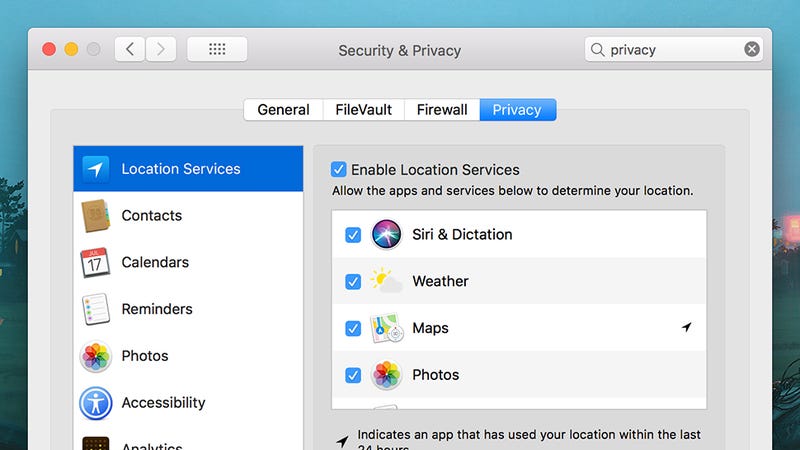
You can put certain limits on data collection—from the Apple menu choose System Preferences then Security & Privacy. Under the Privacy tab are options for preventing apps and macOS itself from tracking your location, as well as settings for which programs can see your contacts, calendars, and so on. Select Analytics and you can choose which diagnostic data gets sent back to Apple—data which the company promises is anonymized.

How to Avoid Being Tracked on Your Laptop, Phone, or Fitness Tracker
Image: Screenshot
Those of you using Windows can take a look at Microsoft’s privacy policy if you want to know what’s being collected and why—your wedding anniversary, maybe, so Cortana can remind you about it. As on macOS, you also need to consult the policies and setting pages for all the applications you install if you want to get a genuinely comprehensive picture of the data you’re giving away.

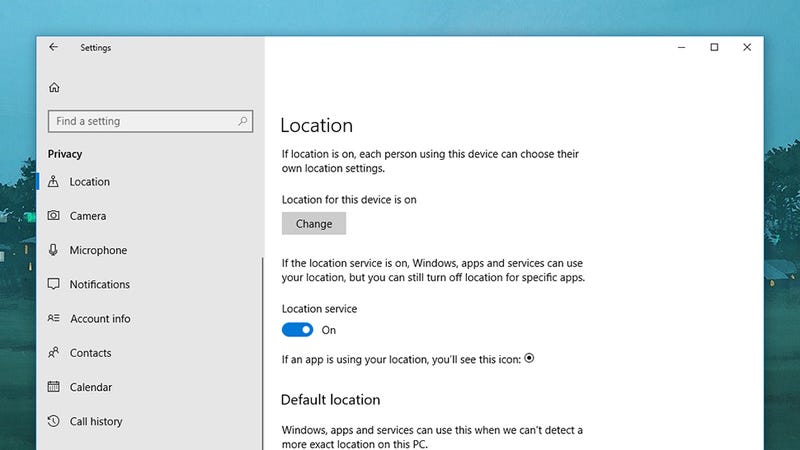
Fire up Settings in Windows 10 (the cog icon on the Start menu), click Privacy, and you can disable tracking settings related to app launches, access to the camera and the microphone by certain apps, and location tracking. You can, for example, limit the apps that have access to your precise location, as well as turn location tracking off for your whole laptop.
Killing location tracking on Windows
Killing location tracking on Windows.
Image: Screenshot
If you’re on a Chromebook then you’ll want to check out Google’s privacy policy to see the data that it’s collecting—which is a lot. Some of this is an inevitable consequence of choosing to use Chrome OS or indeed Chrome on macOS or Windows, but the best place to manage data logging is your Google account page on the web.

Click Go to My Activity to see data being tracked across Chrome, Google search, YouTube, Google Maps and more, and to delete it if necessary. To turn off some of this data collection—like location logging—select Manage your Google activity from the front page, then Go to Activity Controls. This data covers information collected by Google for its own purposes, rather than any data made public.

A big part of the data you’re giving away is to websites you visit, which are keen to track you to the greatest extent possible. We’ve previously written detailed guides to all the data sites collect as well as ways in which you can stop it from happening. For example, you can turn off cookie tracking in your browser’s settings if you don’t want sites to recognize you when you return.

Installing a VPN is one of the best ways of obfuscating your location from the sites you visit, the applications you use, and your ISP. It also encrypts data sent between you and the web, though it doesn’t necessarily do much to stop data tracking on the web. Sites will still be able to recognize you—especially if you log in—unless you take steps to restrict this in your browser settings. If you want to really avoid being tracked on a browser and don’t mind never signing into an account again, than you can always use a TOR browser.

Phone data

As on desktop OSes, you make certain deals with Apple and Google when you sign into your accounts on a brand new phone—if you don’t like it, don’t use iOS or Android. However, there are certain settings you can get at to restrict how much data you’re giving away on your smartphone, both to Apple and Google and the apps you’ve installed.

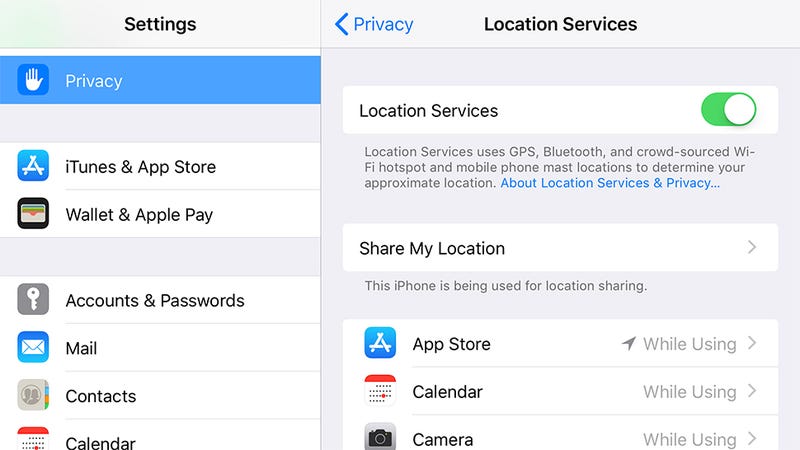
In the case of iOS, you can find a dedicated Privacy menu entry in Settings. Open this then tap Analytics to see the data you’re sending back to Apple—this includes data on how you use your phone, how you use iCloud, and the fitness tracking data logged by your phone’s sensors. None of this information identifies you personally, Apple promises.

How to Avoid Being Tracked on Your Laptop, Phone, or Fitness Tracker
Image: Screenshot
You can actually see the data being logged if you tap Analytics Data. In the words of Apple: “Personal data is either not logged at all, is subject to privacy preserving techniques such as differential privacy, or is removed from any reports before they’re sent to Apple.” If you’re not happy with any of this, turn the toggle switches to off next to Share iPhone Analytics, Share iCloud Analytics, and Improve Health & Activity.

Head back to the Privacy menu and you’ve got all the key permissions being used by your apps, both Apple’s and those from third-party developers—tap any of these entries, like Health, to revoke permissions. In the case of Location Services, you can either turn your phone’s location tracking off completely, or on an app-by-app basis, which is great for your privacy but not so great for finding local coffee shops.

Over on Android, you can check up on what Google is keeping tabs on by launching Settings then choosing Google and Personal info & privacy. The key option on the subsequent screen is Activity controls, where you can choose the data that Google logs, from your voice searches to your location—it’s up to you to what extent you trust Google to use this data in a responsible way.

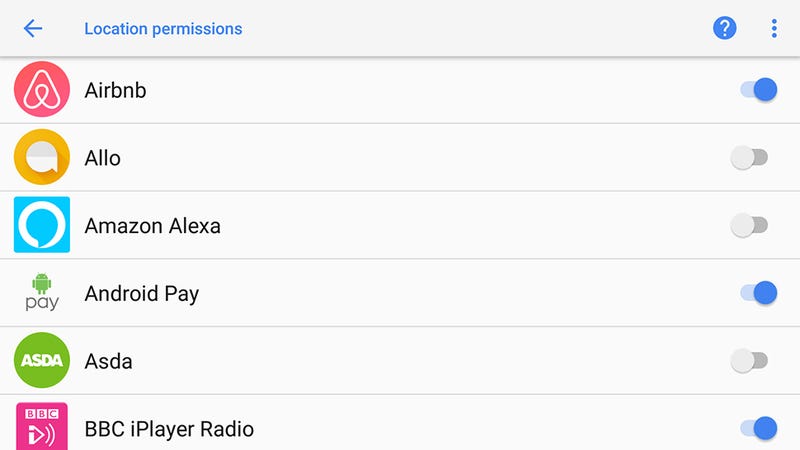
Then there are all the individual tracking permissions assigned to your apps, which on Android can be found by tapping Apps & notifications then App permissions. As on iOS, the items listed here are the various bits of data apps can request access to, from your current location to the phone microphone.

How to Avoid Being Tracked on Your Laptop, Phone, or Fitness Tracker
Image: Screenshot
Tap any of the items on the list to see which apps have access and revoke that access if necessary—just slide the toggle switch to the off position. You can also choose an app from the Apps & notifications screen, then select Permissions to see what it has access to and revoke the access if you want to (which may or may not break some of the functionality of the app along the way).

With any iOS or Android app, having access to something like the microphone doesn’t necessarily mean the app is recording everything you say. Even if it is (maybe it’s a dictation app), it doesn’t necessarily mean the developer is using it for a nefarious purpose. But you’re really at the mercy of the developers, their privacy policies, and how well they stick to them—the safest option is just to turn off permissions.

Fitness tracker data

When you buy and set up a new fitness tracker, you’ve got two concerns: The data the tracker manufacturer is collecting, and the data being collected by any apps you’ve set up to work with the tracker. As always, a thorough read through of the associated privacy policies is recommended, if you can make sense of them.

In the case of individual apps, such as Strava or Fitbit’s bundled app, you can make use of the various permission switches we’ve already mentioned that are built into iOS and Android. However, they refer specifically to the data being collected from your phone, and won’t necessarily cover data being synced from a separate wearable.

How to Avoid Being Tracked on Your Laptop, Phone, or Fitness Tracker
Image: Screenshot
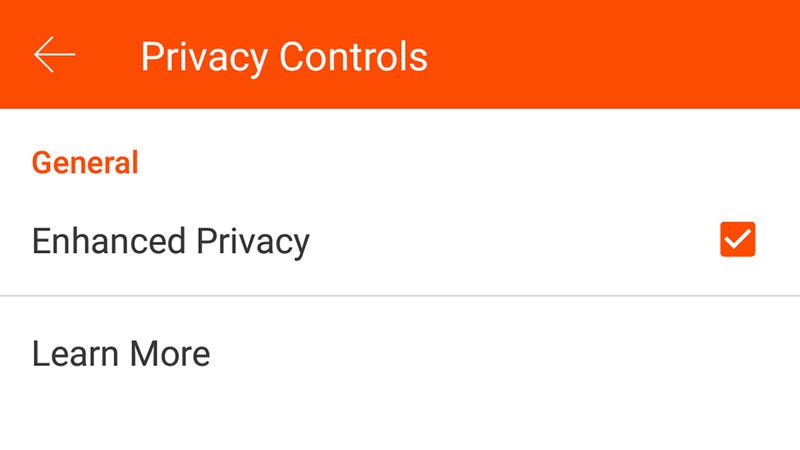
To really take control over the data being logged and shared by your fitness apps, you need to delve into the settings for those apps. In the case of Strava, for example, tap the Menu button (top left on Android) or the More button (bottom right on iOS), choose Settings and then Privacy Controls, and you can hide your activities from other users.

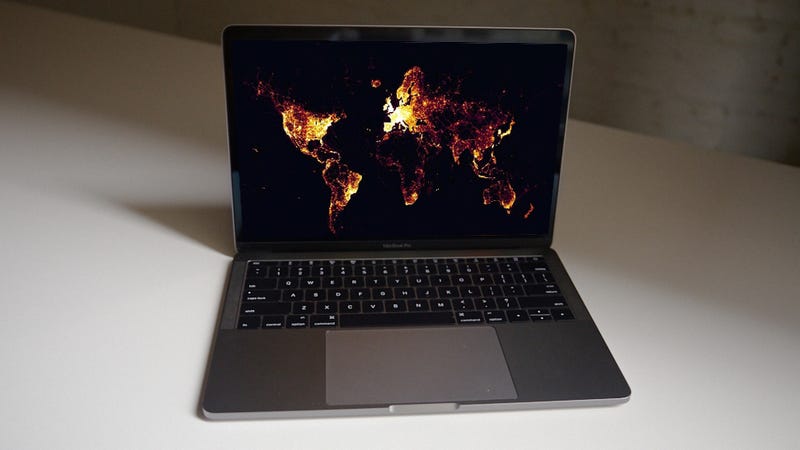
You can also hide individual activities from view, and extra privacy settings are available on the website, including the specific option to exclude you from heat maps, and the option to create privacy zones. These are certain areas of the planet where your activities can’t be viewed by anyone you’ve connected with or anyone browsing your Strava profile.

Of course this only hides your runs and cycles from other people, not from Strava itself—though the company says private activities weren’t shown on the now infamous heat map. As we’ve mentioned above, signing up with these services essentially means you’re giving them permission to log and use your data as defined by their privacy policies (here’s Strava’s), which are usually fairly ambiguously worded.

How to Avoid Being Tracked on Your Laptop, Phone, or Fitness Tracker
Image: Screenshot
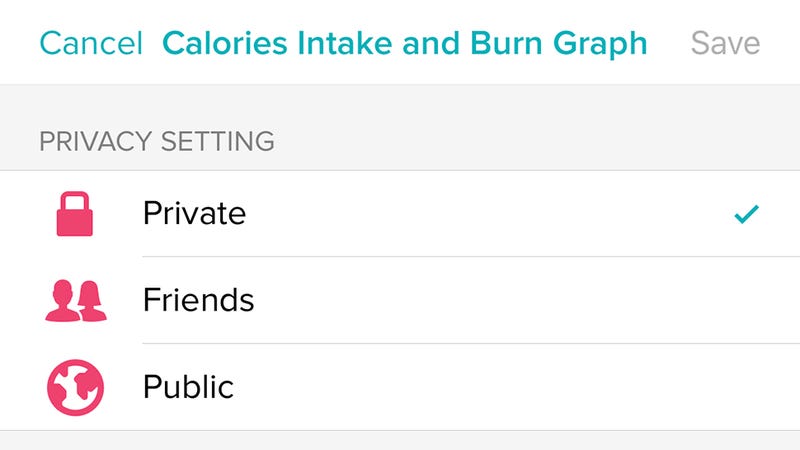
Your own fitness tracker and apps may vary. With Fitbit’s apps, tap the profile icon to the top right, then your account name, then Personal Stats—similar options are available on the Fitbit website via the cog icon (top right)—then Settings, then Privacy. The subsequent screens let you control the data that’s shown on your Fitbit profile and made visible to your Fitbit friends, or indeed the world at large.

So click or tap on any bit of data, such as Average Daily Step Count or Sleep Graph, and you can set its visibility to Public, Friends, or Private. As with Strava though, this is only limiting what other people can see—Fitbit is still collecting all of this information, as it’s the way that its apps work.

Obviously Strava, Fitbit, and others need to collect and log data on you—it’s how the whole fitness tracker experience works, so you can see just how much faster your morning jog is getting. You can limit some of the ways this data is used, depending on the app, but getting out altogether usually means deleting your account and uninstalling the app.

source:Gizmodo

MKRdezign

Contact Form

Name

Email *

Message *

Powered by Blogger.
Javascript DisablePlease Enable Javascript To See All Widget