Articles by "Special"

Keyo modernizes housing with rent auto-pay that boosts your credit

Today in dense urban areas, tenants frequently change apartments as their income grows and they tire of different neighborhoods...
T
here’s nothing we spend more money on for a worse experience than housing. Keyo wants to fix all of it. The audacious startup envisions a world where a building’s other tenants get $20 to show you an available apartment on your schedule. Where you auto-pay your rent online and it improves your credit score. Where you get local business perks and can communicate maintenance requests through an app by renting in a Keyo location. And where it’s all free because landlords pay Keyo to fill their units faster.

It’d seem like a crazily ambitious startup idea if it wasn’t already working. Keyo has 4,300 units under management in Brooklyn. And now it’s ready to come out of stealth with a $2.5 million seed fundraise led by a Silicon Valley fixture it won’t disclose that follows Keyo’s $1 million friends-and-family round.

“Renting hasn’t changed much. It needs to,” declares founder Kiran Bellubbi. “You pay rent on time and get nothing in return.”

Bellubbi might have come from the music world, not real estate, but he’s studied in the art of redefining a behavior pattern. His app Band of the Day usurped the traditional music blog, running for five years and winning runner-up to Instagram for Apple’s App of the Year in 2011. Bringing his total fundraise to $10 million, Bellubbi pivoted Band of the Day into Applauze, a concert ticket app that combined official and secondary sales so you could always see the show. Applauze was secretly acquired in 2016 by a joint venture between Azoff MSGE & Live Nation.

Keyo modernizes housing with rent auto-pay that boosts your credit
Keyo faces the daunting challenge of changing the behavior of landlords who either have been collecting checks the same way for decades, or use property management software designed for them but not necessarily the tenant. But similar to how Uber recruited BLACK-car drivers by enticing them with mobile customer demand, Keyo could incentivize landlords by getting prospective residents to demand its perks.

How Keyo works

Today in dense urban areas, tenants frequently change apartments as their income grows and they tire of different neighborhoods. High prices to buy a home and the desire to delay having kids are leading people to rent for longer. “Twelve to 20 percent of inventory churns every year,” says Bellubbi. “I have no allegiance to a building. I just leave.” Keyo gives them a reason to stay.

Keyo modernizes housing with rent auto-pay that boosts your credit
Bellubbi brought the idea for Keyo to me six months ago when it was just a crowdsourced door-opening service that paid locals to show you an available apartment whenever you wanted. Rather than hassle with coordinating a time with a real estate broker, you could preview apartments in the app and go see them immediately. But Keyo needed a better way to get control of properties.

Now Keyo has blossomed into a full-scale software-as-a-service for landlords, targeting small-to-medium-sized renters with 20 to 5,000 units. It’s either full-featured or trying to do too much, depending on your perspective.

Keyo modernizes housing with rent auto-pay that boosts your credit
The iOS and Android apps are free for tenants, and the pitch to them has five key(o) parts:
  • On-Demand Apartment Viewings – Keyo pays the building’s super, another resident or even the current tenant $20 to act as “scouts” to show you available apartments so you don’t have to wait for a specific real estate broker to be able to meet you
  • Online Rent Auto-Pay – Tenants don’t have to deal with remembering to send checks because Keyo connects with their bank for ACH payments
  • Credit Score Improvement – Paying rent on time qualifies as a way to boost your credit score, but most landlords don’t go through the trouble of integrating with the credit agencies the way Keyo does
  • Local Perks – Being a Keyo tenant is like joining a club that gets you discounts at nearby gyms, dry cleaners and coffee shops looking to attract long-term business from nearby residents
  • In-App Maintenance Requests – Instead of nagging your landlord or super to fix something via annoying phone calls and emails, you can easily file requests through the Keyo app, and they can send back building announcements
The idea is that these benefits will generate demand for Keyo apartments, more quickly filling those already available. “Last month you paid 2,500 and got nothing back,” says Bellubbi. Keyo hopes the benefits spur tenants to ask their landlords to sign up and pay $5 per month per unit. They also pay Keyo one month’s rent per rentee it delivers. That might sound like a lot, but that fee plus paying the scout can be up to 40 percent lower than paying a real estate broker the standard 1.5 months rent.

Keyo modernizes housing with rent auto-pay that boosts your credit In return, Keyo’s software gives landlords:
  • A Faster Way to Fill Units – Keyo lists a building’s available units on top sites for no cost while tracking and optimizing the landlord’s ads
  • Tenant Marketing Analytics – Landlords can see exactly which units they have available when, which sites are driving leads and how often people are visiting them
  • Simplified Paperwork – Tenant applications, credit checks, background checks, digital contract signing and lease management all happen for free instead of being passed on as fees to the tenant, which can suppress demand
This offering has led Keyo to sign up 4,300 units in 60 buildings in Brooklyn. Next year it’s looking to expand into more markets.

But first it will have to convince more landlords to modernize or replace their whole software stack. That could be scary with so much money at stake, and some might just want a piece of the suite like the credit-building rent auto-pay. They also might not want any Keyo branding on their building. Expansion beyond the densest cities will be a slog.

Meanwhile, there are plenty of landlord software options. Yardi, appFolio, RealPage and MDSGo are all focused on property management. They have big budgets, brands and track records. But many cater toward larger enterprise real estate titans, and don’t focus on the customer experience with bonus perks.

The millennial generation and beyond want everything to be mobile. In an era when all your subscriptions pay themselves, having to stamp and mail a physical check on time is a pain. And because people are renting for longer instead of buying housing, they don’t have the same opportunities to build up solid credit. By using rent auto-pay and credit as a wedge, Keyo could pry open a lucrative market that hasn’t kept up with the times.

source:TechCrunch

RightEye’s portable eye-tracking test catches concussions

They say the eyes are the windows to the soul, but physiologically speaking, they’re really windows to the brain.
T
hey say the eyes are the windows to the soul, but physiologically speaking, they’re really windows to the brain.

RightEye looks through that window to detect common but often subtle vision issues resulting from concussions and other brain troubles. Its quick, portable eye-tracking station can tell in minutes whether you should see a doctor — or look into becoming a pro ball player.

It turns out there’s quite a lot you can tell from how someone’s eyes move. We may not notice it ourselves, but we all vary in how and how well we execute a number of basic tasks, from flicking our eyes back and forth to smoothly tracking a moving target. For instance, your eyes may over-correct, fail to line up correctly, or track up or down when moving along a straight line.

For healthy individuals, these variations fall within a safe range, just part of the ordinary differences between bodies. But certain patterns well outside the baseline can be strong indicators of things like concussions and eye muscle problems — and even Parkinson’s and Autism-spectrum conditions.

RightEye’s portable eye-tracking test catches concussions and reading problems in five minutes
RightEye
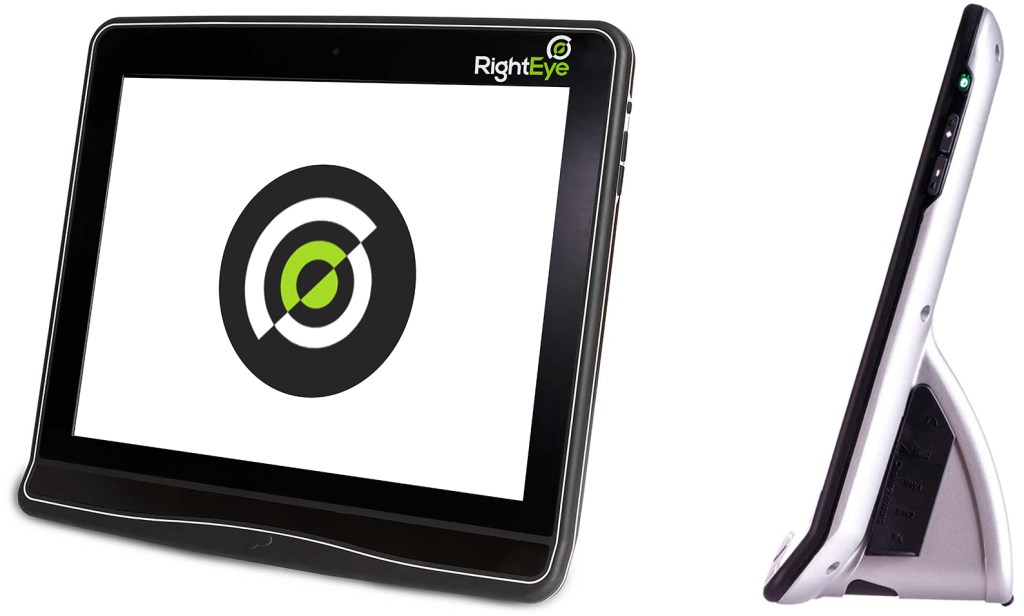
RightEye tracks these movements with a custom device that looks a bit like an all-in-one desktop; it uses a Tobii eye-tracking module built into a single-purpose computer loaded with a library of simple tests. A basic EyeQ (as they call it) test takes five minutes or so, with more specialized tests adding only a few more, and results are available immediately.

To give you an idea: one test in game form has you defending a space station, destroying incoming ships by looking at them. But certain colored ships you must not destroy — meaning you have to detect them in your peripheral vision and avoid looking at them. In another test, you flick your eyes rapidly between two targets appearing on opposite sides of the screen, demonstrating accuracy and functioning saccades (micro-corrections made by your eye muscles).

Each eye is tracked independently, and their performance as a matched pair is evaluated instantly. An easy-to-understand results sheet shows their actual movements and how (if at all) they deviate from the baseline.

It’s compact and can run on battery for some 8 hours, making it ideal for deployment outside hospitals or the like: anywhere from school nurse’s office to the sidelines of an NFL game, even in the home.

I tested the device out myself at CES (my vision is just OK, but I want a rematch), and later chatted with Barbara Barclay, RIghtEye’s President. The two most exciting applications of the technology, as judged by her enthusiasm anyway, are in identifying vision-related cognitive problems in kids and in creating a sort of eye fitness test for sporting persons.

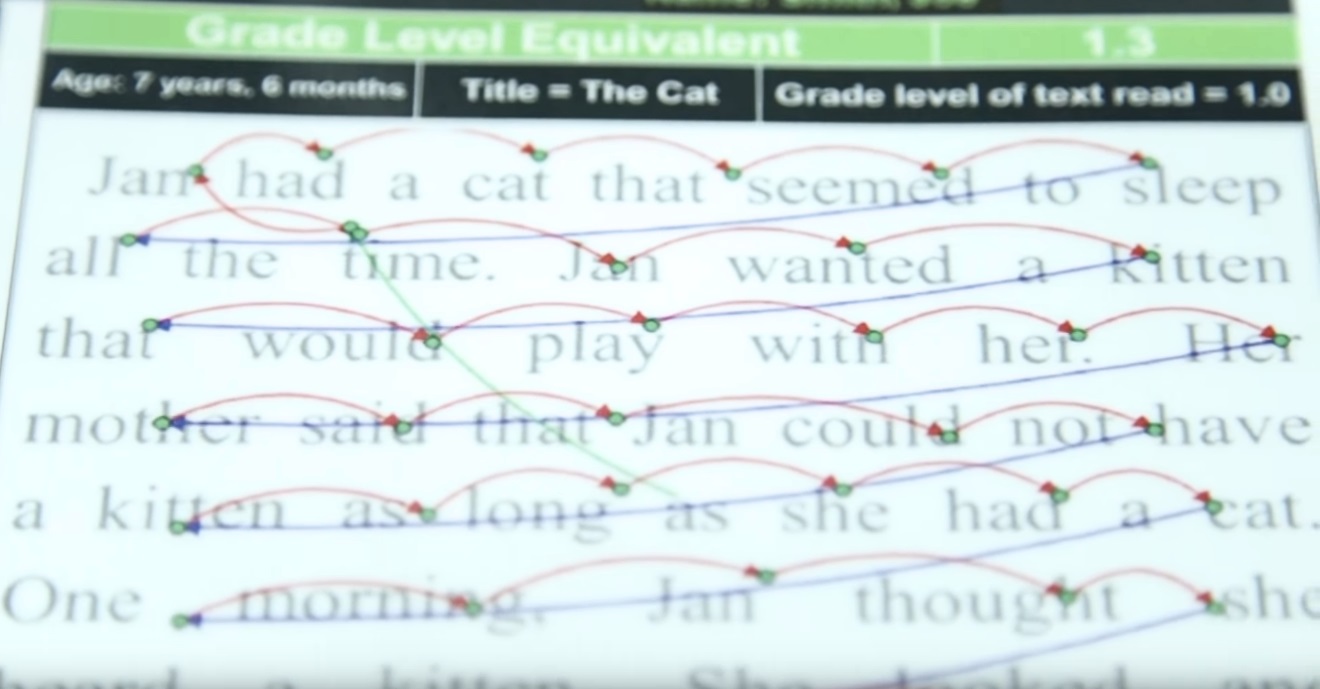
Say a child is having trouble learning to read, or perhaps can’t pay attention in class. The immediate thought these days is frequently ADD. But it’s more than a little possible that it’s a vision problem. A subtle difference in how the eyes track, perhaps one going off the horizontal when tracking a line of text, could easily make reading on the page or blackboard frustrating or even painful. What 3rd-grade kid would keep at it?

RightEye’s portable eye-tracking test catches concussions and reading problems in five minutes
RightEye
A reading-focused test tracks how the eyes move along a line of text.

This isn’t some groundbreaking new idea — but reliably and objectively evaluating individual eye movements was only something you could do if you went to see a specialist, perhaps after other explanations for a behavior didn’t pan out. RightEye’s test practically runs itself and can detect or eliminate the possibility of vision problems in minutes. Honestly, I think a kid might even find it fun.

Barclay has personal experience with this, her own daughter having had health issues that only after multiple false starts were found to have their root in a relatively simple vision problem the system indicated.

In 2016, RightEye acquired the rights to a pair of tests based on research linking eye movement patterns to Parkinson’s and Huntington’s diseases, as well as Autism spectrum conditions. It’s not a magic bullet, but again, the quick and easy nature of the tests make them ideal for routine screening.

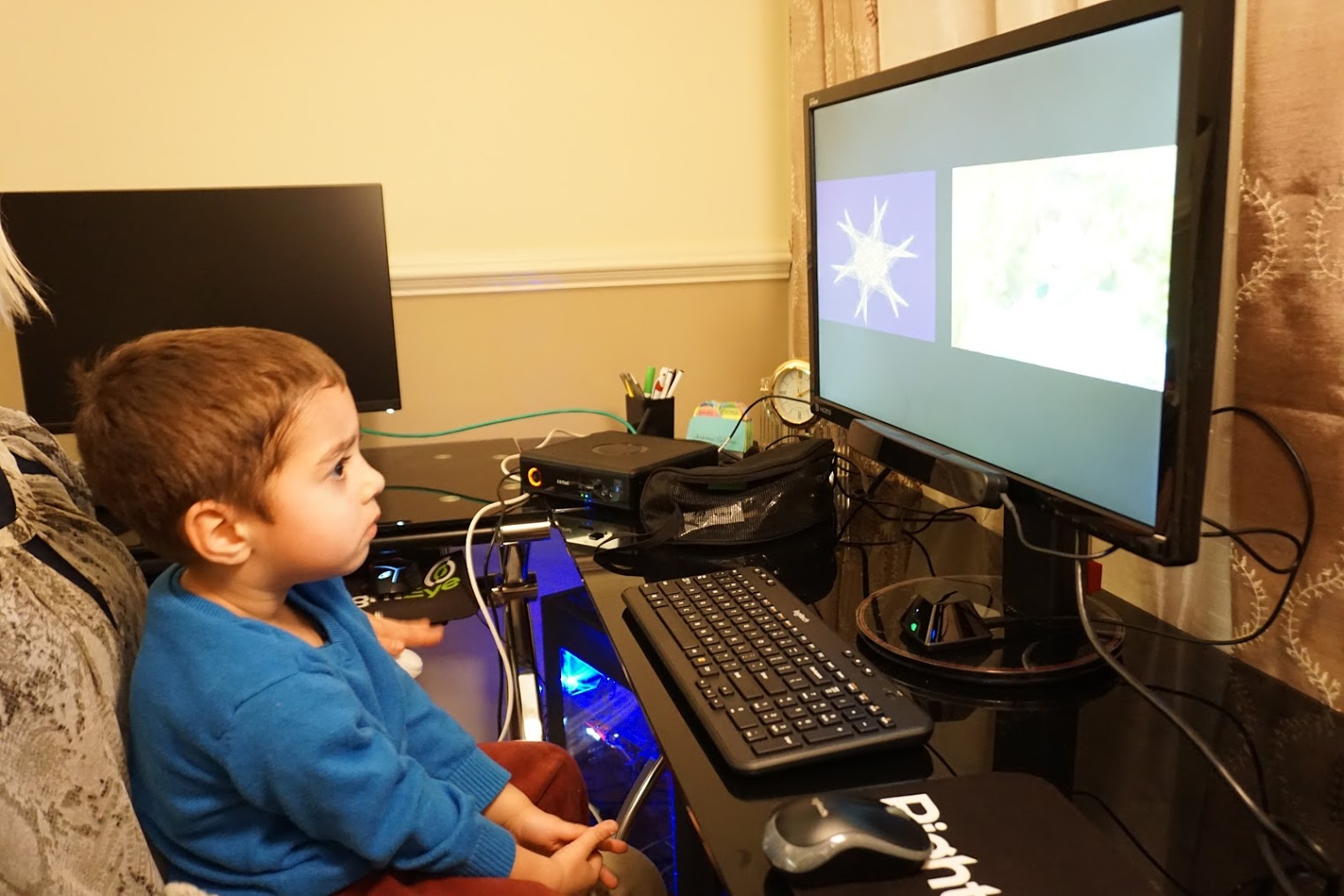
The Autism spectrum test is for children aged only 1 to 3, and watches eye movements between images of people and images of geometric shapes. Lingering on the shapes more than the people, it turns out, is a good indicator that at the very least the kid should receive further testing.

RightEye’s portable eye-tracking test catches concussions and reading problems in five minutes
RightEye
The Parkinson’s and Huntington’s tests watch for the more well understood patterns that accompany the motor degeneration found in those afflictions. They can be administered to people of any age and have (using earlier eye-tracking setups) contributed to many identifications of the diseases.

On a very different, but perhaps more immediately remunerative, note, Barclay told me that the test also works as a way to find outliers on the other end: people with what amounts to super-vision.

It’s entirely possible that someone could take the test and their results will show that they have faster, more accurate saccades, quicker target acquisition, and better continuous object tracking than the baseline. That’s a heck of an asset to have if you’re batting, fielding, goalkeeping, playing tight end — pretty much anything, really.

RightEye’s portable eye-tracking test catches concussions and reading problems in five minutes
RightEye
Examples of a healthy eye movement report (left) and concussed one (right).

It’s also a heck of an asset to have if you’re a scout or coach. If Lopez is catching great on the left side of the field but not the right, you can look into the possibility that he’s having trouble tracking the ball when looking over his left shoulder, his eyes all the way to the right.

Not only that, but you can test for effects of concussions or other traumas right there on the field if they’re having trouble. Given how widespread such injuries are and the immense danger of repeated concussions, testing early and often could literally save lives.

Right now, Barclay told me, 7 MLB teams are using RightEye tech for player assessments. As for the medical side of things, she said the company currently has 200 clients. The new hardware should help boost that number.

Perhaps more importantly, it has the backing (and therefore clout) of VSP, the country’s largest vision insurance company. That’s both a tremendous vote of confidence and a major in — nothing gets people using a system faster than knowing it’s covered by their existing insurance.

source:TechCrunch

Facebook should actually be Tinder too

...You like them, they like you, you both find out and get connected...
T
here’s beauty in the double-blind opt-in. That’s the way you match with someone on Tinder. You like them, they like you, you both find out and get connected. But to date, the feature’s largely been trapped in dating apps that match you with randos or that not everyone wants to be on. That means this anti-loneliness technology is leaving some people out.

Facebook, meanwhile, is on a newfound quest to stimulate “meaningful interactions,” not just passive content consumption. Its latest attempt is a ham-handed Meetups feature. It surfaces big groups of friends saying some might want to hang out with you, and asking if you’re interested. If you both say yes, it connects you over Messenger.

The idea behind Meetups is smart, but the execution is a mess. Because Meetups ambiguously shows multiple people at once, sends aggressive notifications to participate and encompasses all kinds of relationships, the results are meaningless. You don’t know if someone “chose you” because they actually like you, want to chill platonically, actually were approving of another friend shown at the same time or were just mindlessly clicking through after getting an alert to try the confusing feature.

Facebook should actually be Tinder too
Image: TechCrunch
For years I’ve been writing about how Facebook and Messenger should build an offline availability indicator for finding out who’s free to spend time with in person. Messenger’s new test of “Your Emoji,” where you can put a beer mug, or dinner plate, or briefcase on your profile pic for 24 hours to indicate what you’re up to or interested in doing, is a much better approach.

But it’s not designed for dating. And let’s be real. Finding a significant other is the source of some of the most meaningful interactions you’ll ever have. If Facebook can be the matchmaker, it will accomplish its mission while earning tremendous good will from those paired up. And unlike dating apps that become needless to people once they successfully get into a relationship, it doesn’t matter to Facebook if you never use the feature again.

Facebook should actually be Tinder too
Image: TechCrunch
That’s why Facebook should build a “Matchmaker” feature into its profiles.

It’d be completely voluntary from the start. If you’re romantically interested in someone, you could hit a button on their profile that they’ve opted in to displaying. If they hit the button on yours too, Facebook lets you both know.

Here’s the tricky part, or technically, the simple part. Facebook shouldn’t blast you with tons of notifications teasing that someone likes you. It shouldn’t try to get you to guess who it was from a short-list of people. And it shouldn’t push you to swipe through all your friends. It should be subtle. Otherwise, some users, especially women who typically get the majority of inbound interest from men on dating apps, may feel pestered, ogled or even objectified. That’s why many people stray away from sleazy dating apps like Bang With Friends that try to match you via your social graph.

Some will surely cringe at the idea of Facebook getting more deeply involved with our romantic lives. Others might think it’s redundant with Pokes, walls, messages and other ways to connect, even though those are either unclear signals or lack the privacy and protection against unwanted advances of double opt-in. And, understandably, some just wouldn’t want to mix romance into a friendship platform. There’s certainly the risk of creepy dudes following up via message like “I right-swiped you…” Getting this wrong could drive people away from Facebook all together.

But done right, Facebook Matchmaker would hardly exist for anyone who doesn’t want it. It wouldn’t generate tons of unrequited “Yes” swipes. And it’d only result in rare matches. But those matches would be meaningful, because they weren’t coerced, and they didn’t occur on an app designed for finding one-night hookups. They’d be people from whom you already accepted friend requests, in your network, with whom you might already have a lot in common.

Facebook should actually be Tinder too
Image: TechCrunch
I’m increasingly hearing from friends over 30 that they’re anxious they won’t ever find a partner. But we’ve lost many of the other cultural institutions that used to pair us up 100 years ago.

Globalization of opportunity leads people to leave their home towns. Secularization and the rise of science mean fewer people are connected through places of worship. Multi-generational housing has fallen out of fashion so young adults don’t live with parents and grandparents who could match them with a partner. The positive shift toward women pursuing their own careers leads some to push marriage to later in life. People are spending longer on higher education and prioritizing jobs over family.

And now when we feel lonely, when we might have sought in-person companionship, we have phones full of feeds, memes and games to keep us company.

Facebook’s made it easier than ever to “feel connected,” endlessly scrolling through friends’ photos, while actually allowing us to isolate ourselves. Matchmaker is its chance to fulfill the most fundamental purpose of what we used to call “social networks.”

source:TechCrunch

Bringing Magic: The Gathering Back to Where It All Began

For decades, Magic: The Gathering has built up characters and worlds...
For decades, Magic: The Gathering has built up characters and worlds for its expansions in all the little details—snippets of story in the “flavor text” on cards, to novels, and more regularly these days, online short fiction. But its next set, Dominaria, is taking Magic’s story back to the setting it started in 25 years ago with a new writer guiding its future.

io9 can exclusively confirm that speculative fiction writer Martha Wells—whose latest novel, All Systems Red: The Murderbot Diaries, is currently up for the 2018 Phillip K. Dick Award—will be the new head writer behind Magic: The Gathering’s 78th expansion since the legendary card game began in 1993. As leader of Magic’s story team, she’ll be in charge of the story team, driving the fiction and building the lore around the newest expansion, which marks not only the game’s 25th anniversary but also a major event in the Magic franchise.

Scifi Author Martha Wells Is Bringing Magic: The Gathering Back to Where It All Began
Art by Magali Villeneuve
Dominaria will bring players back to the original setting that kicked off Magic’sofficial storyline in 1998, for the first time players have returned to the plane since 2006's Time Spiral. Although Magic: The Gathering is now set in a shared multiverse of elemental planes—full of the powerful spellcasters known as “Planeswalkers” who could travel between them—the world of Dominaria itself is one of the most important locations in Magic’s storied lore, and “home” to many of the characters and creatures found in Magic’s earliest sets, until the storyline started branching out into new worlds in the franchise’s ever-growing multiverse in 2003.

We spoke to Wells to find out more about Magic’s long-awaited return to its original world, as well as what it’s like guiding the rich world behind the card game—check out our full interview below, as well as some gorgeous art from the expansion.

Scifi Author Martha Wells Is Bringing Magic: The Gathering Back to Where It All Began
Art by Yongjae Choi

What drew you to writing for Dominaria in the first place?

Martha Wells: I was approached by the MTG creative team about writing a set of stories for the fiction section of the website. I agreed because I’ve always loved the artwork and being able to write stories about the people and places depicted in it was exciting.

What’s your past relationship with the series like?

Wells: All of my gaming experience is in tabletop RPGs. Although I haven’t played the game, I’ve been a fan of the Magic artwork for a long time. I think I first became aware of it when I bought a print of Donato Giancola’s art for the card “Cartographer” in 2004.

Scifi Author Martha Wells Is Bringing Magic: The Gathering Back to Where It All Began
Donato Giancola’s “Cartographer” art from Odyssey

When crafting the story for an expansion like Dominaria, where do you start?

Wells: The start of the process was getting more familiar with the world of Magic, particularly Dominaria, its history and the characters. I spent a lot of time looking at the Dominaria world guide, which is all the information the creative team has on the plane, including the environments and the history of all the different cultures. I also studied the art, existing characters’ backstories, and the previous installments of Magic Story. The creative team had already come up with an outline for the story so that it would fit in with the overall story arc. To make sure I got it right, I did at least four to five revisions of each story, each time working off of notes from the creative team.

Tell us a little bit about where fans will find Magic’s story going into Dominaria.

Wells: Dominaria’s story starts right after the events of Hour of Devastation. Gideon and Liliana have arrived on Dominaria following the Gatewatch’s defeat at the hands of Nicol Bolas. Together, they begin a mission to kill Belzenlok, the final demon holding Liliana’s contract. They get to see a lot of Dominaria in the process, which gives fans a look at how the plane has changed, and make some allies who may be familiar to longtime players.
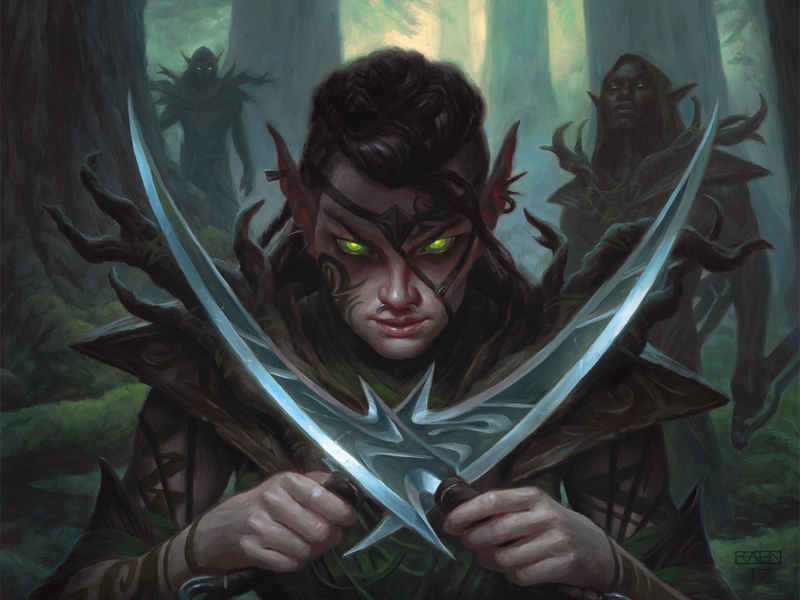
Art by Chris Rahn

What’s changed in Dominaria since fans last went there in Time Spiral?

Wells: Dominaria has started to recover from the Phyrexian invasion, though it’s left its mark on a lot of places and cultures. At the time the story starts, Dominaria is facing a new threat from the rise of the Cabal, which has been taken over by Belzenlok, and is now spreading across the world.

What do you think the biggest challenges are for creating a narrative that most fans will primarily experience outside of the game itself?

Wells: I’ve done tie-in fiction before, for Stargate: Atlantis and Star Wars, two worlds that I’m a huge fan of. The biggest challenge is to get the world and the characterization right, so the new material feels seamless.
Art by Victor Adame Minguez.

What can you tell us about some of the familiar Magic heroes that we’ll see inDominaria?

Wells: Besides the members of the Gatewatch—Gideon, Liliana, and Chandra—you’ll see Jhoira, Teferi, and Karn, plus a few others who make surprise appearances along the way. I don’t want to spoil too much!

You’re adding a new chapter to a story that’s been growing for two decades. What do you hope fans will take from your work on Dominaria?

Wells: I hope they enjoy reading it as much as I enjoyed writing it, and know how much the creative team loves these characters and their world.

Scifi Author Martha Wells Is Bringing Magic: The Gathering Back to Where It All Began
Art by Chris Rahn.
Dominaria cards will hit shelves April 27. For more on the history of Magic: The Gathering’s story, you can find more fiction from previous expansions at the official Magic website.

source:Gizmodo

The Falcon Heavy launch made me feel like a little kid again

Chances are you haven’t been to a rocket launch...
Y
ou know that feeling of awe and wonder you had when you were a kid and you saw something huge and amazing? My blackened heart hasn’t felt it in years. Turns out all it needed was going to see an historic rocket launch. SpaceX’s Falcon Heavy launchlast week was an exhilarating combination of suspense, bureaucracy, and childlike delight at seeing a giant fiery rocket make a big noise.

Chances are you haven’t been to a rocket launch. I’m sure some of you have — especially those who live on the Florida coast — but it really isn’t that common. I sure hadn’t been before this week, and nor had any of the others from the site who joined me to cover the event.

The only thing I can think of that’s comparable is when I went to see the total solar eclipse last summer. That, to be clear, was a more intense, almost religious experience that caused me to temporarily devolve into a cave person, howling at an unknowable and sublime cosmos.

The launch was considerably less transformative, but more regenerative. It evoked a mixture of glee and pride I can see being addictive. Glee because it’s been so long since I saw something truly new happening in the real world, and pride because it demonstrated the capacity of humans to reach for the stars — and actually get them.

Cape Canaverage

Before we drove in, I wasn’t sure what to expect from Cape Canaveral, or specifically Cocoa Beach, where we stayed. Surely, I thought, this would be a sort of astronaut playground, filled with space-age buildings, museums dedicated to various aspects of the space race, and so on.

Not so much.

To my surprise, it was really just your average suburban oceanside town. Upholstery shops, gas stations, chain hotels, and the occasional gator or manatee habitat.

The Falcon Heavy launch made me feel like a little kid again
Image: TechCrunch
All around, marshy dikes and shallow streams swarmed with naked-necked turkey vultures and meticulous long-legged waterfowl, and the vegetation seemed as likely to harbor grazing dinosaurs as rocket scientists.

Yet rocket scientists and other space-related people there were, although not in the forest, exactly. Several times during our stay we ended up sitting next to veteran launch photographers, engineers who worked on the Space Shuttle, and others whom you would be amazed to meet anywhere but a couple miles (as the rocket flies) from the launchpad where Apollo took flight.

The base itself, Kennedy Space Center, was secured in what seemed to me a lax way — a guard or two at entrances on public roads, with cones or a simple bar blocking them late at night. For some reason I expected more. Our bags weren’t searched, nor were our IDs checked — our SpaceX-issued badges and assorted stickers on them (denoting access to this or that area or event) were all we required.

The Falcon Heavy launch made me feel like a little kid again
Image: TechCrunch
I don’t want to make this seem like some Mickey Mouse operation (that would be Disney World, not far away); Bomb dogs certainly sniffed my bag more than once, and police and NASA folks were all over the place. Suspicious activity would have been noticed, yet I can’t help but feel that I could have snuck off into the sticks, built myself a shelter of palm leaves and reeds, and lived in it for weeks before being discovered. (Watch for my upcoming feature!)

Obviously the many secure buildings — the towering Vehicle Assembly Building, SpaceX’s giant shed by pad 39A, the adjacent Blue Origin facility — would be impossible to access without real credentials. The empty expanses of wildness that make up most of the base don’t harbor any secrets worth the risk to discover.

Our inexperience in this field was evident from the first; for one thing, we were strangers among a group of space press who have known each other for years. I have the same experience at CES and at our own events, checking in with friends in other outlets, sharing tips, and complaining about this and that. But here I felt like the intruder, a pitiable tech writer riding along with the people who actually know what they’re doing. Well, you have to learn sometime. (And of course everyone was very friendly and professional.)

The Falcon Heavy launch made me feel like a little kid again
Image: TechCrunch
On the day before launch we were allowed on base to go to various locations near the launch site to set up remote cameras (of which we had none) and b-roll (of the stationary rocket). I was delighted at the variety of hardware people used: cameras old and new, big and small, with enclosures ranging from obviously pro jobs to actual garbage bags secured with electrician’s tape. One was an actual mailbox.

The size of a rocket like the Falcon Heavy can’t be adequately conveyed by pictures or video. Sure, a wide-angle shot will show the people moving like ants around it, and a telephoto lets you pan up its great height to show the details. But as with so many monumental objects, it’s not enough. It was only when we were closest, actually within the launch pad’s fenced area on the “mounds” set up for staging cameras, lighting, and other things, that the size really struck me.

The Falcon Heavy launch made me feel like a little kid again
Image: TechCrunch
It’s a building. And not a small one. 14 stories high, gleaming in the sun (we were fortunate to have some beautiful weather), towering over you in that way that at first it feels like a trick of perspective, but then your mind works things out and you just kind of stand there, jaw dropped, thinking, really? This building is going to fly into space?

There was a similar moment when I fully cottoned to why the VAB is as big as it is, and the reason for the wide swaths of jumbo gravel that I thought were some kind of landscaping feature. No, that’s the titanic road they made so they can move the rocket-buildings around.

It was at these moments that I truly felt like a child. Because these things were so big. Because they were so amazing. And because I felt like I was learning just be being around them.

The Falcon Heavy launch made me feel like a little kid again
Image: TechCrunch
I’m imagining someone reading this and thinking, what a sentimental rube. These things have been here for decades, who cares if you’d never seen them before?

I wanted to talk about our experience for two reasons. First, because really, SpaceX can tell the story of the actual launch much better than I can, no matter how I try. And second because as I mentioned before, it seems unlikely that many of our readers have been to a launch, let alone gotten to be up close and personal with the rocket.

Like me they may have thought about it in the past abstractly, or seen it on video and thought it was the same. But I assure you that launches fall under the class of experiences that must be had in person to get the full effect. Especially if you want to feel a sonic boom (or four).

The sonic booms were on launch day, of course. After being stuck in traffic on a single road for half an hour, we managed to get to Kennedy only a handful of minutes later than the appointed time — 11:30, so we could leave to our various locations from which to shoot the launch.

It turned out, of course, that we need not have hurried. Unceasing winds caused first a half hour delay, then an hour, then two hours — and meanwhile, we sat on these tour buses, waiting for the green light so they could trundle off and put us where we needed to be.

Here the veterans of a dozen launches and more showed their realism. My friend Alan Boyle, who wrote up the launch for Geekwire, said he had a bad feeling from the start — which was nearly correct. A more conservative person than Elon Musk might have delayed and then scrubbed the launch entirely when the winds didn’t die down. They did seem, however, to change direction, and perhaps dipped down from risky to reasonable, though never disappeared entirely.

Others whom we chatted with in the bus, the press room, and the various little outcroppings and branded shacks with fraying signage (CBS News’s was utterly in tatters, but the team looked undeterred), felt sure it would be delayed. An hour, no problem. Two hours, you’re losing your window. Three hours? Might as well wait until tomorrow.

The Falcon Heavy launch made me feel like a little kid again
Image: TechCrunch
Fortunately this was not a high-precision launch with some complex trajectory, and delays were more tolerable. So we were pleasantly surprised when the 3:45 time was locked in and the bus began moving. I say bus because apparently, the other bus ran out of gas from idling and running the A/C for so long. (Incidentally, I’d like to thank the person who ordered up a bunch of BBQ to feed us during the long delay — I didn’t at the time.)

A lucky contingent of wire photographers, VIPs, and those who know people were sent to the roof of the VAB; I tried desperately to join them but was rebuffed multiple times. Instead Veanne and I went to the Causeway, a well-known viewing area that the public can buy tickets to and on which we had a nice, cordoned-off area to spread out our gear.

The Falcon Heavy launch made me feel like a little kid again
Image: TechCrunch
I feel like I missed a big piece of the launch here; though a warm Florida afternoon spent on a beach watching rockets was pleasant, the cheers from the far end of the Causeway indicated that there was a social aspect that we were not a part of. The true fans, locals, sightseers, and former (but actually lifetime) rocketeers were gathered there to experience the launch together the way my friends and I traveled to the totality zone of the eclipse and shared in that particular madness.

Because of a cut-out in the countdown, during which I scrambled to find signal to catch it again on my phone, we were surprised by a cheer — I wasn’t even looking in the right direction at the moment of ignition. We managed to snatch footage anyway, but I felt like a fool — if a rocket is going to launch roughly in the next two minutes, why would you do anything but stare at it with all your eyes?

The Falcon Heavy launch made me feel like a little kid again
Image: TechCrunch
It rose slowly, occasionally leaving a contrail, and I was again reminded of its immense size, and tried to comprehend that the plumes of fire on which it stood were similarly building-sized. The rumble, growing slowly and receding only as it gained altitude, was volcanic.

I was all anxiety, thinking that surely the next second would be the one where it would explode and the sound of the crowd wailing in sympathy would precede the sound of the fireball by six or seven seconds. It was already so loud that I was unsure whether I should cover my ears or not if that happened. But it didn’t.

We knew that the boosters would come down, if all went well, somewhere on the body of land towards the other end of the Causeway. But the timing was unclear and due to my confusion at the moment of launch I had failed to start a timer to keep up with the projected timeline.

So when the boosters appeared, there was a moment of confusion, like I was seeing something I didn’t quite believe in or thought would never happen — ICBMs about to to strike or a UFO flying in. I wasn’t fast enough to start recording before their landing retros ignited, and even if I had been, the shot would have been compromised by my startlement when we were struck by the sonic booms.

The Falcon Heavy launch made me feel like a little kid again
Image: TechCrunch
There were 4, in close succession, one for each end of each booster, though I couldn’t tell you which was which, since the two rockets landed within seconds of each other. By the time the boom reached us they were both on the ground and a plume of smoke had obscured one; at first, I thought the first to land had tipped over and blown up in a staccato series of detonations.

And with that it was over, the ending as sudden as the beginning had been interminable. We packed up our gear, hopped on the bus, went back to the main complex.

Well, it was almost over for me. I moved on to the press auditorium, where we were told there would soon be a press conference. After going in at 5:30 or so, we were told at 6 that the earliest it would start was 6:45, but what were we going to do? Journos from various outlets bargained for energy bars, traded anecdotes, wrote up pieces like this one (though probably shorter).
Image: CNBC
Eventually, a little after the appointed time, Musk walked in to answer questions for half an hour or so. Elon is an entertaining guy, and it was nice to see him so relaxed. I wasn’t lucky enough to land a pre-launch interview but I’m imagining him being a bit distracted. He spoke in his trademark candid-yet-guarded manner, explaining the next steps for the launch platform and what else was to come in what could be an extremely big year for SpaceX.

When he walked out the door, it was like a spell was broken — not because he had beguiled us, but because suddenly it was clear that the whole event had come to a close. There was nothing left but to drive back to our pink motel and start editing and writing.

But there’s a lingering buzz, even nearly a week later, from the whole thing. I can see now why people brave hours of traffic and line up in scorching weather to see these things. I feel I understand a little more what astronauts mean when they talk about the nearly indescribable feeling they get when they leave the Earth and look down on it from above — a feeling of unity and potential, of a rose-tinted futurity.

I saw a rocket go to space. You should try it.

source:TechCrunch

Black Panther rules Marvel's world. Literally

Chadwick Boseman -- known for playing characters forging new ground -- takes on another trailblazing role as Marvel's king of Wakanda.
C
hadwick Boseman has made a career playing pioneers who've had to fight to make their way in the world. In "42," he showcased the quiet dignity of baseball's first black major league player, Jackie Robinson. In "Get On Up," he gave us the man behind the music legend James Brown. And in this year's "Marshall," he brings life to Thurgood Marshall, the first black Supreme Court justice, during his crusade for civil rights early in his career.

So it's no surprise Boseman, 41, would play another trailblazer -- T'Challa or Black Panther, the first black mainstream comic book hero, created in 1966 by Stan Lee and artist Jack Kirby. In Marvel Studios' "Black Panther," which hits theaters this month, Boseman plays the king of the fictional African nation of Wakanda, the world's most technologically advanced, and secretive, country.

T'Challa rules a country grappling with whether to make its presence known to the world and whether to allow in outsiders, eager to exploit its cache of vibranium, a strong, vibration-absorbing metal used to create Black Panther's suit. At the same time, he has to fend off enemies who want to remove him from the throne.


"Everybody has heard the line, 'It's hard for a good man to be king,'" the actor tells me. "Sometimes you have to do bad things or you maybe need to do bad things so there's justice, so there's peace."

Boseman and I had two conversations this summer, in which he talked about creating a new role model for kids, how "Black Panther" may get people to rethink women in tech, and why he's a cautious fan of smart technologies. Here's an edited transcript of our conversations.

Watch this:Chadwick Boseman loves a good challenge

Q: When we saw Black Panther in "Captain America: Civil War," he had become king of Wakanda after seeking to avenge his father's death. You've called him an antihero. Why is that?

Boseman: He has the attributes of a hero, but has difficult decisions, difficult choices. Sometimes there's no right answer. Everybody has heard the line, "It's hard for a good man to be king." I think there's a sense of all the complications of being a good leader. At times it feels like "The Godfather." It's complicated to do what's right. It's complicated to follow the traditions. It's complicated to do something new. It's complicated when you have to deal with who should live and who should die.

Mark Mann

Sometimes you have to do bad things or you maybe need to do bad things so there's justice, so there's peace.

So like "The Godfather," it's a story of people trying to figure out a place for themselves in a complex world? What kind of a movie is this to you?

Boseman: It is definitely a superhero movie. There are going to be action scenes, and some stuff is going to blow up. [laughs]

The thing I love about Marvel in general is that they deal with people. They deal with the human being first: Who is inside the suit? Who is the person that obtained this power or this ability?

This movie is about how you use power. What do you do when you get power? In this case, you're talking about someone taking the throne. But all superhero movies are about a person who has extreme power. They can disappear. They do tricks or they can jump really high. Whatever it is, that ability gives them an advantage. The only difference between a hero and the villain is that the villain chooses to use that power in a way that is selfish and hurts other people.

Chadwick Boseman
Mark Mann

What do you like about this character?

Boseman: I love that he thinks about other people. He's not afraid to hear wise counsel. I think there is some fear of being wrong. I identify with that, with his plight, his personality. And I love him because the fantasy of playing a ruler -- you never get to do that. You never get to explore what that is. It's fun having power and having a say in what happens to the people around you.

Black Panther is notable for being the first black superhero in mainstream comics, and now the star of a big-budget action film. You've said this is a good moment in history for this movie to be made. Why?

Boseman: It's just this tremendous opportunity, not just for me but for all of us really to get out of our boxes. It's not just black people getting out of their boxes. Everybody is excited about the opportunity to do something that we should have already done. People are excited about seeing new stuff, but I think they're extra excited about seeing stuff they should have seen already.

It pulls from various ideologies. It pulls from the blacks-in-science idea, from a nationalist idea, it pulls from a collective-world idea. There's something that will influence people in a particular way. It took all of this time to come to fruition in a larger way, but now the world is right, the world is able to receive that. It's just a special thing.

When they call you and say, "So you want to play Black Panther?" if you know what Black Panther is, there's no way in the world you're going to say no because there's a lot of opportunity for magic to happen.

Chadwick Boseman
Mark Mann

Were you a comic book fan when you were a kid?

Boseman: Not when I was a kid. Unfortunately for some reason that didn't come into my sphere. But in college, that's when I first was put on to Black Panther. Even before I got the role, there was the idea I would love to play that one day.

Did you miss having role models like Black Panther when you were growing up?

Boseman: You don't know what you're missing if you haven't experienced it. People of African descent, most of us grew up accepting and loving Spider-Man. I still love Spider-Man. I still love the Incredible Hulk. I still have those characters that were white role models, superheroes, heroes -- whatever you want to call it. You basically had no choice but to accept those. You might have created other superheroes in sports or in politics, but there was never that renowned, widely accepted superhero in the same way.

But you don't know if you've never experienced it. In the same way, kids now [won't] say, "There will never be a black president." There are kids that that's all they know.

And now you're a role model and an action figure.

Boseman: I love it. You see how much it means. There was one kid [fighting cancer] who used the Black Panther as sort of his inspiration. He saw himself as a Wakandan, he saw himself as having the spirit of Wakanda in his fight. The fact that he chose you, that's the world he lives in. It does mean a lot.

Watch this:Stan Lee's "revolutionary spirit"

What do you think it says that Black Panther was created in 1966 by two white men -- Stan Lee and artist Jack Kirby?

Boseman: Yes, the idea came from Stan Lee, and it came at a time ironically that the totem of the panther was actually part of our revolutionary spirit. It was just something right about that time that these men were on that wavelength. What I think it speaks to is the fact that Stan Lee is just open enough to catching the revolutionary spirit, even as a white man.

Mark Mann

You spent a lot of time thinking about how the king of an advanced African nation speaks, specifically your accent, your intonation. Tell us about it

Boseman: People think about how race has affected the world. It's not just in the States. Colonialism is the cousin of slavery. Colonialism in Africa would have it that, in order to be a ruler, his education comes from Europe. I wanted to be completely sure that we didn't convey that idea because that would be counter to everything that Wakanda is about. It's supposed to be the most technologically advanced nation on the planet. If it's supposed to not have been conquered -- which means that advancement has happened without colonialism tainting it, poisoning the well of it, without stopping it or disrupting it -- then there's no way he would speak with a European accent.

If I did that, I would be conveying a white supremacist idea of what being educated is and what being royal or presidential is. Because it's not just about him running around fighting. He's the ruler of a nation. And if he's the ruler of a nation, he has to speak to his people. He has to galvanize his people. And there's no way I could speak to my people, who have never been conquered by Europeans, with a European voice.

Describe Wakanda to people who don't know anything about Black Panther.

Boseman: It's a utopia. It's not just an African utopia -- it's a utopia. It's a place where spirituality and science do not war with each other.

Black Panther is surrounded by strong women. There's a long-running debate in the tech industry about whether women are smart enough to be in tech.

Boseman: Do they really think that women are not smart enough? [laughs] Women are so much smarter than men most of the time. [laughs] It's crazy to think that you go to work and all of a sudden you get smarter. When you go home, your wife is obviously smarter than you. [laughs] She gives better directions. She can multitask better. You know you can't beat her, whatever it is. It's like, "I'm not going to argue with any of that." Your woman is always smarter. She can catch you in your lies. [laughs]

You've said that Letitia Wright, who plays your sister Princess Shuri in this movie, will change people's perception of women in tech. How?

Boseman: If anyone doesn't think there's a place for women in tech, it's completely demolished in this movie.

Her role is the most important. In the comic book, T'Challa is a scientist and a king, but my sister is the whiz kid. She is the one with that gift. She's the Tony Stark of Wakanda. She's witty, she's cool, she's funny. Now, T'Challa is good in science too, but she's the whiz. That's the way the story's been told forever. T'Challa is technologically sound. He's a scientist as well, but she's the minister of technology.

Nakia (Lupita Nyong'o, left) rounds a corner with Princess Shuri (Letitia Wright), whom Boseman calls the Tony Stark of Wakanda.
Nakia (Lupita Nyong'o, left) rounds a corner with Princess Shuri (Letitia Wright), whom Boseman calls the "Tony Stark of Wakanda."
Marvel Studios

When you think about the most technologically advanced society, what do you imagine?

Boseman: For me, technology is not about gadgets. Technology is essentially your ability to enhance your lifestyle beyond the norm. What I would love to see is for technology and nature to find a way to merge. If that happens in our society, we will have gone to a different place and we can advance the species.

What do you mean?

Boseman: If we're going to build a rocket to go to outer space and go to the moon, how do we do that in a way where it doesn't destroy the Earth? How do we build weapons that won't destroy the Earth? Or the better way, how do you live in a society that doesn't need weapons at all? How can we advance in this computer age without having landfills filled with the parts from those things? That to me, that's advanced.

Are you a gadget guy? Do you have a smart house?

Boseman: I don't have a smart house. My house is very dumb. [laughs] I do use my phone often -- I have no choice. I'm not one of those guys who walks around with a flip phone who doesn't want to be connected. There are times when I'm tech-friendly and there are times when I personally do want to shut everything off because I'm more creative when I shut off.

Looking forward to self-driving cars?

Boseman: I'm not so keen on letting my car drive itself. But I like the idea that it can catch me if I sleep. Even simple things like the fact that we have apps where we can call cars for ourselves instead of getting in the car and driving drunk. I love that. That's really dope stuff.

This story appears in the winter 2017 edition of CNET Magazine.

source:CNet

MKRdezign

Contact Form

Name

Email *

Message *

Powered by Blogger.
Javascript DisablePlease Enable Javascript To See All Widget