Articles by "Facebook"

Facebook-owned Onavo quietly launches Bolt App Lock, a data-tracking app that locks other apps
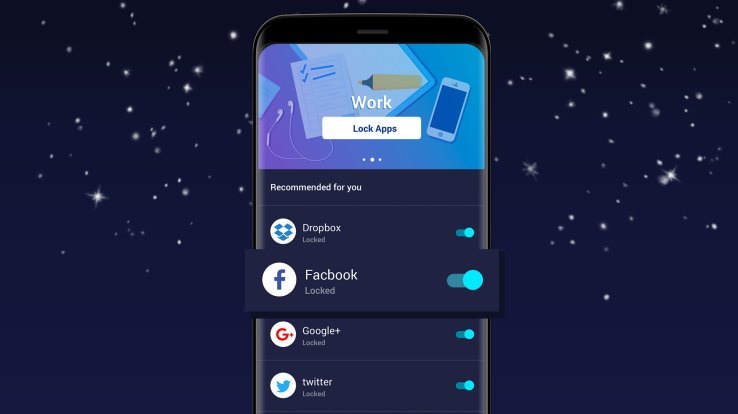
Onavo, the data-security app maker Facebook acquired in 2013 in order gain insights into mobile user activity across apps, has quietly launched a new app aimed at Android users called Bolt App Lock. Instead of offering a VPN, Bolt App Lock is a tool that lets you lock down any app you don’t want others to be able to open, using a PIN code, pattern, or your fingerprint.

Apps that help users lock other apps is a popular category on Android, where you can today find dozens of similar solutions – though largely from unknown companies save for a few, like Keepsafe or Norton, for example. Like the others in this space, the Bolt app lets you lock down other apps that contain personal information, such as private photos or payment details.
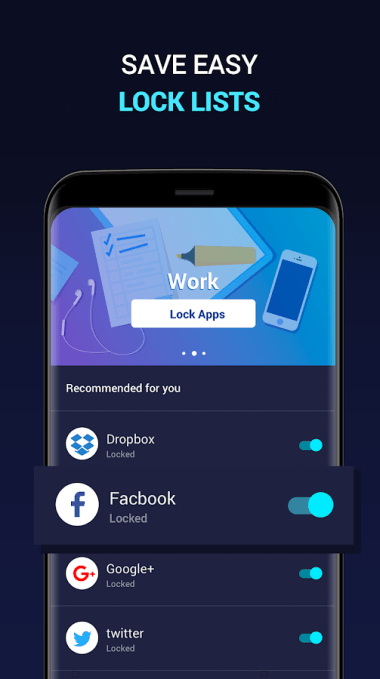
Facebook-owned Onavo quietly launches Bolt App Lock, a data-tracking app that locks other apps
With the resources of Facebook behind it, Onavo appears to have built a more polished, modern alternative to the existing apps.

But Onavo – and Facebook’s – primary interest isn’t on personal security. It’s about finding a way on users’ phones in order to monitor mobile activity and learn what new apps could be taking attention away from Facebook’s social network.

This is disclosed at the bottom of the app’s listing on Google Play, which explains that, as a Facebook company, Onavo will “collect info about your mobile device and the apps installed on it” and share that with Facebook.
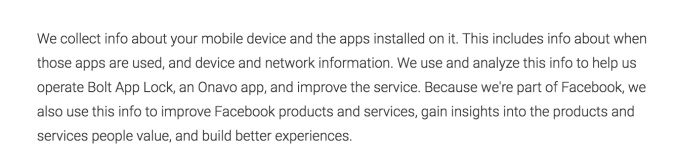
Bolt App Lock’s disclosure regarding data collection
Above: Bolt App Lock’s disclosure regarding data collection
Data on mobile app usage has helped Facebook better compete with rivals like Snapchat – like when it saw how Instagram’s launch of a Stories-like feature was working to slow down Snapchat’s user growth, for instance. It also likely helped to inform Facebook’s newer acquisition of the buzzy teen compliment app tbh, which soon led to a new Facebook Q&A feature, inspired by tbh.

To attract users to its Onavo VPN, Facebook recently began advertising the app directly within Facebook’s main navigation on iOS, under the menu item “Protect.” When clicked, the link would take you to the download page for Onavo Protect on the App Store. The company has also featured a similar “Protect” link in its Facebook app for Android in the past. (We’re not currently seeing the option on Android, but your mileage may vary as Facebook’s apps are continually being tweaked and updated.)

But in order to gain these sorts of insights, Facebook needs a user base willing to install Onavo’s app. That may be more difficult to achieve these days, though.

After TechCrunch broke the news of Onavo’s appearance on iOS, a number of outlets directly warned users not to install the app. (See, for example: Gizmodo’s “Do Not, I Repeat, Do Not Download Onavo, Facebook’s Vampiric VPN Service” or Wired’s “Don’t trust the VPN Facebook wants you to use.”)

Until the backlash over Onavo Protect dies down, a new app like Bolt App Lock could give Facebook a different means of expanding Onavo’s user base, and therefore, Facebook’s access to mobile user data.

The app also hasn’t made an appearance in Facebook’s app, the way Onavo Protect did – at least not as of yet. We asked Facebook if that’s the eventual plan, but haven’t heard back.

Bolt App Lock launched on March 5, 2018, according to data from Sensor Tower. It’s not yet showing on the Onavo homepage as one of the company’s products. The app is a free download on Google Play.

source:TechCrunch

Facebook has signed a deal to stream 25 afternoon MLB games
Filed under moves that are potentially groundbreaking with big implications but with quite small numbers, Facebook has signed an exclusive deal with the MLB to stream 25 afternoon games, according to Bloomberg.

The deal is a bit reminiscent of the one Twitter signed for Thursday Night Football back in 2016 to stream games that are outside of the range of primetime football (usually reserved for Sundays and Monday Night Football). There have been some gripes about how fewer people are watching Thursday Night Football, so it also seems somewhat reminiscent in that respect that Facebook was able to sign a deal for games that are not so critically important outside of the normal primetime games.

That being said, blackouts for MLB games are a big of a nightmare (there’s a long thread by my colleagues complaining about this internally), and getting a deal like this on Facebook could potentially get people to pop in during the afternoon to watch the games. It could also help Facebook users get accustomed to the notion that Facebook is a spot to watch your afternoon baseball games, helping the company build that cachet that would help it negotiate further deals down the line. That the games are exclusive is another potentially big deal with big implications down the line for platforms like Facebook or Twitter, despite there being thousands of MLB games a year.

Regardless of the success of platforms like Twitter and Facebook (and Amazon in snatching the Thursday Night Football deal away from Twitter last year) getting these games on their platforms, the big primetime moments still elude those platforms and are all but locked up by incumbents. These deals are expensive — in 2016, the NCAA extended its agreement with Turner and CBS to air the NCAA Division I Men’s Basketball tournament, which had a price tag of $8.8 billion — and it’s hard to know whether Facebook or Amazon would be able to secure good deals for these kinds of games. There has been some activity at the startup level to disrupt networks like ESPN, which have traditionally been the host of many games in leagues like the NBA and NCAA college basketball games, such as Overtime raising $9.5 million.

Facebook’s first game will be on April 4 between the Philadelphia Phillies and the New York Mets, if you’re into either of them for whatever reason. MLB.com projects the Houston Astros will win 98 games next season, while the Los Angeles Dodgers will win 94. Houston won the World Series in 2017 in seven games over Los Angeles.

source:TechCrunch

TechCrunch’s Messenger bot gets smarter and more conversational
The best bot on Messenger just got better. We’ve teamed up with Chatfuel and Bitext to add Bitext’s NLP Middleware to the TechCrunch Messenger bot. This enhanced version adds functionality for conversational interaction, improved natural language understanding and unique features like negation understanding. You can check out our new and improved Messenger bot here.

To get a better understanding of what the new functionality looks like in action, here are some examples of what the latest version of the bot can do.

1) Understands more natural language queries

More complex but natural queries, like “do you have anything about Google”; “give me Facebook news” or “show me the latest about SpaceX” are now recognized by the bot.

2) Conversational double intent

You can now use the word “and” to search for news that shares multiple characteristics. For example, you could type “I want news on Microsoft and Apple” to find news that specifically mentions both companies. Another example would be “show me news about Messenger and bots.”

3) Conversational negation

This allows you to exclude certain items in your search. For example, if you wanted to see news about Amazon but didn’t want to see anything about Whole Foods you could type “I want news about Amazon but not Whole Foods.” Another example would be “show me news about Apple but not iPhones.”

We’re also looking into adding some other updates, including conversational pagination and video search. There’s also a possibility that we might bring this bot to Slack. More to come soon.

You can check out our new and improved Messenger bot here.

source:TechCrunch

Micropodcasting? Facebook tries Voice Clip status updates
More intimate than text but easier to record than video, Facebook hopes voice could get people sharing more on its aging social network. And internationally where users may have to deal with non-native language keyboards, voice lets them speak their mind without a typing barrier.

Facebook is now testing Voice Clips as a status update option with a small percentage of users in India. First spotted by Abhishek Saxena, Facebook confirms to TechCrunch the presence of the new feature. As a spokesperson tells us, “We are always working to help people share and connect with their friends and family on Facebook in ways that are authentic to them. Voice Clips gives people a new medium through which to express themselves.”

Facebook has spent years struggling to get people to share more unique personal content on the app instead of generic news article links that audiences can find elsewhere, like on Twitter. Original content broadcasting declined 21 percent year-over-year as of mid-2015, and was down another 15 percent as of mid-2016, The Information reported. Original content has shifted to Facebook’s Instagram, but also competitors like Snapchat with its immersive full-screen Stories.

Micropodcasting? Facebook tries Voice Clip status updates
The danger for Facebook is that it becomes a place for drab life events like people getting a new job, and mindless viral link sharing. Facebook has tried to combat this by prioritizing friends in the News Feed, downranking public and news publisher content and introducing its own Facebook Stories feature. Yet still Facebook saw its first-ever decline in U.S. and Canada daily active users in Q4 2017, losing 700,000 — though that was contributed to by new changes that demoted viral videos.

Voice Clips could let people share compelling, deeply personal content even if they’re home and not anywhere interesting, don’t have video capture or editing savvy, aren’t attractive on screen or lack a nice smartphone camera. Making people less self-conscious about what they share is partly why Facebook introduced ephemeral Live broadcasts, and augmented reality masks that cover your face.

Facebook already offers private Voice Clip sharing through Messenger, but the popularity of podcasting has exploded in recent years. If Twitter made blogging into microblogging, perhaps quick shares to the News Feed could let Facebook pioneer micropodcasting.

To access the new feature, users select “Add Voice Clip” from the status update composer menu that includes photo uploads, location check-ins and more. They see a waveform of their voice while they record, and can talk for as long as their device storage allows without a specific limit from Facebook. Users then can preview their clip (but not edit it), and share it to the News Feed where friends can hit play to listen while watching the waveform animation. But unlike some audio apps, users can’t close Facebook and keep listening because technically the clip registers as a video.

Micropodcasting? Facebook tries Voice Clip status updates
It makes sense to start in India, which features 22 popular languages. Typing in a second tongue can be difficult. Last year Google added support for 11 additional Indian languages to its Gboard keyboard app to adapt to the market. Facebook wants to keep growing despite hitting saturation in some of its core Western markets, and India’s population of 1.3 billion is highly appealing.

If the Voice Clips feature proves popular, it could roll out elsewhere, just as Facebook is getting more serious about voice. It’s building a smart speaker code-named Aloha to be released as Portal, Cheddar reports. It’s easy to imagine users dictating Voice Clip status updates to Portal without ever having to open their phone or check that their words were properly transcribed. Facebook wants to encompass all the ways we share, and voice is perhaps our most instinctual communication medium.

source:TechCrunch

Facebook ends its experiment with the alternative ‘explore’ news feed
Facebook is ending its short-lived (and misguided) experiment with the alternative news feed feature called “Explore.”

In a blog post today, Facebook head of news feed Adam Mosseri wrote:
We constantly try out new features, design changes and ranking updates to understand how we can make Facebook better for everyone. Some of these changes—like Reactions, Live Video, and GIFs— work well and go on to become globally available. Others don’t and we drop them. Today, we’re ending one of those tests: the Explore Feed.

The Explore Feed was a trial response to consistent feedback we received from people over the past year who said they want to see more from friends and family in News Feed. The idea was to create a version of Facebook with two different News Feeds: one as a dedicated place with posts from friends and family and another as a dedicated place for posts from Pages.
Whatever the intention, the response from Facebook users was decidedly… “meh.” The split news feed rolled out in six countries as a trial bubble, and it sunk like a lead balloon.

As Mosseri wrote, “You gave us our answer: People don’t want two separate feeds. In surveys, people told us they were less satisfied with the posts they were seeing, and having two separate feeds didn’t actually help them connect more with friends and family.”

Facebook ends its experiment with the alternative ‘explore’ news feed
The product formally launched last October as an option for U.S. users to find additional news and entertainment from Pages that aren’t in a users’ news feed.

As we wrote at the time:
The overall goal, of course, is to increase users’ time-on-site (or time-in-app, if on mobile). This allows Facebook to serve more ads in between the content, in videos and elsewhere. Effectively, it’s a second-tier News Feed that Facebook could monetize.

At this time, however, the feed doesn’t appear to include advertising. (At least no ads appeared in tests after scrolling down for a good minute or so).
Mosseri noted (and as most publishers are painfully aware) Facebook made significant changes to its algorithm earlier this year that have already been used to privilege posts from friends and family. It’s worth noting that the product wasn’t the only thing that folks had problems with. Users in the countries that saw their news feeds split said they didn’t receive important information that they needed after the change took effect, and that they had no idea what the hell was going on with their feeds.

Mosseri acknowledged that Facebook has learned its lesson from that blunder, as well, and will try to provide better communication on changes it’s making to its core product in the future.

The changes and their implementation are examples of what is being recognized as a broad tone-deafness and ignorance of the ways in which changes to a platform used by over 1 billion people are received.

Nations of users should not be social experiments or unwitting A/B testers in the grand design of new products by any company.

Perhaps that’s a lesson that Facebook can like and share.

source:TechCrunch

Facebook Watch to live-stream ‘The Oscars: All Access’
Awards season might be coming to a close, but there is still one awards show left, and it’s a big one. The Academy Awards airs Sunday, March 4.

The awards show will air live on ABC, but Facebook users will also have the ability to tune in to “The Oscars: All Access” via Facebook Watch. The Academy’s show page, ABC Television Network’s Facebook page, Oscar.com and ABCNews.com will all carry the stream.

The stream will include red carpet coverage, backstage behind-the-scenes footage, and live ‘look-ins’ to the Oscars broadcast itself. Plus, viewers on Facebook will also be able to ask for a ‘digital autograph’ from one of their favorite stars, whatever that means.

As cord-cutting becomes more prevalent, a handful of firms are competing to own the streaming space, whether it’s Hulu and YouTube with live streaming products or incumbents like ABC, CBS and others creating digital streaming products to air their content. But you can never count out social networks like Facebook and Twitter, which are working their way into live streaming via major events like NFL games and awards shows.

This isn’t Facebook’s first go at an event like this. In January, it aired the Golden Globes red carpet pre-show.

The stream begins on March 4 at 6:30 pm ET.

source:TechCrunch

Facebook says it’s clarifying its ad metrics
Facebook is looking to clean up and clarify the way advertisers measure their campaign performance.

Over the past couple of years, the company has had to acknowledge multiple mistakes in its ad metrics. Last fall, researchers even pointed out that Facebook’s purported reach was greater than the US Census population in every state.

So making these kinds of tweaks (and taking other steps to increase transparency) could help restore advertisers’ confidence in the company’s numbers.

Facebook laid out the changes in a blog post, and also at a press event this morning, where Vice President of Marketing Science Brad Smallwood was joined by Edward Gaffney, director of Implementation Research at ad agency GroupM. (Gaffney is part of Facebook’s Measurement Council.)

The first change comes in the way these metrics will be labelled. Facebook will now explicitly point out when an ad metric is an estimate, in development or both.

Gaffney said that advertisers are used to working with estimates, but he recalled that even in the Measurement Council there was some uncertainty around which numbers were estimated versus directly measured. So this kind of clarity is needed “to understand that an estimate is just that — it’s better than a guess, but it is not the absolute truth.”

Meanwhile, Smallwood said that it’s natural for Facebook to experiment with the most effective ways to present its data. By labeling a measurement as in development, the company is telling advertisers to expect those measurements to change. (As Gaffney put it: “Don’t build a complex model around that.”)

Some of the metrics might eventually disappear entirely if they’re not helpful to advertisers. In fact, Smallwood said Facebook plans to remove 20 of them in July because they were judged redundant, outdated, not actionable or infrequently used.

For example, he said the social reach metric (which shows how often people saw an ad accompanied with context like a comment from their friend) turned out to be not that different from a standard reach metric, and advertisers didn’t know how to use the data to improve their campaigns. So it’s getting cut.

Lastly, Smallwood said Facebook will be launching a new initiative called Measure What Matters, combining in-person events, online events and online content to help advertisers understand more about how to measure and improve their campaigns.

source:TechCrunch

MKRdezign

Contact Form

Name

Email *

Message *

Powered by Blogger.
Javascript DisablePlease Enable Javascript To See All Widget