Articles by "Artifical Intelligence"

Microsoft Pix can scan business cards to your contacts, find people on LinkedIn
LinkedIn used to have its own business card scanning app, CardMunch, which served a useful purpose in a world where paper cards simply refuse to die. But that app was shut down back in 2014, with LinkedIn suggesting users move to Evernote instead. Today, Microsoft is bringing back business card scanning – but this time, not with a dedicated card scanner app, but with its multipurpose, A.I.-powered camera app, Microsoft Pix.

Since its launch in 2016 as an iOS app that helps you take better pictures, Microsoft has increasingly found more productivity-related uses for Pix. In September, for example, the app was updated to include a way to snap better photos of documents, post-its, whiteboards, and yes, business cards.

But with today’s update, Pix’s business cards smarts are being upgraded – this time with a LinkedIn integration. In the latest version of the iOS app, Pix includes a new business card feature that will add new contacts both to your iPhone’s address book, as well as to your LinkedIn account.

Microsoft Pix can scan business cards to your contacts, find people on LinkedIn
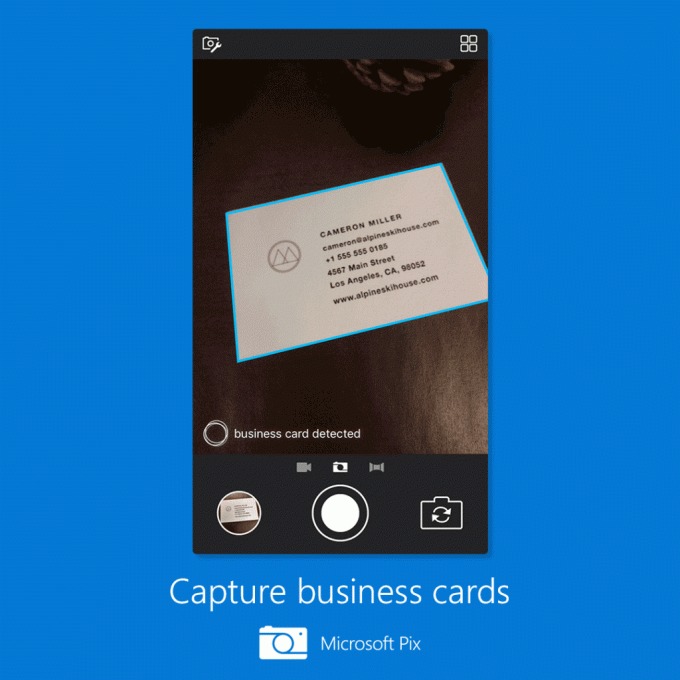
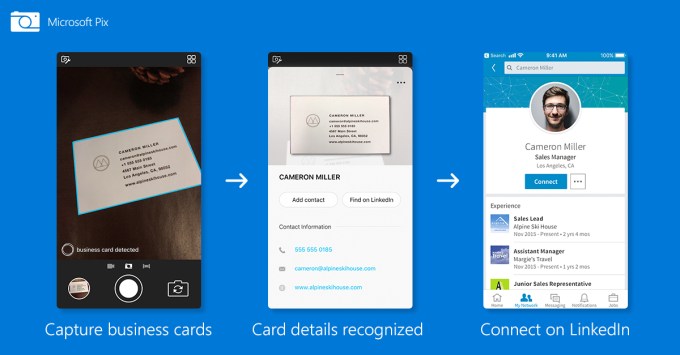
To take advantage of this option, you just launch the app and point it at the business card. Pix then automatically detects what it’s seeing, and asks you if you want to “Add Contact” or “Find on LinkedIn.”

When you tap to add the contact, Pix captures and organizes the contact information – like name, phone, address, and URL – into the correct fields, and adds the newly created contact to your iPhone’s Contacts app. If you opt for LinkedIn, you’re able to view the person’s profile in the LinkedIn app on your iPhone, and optionally add them to your list of connections.

The business card scanning feature, like others in Pix, leverages A.I. technology under the hood to enhance and improve the image. In the case of business cards, Pix is able to detect the edges of the cards, sharpen focus, and tweak the angle of the photo to render the image in a straight-on perspective so it can extract the information from the card.

Microsoft Pix can scan business cards to your contacts, find people on LinkedIn
The Pix update is just one of several ways Microsoft has integrated with LinkedIn since acquiring the company for $26.2 billion in 2016. It has also tied LinkedIn into its other products, including Office 365, Outlook.com, Dynamics 365, Word, and Windows 10.

The updated version of Microsoft Pix is rolling out today. You may not have it yet, as it has to propagate across the App Store, so keep your eyes peeled.

source:TechCrunch

Microsoft wants to help developers bring their AI models to the desktop
Microsoft today announced its AI Platform for Windows developers, a new set of tools that will soon help developers to bring the machine learning models they trained in the cloud to their desktop apps. The AI platform in Windows 10, which will launch with the next major version of Windows, will make use of the GPU on your local machine and allows developers to run their models in real time and without the need for a round trip to the cloud.

“What we are building really completes the story for Microsoft from an AI perspective,” Microsoft Partner Group program manager Kam VedBrat told me. In the past, Microsoft talked a lot about its machine learning infrastructure in the cloud and the tooling it built around this. With this, developers can now easily build their models in the cloud, using their framework of choice and then easily integrate these models with their desktop apps, using Visual Studio and some of the other tooling Microsoft is building for this.

At the core of this is Onnx, a project that is backed by Microsoft, Facebook and Amazon. It allows developers to convert Caffe2, PyTorch, CNTK and other models into the Onnx format to move them between frameworks as necessary.

Microsoft will also allow developers to build image recognition models with the Azure Custom Vision Service and export them for use in Windows ML. Unlike working with traditional framework, a developer doesn’t need to know about the intricacies of building machine learning models to do this. All they need to do is give the service their tagged training data.

These models then make use of the silicon that’s available to them in any given machine, which most likely means a DirectX 12 graphics card or, if that’s not available, the CPU. But the platform will also offer a flexible API for accessing other hardware, including future Intel Movidius vision processing units, for example.

The advantage here, Microsoft corporate VP Kevin Gallo told me, is not just lower latency and increased privacy for your users’ data, but also cost. Running these models in the cloud does, after all, incur a cost that can quickly add up. When they run on the desktop, though, that’s a non-issue.

Starting with the next preview of Visual Studio 15.7, developers can simply add an ONNX file to their Universal Windows Platform (UWP) apps and Visual Studio will generate a model interface for the project. Microsoft will also make tooling for previous versions of Visual Studio available and it’ll add this capability to the Visual Studio tools for AI, too.

source:TechCrunch

Otter's artificial intelligence absorbs recorded conversations and churns out transcripts that identify speakers, suggest keywords and offer text search.

Watch this: Otter's app makes free voice transcriptions easy and...

If you don't hate transcribing, it's probably just because you don't have to do it very much.

Otter, a new, free mobile app from a team of vets from Google and speech-recognition company Nuance, aims to make voice transcriptions become as easy and accessible as typing into a Google Doc.

Voice is an obsession of tech giants right now. But companies like Amazon, Google and Apple are mostly zeroed in voice-command assistants like Alexa or Siri, premised on the bet that voice interaction will become the next stage of computing. Getting less attention, though, are voice transcriptions -- tech that takes a recording of people talking and turns it in to text -- even though that kind of technology could be transformative for people across different needs and professions.

Most transcription apps or services fall into two buckets. If they're free, they're not often accurate. And those that give you clean transcript are usually expensive. That's because voice-to-text is technologically tricky, and most services that provide you with accurate transcripts usually need a human to review the recording.

Otter, which debuted this week at Mobile World Congress, aims to make transcripts not only free and accurate but also smart.

Otter is a free mobile app aiming to make transcription simple and easy
Otter is a free mobile app aiming to make
transcription simple and easy.
Mark Licea/CNET
"This is a perfect time," said Sam Liang, the CEO and founder of AISense, the company behind Otter. "With A.I. tech and deep in the last few years, the accuracy for speech recognition has improved dramatically. A few years ago, this system wouldn't be usable."

To use Otter, you tap a microphone icon to begin a recording, and almost immediately, a live raw transcript of what you're saying begins to unspool in front of you. It's after that recording ends that Otter's artificial intelligence can really do its work. After processing, the cleaned-up transcript separates speakers as they take turns to talk. As part of your sign-up process, Otter takes a "voiceprint" of you by asking you to read a five-paragraph statement so it can learn your voice and specifically identify you next to the passages you spoke.

Otter's transcripts also are searchable, not only within one transcript but across all your stored recordings. It automatically generate keywords that you can tap to search. You can form teams in Otter, and content can be shared within the Otter app with individuals or team members. You can also send anyone a link to a transcript viewable on the web.

In one neat feature, the text and audio are synchronized when you playback the recording, so if you tap on any part of the transcript, the audio will jump right to that place for quick accuracy checks. The app also highlights each word as its spoken during an audio playback.

It's not a perfect transcription. Punctuation is sometimes out of whack. It misidentifies some words -- I told Otter "Hi, I'm Joan" and my readout picked up my name as John, for example. And it's less successful in a crowded environment or during cross-talk. And the app, which was released publicly Monday, is somewhat buggy in its early days. When I opened it once, all my recordings and their transcripts from the previous day were missing. Restarting the app restored them, but you may notice other bugs.

And it lacks some tantalizing capabilities, like importing a previously recorded conversation. The app and its baseline transcription service is and will remain free, but the company plans to add a subscription tier later that unlocks extra utilities, along the same lines as Evernote's business model.

Its privacy relationship with your materials is similar to that of an Evernote, too. Otter is confidential and encrypted. And the company isn't building an ad-based business with Otter, so it's not interested in peeking into your materials so it can creating a profile that will target ads to you, the company said.

Otter is available for devices running Google's Android system and on Apple mobile products. and will be available on the web, iOS and Android.

source:CNet News

UiPath raising around $120M at $1B+ valuation for its ‘software robots’ for internal business tasks
The initial hype around bots — applications that run partly or entirely using natural language processing, machine learning, computer vision and other AI tech to help consumers ask and answer questions, buy things and get other stuff done — may have waned a bit, but a startup building the equivalent for the enterprise world, in a fast-growing field called robotic process automation, is seeing its star rise.

TechCrunch has learned that UiPath, a startup that builds ‘software robots’ for enterprises to help automate legacy and back-office functions, has raised a Series B round of funding that sources tell us is around $120 million — a round that will catapult it to a valuation of over $1 billion.

“Catapult” is the operative word here: the company last raised money in April 2017, a $30 million round that valued UiPath, founded in Bucharest, Romania but now headquartered in New York, at around only $109 million, according to data from PitchBook. In other words, this latest funding increases its valuation nearly tenfold.

“I’ve never seen an enterprise company grow this fast,” one source close to the company said to us, when we asked how its valuation jumped so high, so quickly.

From what we understand, this latest round — which the company will use to continue investing in its product and growth — will include existing investors along with some high profile new backers. A couple of sources have told us that Kleiner Perkins Caulfield Byers is in this round, along with other “household name” VCs (we are still working on figuring out who these might be). Its previous backers include Accel, Credo Ventures, Earlybird and Seedcamp.

The company is announcing the funding as soon as next week. It has declined to talk to us for this article. KPCB has not responded to our request for comment, so the final amount and investor names will likely change.

Another clue to the final amount and the fact that an announcement is around the corner: just this morning, UiPath filed documents in Delaware that authorized $100 million+ of a Series B & B-1, where the post-money valuation could be as high as $1.15 billion, according to Lagniappe Labs, the creator of the Prime Unicorn Index.

RPA as a market is on something of a growth tear at the moment. Grand View Research forecasts that RPA services will be a $8.75 billion market annually by 2024, while Forrester projects revenues of $2.9 billion by 2021. As of the end of 2017, UiPath’s revenues were on a rate of 500 percent growth annually and from what we understand it’s growing even faster now.

UiPath, and other companies working in the area of RPA, are filling a gap in the market for large enterprises: while the general trend for businesses is to upgrade their legacy systems with new technology in the longer term, in the short term, many of them are looking for ways of making their existing systems — and staff — more efficient.

UiPath uses AI tools like computer vision, machine learning and natural language processing to automate some of the more mundane tasks around administrative systems and processing “paperwork” such as filling out insurance claims, processing invoices, and most recently, running customer contact center operations.

The idea is that using UiPath’s bots creates more time for a company’s human workers to focus on using skills that the AI systems can’t (yet?) handle, for example applying advanced judgement skills to help assess the content of an invoice, or the needs of a customer contacting the business.

“In the area of finance, for example, a lot of teams spend time creating reports but don’t require them using as much of their judgment skills, leaving the human employees with little time for the analysing part of their jobs,” Accel partner Luciana Lixandru told us at the time of UiPath’s previous funding round. “A software robot that understands what is happening on the screen using computer vision and performs the task as a human would do it becomes a useful tool.”

UiPath has fit neatly so far into the fabric of enterprise IT systems and services.

In November last year the company said that it counted over 300 large enterprises as customers — customers we’re written about before include Lufthansa, Generali, Telenor and Dong Energy — and from what we understand that number now is around double that, with customers not just in the financial sector, but also healthcare, telecom, public sector, and more.

The startup also partners with the wide array of integrators and software providers that these enterprises are already using to help build and run their IT systems, including the likes of Oracle, Accenture, Capgemini, Symphony Ventures and many others.

What’s also worth noting is the pedigree of this company. Although now headquartered in New York, UiPath was founded in Romania — a country well known for engineers but not for hatching many huge tech startups (although that is quickly changing). In the wider conversation we’ve been having about how the tech world is still too weighted in favor of Silicon Valley, it’s nice to see this example of how it’s gradually decentralising, and strong startups founded far from the Bay Area are getting the recognition they deserve.

source:TechCrunch

Machine learning proves its worth for new video effects tech: distinguishing between faces and backgrounds at 100 frames per second.

Google's AI software can detect the subject of a  video and change the background
Google's AI software can detect the subject of a
video and change the background.
Google
Google's artificial intelligence researchers have a new trick up their sleeves: giving selfie videos a new background the way you can with still photos today.

Switching out background scenery is a decades-old technology, but it's generally complicated and time-consuming -- think of making movies with superheros acting in front of green screens so computers can later replace the uniform green color with digital effects like exploding buildings. Having 3D scene data, for example extracted from newer iPhones' twin cameras, makes the process only a little easier.

Google, though, trained a neural network with lots of carefully labeled imagery that helped it learn how to distinguish facial features -- eyes, hair, glasses, mouths, and so on -- from everything else. The result is a system that can swap out backgrounds fast enough to keep up with video. Digital video frames whip by at 30 frames per second, but Google's technology works at 40 frames per second on a Google Pixel 2 phone and more than 100 frames per second on an Apple iPhone 7.

Want to try it out for yourself? Sorry. For now, only a pretty small number of high-profile YouTubers with access to the YouTube stories service, which offers an ability to share Snapchat-esque short videos.

Google detailed the research in a blog post Thursday.

"Our new segmentation technology allows creators to replace and modify the background, effortlessly increasing videos' production value without specialized equipment," Google programmers Valentin Bazarevsky and Andrei Tkachenka said in the blog post.


Google uses machine learning in its video segmentation technology that can determine background imagery that can be replaced with something funny or eye-catching
Google uses machine learning in its video segmentation technology that can determine background imagery that can be replaced with something funny or eye-catching.
Google
The technology shows how versatile AI and machine-learning technology is for solving complex computational problems. Neural network technology doesn't have to know endless rules, like "faces have two eyes, located above the nose, unless the face is viewed in profile, in which case there may only be one eye visible, unless the subject is wearing dark glasses." It just has to be trained on enough photos, labeled by humans who do actually know what a face is, that it eventually learns the patterns. It's proven a remarkably useful technology for everything from screening out email spam to predicting what word you're trying to type into your phone.

Google already uses AI in a related feature today on its Google Pixel 2 phones. The phones only have single cameras, but AI helps blur backgrounds for portrait-mode photos.

source:CNet News

Microsoft advances several of its hosted artificial intelligence algorithms
Microsoft Cognitive Services is home to the company’s hosted artificial intelligence algorithms. Today, the company announced advances to several Cognitive Services tools including Microsoft Custom Vision Service, the Face API and Bing Entity Search .

Joseph Sirosh, who leads the Microsoft’s cloud AI efforts, defined Microsoft Cognitive Services in a company blog post announcing the enhancements, as “a collection of cloud-hosted APIs that let developers easily add AI capabilities for vision, speech, language, knowledge and search into applications, across devices and platforms such as iOS, Android and Windows.” These are distinct from other Azure AI services, which are designed for developers who are more hands-on, DIY types.

The idea is to put these kinds of advanced artificial intelligence tools within reach of data scientists, developers and any other interested parties without any of the normal heavy lifting required to build models and get results with the myriad testing phases that are typically involved in these types of exercises.

For starters, the company is moving the Custom Vision Service from free preview to paid preview, which is the final step before becoming generally available. Sirosh writes that this service helps “developers to easily train a classifier with their own data, export the models and embed these custom classifiers directly in their applications, and run it offline in real time on iOS, Android and many other edge devices.”

Andy Hickl, who works in the Cognitive Services group as principal group program manager, says the tool is designed to help companies identify similar entities in an automated way such as not only recognizing that a particular picture is a dog, but that’s it’s a specific kind of dog or a dog that belongs to a particular person.

The Face API, which is generally available as of today, helps identify a specific person from a large group of people in an automated way. With today’s release the tool allows developers to create groups of up to a million people. Hickl says this is significant because up until now, many face recognition algorithms could only recognize a handful of faces, useful as far as it goes, but not truly scalable like this, he pointed out.

Finally, the Bing Entity Search algorithm enables developers to embed Bing search results in any application. So for example, you could retrieve search results within any tool narrowed down by any Bing entity such as image or website. This tool is generally available as of today.

Microsoft search results embedded in application
Microsoft search results embedded in application.
Photo: Microsoft
source:TechCrunch

IBM Watson CTO Rob High on bias and other challenges in machine learning
For IBM Watson CTO Rob High, the biggest technological challenge in machine learning right now is figuring out how to train models with less data. “It’s a challenge, it’s a goal and there’s certainly reason to believe that it’s possible,” High told me during an interview at the annual Mobile World Congress in Barcelona.

With this, he echoes similar statements all across the industry. Google’s AI chief John Giannandrea, for example, also recently listed this as one of the main challenges the search giant’s machine learning groups are trying to tackle. Typically, machine learning models need to be trained on large amounts of data to ensure that they are accurate, but for many problems, that large data set simply doesn’t exist.

High, however, believes this is a solvable problem. Why? “Because humans do it. We have a data point,” he said. "One thing to keep in mind is that even when we see that evidenced in what humans are doing, you have to recognize it’s not just that session, it’s not just that moment that is informing how humans learn. We bring all of this context to the table.” For High, it’s this context that’ll make possible training models with less data, as well as recent advances in transfer learning, that is, the ability to take one trained model and then use this data to kickstart the training of another model where less data may exist.

The challenges for AI — and especially conversational AI — go beyond that, though. “On the other end is really trying to understand how better to interact with humans in ways that they would find natural and that are influential to their thinking,” says High. “Humans are influenced by not just the words that they exchange but also by how we encase those words in vocalizations, inflection, intonation, cadence, temper, facial expression, arm and hand gestures.” High doesn’t think an AI necessarily needs to mimic these in some kind of anthropomorphic form, but maybe in some other form like visual cues on a device.

At the same time, most AI systems also still need to get better at understanding the intent of a question and how that relates to individuals’ previous questions about something, as well as their current state of mind and personality.

That brings up another question, though. Many of these machine learning models that are in use right now are inherently biased because of the data with which they were trained. That often means that a given model will work great for you if you’re a white male but then fails black women, for example. “First of all, I think that there’s two sides to that equation. One is, there may be aggregate bias to this data and we have to be sensitive to that and force ourselves to consider data that broadens the cultural and demographic aspects of the people it represents,” said High. “The flip side of that, though, is that you actually want aggregate bias in these kind of systems over personal bias.”

As an example, High cited work IBM did with the Sloan Kettering Cancer Center. IBM and the hospital trained a model based on the work of some of the best cancer surgeons. “But Sloan Kettering has a particular philosophy about how to do medicine. So that philosophy is embodied in their biases. It’s their institutional biases, it’s their brand. […] And any system that is going to be used outside of Sloan Kettering needs to carry that same philosophy forward.”

“A big part of making sure that these things are biased in the right way is both making sure that you have the right people submitting for and who these people are representative of — of the broader culture.” That’s a discussion that High says now regularly comes up with IBM’s clients, too, which is a positive sign in an industry that still often ignores these kind of topics.

source:TechCrunch

BrainQ aims to cure stroke and spinal cord injuries through mind-reader tech
Israel-based BrainQ is a new nuerotech startup hoping to take on brain-computer interface (BCI) companies like Braintree founder Bryan Johnson’s Kernel and Silicon Valley billionaire Elon Musk’s Neuralink.

It’s not clear yet what Musk’s startup intends to do with the computer chips it plans to put in our heads but Johnson’s startup says it is focused on developing “technologies to understand and treat neurological diseases in new and exciting ways.”

Whatever sector each company goes for, both plan to insert chips in our brains to connect us to computers — the consequences of which could have dramatic effects on human memory, intelligence, communication and many other areas that could rocket humanity forward, should they work out.

But it’s early days in this industry, including for BrainQ, which plans to use a non-surgically embedded EEG machine instead to gather data and help improve outcomes for stroke and spinal cord patients.

Aside from the brain implant options, BrainQ faces quite a bit of competition in this area. EEG machines are nothing new, not even in the spinal cord injury space. Missouri-based Neurolutions is working on similar EEG type technology to improve and restore function to paralytics. Neuropace, a Kleiner funded startup, is focused on seizures rather than stroke and spinal cord injuries but is based on the same idea.

BrainQ aims to cure stroke and spinal cord injuries through mind-reader tech
BrainQ admits it is also a couple years out from being fully operational here. It still needs to get through clinical human trials and gain Food and Drug Administration approval to sell its services in the U.S.

So far, the company is in the process of conducting two human clinical trials for stroke patients in Israel and a spokesperson for the company Assaf Lifshitz says BrainQ will likely try to go to other markets first while waiting on the FDA. BrainQ tells TechCrunch it hopes to be available in the U.S. market by 2020.

Alzheimer’s research is another area TechCrunch was told the company wants to get into soon, and possibly children’s syndromes as well.

There are a lot of different areas the company could go into with this type of tech but it’s probably safest to bet on a few narrow areas in the beginning as there is already so much competition in the space in just the U.S. For instance, Nuerulutions’ Ipsihand device is already connecting stroke patient’s brains to a moveable brace they can control with thought and help them move certain body parts again.

And, while Lifshitz believes BrainQ is at least ahead of the market as far as Kernel and Nueralink go, that’s too easy of a comparison to make. EEG is a low-risk entry toward a BCI device gaining FDA approval. All the company need to show, as many of these companies are either on their way to proving or have proved already, is that the device works. That is far from the same thing as a chip surgically inserted into your head.

BrainQ will continue to forge ahead, of course. Google’s Launchpad Studio chose to work with the startup this last fall, based on what it thought was some interesting machine learning tech. The company has also raised about $3.5 million to date from various Israeli investors and angels and presented previous clinical findings to the World Congress of Neuro Rehabilitation.

source:TechCrunch

Customer service bot startup Agent IQ announces $6.3 million Series A led by Sierra Ventures
If you’ve tried to deal with a bot before you can speak to a human customer service rep, you know how frustrating that process can sometimes be. Sure, there are basic tasks that can free up a human rep to handle the more difficult matters, but it can be exasperating when there is no easy way to talk to a person. Agent IQ, a startup that has developed customer service bots, acknowledges that problem and today it announced a $6.3 million Series A investment.

The round was led by Sierra Ventures with participation from CRCM and Rubicon Ventures. Today’s investment brings the total raised to $8.5 million.

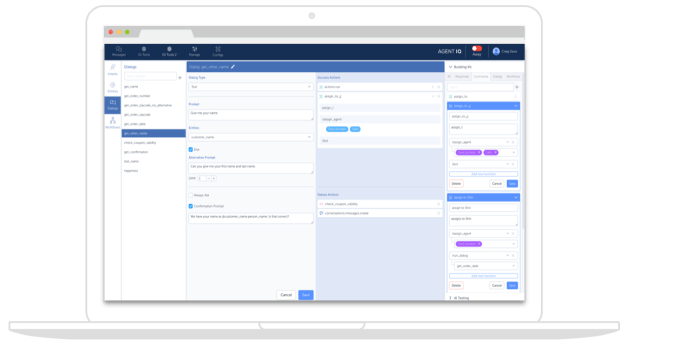
Agent IQ has its roots in a Nike marketing program, which allowed customers to communicate with a bot by typing “Hey Nike” into their chat app. CEO and founder, Craig Davis says they began building on that early program, and they learned that just the bot or just an agent didn’t really work for many customers. It required a product that blended technology with humans.

He found by visiting countless customer service centers, the pain wasn’t just for the customers. Reps were bored answering the same basic questions repeatedly, which wasn’t fun or challenging for them. What’s more, when they did need to answer unique questions, it required accessing a variety of disparate systems. The agents had to have multiple windows open trying to juggle different content repositories to find the appropriate response.

Customer service bot startup Agent IQ announces $6.3 million Series A led by Sierra Ventures
Photo: Agent IQ
“We thought it was important to help the agent, suggesting responses based on past conversations and based what they picked up on new knowledge,” Davis explained. They also began presenting knowledge base articles dynamically based on the context of the conversation, using that power of artificial intelligence and machine learning underpinning their solution.

Davis understands that he is competing with giants like Salesforce and Oracle, but he says because his company’s solution is built from the ground up with the latest technology, it has a leg up on these usual suspects. “Let’s talk about AI piece. They have years of technical debt and their technology is overlaid on their customer service management platform. They don’t get seamless handoff and don’t get that closed loop AI learning [that we provide],” Davis claimed.

He’s also competing with startups offering a similar value proposition like Digital Genius.

The company currently has 20 employees and 14 customers, all of which Davis says are Fortune 1000 customers paying at least $500,000 a year. He says the company plans to expand on the sales side and to build out customer success teams using the new funds.

source:TechCrunch

This autonomous 3D scanner figures out where it needs to look
If you need to make a 3D model of an object, there are plenty of ways to do so, but most of them are only automated to the extent that they know how to spin in circles around that object and put together a mesh. This new system from Fraunhofer does it more intelligently, getting a basic idea of the object to be scanned and planning out what motions will let it do so efficiently and comprehensively.

It takes what can be a time-consuming step out of the process in which a scan is complete and the user has to inspect it, find where it falls short (an overhanging part occluding another, for instance, or an area of greater complexity that requires closer scrutiny) and customize a new scan to make up for these lacks. Alternatively, the scanner might already have to have a 3D model loaded in order to recognize what it’s looking at and know where to focus.

Fraunhofer’s project, led by Pedro Santos at the Institute for Computer Graphics Research, aims to get it right the first time by having the system evaluate its own imagery as it goes and plan its next move.

“The special thing about our system is that it scans components autonomously and in real time,” he said in a news release. It’s able to “measure any component, irrespective of its design — and you don’t have to teach it.”

This could help in creating one-off duplicates of parts the system has never seen before, like a custom-made lamp or container, or a replacement for a vintage car’s door or engine.

If you happen to be in Hanover in April, drop by Hannover Messe and try it out for yourself.

source:TechCrunch

Pulse Q&A wants to transform the way we gather data from CIOs
Lots of companies need to understand what CIOs are thinking, but it’s hard to get a group of busy people to give meaningful answers about the products they use or their budget priorities in public forums for obvious reasons. Pulse Q&A is a new company in the Y Combinator Winter 2018 class that wants to change how we gather and share this valuable information.

“Imagine you had a chatbot where you could ask CIOs for exact information and crowdsource the [answers],” says Pulse co-founder and CEO Mayank Mehta. That’s exactly what Pulse Q&A hopes to provide. It has already attracted over 2000 CIOs to its Facebook Messenger chat tool and the one it runs on its website.

The idea for the company has its roots in a problem that the founders encountered in earlier startups. They needed to talk to hundreds of CIOs to find the right product-market fit, a process that took months to complete. The the idea of a crowd-sourced platform where they could ask questions in a centralized fashion to speed up that process began to take shape.

It launched the company last year and has built up a stable of CIOs through word of mouth, email marketing, Facebook ads and LinkedIn. Mehta says they don’t offer financial rewards to get people to answer questions, but instead give them points for participating, which they can exchange for information by asking their own questions.

Pulse Q&A wants to transform the way we gather data from CIOs
Photo: Pulse Q&A
Mike Kail, who is CTO and co-founder at Cybric, a security as a service startup, who had previous executive stints at Netflix and Yahoo, said he had known Mehta and liked the idea of a private network where IT executives could discuss issues outside of a public forum. Kail said he gave up on LinkedIn groups, which he says are is not a place where you can be candid or transparent.

But he says there is a need for a place where executives can compare notes online. “I want to talk to peers who are facing the same problems I am and their platform gives me that,” Kail told TechCrunch

Pulse Q&A has a broad range of paying market targets for the product including CFOs and CEOs who want to understand CIO benchmarks, CMOs who want to tune their messaging to the needs of CIOs, Hedge funds managers looking to validate investment decisions and journalists looking for data on the business impact of the technology they are writing about.

While the company is still working on pricing models, it doesn’t come cheap, starting at $2500 for a hundred responses to five questions, Mehta said. They currently have two dozen paying customers.

Pulse Q&A wants to transform the way we gather data from CIOs
Pulse Q&A web report. Photo: Pulse Q&A
The founders have found being part of Y Combinator to be an invaluable experience. “We are getting emotional support of being an early stage startup from other portfolio companies and partners and support from Y Combinator community,” Mehta said.

As for the future, the company hopes to expand beyond the two current channels of Facebook Messenger and its web client to Skype for Business and Slack and to continue to build out the CIO network and the product, making it easier to ask questions and get specific answers and filtered reports.

source:TechCrunch

Google Flights will now predict airline delays – before the airlines do
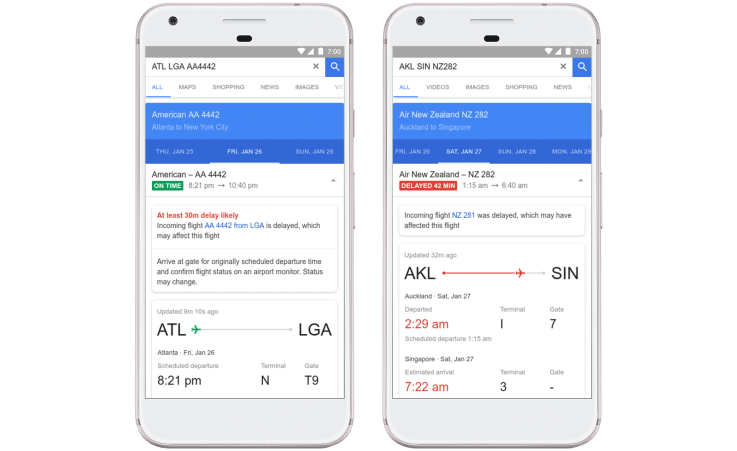
Google is rolling out a few new features to its Google Flights search engine to help travelers tackle some of the more frustrating aspects of air travel – delays and the complexities of the cheaper, Basic Economy fares. With the regard to delays, Google Flights won’t just be pulling in information from the airlines directly, however – it will take advantage of its understanding of historical data and its machine learning algorithms to predict delays that haven’t yet been flagged by airlines themselves.

Explains Google, the combination of data and A.I. technologies means it can predict some delays in advance of any sort of official confirmation. Google says that it won’t actually flag these in the app until it’s at least 80 percent confident in the prediction, though. (Of course, you should still get to the airport on time, but at least you’ll know what you’re about to face once there.)

It will also provide reasons for the delays, like weather or an aircraft arriving late.

You can track the status of your flight by searching for your flight number or the airline and flight route, notes Google. The delay information will then appear in the search results.

The other new feature added today aims to help travelers make sense of what Basic Economy fares include and exclude with their ticket price.

These low-cost fares are often the only option for travelers on a budget, but they have a number of restrictions that can vary by airline.
Google Flights will now predict airline delays – before the airlines do
Google Flights will now display the restrictions associated with these fares – like restrictions on using overhead space or the ability to select a seat, as well as the fare’s additional baggage fees. It’s initially doing so for American, Delta and United flights worldwide.

These changes come only a month after Google Flights added price tracking and deals to Google Flights as well as hotel search features for web searchers.

The additions seem especially targeted toward today’s travel startups and businesses, like Hopper which had just added hotel search, and uses big data to analyze airline prices and other factors; or TripIt, a competitor of sorts to Google’s own travel app Google Trips, whichmost recently introduced security checkpoint wait times. (Given that Google already knows the busy times for area businesses by tracking people’s movement via Google Maps, it wouldn’t be surprising to see it implement security wait times next.)

The features are also a real-world demo of Google’s machine learning and big data capabilities, especially in the case of predicting flight delays. Since you can’t take action on the alerts until the airline makes an official announcement, they will largely just cause more anxiety on top of your already stressful travel experience.

source:TechCrunch
Google adds price tracking and deals to Google Flights, Google Trips and hotel search
Google today is expanding its booking features for travelers using Google services including Trips, Flights and hotel search, with a focus on helping people find better rates. For example, Google can now tell you the best time to buy an airline ticket or see when room rates are higher, among other things.
Google adds price tracking and deals to Google Flights, Google Trips and hotel search
These price-tracking features are similar to those that some other travel services, like Kayak, as well as startups, like Hopper, already offer. Now Google is taking what has been a differentiating feature for those services, and making it more broadly accessible to everyone searching for travel information on the web.

With Google Flights, the company is leveraging machine learning technology to analyze historical price data to inform you as to when it’s the best time to book a flight. After entering in a destination, you can receive tips like “prices won’t drop further” or “prices are less than normal,” to help you figure out if you should book now or wait. These tips appear above your search results, and are of more use to leisure travelers whose dates may be flexible.

The flight search price tracking is rolling out worldwide, on both desktop and mobile.

Meanwhile, Google’s hotel search results will offer the same kind of information. After searching for a hotel on Google, you’ll see if room rates are higher or the area is busier than usual due to a local event. You can also opt in to receive email alerts about price fluctuations, starting on desktop early next year.

This price tracking is available globally in all languages on mobile.


The addition of hotel price tracking may be of particular concern to the popular booking app Hopper, which just recently began offering hotel price tracking – but only in limited markets. Now it has to compete with Google in this area as well.

Finally, Google is also adding information about discounted tickets and tours in its Google Trips mobile application for iOS and Android.

The Google Trips app was launched just over a year ago, as a personalized travel planner. But it makes sense that Google would integrate its travel-booking features in here, as well, as opposed to just making it another way to leverage Google Maps’ data.

The new ticket and tour deals will appear in the city you’re visiting within the app, and will be launched worldwide in English, French, Italian, German, Spanish, Portuguese.

source: TechCrunch

MKRdezign

Contact Form

Name

Email *

Message *

Powered by Blogger.
Javascript DisablePlease Enable Javascript To See All Widget