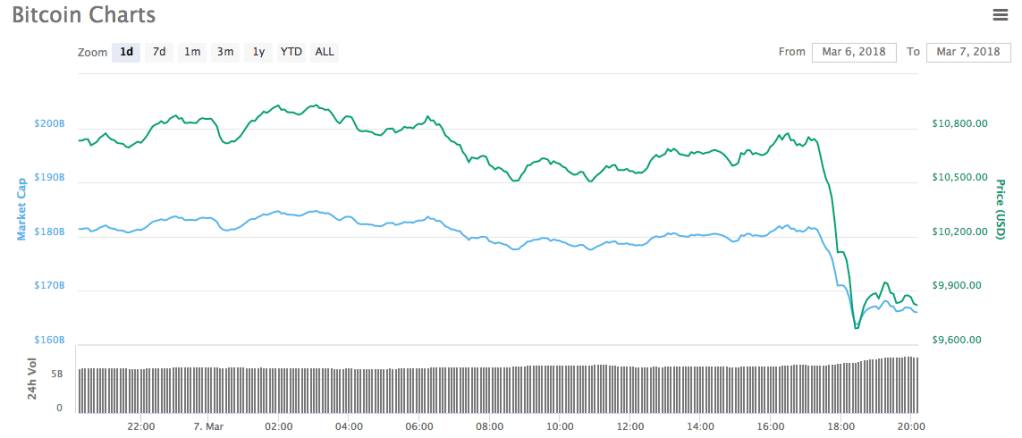
Welcome to another rollercoaster day for the cryptocurrency community. In just a few minutes, bitcoin price crashed from $10,740 to $9,690, which represents a 10.8 percent crash.
As always, it’s a bit hard to know for sure what’s happening. But one company in particular is having a bad day. Cryptocurrency exchange Binance has spotted some unusual activities and halted withdrawals.
Binance is one of the biggest exchanges out there. According to CoinMarketCap, it’s one of the 4 biggest exchanges for the top cryptocurrencies when it comes to traded volume.
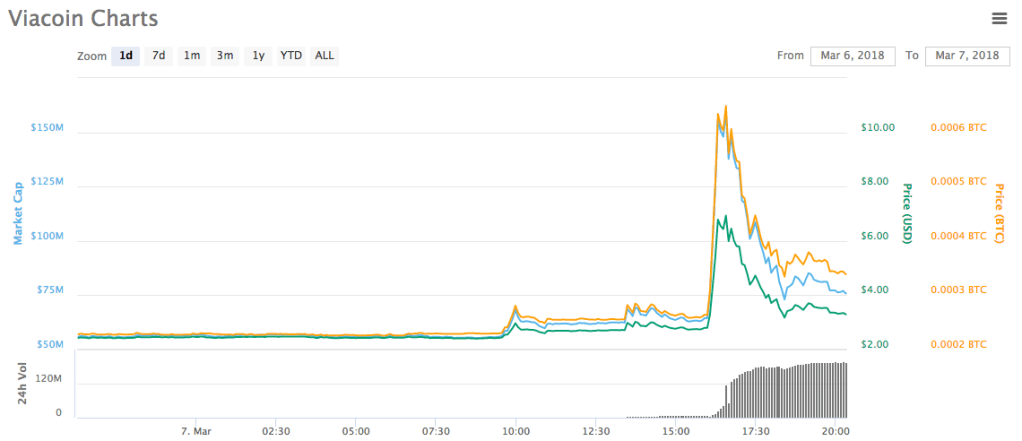
Many people noticed something highly unusual with Viacoin happening right before the crash. There was a huge increase in buy orders for Viacoins on Binance. In just a few minutes, Viacoin’s market capitalization jumped from $64 million to $159 million
Binance looked into it and noticed unauthorized sell orders. “We are investigating reports of some users having issues with their funds. Our team is aware and investigating the issue as we speak,” the company wrote on Reddit. “As of this moment, the only confirmed victims have registered API keys (to use with trading bots or otherwise). There is no evidence of the Binance platform being compromised.”
So it seems like a third-party service or app got compromised. Users of that third-party app were relying on API keys to control Binance accounts. A hacker may have developed a bot that submits orders at the same time (7:00 AM Pacific).
While the Binance team halted withdrawals, it might be too late. It’s also possible that the hacker already had a big position in Viacoin on another exchange. The hacker could have sold a big pile of Viacoins shortly after manipulating the price on Binance.
In all cases, it proves once again that security is a big issue when it comes to cryptocurrencies. Don’t store your coins on an exchange. Use a hardware wallet or a wallet that lets you control the private keys.
Disclosure: I own small amounts of various cryptocurrencies.
The U.S. Securities and Exchange Commission has issued a warning on cryptocurrency exchanges. The SEC says that many exchanges are currently unregulated and can do whatever they want with your money. As an investor, you should be extremely careful. As a company running an exchange, you should expect a crackdown soon.
The SEC first assumes that cryptocurrencies and tokens offered through ICOs are securities. As securities, cryptocurrency exchanges should follow the same rules as every exchange. They should register through the SEC as a national securities exchange, an alternative trading system (ATS) or a broker-dealer.
But the SEC says that the current situation is a mess. “The SEC staff has concerns that many online trading platforms appear to investors as SEC-registered and regulated marketplaces when they are not,” the SEC wrote. “Many platforms refer to themselves as ‘exchanges,’ which can give the misimpression to investors that they are regulated or meet the regulatory standards of a national securities exchange.”
Many exchanges have set up their own rules when it comes to listing new cryptocurrencies, but the SEC has no say in this process and can’t guarantee that those are safe investments.
Similarly, the SEC never reviews trading tools on cryptocurrency exchanges. For instance, if you submit a limit order on an exchange, you have to trust the exchange that it’ll strictly follow your order. The exchange could give priority to bigger investors or screw up the order book without any consequence.
The SEC also reminded cryptocurrency exchanges that they’re supposed to register as an ATS for example. After Circle’s acquisition of Poloniex Nathaniel Popper saw a confidential Circle presentation. Circle plans to work with the SEC to register Poloniex:
Just got this slide from a confidential Circle presentation. It does more to explain Circle's acquisition of Poloniex than anything I have seen today. pic.twitter.com/gRXxDeXvxl
“The SEC was very favorable on this approach and indicated that they would not pursue any enforcement action for prior activity,” Circle wrote. “They said we are the first and only company in the space to approach them, and were very progressive on working closely with us.”
So it seems like there could be a grace period for U.S.-based exchanges before an eventual crackdown. But many U.S. investors rely on foreign exchanges to trade cryptocurrencies. It’s unclear how the SEC plans to protect U.S. investors from creating accounts on foreign exchanges.
Here’s the SEC’s list of questions to cryptocurrency investors to help them pick an exchange:
Do you trade securities on this platform? If so, is the platform registered as a national securities exchange (see our link to the list below)?
Does the platform operate as an ATS? If so, is the ATS registered as a broker-dealer and has it filed a Form ATS with the SEC (see our link to the list below)?
Is there information in FINRA’s BrokerCheck ® about any individuals or firms operating the platform?
How does the platform select digital assets for trading?
Who can trade on the platform?
What are the trading protocols?
How are prices set on the platform?
Are platform users treated equally?
What are the platform’s fees?
How does the platform safeguard users’ trading and personally identifying information?
What are the platform’s protections against cybersecurity threats, such as hacking or intrusions?
What other services does the platform provide? Is the platform registered with the SEC for these services?
Does the platform hold users’ assets? If so, how are these assets safeguarded?
Disclosure: I own small amounts of various cryptocurrencies.
Buzzwords, "banking without bankers", a team of cryptocurrency experts working together on a new piece of ground breaking technology. Great stuff.
But then you scroll down its list of advisors and notice something a bit weird.
Is that... Ryan Gosling?
Meet Kevin Belanger, an "[e]xperienced graphic designer with a clear focus on identities and illustration." He is apparently working on MIROSKII. He also looks a lot like Ryan Gosling. That's because his profile picture is literally a stock image of Ryan Gosling.
So is Ryan Gosling working on an ICO for a brand new cryptocurrency?
For background, an "ICO" is an "initial coin offering". An ICO allows potential buyers to invest in a cryptocurrency before launch. ICOs are used to help fund the development of a new currency. If the technology is legitimate, it can be good to get in early before it starts getting traded freely on exchanges.
But the MIROSKII ICO appears to be an elaborate fake.
The MIROSKII ICO (and the Gosling connection) was intially brought to our attention by Jackson Palmer, the founder of Dogecoin, who we profiled as part of our Blockchain Decoded series.
— Shill Nye The ICO Guy (@CryptoShillNye) 4 Mart 2018
Incredibly, it looks as though almost everyone on MIROSKII's list of advisors is fake.
I'm still google-image-searching but so far all advisors/team portraits on that site are fake. Billion dollar business idea: Do this publicly, for all shitcoin websites.
From our own research, Perry Henderson is listed on the site as a "Blockchain enthusiast", a CEO of multiple online companies, but a quick Google search uncovered this: Perry Henderson is actually a real estate agent from Texas.
Joel Hermann ("Founder of Mysterium Network" and a "[h]uge technology fan") is actually Ben B. Rubinowitz, a practicing lawyer from New York.
So far every single person on the team he's looked into is "fake".
For example, "Mark Anderson" is Christopher Cane, the image was taken from his Twitter profile. Craig Gulledge is Peter Roper, a business developer. Many others appear to be taken from stock images.
Perhaps the most disturbing part of this story: MIROSKII appears to have raised $833,000 already. We have no real way of verifying at this point if the money raised is a legitimate figure.
Most likely it's not legitimate, but we have no way of telling at this point. We've attempted to get into touch through MIROSKII's social media, but we've yet to hear back and don't expect to hear back at this point.
For months now, much of the media attention on the crypto space has been directed at ebbs and flows in the price of bitcoin on one side, and whiz-bang ICOs on the other.
The price of the most valuable cryptocurrency, Bitcoin (specifically the BTC chain), has backpedaled significantly from highs set in December 2017. The chart below shows pricing data from the CoinDesk Bitcoin Price Index (BPI) over the last 365 days.
Those dramatic price swings write headlines. And the media, Crunchbase News included, has not been shy in covering bitcoin’s ups and downs.
But the comparatively quiet and glacially paced world of traditional venture capital deserves no short shrift from reporters, market analysts and enthusiasts alike. At the time of writing, 2018’s venture fundraising totals alone are more than 40 percent of the way to 2017’s high water mark, according to Crunchbase data.
And it’s been only around two months since the start of the year.
But like all emerging technologies, and most nascent companies working on them, there’s no telling whether these bets will generate significant returns. Like with the very cryptocurrency mining computers hashing away at these blockchains, venture investment in this ecosystem may prove to be a waste of energy and a lot of hot air. But venture investors seem alright with buying equity during the dip.
Here we’ll see how much venture money is being invested, by whom and where these venture-backed crypto companies call home.
(Data) mining for insights into blockchain and blockchain-adjacent companies
To avoid any complaints from so-called maximalist supporters of any one cryptocurrency or blockchain ecosystem, we’re going to base the following analysis on a fairly wide basket of companies.
To learn more about the data set of companies we used for this article, skip to the bottom for notes on methodology. What follows is an analysis of the data that shakes out of our bundle of crypto companies.
Venture dollar volume may eclipse 2017’s highs this year despite ICO hype
Despite all the market hype around ICOs, some of which have raised hundreds of millions of dollars, venture investment in blockchain and related companies has kept pace, as well.
What’s captured here are just good ol’ fashioned venture rounds — convertible notes, seed and angel rounds, Series As and on through the alphabet — not the Wild West world of ICOs. The chart above excludes rounds labeled as ICOs, even if they had participation from VCs.
The chart makes an important point: Despite price volatility in crypto-land’s most valued blockchain asset, bitcoin (specifically the BTC chain) venture investment — in terms of sheer dollar volume — is on pace to eclipse even the banner year of 2017.
But which funds are investing in these more recently raised rounds? The chart below shows the most active venture investors from the past 14 months, according to what’s captured by Crunchbase data.
So we’ve seen how much is being invested, but which countries are leading the way?
Listed headquarters of recently funded companies reveals legal trends
In the chart below, we chart the location of the blockchain companies that raised venture funding in 2017 and 2018 so far.
Two main features stand out from the chart above: venture fundraising activity in blockchain and blockchain-adjacent companies is highly concentrated in just a handful of countries, with the U.S. leading the way, and a small but growing percentage of companies are choosing to locate themselves in countries with friendly attitudes toward blockchain and cryptocurrency innovation.
The two that stand out here are Singapore and Switzerland, each of which are home to (at least) four percent of the startups that raised venture funding over the last 14 months. Over the course of reporting on other stories, Crunchbase News has learned from investors and entrepreneurs that many Asia-focused blockchain companies and investors in Singapore and Hong Kong are increasingly attractive domiciles for Chinese firms leaving that country in the wake of regulatory crackdown. Japan and Malaysia are also popular locales in Asia for blockchain companies and funds, in part thanks to permissive regulatory environments.
In Europe, Switzerland has been particularly progressive when it comes to clarifying policies around cryptocurrencies and blockchain technology. At CryptoCon in Chicago earlier this month, Brent Traidman, chief revenue officer for Zurich-based mobile wallet-maker Bread, referred to the country as “crypto valley.” Switzerland’s financial authority issued specific guidance to companies looking to raise capital in ICOs last week.
As long as the regulatory environment for cryptocurrencies and other blockchain assets remains somewhat cryptic in the U.S., American crypto-entrepreneurs may opt to leave the country for clearer legal frameworks abroad.
Notes on methodology
Here’s how we found the data we worked with.
We first created a list of companies in Crunchbase’s bitcoin, ethereum, blockchain, cryptocurrency and virtual currency categories. Then we took the list of companies in Crunchbase’s data that have raised capital via an initial coin offering (a funding method better known by its initialism ICO). Finally, we created another list of companies that use those keywords, in addition to “digital currency” and “utility token” in their company descriptions.
We then combined and de-duplicated the list to produce a data set of just over 2,900 blockchain and blockchain-adjacent organizations that we’ll use in our analysis. And, at least for the purposes of this article, we’re going to refer to these companies using some variation of that inelegant if quite inclusive phrasing: “blockchain and blockchain-adjacent.”
US regulators have begun a broad investigation into initial coin offerings of cryptocurrencies, according to The Wall Street Journal.
The SEC is reportedly tightening the screws on cryptocurrency offerings. Securities and Exchange Commission
US regulators apparently are pushing harder to squeeze the snake oil out of the new cryptocurrency technology.
Digital currency and its underlying technology, blockchain, has the potential to refashion financial transactions and data sharing. But there are plenty of shenanigans, particularly through the money-raising process called initial coin offerings (ICOs), through which people can invest in new cryptocurrencies.
Now the Securities and Exchange Commission is cracking down more aggressively and has sent cryptocurrency companies dozens of subpoenas and information requests, The Wall Street Journal reported Wednesday. The SEC's requests seek information on investors, marketing materials, details on people involved and their locations, and more, according to lawyers who've seen the requests, reports cryptocurrency news site CoinDesk. One request was 25 pages long and "hyper-detailed," according to an unnamed lawyer CoinDesk heard from.
Plenty of people have gotten rich off cryptocurrencies like bitcoin and ether as valuations surged along with investor interest in 2017. The frenzy has slowed down for now. But startups, big businesses and cryptocurrency enthusiasts are still actively pushing the technology, and its long-term future is uncertain.
The SEC didn't immediately respond to a request for comment. But there's growing evidence it's taking a stand against shady ICOs. SEC Chairman Jay Clayton in January warned lawyers and accounts that they were falling short in their duties when it came to ICOs. "I have instructed the SEC staff to be on high alert for approaches to ICOs that may be contrary to the spirit of our securities laws and the professional obligations of the US securities bar," Clayton said.
The SEC has taken enforcement actions, too. In December, the agency froze assets of a cryptocurrency firm it alleged was a fraud, halted an ICO in January for another it called "an outright scam" and suspended trading in February in three companies that claimed cryptocurrency or blockchain dealings.
Today's initial coin offerings make the cryptocurrency realm very much like the wild west, Marina Niessner, an assistant professor of finance at Yale School of Management, said in an earlier interview. But eventually, the lawless phase will end, she predicted.
"My guess is a lot of the cryptocurrency stuff is probably going to go away," she said. Blockchain, though, which can be applied more broadly to business transactions and data-handling technology, "is probably here to say. It'll streamline a lot of finance."
A reminder that I’m going to have Paul Vigna and Michael Casey, authors of The Truth Machine, onstage with me next week at Knotel, a co-working and event space in Manhattan. I’d love for you to come.
You can RSVP here and space is limited. It’s happening Tomorrow, February 28, at 7pm and will feature a 35-minute talk with two of the top writers in crypto. These guys literally wrote the book on bitcoin and their new book is about to hit store shelves. I will also have a maximum of five crypto pitches on stage after the talk so if you’d like to pitch please fill this out. If you don’t hear from me you weren’t picked for this round.
Abraham Lincoln famously said that “government of the people, by the people, for the people, shall not perish from the earth,” but looking around these days, you would be forgiven if you thought representative democracy had already been buried alongside Washington, Jefferson, and Roosevelt. Confidence in Congress remains pitifully low, driven by perceived low ethical standards and an increasing awareness that politics is bought by the highest bidder.
Now, a group of technologists and blockchain enthusiasts are asking whether a new approach could reform the system, bringing citizens closer to their representatives and holding congressmen accountable to their voters in a public, verifiable way. And if you live in western San Francisco, you can actually vote to put this system into office.
The concept is known as liquid democracy, and it’s a solid choice for fixing a broken system. The idea is that every person should have the right to give feedback on a policy issue or a piece of new legislation, but often people don’t have the time to do so. Using a liquid democracy platform, however, that voter can select a personal representative who has the authority to be a proxy for their vote. That proxy can be changed at will as a voter’s interests change.
Here is where the magic happens. Those proxies can themselves proxy their votes to other people, creating a directed network graph, ideally connecting every voter to politicians and all publicly verified on a blockchain. While there may be 700,000 people in a congressional district, potentially only a few hundred of a few thousand “super proxies” would need to be deeply engaged in the system for better representation to take place.
David Ernst is a leader of the liquid democracy movement and now a candidate for California Assembly District 19, which centers on the western half of San Francisco. He is ardently committed to the concept, and despite its novelty, believes that this is the path forward for improving governance.
Ernst has had a long-time interest in politics — his father was the city attorney of Dallas from 2013-2016 — but he found the current political environment uninviting. “I have always had the bug, but the biggest thing for me has been the partisanship, it drives me crazy,” he said.
Following college (which he began at age 16) and a few startup jobs, Ernst began working as CTO of a startup called Numerai, a crypto-backed decentralized hedge fund that allows data scientists to earn money when they solve data challenges. “The idea was that we can include many more people to participate in the system who weren’t able to before,” Ernst explained. That’s when it hit him that the decentralized nature of blockchain could allow for more participation in politics, fusing his two passions.
Ernst followed the campaign of the Flux Party in Australia in 2016, which is trying to implement what it calls “issue-based direct democracy” in that country’s legislature. “That was when something clicked,” he said. A congressman for example could commit to voting the calculated liquid democracy position, and “We could elect these sort of remote-controlled politicians as a way to graft this new system onto the old system.”
He built a platform called United.vote to handle the logistics of selecting personal representatives and voting on issues. More importantly, the app then tracks how those votes compare to the votes of congressmen and provides a scorecard.
Ernst believes this is vastly superior compared to other feedback mechanisms. “They say call your senator and call your congressperson, but it can be kind of a frustrating experience because it is unclear what really happens after the call, and worse, no one else knows that you have called in — your call essentially falls into this black hole,” he said.
Tech platforms and Medium posts are nice, but he realized that the most effective way to engage people’s interest in the project is to give them a candidate — himself. “No, it is not just a website, we are actually giving voters the option to have this better system,” Ernst explained. “All you need to do is check the box next to the liquid democracy person’s name, and then we can put this system into office.”
The popularity of liquid democracy today is certainly small. United.vote’s homepage lists 968 members who have signed up for liquid democracy. The Flux Party in Australia garnered 0.15% of the first preferences nationwide in 2016. Ernst, though, is unperturbed. “If I got elected, but only 20 people were actually using [the platform], I would still follow those people,” he said. The hope is that more people will join the platform when they see it can provoke real change in politics.
Ernst is running as an independent, and competing against incumbent Democrat Phil Ting, who he describes as “a nice guy.” Ting won the 2016 election with 80% of the vote, with Republican Carlos Taylor netting 20%, and has represented District 19 since 2012. The 2018 primary will be held June 5, and the top two candidates regardless of party affiliation will compete in the general election on November 6th.
Ernst knows that the tech is early. “There are a million ways in which the software isn’t all it can be yet, but we are putting it out there so that people will tell us to fix this or fix that,” he said. Those software fixes though just might fix democracy itself.
Coinbase has some serious competition. Today, Robinhood starts rolling out its no-commission cryptocurrency trading feature in California, Massachusetts, Missouri, Montana and New Hampshire. Users there can buy and sell Bitcoin and Ethereum with no extra fees, and everyone can track those and 14 other coins in its sleek app. That’s compared to paying 1.5 to 4 percent fees in the U.S. on Coinbase. Users can sign up on the Robinhood Cryptosite to waitlist for access.
Robinhood has a chance to usurp Coinbase as the de facto crypto trading site app by vastly undercutting its fees. When people are buying thousands of dollars of cryptocurrencies at a time, Coinbase’s 1.5 to 4 percent fees in the U.S. can quickly add up.
But Robinhood sees giving away the service for free as a powerful play to gain users for its existing service that lets people trade stocks, ETFs and options without additional charges. Its stylish, retro-future Tron interface is also a super easy way to check on pricing and news about 16 coins: Bitcoin, Ethereum, Bitcoin Cash, Litecoin, Ripple, Ethereum Classic, Zcash, Monero, Dash, Stellar, Qtum, Bitcoin Gold, OmiseGo, NEO, Lisk and Dogecoin. Tracking is now available for everyone, with trading coming to waitlisted users and more states soon.
Robinhood Crypto first announced the feature last month, with one million people signing up in just the first four days. That interest has driven Robinhood’s total registered user count to more than 4 million, up from 3 million in November. Those users have transacted more than $100 billion to date, saving $1 billion in commission fees.
On most stock trading services like E*Trade and Scottrade, customers pay around $7 per trade to cover these companies’ marketing, physical branches and sales reps. Founded in 2013, Robinhood ditches those fees by running a lean operation centered around engineers and its app. It makes money on the interest of cash its customers keep with it, or by selling monthly Robinhood Gold subscriptions that let users borrow money to trade with.
That business has allowed the startup to raise $176 million, most recently at a $1.3 billion valuation. And with its free crypto trading, it may have found a way to luring in a fresh class of amateur investors. Keeping security locked tight will be critical, especially given disastrous breaches at other crypto companies. But as crypto draws a new generation into the world of finance, Robinhood wants to help them play the market, day or night.
Commentary: My encounter with a bitcoin ATM four years ago turned $20 into a saga of frustration, forgetfulness and jackpots won and lost.
Thunk. That's the sound of bitcoin investors bopping their foreheads on their keyboards through early 2018 as the price of the cryptocurrency plummets (currently down to a value of around $10,191 from a high near $20,000 last year). I'm a bitcoin investor of sorts, but my forehead is unmarked by QWERTY keys.
This bitcoin ATM machine is where my cryptocurrency story started. Amanda Kooser/CNET
In 2014, bitcoin was still the new and rising kid on the block -- a mystery, a temptation, a promise. The idea of a bitcoin ATM where you could exchange cash for pieces of cryptocurrency felt like a fresh and daring idea dancing at the edges of financial regulations. And I was one of the first US users of this newfangled kind of machine.
A tiny bitcoin investment, made in pursuit of a story, kicked off a multi-year saga of forgetfulness, password frustration and the kind of jackpot that would make a hardened slots player shrug and reach for the bandit's arm. This is the tale of my fraction of a bitcoin.
Enchanted Bitcoins, a company that hasn't updated its website since 2014, installed one of the nation's first bitcoin ATMs just a few blocks from my house in Albuquerque, New Mexico. On a bright February afternoon, I strolled into the Imbibe bar in the swanky-funky Nob Hill neighborhood and found Enchanted Bitcoins founder Eric Stromberg manning the ATM amid a haze of cigar smoke.
I fed my $20 in cash into the Lamassu-made kiosk. Lamassu now has 275 working cryptocurrency ATMs worldwide, but Albuquerque was its first in the US.
My paper bill earned me a tiny 0.02747908 fraction of a bitcoin, held in a digital wallet from Blockchain, a software platform that lets you safely store your digital currency. A little too safely, as it turned out for me. That day, my bitcoin bit was worth $17.45 after fees and price fluctuations.
Forgotten, but not gone
I wrote the article. I moved on. I paid little attention to bitcoin. In 2017, the bitcoin currency market soared to insane new heights as news outlets trumpeted headlines like "Bitcoin: How high could the price go?" and "What happens if the bitcoin bubble pops?" And something stirred in the back of my brain. Wait ... didn't I have a bitcoin investment?
I searched my email archives and found the "Welcome To My Wallet" message from Blockchain. I dug up the ATM article. Curious what my $17.45 was worth now, I headed over to Blockchain and tried to log in to check. Wrong password. Tried again. Still wrong.
Blockchain says, "Unfortunately, we're unable to help you re-gain access to your wallet if you've lost or forgotten your password. This is because we don't have access to your wallet or your wallet password." There was an option to use a 12-word security passphrase, but I didn't have that, either.
I first tried to gain re-entry to my wallet in August 2017. I tested every password combination I could think of and nothing worked. About once a month, I went back and typed out more options. In December, I literally threw my hands up in the air and thought to myself, "Well, it's gone. I can't access it."
I didn't break back into my wallet until Jan. 15, during a last-ditch effort when a weird combination of numbers and a favorite fictional character's name finally ushered me back into the bitcoin promised land.
Drumroll please ...
On Jan. 15, my $20 bill from 2014 was worth nearly $400. Nice. I could buy a used guitar, I thought to myself. The next day, it had fallen into the 200s. Suddenly, I was mentally shopping for used guitar pedals instead. On Jan. 18, it was back up over $300.
Now, in mid-February, it's barely over $280. I eye the jagged chart showing bitcoin's price fluctuations over the last couple of months. It looks like a heartbeat monitor going haywire. But there is a distinctive downward pattern.
If I had more than 20 bucks invested in bitcoin, I might be stressed out. But I don't. I've got a pittance of a bitcoin to my name. The question is what I should do from here. I could buy more bitcoin. I could cash out what I've got now and kiss the world of volatile cryptocurrency goodbye.
But I'm going to take what's behind Door No. 3. I'm reaching for the slot machine arm and pulling down. I'm going to let it ride. Maybe in a year my 27.90 millibitcoin will be worth $1,000. Or maybe it will be worth $17.45 or even $0.
I'm going to try my best to forget about it and wait for when (or if) the headlines start chanting about bitcoin's rise again. I've got my Blockchain password backed up now. Maybe one day my $20 bill and a few minutes in the smoldering miasma air of an Albuquerque cigar bar will buy me a nice guitar. I'm willing to wait.
Yesterday, we wrote that Coinbase customers were being charged multiple times for past transactions.
While some speculated that the erroneous withdraws were down to a Coinbase engineering issue, Coinbase issued a statement saying it wasn’t liable for the duplicate charges. The blame, instead, rested with Visa for the way it handled a migration of merchant categories for cryptocurrencies, Coinbase said.
While you can read my post yesterday for an in-depth description of what happened, the basic gist is that Visa refunded and recharged (under a different merchant category) a month of old transactions. Many users saw the recharge come through before the refund processed, making it look like they were double charged. Honestly, the issue was likely exacerbated by existing payment rails — it’s normal for refunds to take multiple days to show up on credit and debit statements.
But here’s where it gets weird — this morning Visa issued a statement to some publicationsshifting the blame back to Coinbase, telling TNW that “Visa has not made any systems changes that would result in the duplicate transactions cardholders are reporting.” We are also not aware of any other merchants who are experiencing this issue.
But now it seems that the payment giant has revised its stance, and clarified that it wasn’t Coinbase’s fault.
The following is a joint statement from Visa and Worldpay, which is Coinbase’s payment processor partner. While Coinbase initially distributed the statement on its own blog, we’ve also received the statement directly from Visa.
Over the last two days, some customers who used a credit or debit card at Coinbase may have seen duplicate transactions posted to their cardholder accounts.
This issue was not caused by Coinbase.
Worldpay and Coinbase have been working with Visa and Visa issuing banks to ensure that the duplicate transactions have been reversed and appropriate credits have been posted to cardholder accounts. All reversal transactions have now been issued, and should appear on customers’ credit card and debit card accounts within the next few days. We believe the majority of these reversals have already posted to accounts. If you continue to have problems with your credit or debit card account after this reversal period, including issues relating to card fees or charges, we encourage you to contact your card issuing bank.
We deeply regret any inconvenience this may have caused customers.
While the statement doesn’t give a ton of clarity on the issue, it seems to absolve Coinbase of any blame, which is a win for the startup considering it’s been trying to prove to the world that its engineering and customer service teams can stand up to the challenge of maintaining a reliable financial platform.
Indeed, Coinbase CEO Brian Armstrong hit out at media reports that initially placed the blame for the snafu on Coinbase.
Glad to see the record set straight on this. It was tough to see people jump to conclusions here and assume the worst from Coinbase. We'll have to do a better job getting ahead of issues like this in the future. https://t.co/rfZeCIeGnVhttps://t.co/inweZzbNKE
The startup — is valued at $1.6 billion after raising $100 million last year — has endured some challenging periods as it continues to scale its service to accommodate its 10 million-plus registered customers.
Issues over the past year have included muddling prices on Overstock.com, a flash crash, and a general struggle to keep up as cryptocurrencies boomed in 2017. In December, Coinbase launched an internal investigation into suggestions that company insiders profited from knowledge of impending support for Bitcoin Cash.
Note: The author owns a small amount of cryptocurrency.
Jon Russell contributed to this story. He also owns a small amount of cryptocurrency.
Phil DeFranco is betting on a new cryptocurrency called Props to help stoke a YouTube rival that rewards both creators and fans.
This is part of "Blockchain Decoded," a series looking at the impact of blockchain, bitcoin and cryptocurrency on our lives.
Phil DeFranco has 2.2 billion views on YouTube. If each one were a penny, the stack could loop around the planet once and then some.
Now imagine if every view and every "like" on YouTube deposited a penny in a piggy bank, one that's broken open daily to pay both fans and stars.
YouTube star Philip DeFranco is advising and investing in a new cryptocurrency aiming to rebuild the ecosystem for online video. Frazer Harrison/Getty Images
That's the basic idea behind Props, a cryptocurrency that aims to reward anyone who contributes to a new social live-video app called Rize. Anytime you stream, you can earn Props. Every time you get a "like," you can earn Props. If a friend of yours joins, you earn Props.
Theoretically, it's a YouTube where the only participant notgetting a payday is YouTube itself.
"The biggest part is just removing the middleman as much as possible," DeFranco, an adviser to and investor in Props, said in an interview last month. "The thing that's really exciting about Props is that it's creator-forward first."
Like cryptocurrency-based social network Steemit, Props and Rize are aiming to create a new ecosystem in which blockchains and tokens recompense everyone whose contributions make the network worth visiting. It's one of the many uses of blockchain, a technology best-known for underpinning bitcoin but used in a wide range of applications, such as tracking prescription drugs, tracing organic foods and ensuring the legitimacy of elections.
Props payouts are based on a formula that evaluates how valuable your contribution is: A stream with thousands of viewers will work out to more Props than you'll earn from a live-video chat with friends in a virtual living room. You can convert Props to dollars, you can use them to send virtual gifts on Rize, or you can hold onto them if you believe they'll rise in value.
Props is one of the latest cryptocurrencies to crop up after the massive attention garnered by the likes of bitcoin and Ethereum, and another example of how their foundational technology -- blockchain -- is poised to change your life.
Blockchain paradox
Blockchain is a technology designed to hard-wire trust and security into transactions. But the irony of blockchain and cryptocurrency is that they're so unfamiliar and confusing to the average person, they've created a breeding ground for scams and mistrust.
DeFranco's advocacy for Props, for example, brings him adjacent to the dubious realm of celebrity cryptocurrency endorsements.
Socialite Paris Hilton and boxer Floyd Mayweather, for instance, have hyped cryptocurrencies to their large followings. "I'm gonna make a $hit t$n of money on August 26th," Mayweather said on his Instagram account in July, four months before the Securities and Exchange Commission issued a warning to token-touting celebs. If stars don't detail how they're benefiting from a token offering, they could be breaking the law, the agency said.
DeFranco isn't exactly tweeting about the $hit ton of l00t he's going to score with Props. "I'm talking about this because it's something that I believe in," he said. "I actually plan on using it. It's not a cash grab for me."
Paris Hilton publicized a cryptocurrency last year by tweeting about it. Cole Bennetts/Getty Images
DeFranco, whose news commentary channel on YouTube has 6 million subscribers, is an adviser to the team launching both Props and Rize, which opens to the public Feb. 23 as the first place Props will be earned and paid.
He's staying on the legitimate side of the fence, he said, by being transparent and encouraging people to research Props' white paper. In cryptocurrencies, he said, "you have a lot of situations that people really are just being blinded by hype."
As payment for his role as adviser, DeFranco has been awarded Props during a token distribution event. (Longtime YouTuber Casey Neistat is another Props adviser and was also awarded tokens.) DeFranco is personally investing some of his own money in Props too, but he's keeping the amount private.
"While he is open to discussing what he's invested in, he doesn't disclose actual details of the deals," a representative said in a follow-up email, after DeFranco deferred to his legal team when asked about how much he's investing.
A new model
Ultimately, DeFranco was attracted to Props because of its mission to toss out the current model divvying up the riches of online video and rebuild it based on rewarding creators foremost, rather than enriching a tech giant, he said.
Props and Rize are being launched by the same team behind YouNow, a social live-video app. YouNow has 42 million registered users and has generated $50 million in sales of virtual goods, such as paid "likes" that help the receiving broadcaster trend on the network.
Adi Sideman, the founder and CEO of YouNow, said he wanted to decentralize the current business model of user-generated video, in which big entrenched players rely on creators and users to generate billions of dollars in value. Typically, that value goes back to founders and investors, while some creators get a cut and users get zero.
Karthik Kannan, a management professor at Purdue University's Krannert School of Management, said Props' pedigree, having descended from the same team behind YouNow, lends the new ecosystem legitimacy. YouNow has already built a virtual market of coins and gold bars, without a cryptocurrency foundation that many of its users take part.
"This isn't any random company," he said. "This YouNow community has some credibility already."
Phil DeFranco and YouNow CEO Adi Sideman discuss Props, a cryptocurrency being created by YouNow's team. YouNow
Launching a cryptocurrency can sometimes be a sneaky way to raise a bunch of money and jet, but the way YouNow has devised Props and Rize indicates that the company is creating its cryptocurrency in good faith.
"They could have gone and stolen a golden egg, but they already have an ecosystem that was laying golden eggs," Kannan said. "They will probably generate more value by letting that ecosystem flourish."
Make no mistake, online video creates riches. Google's YouTube, the biggest digital video source in the world, booked an estimated $10.7 billion in revenue last year, according to analyst Michael Nathanson of MoffettNathanson. Like many sites, YouTube gives a cut of that back to people who run ads next to their videos -- but it keeps a large portion of those ad revenues to itself, and it takes a cut of the "tips" that viewers can give to creators, like a Super Chat donation during a live stream.
But some complain that systems like YouTube, which wouldn't exist without users voluntarily posting their creations and ideas, don't return a fair amount of value to those contributors.
Still, the wider cryptocurrency universe is too much of a complicated mess even for DeFranco, who built his name on plain-English explanations of complex cultural news.
"It's the reason why I haven't done an 'explaining cryptocurrency' video," he said. "I'd have to do a 30-minute video to make sure I didn't sound like an asshole."
While Coinbase has had its fair share of technical issues the last few months, it seems the latest one may not be their fault.
Earlier today reports started coming in across social media and reddit that Coinbase users were seeing strange charges on their credit and debit cards. Many of these were users being double-charged for a past transaction, although there were also some (unconfirmed) reports of people being hit with as many as 50 duplicate charges.
Understandably, users have been freaking out. It’s never fun to be charged more than you should have been, especially when it overdraws your bank account or maxes out your credit card.
While it was initially unclear what was causing the issue (some were even alleging that Coinbase was withdrawing unauthorized money out of user’s bank accounts) we’ve now heard from Coinbase and have some clarity on what happened.
According to Coinbase, the issue was a problem related to their credit card processing rails, and can be traced back to Visa. Specifically, it’s the result of Visa reversing and recharging past charges in wake of a decision to classify Coinbase transactions as “cash advances”.
As background, last week most banks and card issuers changed the Merchant Category Code (MCC) for Coinbase, meaning all transactions would now be classified as cash advances (which typically means your bank charges a higher fee). None of these extra fees go to Coinbase, and it’s ultimately a negative for the startup since the higher fee will likely lead to a decline in users purchasing cryptocurrency with their credit cards.
While one would assume that these changes would be applied only to future transactions, it seems that today without warning Visa (but not MasterCard or any other card network) reversed and recharged some transactions that occurred between January 22nd and February 11th, in order to classify them under the new MCC.
All of these transactions were refunded at the same time they were re-charged, meaning theoretically users shouldn’t have noticed anything besides the increased fee attributed to the new MCC code. But as anyone familiar with the payments space knows, banking and credit card systems rarely update instantaneously – especially for refunds which can take multiple days to reflect. This delay means that some users may be seeing the second charge come through before the refund, which without clarification would just appear as duplicate charges.
Ultimately, all users should be fully refunded soon. Coinbase has said they’re working with Visa to make sure this happens, and also will reach out to customers who were potentially affected urging them to check and make sure their transaction history is accurate. It’s still unclear how many people will be hit with overdraft fees related to the issue, but Coinbase has said they’ll ensure each customer is refunded in full for any erroneous charge.
While Coinbase has certainly suffered from many technical glitches in the past few months, it seems this one may not have necessarily been caused by them. Of course this doesn’t mean that Coinbase users shouldn’t be upset. Regardless of who caused it no one should ever be erroneously charged (even if it’s temporary), especially if it led to users’ accounts being overdrawn or without funds. Coinbase needs to understand that they don’t operate in a bubble (no pun intended) – the crypto world is known for being rife with scams and fraudsters, and regardless of how legitimate the company is, people are going to assume the worst when their credit cards are charged without their consent.
We’ve reached out to Visa for comment and will update this post when we hear back. Coinbase gave TechCrunch the below statement:
Based on an internal investigation into the issue, we determined the credit and debit card charges were a result of Visa reversing and recharging transactions. We are working closely with Visa to ensure affected customers are being refunded as soon as possible, as well as notifying all customers that made transaction during the past few weeks that they might be impacted.
The issue stemmed from a recent decision by large banks and card issuers that card networks change the Merchant Category Code (MCC) for purchases of digital currency. Visa changed the MCC for digital currency purchases to a code that allows large banks and card issuers to charge consumers additional fees.
Coinbase is actively working with major card networks to create a new MCC for digital currency purchases. For the benefit of consumers, we hope that this will not have additional “cash advance” fees as we believe that cards provide wider access to digital currency than just bank accounts.
We take this very seriously and are taking all necessary steps to resolve this issue as soon as possible.
It’s no secret that the cryptocurrency market cap has grown faster than the broader crypto industry. This means that the options for tools to help hold, track and manage your cryptocurrency are still pretty slim.
CoinTracker is one of the recently launched startups trying to help. Part of YC’s Winter ’18 class, it’s a platform to track your crypto across all exchanges, wallets, and even currencies. Today most crypto-enthusiasts try to do this using complicated and bloated Google spreadsheets. But that only works if you’re meticulous about recording each transfer and trade and have been so since you made your first crypto purchase.
CoinTracker tries to automate this process. You start by connecting its to every exchange you use (they currently support 13), but can also add the public address to any wallet that holds Bitcoin, Ethereum, Litecoin and Dogecoin and it will automatically read the balance and update it in your portfolio. If you hold other coins (they support and pull prices for 2,000+) you have to enter those manually, inputting how much you paid for them and on what date.
Having its hands in all of this transaction data allows CoinTracker to essentially detect when you transfer crypto between different exchanges or wallets, which means it can keep track of the cost basis and capital gains of your whole portfolio, regardless of where your crypto is being held.
Keeping track of cost basis and capital gains allowed CoinTracker to create another sought after feature, which is the ability to optimize tax filings by computing capital gains reports using FIFO, LIFO or HIFO accounting.
This tax feature launches today, starting at $29.00 for a tax report of less than 100 transactions and pre-populated IRS Form 8949, all the way up to $999.99 for unlimited transactions including prior years. The existing features, which are syncing with exchange wallets, showing you your performance over time and collating your transaction history into one list will remain free for anyone to use.
The service is by no means perfect, especially for those of us who have been involved in crypto since before 2017 and have transactions and coins scattered across dozens of exchanges (some of which are now shut down). It’s also missing a few key features depending on which exchanges you link – for example, Gemini doesn’t provide CoinTracker with withdraws or deposits, meaning your cost basis history is a little out of whack.
But it’s a good start, and likely will be near perfect if you’re an average crypto investor who got involved sometime in 2017 and only have a few different currencies across a few major exchanges.
The site also has a price list of the top 100 coins (basically an alternative to coinmarketcap.com) and is working on an investment offering where users can invest in a basket of the top cryptocurrencies.
CoinTracker’s tax feature launches today, and you can check it out here.
Disclosure: Writer owns a small amount of various cryptocurrencies.
Cryptocurrencies so far haven't lived up to their promise as digital cash for buying goods and services. Whether that happens someday is anyone's guess.
This is part of "Blockchain Decoded," a series looking at the impact of blockchain, bitcoin and cryptocurrency on our lives.
Ever the tech enthusiast, Bert Green decided to start accepting bitcoin at his Chicago storefront in 2013, becoming one of the first art galleries in the US to accept the digital currency as payment.
Things didn't work out as planned.
"It's hardly ever happened," he said, recalling just two sales using the cryptocurrency over the past four years at his gallery, Bert Green Fine Art. "People do not transact in bitcoin."
Green's experience isn't unique. Despite bitcoin and other digital currencies being billed as -- you know -- currencies, they've instead turned into investment vehicles or stores of wealth. That shift appears to have sped up last year, when bitcoin's priceskyrocketed from $1,000 last February to nearly $20,000 by December -- causing cryptocurrency to become a topic at the family dinner table.
This lack of spending with cryptocurrencies could limit their future potential. Bitcoin, ethereum and other digital currencies may remain in the realm of investors and crypto enthusiasts, instead of becoming long-sought universal monies that people use every day and can be spent at any store or website around the world.
Even after bitcoin's price tumbled this year, chances that it could reach that promise are anyone's guess.
"That is the $64,000 question, that is, what's the next narrative for bitcoin?" said Nick Colas, co-founder of the independent research firm DataTrek Research, who's been following cryptocurrencies since 2012. "It's really hard to pin down and that's why the price is so volatile."
The headaches of bitcoin lunch
Things weren't always this way. Back in 2013, bitcoin was being trumpeted as the next, new currency, unfettered by governments, easily movable across borders and anonymous for users.
Looking to take part in this new concept, Kashmir Hill, now a senior reporter in San Francisco for Gizmodo Media Group, spent a week that year living solely on bitcoin, writing about her experience for Forbes. It was a giant pain just finding retailers that would accept the currency.
She did the same experiment a year later and found more retailers accepted the digital tokens, but she bumped up against plenty of other problems. One day, she tried to buy lunch at a local market that accepted bitcoin. Her payment didn't go through so she left starving, she said. The transaction completed about two hours later and she had to go back the next day to get her meal.
In another situation, Hill said she bought a bunch of strangers dinner at a sushi restaurant in 2013 for 10 bitcoin, the equivalent at the time of $200. The price of those bitcoin today would be roughly $93,000.
"I just don't know how I could again spend this currency that could be worth so much more," she added. "I think I would be going crazy while doing it."
Hill's experiment revealed a bunch of annoyances with spending with bitcoin. It's only accepted in a small fraction of retailers, and using it to buy stuff isn't all that simple, often requiring sending funds from one digital wallet to another using an online address called a public key. Plus, cryptocurrency fans don't want to part with their digital tokens for fear they'll miss out on the next big run-up in prices.
One of the best-known examples of missed opportunities with bitcoin came from one of the earliest transactions using the currency. In 2010, when bitcoin was worth a fraction of a penny, Florida software programmer Laszlo Hanyecz agreed to pay someone 10,000 bitcoin for two Papa John's pizzas.
"Those are the two most expensive pizzas in the history of the planet," Colas said. (This week, they'd be worth approximately $93 million -- or $46.5 million per pie.)
With so few people agreeing to part ways with their bitcoin, some retailers have stopped accepting it. For instance, the gaming company Valve in December said it would stop taking the currency on its Steam service, citing its high fees and volatility.
The e-retailer Overstock.com started accepting bitcoin in 2013 and now takes dozens of cryptocurrencies as payment, including Dash, Monero and litecoin. Despite that, the company said roughly 0.25 percent of its revenue comes from purchases using cryptocurrencies.
Julian Plyter, co-founder and CEO of the Manhattan ice-cream sandwich shop Melt, said his business has made just 75 transactions with bitcoin between 2014 and 2017. But, he added, many of those transactions were with journalists curious how bitcoin buying works.
Better on the dark web
Slow bitcoin sales aren't a drag for everyone, though. Lior Rachmany, CEO of Dumbo Moving in Brooklyn, started accepting bitcoin, ethereum and litecoin a few months ago.
While these crypto-sales make up just 5 percent of his business, he likes using digital money because transactions are irreversible, ensuring he'll get paid for a move without fear a customer will charge back the transaction. Plus, past moves have the potential of accruing in value as bitcoin prices rise and some international customers found it easier to use, he said.
He's now planning on selling some of his company's crypto reserves for cash to stock up on equipment ahead of the summer moving season. "I think that's the way of the future, less politics behind the money," Rachmany said. "And I think everybody should get on it."
These benefits for retailers, of course, can also be seen as disincentives for consumers.
One area that bitcoin is still regularly used for transactions is the dark web. Thanks to the currency's anonymity, it's found a following for money laundering, murder for hire, drugs and ransomware.
On a daily basis, an estimated 20 percent of overall bitcoin transfers -- roughly $50 million to $60 million -- are for illicit activity, according to Lance Morginn, CEO of Blockchain Intelligence Group, a Vancouver-based company that tracks suspicious bitcoin activity.
That reputation of being tied to illegal activities is another hurdle for bitcoin in reaching the mainstream. Morginn, whose clients include the US Department of Justice, said his company is working to cut down on that problem. In the future, he suggested, the currency may need to become less anonymous to thrive.
Green, the art gallery owner, stocked up on some bitcoin in the early days and now tends to use his reserves the same way as most other crypto fans. At times, he's traded it a bit between different cryptocurrencies and when business is slow he'll sell some to make ends meet. But for the most part he just holds onto it.
"I'm not spending it," he said. "I'm not using it for stuff, because I see a long-term value in holding it."
Bitcoin and its brethren have earned a reputation for fast returns on investment, but they're vehicles for exploitation too.
This is part of "Blockchain Decoded," a series looking at the impact of blockchain, bitcoin and cryptocurrency on our lives.
Image: CNet
The Winklevoss twins aren't the only ones getting rich off cryptocurrency. Criminals are raking it in too.
Thanks to the meteoric rise of bitcoin over the past year, you've probably heard of cryptocurrency, or digital money that uses blockchain encryption technology for transaction security. By mid-December, the value of one bitcoin reached more than $19,000. It's since fallen below $7,000, though it's recovered some ground over the past week.
Bitcoin is the best-known cryptocurrency on the market. However, there are more than 1,500 cryptocurrencies out there, some with goofy names like Dogecoin, PinkDog and Californium.
Before you get too excited about using or trading this new form of money, be aware that cryptocurrencies are rife with criminal activity. Cryptocurrency, for instance, is the preferred form of payment when hackers lock up your computer for ransom, such as in last year's widespread WannaCry attack. Likewise, there are viruses that turn computers into slave machines mining for cryptocurrency. Hackers have also created malware disguised as cryptocurrency apps, tricking folks who think they're cashing in on the trend.
"It's usually being used for something illegal," said Steve McGregory, the application and threat intelligence director at security firm Ixia. He estimates that 99 percent of illegal activities online use cryptocurrency.
This is cryptocurrency's dark side, which sometimes gets lost in the hype over the rocketing value of bitcoin and its brethren. But just as digital currency has turned into a hot new investment vehicle, it's given hackers and cybercriminals new opportunities for exploitation.
Even old-school cons have taken a new blockchain twist, with consumers excitedly buying new forms of cryptocurrency only to find they're little more than hot air and false promises.
"With cryptocurrency, it's like choose-your-own adventure," said Rick Holland, a cybercrime researcher at security company Digital Shadows. "People can pick so many routes to target victims now."
Hide the money
The reasons that cryptocurrency has become a trusted, valued form of money are the same reasons it has become an invaluable asset for cybercriminals, who want to get paid for their efforts.
All cryptocurrency transactions use a mix of public and private keys to keep payments secure and, in some scenarios, completely secret. You can see where the money goes and which wallets its headed to. But if you can't link the wallet to a person, the identity remains secret.
That anonymity allows cybercriminals to sell information from massive breaches, such as the 145.5 million Social Security numbers stolen from Equifax or data from 3 billion hacked Yahoo accounts, without worrying about law enforcement tracking who's buying or selling it. Likewise, the WannaCry hackers demanded victims each pay $300 worth of bitcoin to get their devices back to normal last year. Criminals even use cryptocurrency to pay for online classes that teach ways to use stolen credit card numbers.
That cover has helped boost the ranks of cybercriminals, despite the nascent efforts of governments to crack down. For example, the European Union and the UK are working to crack down on the anonymous nature of cryptocurrency, out of concern that it helps terrorist groups and their money-laundering efforts.
The EU plans to require platforms where bitcoins are traded to report suspicious sales and to monitor users, while the UK wants officials to oversee online transactions. In November, Stephen Barclay, then-economics secretary to the UK treasury, said the government expects these changes to take effect this year.
Banking on botnets
Botnets, a mass of hijacked computers under the control of a hacker, were once primarily used to fire off spam emails or initiate distributed denial-of-service attacks, which essentially block a website by overwhelming it with traffic.
But with cryptocurrency, hackers found another purpose for botnets: making money.
Cryptocurrency is bought and sold, but it must also be mined, or verified, with immense computing power. Given the processing chops needed to mine cryptocurrency, the cost of the electricity to run the machines can be higher than the mining revenue. But if you're not using your own computer, there's little expense eating into your profits. When the Mirai botnet hit in 2016, hackers took control of thousands of connected devices around the world.
"We were expecting DDoS attacks, but then we started seeing loads of people dropping bitcoin-mining payloads on the routers and cameras," McGregory said. "If you get thousands of these, you can make money off of someone else's machine and it's easy pickings."
McGregory spotted malware designed to stay hidden on hacked machines and mine for cryptocurrency in the background. If you owned one of these computers, the effect would be a dramatic slowdown in performance. And that wasn't even a sophisticated attack.
McGregory said mining apps in the Google Play Store have been downloaded more than 10 million times. He's found them in fake puzzle games, crosswords and tic-tac-toe apps. He's also spotted one called Reward Digger, in which the player earns virtual coins but in actuality is helping hackers mine bitcoin.
Mugging malware
If you can't mine cryptocurrency or get a botnet to do it for you, there's always the old-fashioned way: stealing it.
Some malware searches for cryptocurrency wallets and empties them via virtual burglary. In October, antivirus company Kaspersky Lab researchers discovered CryptoShuffler, a trojan that lets hackers change the wallet address from a victim's computer to their own, essentially diverting the funds away from the intended person.
Because of the anonymity of transactions, a victim doesn't know what happened until it's too late. Since Kaspersky discovered it, the trojan has stolen 23 bitcoins, now worth around $210,000.
In December, NiceHash, another cryptocurrency mining marketplace, said it had been hacked to the tune of $62 million. And unlike money stolen from a bank, police can't find it and victims won't ever get it back.
Old crimes, new tech
The connection between cryptocurrency and crime is only going to get worse as investments continue to boom.
The US Securities and Exchange Commission last year cracked down on a cryptocurrency scheme that it said raised more than $15 million before it was busted. The alleged scammers promised wild returns on the launch of a new digital currency, but the SEC said that investments went toward their personal expenses instead.
Holland predicts that it'll be five to 10 years before governments can get a handle on digital currency crimes, and even then it may not be possible. That's because the schemes will just evolve.
"It's a new twist on an old game," Holland said. "But now the scale at which you can do this is high and the likelihood of you being busted is low."