We constantly try out new features, design changes and ranking updates to understand how we can make Facebook better for everyone. Some of these changes—like Reactions, Live Video, and GIFs— work well and go on to become globally available. Others don’t and we drop them. Today, we’re ending one of those tests: the Explore Feed.
The Explore Feed was a trial response to consistent feedback we received from people over the past year who said they want to see more from friends and family in News Feed. The idea was to create a version of Facebook with two different News Feeds: one as a dedicated place with posts from friends and family and another as a dedicated place for posts from Pages.
Whatever the intention, the response from Facebook users was decidedly… “meh.” The split news feed rolled out in six countries as a trial bubble, and it sunk like a lead balloon.
As Mosseri wrote, “You gave us our answer: People don’t want two separate feeds. In surveys, people told us they were less satisfied with the posts they were seeing, and having two separate feeds didn’t actually help them connect more with friends and family.”
The product formally launched last October as an option for U.S. users to find additional news and entertainment from Pages that aren’t in a users’ news feed.
As we wrote at the time:
The overall goal, of course, is to increase users’ time-on-site (or time-in-app, if on mobile). This allows Facebook to serve more ads in between the content, in videos and elsewhere. Effectively, it’s a second-tier News Feed that Facebook could monetize.
At this time, however, the feed doesn’t appear to include advertising. (At least no ads appeared in tests after scrolling down for a good minute or so).
Mosseri noted (and as most publishers are painfully aware) Facebook made significant changes to its algorithm earlier this year that have already been used to privilege posts from friends and family.
It’s worth noting that the product wasn’t the only thing that folks had problems with. Users in the countries that saw their news feeds split said they didn’t receive important information that they needed after the change took effect, and that they had no idea what the hell was going on with their feeds.
Mosseri acknowledged that Facebook has learned its lesson from that blunder, as well, and will try to provide better communication on changes it’s making to its core product in the future.
The changes and their implementation are examples of what is being recognized as a broad tone-deafness and ignorance of the ways in which changes to a platform used by over 1 billion people are received.
Nations of users should not be social experiments or unwitting A/B testers in the grand design of new products by any company.
Perhaps that’s a lesson that Facebook can like and share.
So making these kinds of tweaks (and taking other steps to increase transparency) could help restore advertisers’ confidence in the company’s numbers.
Facebook laid out the changes in a blog post, and also at a press event this morning, where Vice President of Marketing Science Brad Smallwood was joined by Edward Gaffney, director of Implementation Research at ad agency GroupM. (Gaffney is part of Facebook’s Measurement Council.)
The first change comes in the way these metrics will be labelled. Facebook will now explicitly point out when an ad metric is an estimate, in development or both.
Gaffney said that advertisers are used to working with estimates, but he recalled that even in the Measurement Council there was some uncertainty around which numbers were estimated versus directly measured. So this kind of clarity is needed “to understand that an estimate is just that — it’s better than a guess, but it is not the absolute truth.”
Meanwhile, Smallwood said that it’s natural for Facebook to experiment with the most effective ways to present its data. By labeling a measurement as in development, the company is telling advertisers to expect those measurements to change. (As Gaffney put it: “Don’t build a complex model around that.”)
Some of the metrics might eventually disappear entirely if they’re not helpful to advertisers. In fact, Smallwood said Facebook plans to remove 20 of them in July because they were judged redundant, outdated, not actionable or infrequently used.
For example, he said the social reach metric (which shows how often people saw an ad accompanied with context like a comment from their friend) turned out to be not that different from a standard reach metric, and advertisers didn’t know how to use the data to improve their campaigns. So it’s getting cut.
Lastly, Smallwood said Facebook will be launching a new initiative called Measure What Matters, combining in-person events, online events and online content to help advertisers understand more about how to measure and improve their campaigns.
At this point, if you haven’t accepted the celebrity influence of the Kardashian/Jenner machine, you probably haven’t been paying attention to pop culture at large. Snap is definitely paying attention. Yesterday, Kylie Jenner tweeted a pretty brutal takedown of Snapchat with the nonchalance that only a celebrity who has mastered social media better than most can do.
sooo does anyone else not open Snapchat anymore? Or is it just me... ugh this is so sad.
The words were significant not only because of who was saying it, but because it fits a pretty clear narrative that Snap is slowly losing its bread-and-butter users to Instagram and that its controversial redesign has alienated the core who were still holding on. It’s also important because Snap’s stock has had a rough week on Wall Street after Citi downgraded the stock Tuesday in response to some of the blowback to the redesign. Snap’s stock price is down 8 percent today.
Even though Snap CEO Evan Spiegel voiced that the company was anticipating some blowback from the app’s redesign, things have still been a bit of a disaster with the company being forced to respond to a Change.org petition decrying the redesign that currently has more than 1.2 million signatures. This PR nightmare has had negative impacts on the company’s business, as well.
Kylie Jenner is just about as influential a celebrity as they come; many of the product advances of social media companies like Snap have been borne on the backs on influencers like Jenner, who have hundreds of millions of followers across these platforms that she uses to push her makeup products and lifestyle onto culture.
Snapchat’s advantage has always been that it’s been a bit of a youth-centric enigma; investors have assumed that the audience of DAUs that it has in its back pocket is the most highly valuable demographic of young, loyal users. It turns out that after a divisive redesign, people are discovering that the kids aren’t alright with change and that they are just as aware of the creeping sense of stagnation as everyone else.
After sending a tweet that signified Snapchat hadn’t done anything to hold her attention, Jenner went one further, basically signaling that the app was a point of nostalgia for her now. As my colleague Jon put so succinctly, “Live by the influencer, die by the influencer.”
Another blow for Facebook in Europe: Judges in Belgium have once again ruled the company broke privacy laws by deploying technology such as cookies and social plug-ins to track Internet users across the web.
Facebook uses data it collects in this way to sell targeted advertising.
The social media giant failed to make it sufficiently clear how people’s digital activity was being recorded, the court ruled.
Facebook faces fines of up to €100 million (~$124M), at a rate of €250,000 per day, if it fails to comply with the court ruling to stop tracking Belgians’ web browsing habits. It must also destroy any illegally obtained data, the court said.
Facebook expressed disappointment at the judgement and said it will appeal.
“The cookies and pixels we use are industry standard technologies and enable hundreds of thousands of businesses to grow their businesses and reach customers across the EU,” said Facebook’s VP of public policy for EMEA, Richard Allan, in a statement. “We require any business that uses our technologies to provide clear notice to end-users, and we give people the right to opt-out of having data collected on sites and apps off Facebook being used for ads.”
The privacy lawsuit dates back to 2015 when the Belgium privacy watchdog brought a civil suit against Facebook for its near invisible tracking of non-users via social plugins and the like. This followed an investigation by the agency that culminated in a highly critical report touching on many areas of Facebook’s data handling practices.
The same year, after failing to obtain adequate responses to its concerns, the Belgian Privacy Commission decided to take Facebook to court over one of them: How it deploys tracking cookies and social plug-ins on third party websites to track the Internet activity of users and non-users.
Following its usual playbook for European privacy challenges, Facebook first tried to argue the Belgian DPA had no jurisdiction over its European business, which is headquartered in Ireland. But local judges disagreed.
Subsequently, Belgian courts have twice ruled that Facebook’s use of cookies violates European privacy laws. If Facebook keeps appealing the case could end up going all the way to Europe’s supreme court, the CJEU.
The crux of the issue here is the pervasive background surveillance of Internet activity for digital ad targeting purposes which is enabled by a vast network of embedded and at times entirely invisible tracking technologies — and, specifically in this lawsuit, whether Facebook and the network of partner companies feeding data into its ad targeting system, have obtained adequate consent from their users to be so surveilled when they’re not actually using Facebook.
“Facebook collects information about us all when we surf the Internet,” explains the Belgian privacy watchdog, referring to findings from its earlier investigation of Facebook’s use of tracking technologies. “To this end, Facebook uses various technologies, such as the famous “cookies” or the “social plug-ins” (for example, the “Like” or “Share” buttons) or the “pixels” that are invisible to the naked eye. It uses them on its website but also and especially on the websites of third parties. Thus, the survey reveals that even if you have never entered the Facebook domain, Facebook is still able to follow your browsing behavior without you knowing it, let alone, without you wanting it, thanks to these invisible pixels that Facebook has placed on more than 10,000 other sites.”
Facebook claims its use of cookie tracking is transparent and argues the technology benefits Facebook users by letting it show them more relevant content. (Presumably, it would argue non-Facebook users ‘benefit’ from being shown ads targeted at their interests.) “Over recent years we have worked hard to help people understand how we use cookies to keep Facebook secure and show them relevant content. We’ve built teams of people who focus on the protection of privacy — from engineers to designers — and tools that give people choice and control,” said Allan in his response statement to the court ruling.
But given that some of these trackers are literally invisible, coupled with the at times dubious quality of ‘consents’ being gathered — say, for example, if there’s only a pre-ticked opt-in at the bottom of a lengthy and opaque set of T&Cs that actively discourage the user from reading and understanding what data of theirs is being gathered and why — there are some serious questions over the sustainability of this type of ‘pervasive background surveillance’ ad tech in the face of legal challenges and growing consumer dislike of ads that stalk them around the Internet (which has in turn fueled growth of ab-blocking technologies).
Facebook will also face a similar complaint in a lawsuit in Austria, filed by privacy campaigner and lawyer Max Schrems. In January Schrems prevailed against Facebook’s attempts to stall that privacy challenge after Europe’s top court threw out the company’s claim that his campaigning activities cancelled out his individual consumer rights. (Though the CJEU’s decision did not allow Schrems to pursue a class action style lawsuit against Facebook as he had originally hoped.)
Europe also has a major update to its data protection laws incoming in May, called the GDPR, which beefs up the enforcement of privacy rights by introducing a new system of penalties for data protection violations that can scale as high as 4% of a company’s global turnover.
GDPR means that ignoring the European Union’s fundamental right to privacy — by relying on the fact that few consumers have historically bothered to take companies to court over legal violations they may not even realize are happening — is going to get a lot more risky in just a few months’ time. (On that front, Schrems has crowdfunded a not-for-profit to pursue strategic privacy litigation once GDPR is in place — so start stockpiling the popcorn.)
It’s also worth noting that GDPR strengthens the EU’s consent requirements for processing personal data — so it’s certainly not going to be easier for Facebook to obtain consents for this type of background tracking under the new framework. (The still being formulated ePrivacy Regulation is also relevant to cookie consent, and aims to streamline the rules across the EU.)
And indeed such tracking will necessarily become far more visible to web users, who may then be a lot less inclined to agree to being ad-stalked almost everywhere they go online primarily for Facebook’s financial benefit. (The rise of tools offering tracker blocking offers another route for irate consumers to thwart online mass surveillance by ad targeting giants.)
It’s still not fully clear how Facebook will comply with GDPR — though it’s announced a new global privacy settings hub is incoming. It’s also running a series of data protection workshops in Europe this year, aimed at small and medium businesses — presumably to try to ensure its advertisers don’t find themselves shut out of GDPR Compliance City and on the hook for major privacy legal liabilities themselves, come May 25.
Of course Facebook’s ad business not only relies on people’s web browsing habits to fuel its targeting systems, it relies on advertisers liberally dollars pumping in. Which is another reason consumer trust is so vital. Yet Facebook is facing myriad challenges on that front these days.
In a statement on its website, the Belgium Privacy Commission said it was pleased with the ruling.
source:TechCrunch
Facebook Chief Security Officer Alex Stamos apologized for spam texts that were incorrectly sent to users who had activated two-factor authentication. The company is working on a fix, and you won’t receive non-security-related text messages if you never signed up for those notifications.
Facebook says it was a bug. But calling it a bug is a bit too easy — it’s a feature that was badly implemented as it’s clear that Facebook has been treating all phone numbers the same way. It doesn’t matter if you add your phone number for security reasons or to receive notifications. Facebook put all of them in the same bucket. It’s poor design, not a bug.
“It was not our intention to send non-security-related SMS notifications to these phone numbers, and I am sorry for any inconvenience these messages might have caused,” Stamos wrote. “We are working to ensure that people who sign up for two-factor authentication won’t receive non-security-related notifications from us unless they specifically choose to receive them, and the same will be true for those who signed up in the past. We expect to have the fixes in place in the coming days. To reiterate, this was not an intentional decision; this was a bug.”
And yet, this is particularly bad because it creates a bad narrative around two-factor authentication. While Facebook lets you use a code generator mobile app or a U2F USB key, many people rely on text messages for two-factor authentication. It’s a second layer of security so that strangers who have your password can’t connect without the second factor.
Everyone should enable two-factor authentication. But people might hesitate now that they know Facebook has used a security feature to improve engagement in the past. I’d recommend turning it on with a code generator.
Does it mean tech publications shouldn’t have shared this information? Of course not (and I’m looking at you, former Facebook security engineer Alec Muffett). If nobody had written about the issue, Facebook would still be spamming users and sharing great engagement numbers in its quarterly earnings release.
The fact that Facebook poorly implemented a security feature is… Facebook’s fault.
In addition to that, Facebook is also disabling posting to Facebook via text messages altogether. Earlier this week, a tweet went viral as Gabriel Lewis tried disabling those text notifications and ended up sharing posts on Facebook:
So I signed up for 2 factor auth on Facebook and they used it as an opportunity to spam me notifications. Then they posted my replies on my wall. 🤦♂️ pic.twitter.com/Fy44b07wNg
Instagram has taken down content posted by Russian opposition leader Aleksei Navalny under pressure from a government agency, while YouTube has yet to do so. Navalny and others have criticized Instagram for complying to what they call a politically motivated move to silence him.
The issue is around a video accusing a Russian official, deputy prime minister Sergei Prikhodko, of accepting a bribe from prominent businessman Oleg Deripaska — in the form of a trip on a yacht populated with upscale escorts. It uses footage posted to Instagram (and later removed) by one of the alleged escorts.
Deripaska sued in a local court, which turned around and ordered that the material be removed web-wide, recruiting the Russian communications regulator Roskomnadzor to enforce the order. The deadline was yesterday.
Among the sites and services complying with the order to remove the content in question is Instagram, which upon doing so was the target of swift rebuke from Navalny and his supporters.
.@instagram decided to comply with Russian illegal censorship requests and deleted some content about oligarch Deripaska. Shame on you, @instagram! This content was spotlighted by our corruption investigation https://t.co/Pa4xVQE8MQ
I’ve asked both YouTube and Instagram for comment on their actions (or future actions). Facebook confirmed to the BBC that it had complied with the regulator’s order, but did not offer any more than a blanket statement regarding how it handles government content take-down requests.
In addition to the Instagram and YouTube posts, the Russian court ordered that Navalny’s own website be blocked, after he refused to take down the content in question. He and his supporters consider this a blatant attempt to silence him ahead of next month’s election, of which Navalny was organizing a boycott.
...You like them, they like you, you both find out and get connected...
T
here’s beauty in the double-blind opt-in. That’s the way you match with someone on Tinder. You like them, they like you, you both find out and get connected. But to date, the feature’s largely been trapped in dating apps that match you with randos or that not everyone wants to be on. That means this anti-loneliness technology is leaving some people out.
Facebook, meanwhile, is on a newfound quest to stimulate “meaningful interactions,” not just passive content consumption. Its latest attempt is a ham-handed Meetups feature. It surfaces big groups of friends saying some might want to hang out with you, and asking if you’re interested. If you both say yes, it connects you over Messenger.
The idea behind Meetups is smart, but the execution is a mess. Because Meetups ambiguously shows multiple people at once, sends aggressive notifications to participate and encompasses all kinds of relationships, the results are meaningless. You don’t know if someone “chose you” because they actually like you, want to chill platonically, actually were approving of another friend shown at the same time or were just mindlessly clicking through after getting an alert to try the confusing feature.
Image: TechCrunch
For years I’ve been writing about how Facebook and Messenger should build an offline availability indicator for finding out who’s free to spend time with in person. Messenger’s new test of “Your Emoji,” where you can put a beer mug, or dinner plate, or briefcase on your profile pic for 24 hours to indicate what you’re up to or interested in doing, is a much better approach.
But it’s not designed for dating. And let’s be real. Finding a significant other is the source of some of the most meaningful interactions you’ll ever have. If Facebook can be the matchmaker, it will accomplish its mission while earning tremendous good will from those paired up. And unlike dating apps that become needless to people once they successfully get into a relationship, it doesn’t matter to Facebook if you never use the feature again.
Image: TechCrunch
That’s why Facebook should build a “Matchmaker” feature into its profiles.
It’d be completely voluntary from the start. If you’re romantically interested in someone, you could hit a button on their profile that they’ve opted in to displaying. If they hit the button on yours too, Facebook lets you both know.
Here’s the tricky part, or technically, the simple part. Facebook shouldn’t blast you with tons of notifications teasing that someone likes you. It shouldn’t try to get you to guess who it was from a short-list of people. And it shouldn’t push you to swipe through all your friends. It should be subtle. Otherwise, some users, especially women who typically get the majority of inbound interest from men on dating apps, may feel pestered, ogled or even objectified. That’s why many people stray away from sleazy dating apps like Bang With Friends that try to match you via your social graph.
Some will surely cringe at the idea of Facebook getting more deeply involved with our romantic lives. Others might think it’s redundant with Pokes, walls, messages and other ways to connect, even though those are either unclear signals or lack the privacy and protection against unwanted advances of double opt-in. And, understandably, some just wouldn’t want to mix romance into a friendship platform. There’s certainly the risk of creepy dudes following up via message like “I right-swiped you…” Getting this wrong could drive people away from Facebook all together.
But done right, Facebook Matchmaker would hardly exist for anyone who doesn’t want it. It wouldn’t generate tons of unrequited “Yes” swipes. And it’d only result in rare matches. But those matches would be meaningful, because they weren’t coerced, and they didn’t occur on an app designed for finding one-night hookups. They’d be people from whom you already accepted friend requests, in your network, with whom you might already have a lot in common.
Image: TechCrunch
I’m increasingly hearing from friends over 30 that they’re anxious they won’t ever find a partner. But we’ve lost many of the other cultural institutions that used to pair us up 100 years ago.
Globalization of opportunity leads people to leave their home towns. Secularization and the rise of science mean fewer people are connected through places of worship. Multi-generational housing has fallen out of fashion so young adults don’t live with parents and grandparents who could match them with a partner. The positive shift toward women pursuing their own careers leads some to push marriage to later in life. People are spending longer on higher education and prioritizing jobs over family.
And now when we feel lonely, when we might have sought in-person companionship, we have phones full of feeds, memes and games to keep us company.
Facebook’s made it easier than ever to “feel connected,” endlessly scrolling through friends’ photos, while actually allowing us to isolate ourselves. Matchmaker is its chance to fulfill the most fundamental purpose of what we used to call “social networks.”
How can Facebook promote meaningful interaction between users? By letting them downvote inappropriate comments to hide them. Facebook is now testing a downvote button on a limited set of public Page post comment reels, the company confirms to TechCrunch. But what Facebook does with signals about problematic comments could raise new questions about censorship, and its role as a news editor and media company.
A Facebook spokesperson tells TechCrunch Facebook that the motivation behind the downvote button is to create a lightweight way for people to provide a signal to Facebook that a comment is inappropriate, uncivil, or misleading.
Here’s the statement Facebook provided: “We are not testing a dislike button. We are exploring a feature for people to give us feedback about comments on public page posts. This is running for a small set of people in the U.S. only.”
This is what the downvote button looks like up close:
Facebook confirms test of a downvote button for flagging comments. Image: TechCrunch
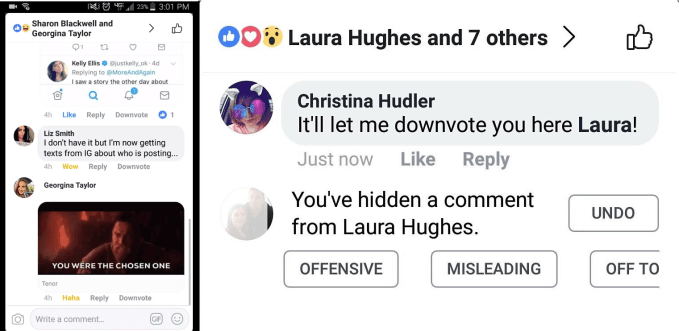
When tapped, the downvote button hides a comment, and gives users additional reporting options like “Offensive”, “Misleading”, and “Off Topic”. Those could help Facebook figure out if the comment is objectionable, a form of “fake news”, or just irrelevant. Facebook already has a “Hide” button for comments, but it’s usually hidden behind the drop-down arrow on comments rather than immediately clickable.
Here you can see the downvote button on a comment thread, plus what happens when you click it. The screenshots come from Christina Hudler.
Facebook confirms test of a downvote button for flagging comments. Image: TechCrunch
According to Facebook, this is a short-term test that doesn’t affect the ranking of the comment, post, or Page. It’s designed as a way to give feedback to Facebook, not the commenter, and there will be no publicly visible count of how many downvotes a comment gets. The test is running for 5% of Android users in the U.S. with language set to English. The downvote button only appears on public Page posts, not on posts by Groups, public figures or users. There’s currently no plan to expand the test as is.
Not A Dislike Button
A dislike button has long been the most requested Facebook feature, but Facebook has never given in.
Back in 2015, CEO Mark Zuckerberg responded to a Q&A question about it, saying:
We didn’t want to just build a Dislike button because we don’t want to turn Facebook into a forum where people are voting up or down on people’s posts. That doesn’t seem like the kind of community we want to create.
Instead, Facebook built the Reactions options that let you respond to posts and comments with love, wow, haha, sad or angry emoji. Facebook also built reactions into Messenger with the option to give messages a thumbs-up or thumbs-down so you could show agreement or disagreement.
Facebook confirms test of a downvote button for flagging comment. Image: TechCrunch
But the new downvote button is the closest Facebook has come to actually giving people a dislike button. Downvoting was popularized on Reddit for crowdsourcedcomment ranking. Reddit co-founder Alexi Ohanian weighed in on Facebook’s version via Twitter:
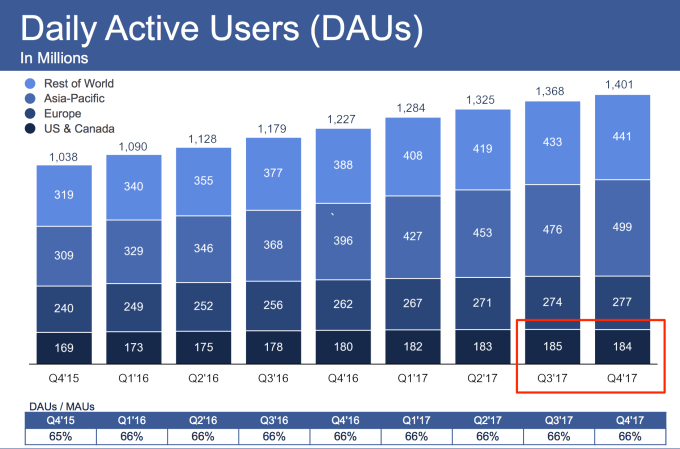
The downvote button ties in with Facebook’s recent push to enhance its users’ well-being by prioritizing News Feed content that drives meaningful interactions instead of passive, zombie browsing. That led Facebook to show fewer viral videos, which in turn contributed to a 700,000 user decrease in U.S. and Canada daily active users — its first decline ever anywhere — and Facebook’s slowest DAU growth rate it’s ever reported.
Sincerest form of flattery! Wish I'd trademarked it and “upvote” when came up with it. 😂😂 https://t.co/wJMxILChCV
— Alexis Ohanian Sr. (@alexisohanian) 8 Şubat 2018
But one way Facebook could generate more meaningful interaction without losing time on site could be by ensuring the most interesting comments are at the top of posts. Facebook already ranks comments by relevancy based on Likes and replies. But the downvote button could ensure that if objectionable comments rise up and stall discussion, Facebook will know.
That could eventually lead to a way for Facebook to bury these comments, or the people that post them. However, this will only open up more questions about censorship and what qualifies as inappropriate at a time when Facebook is already struggling to manage its responsibilities as what Zuckerberg calls “not a traditional media company.”
The Facebook chief executive says he's made "almost every mistake you can imagine" as the social network puts 14 candles on its cake.
Mark Zuckerberg used Facebook's 14th birthday to chronicle the social network's growth from dorm room project to globe-spanning communication platform. Sounds like making mistakes is a crucial element of success.
Almost half of the 245-word post on Sunday is about missteps Zuckerberg has made as Facebook's chief executive. The post doesn't offer specific examples, but describes relatively common problems at all organizations, such as "technical errors." However, Zuckerberg also said he's made "bad deals,""trusted the wrong people" and "missed important trends."
"Over the years I've made almost every mistake you can imagine. I've made dozens of technical errors and bad deals. I've trusted the wrong people and I've put talented people in the wrong roles," Zuckerberg said in the candid post. "I've missed important trends and I've been slow to others. I've launched product after product that failed."
Somehow in spite of all that, Facebook has managed to become the dominant social network on the planet, with more than 2 billion users who stop by at least once a month. It pulled in nearly $13 billion in revenue in the fourth quarter of 2017.
Facebook didn't immediately respond to a request for comment on the issues Zuckerberg mentioned.
The acknowledgment comes as Facebook, as well as peers Google and Twitter, faces scrutiny about its influence and reach after the service was abused by Russian agents. Facebook has recently said it will prioritize posts from family and friends over posts from brands and media outlets. It will also push local stories in user news feeds.
Last month, Zuckerberg laid out his personal challenge for 2018, pledging to fix Facebook's assortment of problems over the course of "a serious year of self-improvement."
Snap Inc. just launched a merchandise store. The goal isn’t to make money yet, but it proves the potential for an in-app commerce platform for other brands.
Today the company opened the Snap Store, which lives in the Snapchat app’s Discover section and lets you buy Snapchat merchandise, like a $20 Dancing Hot Dog Plushie or a $30 Dog Lens T-Shirt. You can scan the Snap Code below with the Snapchat camera to open the store and buy exclusive items that will only be available for a limited time. Click here on mobile to open the in-app store.
This isn’t designed to be a serious revenue stream for Snap Inc., though, despite it missing revenue targets last quarter. A Snapchat spokesperson gave no official comment, but told me this is something the company does for its community. Essentially, it’s a way to drive brand loyalty, though it also earns Snap some free marketing as people wear the gear.
But if Snap can use its own Snap Store to prove the potential for in-app e-commerce, it could potentially develop a real revenue stream around charging brands a cut of what they sell on Snapchat or getting them to buy ads promoting their stores.
Snapchat has previously sold a few items, like a Ghostface Chillah backpack and Dancing Hot Dog Halloween costume on Amazon, and it sold its Spectacles camera sunglasses through its Snap Bots, pop-up shops, retail partnerships and online. But now Snap is running its own sales of the third-party manufactured merchandise, and appears to have pulled everything but Spectacles off of Amazon.
Users can visit the Snap Store’s site for the Snapcode (also below), and subscribe when they first open the in-app store to see it pop up in the Discover section when new items become available. The next product drop happens on February 8th. We got tipped off to the store’s launch by reader Moshe Isaacian.
The current product offerings are:
Dancing Hot Dog Plush Doll: $19.99
Streak Hat: $29.99
Winkface Sweatshirt: $49.99
Dog Lens Tee: $29.99
Bring Back Best Friends Sweatshirt: $49.99
It would have to sell a ton of these to make any dent in the revenue expectations Wall Street places on the company to justify its $16.7 billion market cap. Still, after a great morning for its share price following Facebook announcing its first-ever decline in U.S. users yesterday and its slowest-ever user growth, investors push $Snap higher on news of the store’s launch.
I bought a Dancing Hot Dog… for science. Check-out happens entirely within the app, and Snapchat prompts you to save your payment details. That means it could be building up a database of credit cards to facilitate future purchases. The fact that this was built by Snap product designer Trevor Denton, who previously worked on Starbucks’ coffee ordering app, signals that this isn’t just some throwaway project for the company.
Commerce on mobile can be incredibly annoying. Between slow-loading websites, a paralyzing array of choices and having to punch in all your payment details, tons of users drop-off before they hit Buy. Snapchat could poise itself as a way for top brands to reach a premium teen audience in a way that makes shopping a seamless part of the social experience.
Despite worries about Russia and that passive News Feed scrolling hurts us, Facebook beat expectations again in its Q4 2017 earnings report. Facebook now has 1.4 billion daily users, up 2.18% compared to growing 3.8% to 1.37 billion users in Q3. That’s a sizeable slow down, and the lowest quarter-over-quarter percentage daily user growth ever reported by the company.
That could be because CEO Mark Zuckerberg says Facebook made changes including showing fewer viral videos “that reduced time spent on Facebook by roughly 50 million hours every day.” That equates to 2.14 minutes per daily user per day, or 5% of total time spent on Facebook. The viral video changes triggered Facebook’s first-ever decline in daily active users in the US & Canada region, which saw a 700,000 user decline.
Facebook reached $12.97 billion in revenue with $2.21 adjusted GAAP earnings per share if you don’t count a massive tax it had to pay on overseas cash that translated into a $0.77 reduction in EPS. Without that tax, it beat Wall Street’s estimates of $12.55 billion in revenue and $1.95 EPS, but with it reported $1.44 EPS.
Facebook’s monthly user count is now at 2.13 billion, up 3.39% from 2.06 billion in Q3 compared to 3.19% growth that quarter, so the monthly user growth sped up even as daily user growth slowed. Yet Facebook’s stickiness, or the percentage of monthly users that come back daily, held strong at 66% where it’s been since 2015. That shows people are still avidly returning to the site even if they spend less time there.
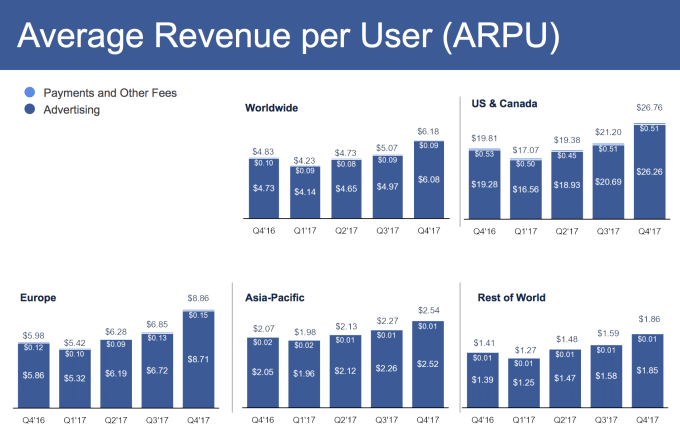
Average revenue per user climbed to $6.18, up 27% from a year ago. Average revenue was up 47% year-over-year, even though Facebook has been warning investors that it’s running out of space in the News Feed to put ads. Facebook raked in a record $4.26 billion in profit, down from $4.7 billion the previous quarter due to that big tax. Facebook’s share price was down at first down a steep 4% in after-hours trading, but now is up over 3%.
[Updates from the earnings call: Facebook announced that WhatsApp now has 1.5 billion monthly users, up from 1.3 billion in July. It announced a 700,000 daily user decline in the US & Canada due to reducing viral video visibility. Zuckerberg said he’s directed his company to priortize not the most meaningful content, but the content that drives the most meaningful interaction. Facebook’s research suggests total Story posting across apps will overtake feed posting.]
Overall, the results show how divorced Facebook’s user behavior is from the day-to-day news coverage blasting it for allowing Russian interference in US elections and for making us unhealthy zombie browsers. ComScore and Nielsen claim time spent on Facebook per U.S. user is declining, and that showed up in the daily user count growth. And Facebook purposefully made changes leading to its first ever decline of daily users in the US. But Facebook seems to be making up for that in international monthly user growth and squeezing more dollars out of each ad.
With the Snapchat threat largely neutralized via Instagram, Facebook’s biggest enemy is itself. Now it has to work to preemptively disarm any future privacy crises or other scandals, and co-opt the “Time Well Spent” rallying call before it becomes a “Time to leave Facebook” movement.