Articles by "Wearable Tech"

All of Oculus’s Rift headsets have stopped working due to an expired certificate
Someone at Oculus screwed up pretty badly today: An expired certificate appears to have soft-bricked all of the company’s Rift VR headsets, with users still unable to fire up software on the devices and no word of an incoming fix from the company yet.

Issues were first reported several hours ago on Reddit, where a post on the topic has already garnered hundreds of comments. The problem seems to have resulted from Oculus failing to update an expired certificate with the update, which is now leaving users with an error message saying that the system “Can’t reach Oculus Runtime Service.”

Update:
The company has confirmed that the problem is a result of “an issue with our software certification…”

Users are not happy.
The embarrassing issue has left the company’s flagship device unusable. This comes as the company continues to deliver major software updates that it announced at its most recent developer conference. This issue is a bummer to gamers who aren’t going to get to play the titles they’ve purchased until the issue is resolved — but it’s a much less forgivable issue for commercial users who use the headset.

Oculus co-founder Nate Mitchell confirmed on Twitter that there was an issue affecting the company’s Rift headset.
We’ve reached out to Oculus for more details.

Some users are reporting that they’ve been able to get things back up-and-running by messing with their system clock, but this is generally a bad solution and can often screw up a lot of things, so it’s probably best to wait for a patch from Oculus.

An Oculus staffer on the company’s forums further confirmed the issues, apologizing on behalf of the company. “Our teams apologize for any inconvenience this may be causing you and appreciate your patience while we work on a resolution. We’ll share more updates here as we have them. Thanks.”

source:TechCrunch

Which wireless headphone is right for you? Find out how the BeatsX and Bose SoundSport Wireless stack up in our real-world comparison.

If you're looking for a new wireless Bluetooth headphone, you've probably looked at one of the two big names out there: Beats and Bose.

Both the BeatsX and the Bose SoundSport Wireless headphones are $149 in the US, share similar specs and design. How do you decide which one's right for you? (International pricing is slightly different for both: the BeatsX is £130 in the UK and AU$200 in Australia, while the Bose goes for £140 and AU$249).

Whether you're working out in the gym or just using them to soundtrack your daily commute, these headphones are designed for being active. We're going to take the two neckbuds and compare how they look, how they sound and how they perform on the go.

Watch this: The BeatsX battle it out against the Bose Soundsport...

Design and durability

Unlike truly wireless earbuds, both the Beats and the Bose have a wire to connect them together. The Beats buds are magnetized so they clip together when not in your ear, while the Bose has a detachable clip on the wire that secures it to your clothes.

Bose claims to be water and sweat resistant, while Beats is not officially labelled as such.

Here's what we like and dislike about the design of each.

BeatsX

  • It's smaller and lighter in the ear than the Bose
  • Tip selection is extensive. You get three different designs in varying sizes
  • It's comfortable to wear around your neck when not in use

Bose SoundSport Wireless

  • It sticks out of the ear more than the Beats
  • You only get three different sizes of wing tips in the box
  • Buttons on the remote are easy to feel and use without looking
Both stayed put in our ears when running as long as we chose the right wing tip. We didn't feel like either would fall out easily. If you're going for the Beats though, you may want to go with a darker color option because they collect dirt and makeup.

Connectivity and controls

Both Bluetooth earbuds work with iOS or Android. The BeatsX has Apple's W1 chip that makes them faster to pair with newer iOS devices. Just press the button on the wired remote and wait for a pop-up to appear on your iPhone. It's that easy. The Bose has NFC so you can tap and pair with Android phones.

To test the range of the headphones, we took a pair each out onto a soccer field to see how far we could get from the phone before the signal dropped out. While our test was not scientific, it gave us a good real-world indicator of how far they can get.

After doing this test multiple times, the Bose generally got further from the phone than the Beats before the sound cut out completely (slightly before the halfway point on the field). While the Beats cut out earlier, playback was intermittent and kept cutting in and out. When we turned to face the phone and walked backwards, the Beats pulled further away from the Bose -- but let's be honest, this isn't how you'd actually walk.

Both headphones have a remote on the wire to adjust the volume, accept or reject calls, skip tracks and even summon your assistant.

Sound quality

Want good sound isolation? Beats has the edge here as they block out ambient noise better when you wear with the in-ear tips. Bose has a more open design so you hear more of the outside world.

But sound can be subjective so here's what we liked about each.

BeatsX

  • Lexy: I appreciated the sound isolation so I didn't have to have the volume cranked up so loud when I was on the bus. But I found the Beats sounded a bit flatter overall than the Bose which were slightly clearer and had better bass.
  • Vanessa: The in-ear tips allow you to really immerse yourself in the music, but if you're on the go this may not be a good thing. Outside of the office, I would change out the tips for the less intrusive option and then the sound quality wasn't as good.

Bose

  • Vanessa: The design on these feels like the best of both worlds, you can still hear the outside world when running or biking without sacrificing sound quality.
  • Lexy: I found they had more definition between mids and bass than the Beats, even if I had to turn the volume up a bit more to compensate for outside noise

Battery life and charging

Beats has the edge when it comes to battery life: 8 hours compared to 6 hours on the Bose. Beats also charges faster. It uses Apple's Lightning port and will give you two hours of playback with just a 5-minute charge. The Bose uses Micro-USB and only give you about one hour of playback after charging for 15 minutes.

But Bose is better about letting you know how much juice you have left. It has an audio alert that tells you as as soon as you turn it on and an LED that changes color from green to amber to blinking red when you're running low on juice. The Beats also has an LED indicator that changes from white to red, but it's tiny, so you're better off checking on your phone. And auto-power off doesn't work consistently -- so many times we'd forget to turn them off and end up draining the battery completely.

Bose also comes with a companion app so you can see the battery level and change the auto-time off duration.

And our winner is?

Lexy: Sound quality is my number one priority, so I would probably go with the Bose despite the bulkier design. The open design and the sweat resistance are also a plus for working out.

Vanessa: I like the fact that I can wear the Beats around my neck all day, and the fact that I can charge them for 5 minutes and still use them on my commute to work, so for me these would be a lot more practical.

source:CNet News

Imagine two Amazon Dash buttons sewn into specialized, limited-edition marketing gimmicks. Welcome to the return of the Pie Top.

Pizza Hut's new shoes order pizza and pause your TV
I'm not here to tell you why pizza-ordering, TV-pausing shoes exist. But, here we are.

Pizza Hut created a marketing stunt of specialized sneakers last year that could order a pizza (Pizza Hut only, of course) with a press of a large button on top.

This year, these shoes have returned: Pie Tops II, as they're called. Sneaker collectors take note: they're a limited run of 50, created by the Shoe Surgeon, a custom sneaker designer in Los Angeles. Pizza Hut's run of Pie Tops last year were made the same way.

The shoes are red or wheat-colored. They pair with Bluetooth to the Pizza Hut app to basically do one-press ordering. Also, these shoes add another button that pairs with certain cable TV set-top boxes to pause live television... a one-button remote.

Pizza Hut's new shoes order pizza and pause your TV
Wheat pizza shoes.
Paul Mcgeiver
If you're desperate to buy a pair of Pizza Hut sneakers, they'll be available to order on March 19 on HBX, until the very limited run ends. In the meantime, I'm actually going to try wearing a pair and see if they actually work well to pause TV.

It's a marketing stunt timed to March Madness. It's absurd. Of course, branded weirdness has been around for years now, like the Doritos MP3 player bag or an unfolding pizza turntable. At least these are actual shoes.

Plenty of other smart shoes already exist in the world. GPS-enabled safety ones, training ones and fitness ones. Add some volume controls and voice, and maybe the next Pie Tops could be... never mind.

source:CNet News

Google needs to give the AirPods better competition
In the race for in-ear AI, Apple has the clear advantage despite the fact that their intelligent assistant is one of the dumbest of the bunch.

Yesterday, reports emerged that Apple was working on a pair of follow-ups to its Airpods headphones that could bring them always-on Siri functionality as well as a splash-proof design. As we think about all the things that Apple could do right with its next set of wireless earbuds, it’s easy to reflect on all that Google did wrong with its Pixel Buds and how much of an opportunity they still have.

Google Assistant lends so much potential to a pair of smart wireless earbuds from Google. The fact is that Siri doesn’t hold a candle to Google Assistant in many ways, and while the functionality of voice control on the AirPods is largely focused on music and calls, the superior intelligence of Google Assistant should make them a much clearer companion for a set of earbuds.

Hardware is still very much a side project for Google, but as the company prioritizes home assistant hardware, it really doesn’t make sense that they’re not putting more resources into a pair of wireless headphones. The Pixel Buds need a more purposeful design that minimizes friction and delivers Assistant insights more effortlessly in a package that feels like more than just a follow-on.

Google needs to give the AirPods better competition
The AirPods are an engineering marvel, and while some of the functionality of the Pixel Buds was interesting — mainly their ability to interface with the Pixel 2 for language translation — they fell flat on design. Google needs to rethink its wireless earbuds from the ground-up and focus more on creating something with the sleekness of the Pixel phones rather than the fabric-obsessed friendliness of their Home devices. Cutting the woven cord and moving to a truly wireless form factor is a necessary step, as is shrinking down the size of the Bud part of the product. It’s really not about the sound quality as much as it is about the connectivity and the lack of friction. While FastPair has been a great step in simplifying the bluetooth pairing, there are still some quirks that aren’t present with Apple’s W1 chip.

While Siri is always quick to refer you to search results when it doesn’t have an answer (a frequent occurrence), Assistant’s optimization for its display-free Home devices has led it to order functionality around the assumption that there’s not always a screen available to default to. Today, Google announced that it was bringing location-based notifications and voice-optimized routine functionality to its Home devices so it could complete regular custom tasks without you having to pepper it with commands, stuff like this would be ideal for earbuds that are always-listening, something that Google could do much more with than Apple.

Even as features take months to roll out, Google has still shown a degree of nimbleness on the voice assistant front that Apple can’t match in annual WWDC keynotes. While Amazon is just as quick with Alexa, Google Assistant’s deepening integration with Android establishes an arena where they should be the clear champion.

AirPods are clearly the best wireless earbud that an Apple user can own and even with the reduced functionality that still might be true of Android phones. People are building tools to bring iOS-only feature sets to Android and that fact alone should suggest Google take a more serious look at its own hardware and the opportunity that it’s losing out on.

source:TechCrunch

Apple devices are butt dialing 911 from its refurbishing facility – 20 times per day
Since October, emergency responders in Elk Grove and Sacramento County, California have received over 1,600 false alarm 911 calls coming from an Apple repair and refurbishing site in the area.

It’s not clear if the calls are coming from Apple’s iPhones or Watches but each time a call originates out of the Elk Grove facility, there’s no one on the other end of the line and it’s gumming up the emergency response system in the area, draining resources and possibly slowing down response teams in actual emergencies.

Apple devices are butt dialing 911 from its refurbishing facility – 20 times per day“The times when it’s greatly impacting us is when we have other emergencies happening and we may have a dispatcher on another 911 call that may have to put that call on hold to triage the incoming call,” police dispatcher Jamie Hudson told Sacramento CBS Local News, which first reported these incidents.

The Sacramento County Sheriff’s Department says it has also received these false calls, telling CBS Local dispatchers sometimes heard technicians in the background.

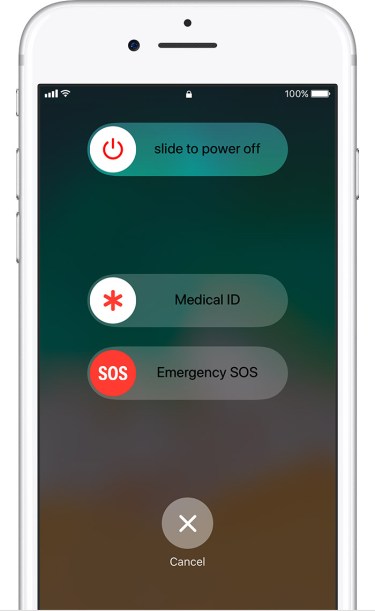
iPhones and Apple Watches are easily triggered to call emergency response services with an accidentally long touch of a button. iPhone X, iPhone 8, or iPhone 8 Plus call up the SOS emergency service by holding down the side button and one of the volume buttons for an extended period. The Watch triggers a call to 911 just by pressing and holding the side button.

Though Apple Watches and iPhones make it easier for individuals to get hold of 911 dispatchers quickly, the Watch’s accidental calls issue has been a known problem for a while now. In early 2017, Tolland County, Connecticut emergency responders reported a series of accidental calls coming from Apple Watches in the Tolland and Hartford areas. Earlier this month, a dispatcher in Ottawa County, Michigan told Newsweek his local branch had been receiving accidental butt dials from Apple Watches at least 10 times a day.

Apple has told CBS Local it was aware of the problem and was “working closely with local law enforcement to investigate the cause and ensure this doesn’t continue.”

We’ve reached out to Apple to find out what specific measures it is taking to stop these false alarm calls from causing havoc on the emergency systems in the area and possibly slowing down responders from getting to a real life and death situation. So far, we have yet to hear back but will be sure to update you when we do.

source:TechCrunch

Hasbro's new head games want to drive you mad

Heart-rate-sensing games, audio feedback loops, and dangly food helmets: Welcome to Game Night 2018.

I wore a heart rate-measuring hat once, but I've never tried a heart-rate gaming headband. It's beeping and glowing red, because I guess I've already lost my cool. That's 2018.

Hasbro's upcoming $20 game for kids and families and whoever else, Don't Lose Your Cool, involves a heart-rate sensor headband with a crazy light-up indicator light pole that sticks out of the top of your forehead. It also comes with three dice, which are full of instructions for how to act inappropriately and create discomfort.

Watch this:Hasbro's heart-rate-activated party game measures your...

Stare closely at someone, be close to them, make fart noises, dance slowly. The other player presses the button on the headset to start measuring heart rate/stress, and you try to stay cool.

I was never able to keep the red light and alert from going off. Alas, I am not an expert at meditation, and I need to work at regulating my stress.

Hasbro's new head games want to drive you mad
I can't make sense anymore.
Sarah Tew / CNET
Hasbro has another chaos-inducing game: Speech Breaker. The headphones and microphone send your own voice to your ears at a slight delay as you speak. Delayed auditory feedback is a known cognitive effect that can cause stress (or, apparently, treat stuttering). Here, it's used to play a Taboo-like game where the player wearing the headset has to make someone guess clues without naming the clue specifically. I couldn't make it through two sentences without descending into a feedback loop of gibberish. It can be yours for $20 this fall.

Hasbro's new head games want to drive you mad
I'm sorry. (Chow Crown)
Sarah Tew / CNET
And, then there's Chow Crown. No tech is involved in Chow Crown, just humiliation. It's a spinning plastic helmet with bendy plastic fork-prongs that dangle, tantalizingly, out of mouth-reach. Load the forks with candy, or sushi, or broccoli, or meatballs, or whatever you'd like to embarrass yourself with. Then, try to eat the things by bending your head, like an old Nickelodeon game show. I didn't fare very well, but I did run into an old theater classmate who was at the Hasbro showroom, and I caught up on old times with him while trying to eat candy, which was fantastic. It'll be available this fall for $25.

Hasbro dipped into head-mounted games with Simon Optix, a visor-based version of the old musical pattern-memorizing electronic game.

I'd wear any of these for fun, but I don't know if I'd want to play any of them for more than a single evening.

source:CNet

Hear360 begins shipping its ASMR-ready omni-binaural microphone, the 8ball
8-balls have been known to hold some disappointing, trivial answers to teenage life’s hardest questions, but one LA startup is hoping to find success in them. Hear360 has just begun shipping pre-orders of 8ball, a souped-up binaural 360 microphone rig geared towards professionals that are all about experimenting in new immersive mediums.

The 8ball is an “omni-binaural” microphone meaning it captures 360 audio of a space using four pairs of omnidirectional mics. The effect is 8 tracks of sound that envelops the listener wherever they turn, something pretty essential for virtual reality specifically. The unique design involves a custom clamping mechanism that means the rig can be mounted below a 360 camera and stay out of the shot, capturing sophisticated audio invisibly as a result. Buyers of the $2,500 8ball will get a bunch of pro plug-in tools so they can fit the product into their editing pipeline with ease. The system is available for order here.

CEO Matt Marrin and his co-founder CTO Greg Morgenstein got together in 2016 with the idea of a high-end microphone system that got everything right. The audio engineers bootstrapped the company the best way they knew how, funding the project by continuing to mix records on the side. Last year, the team closed a $1 million round of funding from creative audio agency Grayson Matthews.

Hear360 begins shipping its ASMR-ready omni-binaural microphone, the 8ballCapturing live action VR has always been a bit of a hacker’s enterprise. Different projects generally need different solutions for getting high-quality video and audio. Attempts at creating all-in-one audio/video professional solutions haven’t gone all that swimmingly, last year Nokia shut down its Ozo VR camera unit and laid off hundreds. The general feeling from the people I’ve been chatting with has been that there’s still a big demand for companies and tools to create VR well, but the scale has been overblown and the timelines are going to need to fall a bit more in line with reality.

“There’s definitely an evolving perspective on this space,” Marrin told TechCrunch. “As there’s a little bit of pullback in some areas, I think that there are other areas that are creeping into VR.”

With tools like 8ball, the team at Hear360 hopes that creators keep exploring 360 content, but they’re not putting all their eggs in the VR basket. The startup says that outside of VR production, there’s an opportunity to be had in the burgeoning and bizarre world of ASMR videos. Autonomous sensory meridian response (ASMR) videos are slightly unsettling clips that generally involve someone whispering into a camera and making noises in a way that makes viewers feel a tingle in the back of their neck, which some have called a “brain orgasm.” The videos have tens of millions of views on YouTube and they are growing increasingly popular. Given that so much of the sensation comes from what viewers are hearing, there’s a lot of potential hear for a high-end mic maker.

Whether brain orgasms and VR are enough to build a successful audio startup is anyone’s guess, but as Hear360 begins shipping out “hundreds” of its high-end microphone rigs, they’re looking for that answer.. in the 8ball.

source:TechCrunch

Microsoft’s HoloLens is now available to rent
Microsoft has spent much of the past couple of years arguing its vision of an augmented reality future with the HoloLens. Now, it’s realizing that for potential buyers of the company’s enterprise-focused Commercial Suite edition, there’s some desire to try it out before they break out the corporate card.

Until now, the best way for interested companies to see whether Microsoft’s product was hype junk or something transformational was to plunk down $5,000. Well, now Microsoft has decided to partner with a company called Abcomrents, an event tech rental service, to let people get their feet wet and rent the HoloLens without making the full investment.

Why would people even want to do that? Microsoft posits that companies have shown interest in rentals so they “can evaluate before purchasing or increase their inventory temporarily to support tradeshows and events.” For now, the rental program is just available in North America, but Microsoft says they’re working to expand the availability of the program.

The company also announced in a post that they will be expanding general HoloLens availability to Singapore and the United Arab Emirates.

source:TechCrunch

Commentary: Magic Leap's big promises have a familiar ring about them. But whether they'll change my life as a serious sports fan remains to be seen.

Magic Leap imagines holographic entertainment, starting with a partnership with the NBA
I don't have a DVR. When a New York Jets game begins on any given autumn Sunday, I'm racing to sit down and start watching. I clear my schedule. I open Twitter, and keep a sports app handy, too. I'm insufferable. It's a routine. And being on time -- to the second -- matters immensely.

I tried using Twitter's live-streaming NFL app in 2016 during a Jets game and gave up. The live stream was often laggy, and tweets didn't line up with what was happening in real time. I hate reading tweets of events I haven't caught up with yet. I can't stand streams that won't work. I don't want texts from my brother-in-law telling me the Jets scored a touchdown if I haven't seen it yet. Heck, I'll even stop talking to my mom (also a Jets fan) on the phone if a play is in motion, because I'm worried her live broadcast will be ahead of mine and she'll see something before me.

It's like some weird superstitious version of the quantum measurement problem -- if you look at something, maybe it changes. Or if you don't look.

Not every sports fan is as insane as me. Some are far more casual. And, for sports I care less obsessively about, I can relax and catch up in different ways. For baseball games, I'd experiment with new tech, and not care about real time. Maybe I'd feel the same about the NBA, if it made me care more.

That's probably where the "engagement" part of sports and tech kicks in. For those who aren't following, maybe new tech can hook them in. Tech like, say, Magic Leap's partnership with the NBA, announced Tuesday night at Recode's Code Media conference, which promises holographic games on mixed-reality goggles you can wear in your living room.

I've heard this pitch before. Microsoft dreamed the same dream with the NFL and Hololens: scale-model stadiums on your coffee table, multiple screens floating in the air, Russell Wilson hanging out by your bookcase.

(Magic Leap didn't immediately respond with a request for comment.)

Shaq wears the Magic Leap One
Shaq wears the Magic Leap One.
Recode/Screenshot by Sean Hollister/CNET

A personal experience, or the new 3D TV glasses?

I also have a bucket of 3D glasses somewhere in my house that I never used with my TV. The proposition that everyone in the family would grab a pair and watch sports in magical 3D was a thing that companies promised not so many years ago. Again, it didn't happen.

I agree with Adi Robertson of The Verge when she says dealing with goggles on your face for any length of time isn't an easy proposition. Even if they worked spectacularly (and I've never tried Magic Leap once), I think of how they'd fit on my face...and how long the battery life is. Would they start up and work easily? Would they be social? Would I be watching my holographic sports on my own, like someone in my own living room with headphones on, or with others? And who else would even be wearing these with me?

Microsoft's two-year-old vision of the Hololens and watching NFL games, seen below, still hasn't materialized.

Alone or together?

I've watched sports alone, in VR -- NextVR and Intel have been streaming live events for years. Boxing matches are sort of fascinating, and companies are getting better at layering in floating stats. In VR, though, you trade that sense of immersion for access to everything else: stats, community (what did Twitter say about that last play?) and better TV resolution in most cases. I still feel the way I did three years ago: live events in VR are isolating. Also, in VR, you can't easily chat and tweet. Facebook Spaces is aiming to make social happen for live events, and maybe mixed reality would allow for me to text and see holograms at the same time -- but who knows?

My TV at home, on the other hand, is pretty great. So is Twitter, which gives me the latest thoughts from the best beat writers that help me break down events as I'm watching them. I also like talking with friends who like what I'm watching too, if I'm with them. For AR, mixed reality and VR to match that will be a tall order.

Magic Leap One

The first product from the secretive, Google-funded augmented-reality startup has finally been revealed. Founder and CEO Rony Abovitz shares some key insights about Magic Leap One. Read More

Live or replay?

The best-case scenario I can envision is a way to see plays and break down stats afterward, like some supercharged version of holographic Madden or NBA 2K meets a game recap. Armchair quarterbacks and superfans could study classic games or last night's action and check out different angles. Maybe it could help me learn more about how sports are played and understand strategy, or be my midweek therapy session like Madden is.

If I could buy virtual recreations of all the Jets seasons and obsessively rewatch and break down stats like the miserable fanatic I am, would I get them? Yes, I would. Maybe those types of holographic games are where virtual sports can go next. I'm just not sure I'd want to enjoy those holograms and virtual overlays live, unless they're fantastic. And I doubt I'd want to use it for hours at a time, which is what a live game would require.

Capturing a live game is a mixed blessing, anyway. At games in person (I used to have season tickets), you trade immersion for good access to close-ups and stats. Phone reception is terrible. But I remember the crowd vibes. VR recreations of live events never feel the same. I wouldn't want a holographic stadium all around me unless it really felt excellent, and I could switch it on and off as needed. I went to live games because I could be there with my family. It's the social connection over something ridiculous like live sports that matters. At live games, I've even tried augmenting my experience with connected devices, years ago. It never quite worked. Usually, the problem was lag.

I'm already watching sports in augmented reality, though

But I stop and realize that, with a phone in hand, and listening to a radio broadcast for commentary, or staring at my TV screen, and talking to my mom and sister and brother-in-law, I'm already in augmented reality. It's just on my terms, and it's seamless. Seamlessness is what will make me love any future tech in sports.

We'll see what Magic Leap can conjure up.

source:CNet

Apple and Android are destroying the Swiss Watch industry
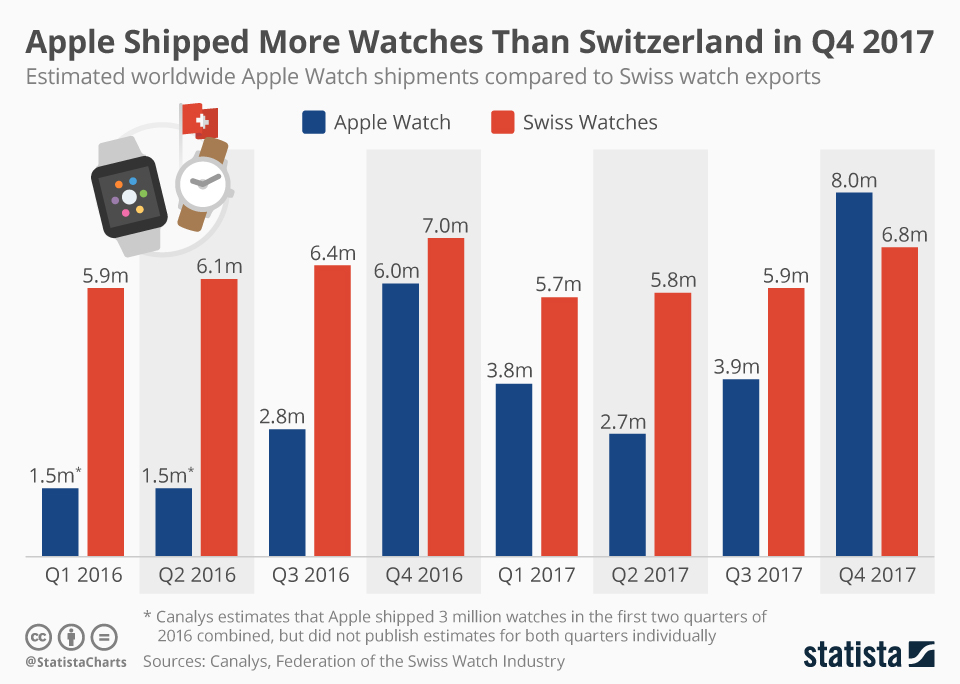
In Q4 2017 – essentially during the last holiday season – market research firm Canalysfound that more people bought Apple watches than Swiss watches. Two million more, to be exact. Brian Heater has more data but this news is quite problematic for the folks eating Coquilles St-Jacques on the slopes of the Jura mountains.

The numbers are estimates based on market data but they still point to a trend. In Q1 2016 Apple shipped 1.5 million watches to Switzerland’s 5.9 million. The intervening quarters were about the same until the launch of the Apple Watch 3 in September 2017, just in time for holiday shopping. The boost of a new phone and a new watch at the same time meant a perfect storm for upgraders, driving the total number of Apple Watches sold past the Swiss watch sales numbers.

Apple and Android are destroying the Swiss Watch industry
Image: TechCrunch
This switch does not mean Apple will maintain that lead – they have one product while Switzerland has thousands – but comparing a single company’s output to an entire industry’s in this case is telling.

Wearing watches is, as we all remind each other, is passé.

“I check the time on my phone,” we said for almost a decade as phones became more ubiquitous. Meanwhile watch manufacturers abandoned the low end and began selling to the high end consumer, the connoisseur.

Take a look at this chart:

Apple and Android are destroying the Swiss Watch industry
Image: TechCrunch
Sales of low- to mid-tier watches – and a mid-tier watch can range in price between $500 and $3,000 (and I would even lump many $10,000 watches in the mid-tier category) – were stagnant while the true cash cows, the expensive watches for the ultra-rich, fell slowly from a high in 2014. This coincides with falling purchases in China as what amounted to sumptuary laws reduced the number of expensive gifts given to corrupt officials. Sales are up as December 2017 but don’t expect much of a bump past the current slide.

As a lover of all things mechanical – I did ruin a few years of my life writing a book about a watch – I look at these trends with dismay and a bit of Schadenfreude. As I’ve said again and again the Swiss Watch industry brought this on itself. While they claim great numbers and great success year after year the small manufacturers are eating each other up while nearly every major watch brand is snooping around for outside buyers. There is no money in churning out mechanical timepieces to an increasingly disinterested public.

As time ticks ever forward things will change. The once mighty Swiss houses will sink under the weight of their accreted laurel-resting and Apple will move on to embedded brain implants and leave watches behind. The result, after a battle that raged for more than four decades, will be a dead Swiss industry catering to a world that has moved on.

source:TechCrunch

Ralph Lauren's 2018 Olympic opening ceremony jackets sold out in minutes, but their conductive ink technology may be added to future clothing. We tried one on.

The coolest thing about Ralph Lauren's heated jacket technology is, well… it doesn't feel like tech.

It doesn't beep or light up. There's no buzzing or distracting alerts. It doesn't even feel like you're wearing a gadget. It's just smarts woven into your clothes.

The heated panel is made up of conductive inks, bonded to the inside lining on the back of the jacket. It's thin and flexible, and can be crumpled and washed
The heated panel is made up of conductive
inks, bonded to the inside lining on the back
of the jacket. It's thin and flexible,and can
be crumpled and washed.
Ariel Nunez/CNET
This battery-powered parka is part of the parade uniform for Team USA at the 2018 Winter Olympics opening ceremony. It's the first time Team USA will have a heated jacket as part of the ensemble.

The limited-edition jacket is sold out, but the company is planning to use this again in the future -- so pay attention. Feedback from the American athletes will determine how this clothing design evolves into other products, as it's put to the test in the frigid temperatures of Pyeongchang, South Korea.

I got a rare chance to check out the toasty tech for myself at the Polo Ralph Lauren store here in New York.

Watch this:The tech behind Team USA's toasty Opening Ceremony jacket

What surprised me was how the heating system felt like any slick jacket liner. I could crumple the fabric in my fist, and it felt like a plastic sticker decal.

That's because the tech is, put simply, ink. Designed in the shape of an American flag, the heat comes through conductive carbon and silver inks electronically printed on a panel that's bonded to the interior of the jacket. The panel itself is about the size of both my hands put together, under a foot long.

Of course, it needs power. Hidden beneath the jacket's puffy padding is a thin power cord that starts at the panel and snakes its way down to the right-side front pocket. Open the pocket, and you'll find a wad of cords and a removable, rechargeable battery pack emblazoned with the Polo logo.

The battery pack has a big, glove-friendly button to toggle between high and low heat settings
The battery pack has a big, glove-friendly button
to toggle between high and low heat settings.
Ariel Nunez / CNET
The battery pack controls the heat settings with two simple buttons. One turns it on, the other is a large, glove-friendly button to toggle between low and high heat.

And yes, the jacket can be washed if you're gentle. (I would just be careful about that power cord.)

Cranking it up to max, the jacket warmed up quickly -- but subtly. It wasn't jarring. Nor did I ever feel a big, hot rectangle on my back. On a short trip outside the store, it made the rainy 34-degree slush outside a little more tolerable.

The jacket and all its gadgetry is made in the United States (USA! USA!). It has been in development for over a year, according to David Lauren, chief innovation officer and son of designer Ralph.

The company dresses over 700 Team USA Olympic and Paralympic athletes, coaches and staff, each one given a limited-edition heated parka for the opening ceremony and a heated bomber jacket for the closing ceremony.

Athletes are supported financially through the sale of Ralph Lauren apparel. But as for the heated jackets, fewer than 100 were released to stores, each costing $2,495 a piece -- and all sold out in under 20 minutes. (They're listed for $7,000 on eBay right now.) That got the company encouraged to look into using this for future apparel. Lauren says he wants to see the next iteration of this technology to use smaller battery packs and controls tied to an app.

This isn't the first wearable tech from the designer. For the 2014 US Open, the company debuted a fitness shirt with biometric sensors that monitor heart rate, calories burned, respiration, stress levels and energy output. The data was fed to an iOS app that guided tennis players to adjust their training and exertion.

Lauren says the challenge with wearables in fashion has been incorporating technology that consumers actually need -- and making sure it won't go out of style.

"In 20 years, when the technology is outdated," Lauren says, "you still want it to be a great jacket to wear."

The herculean task of running IT at the Olympics


source:CNet

Zombie VR showed me how to cut the cord and walk with the dead

The latest free-roaming VR game by Zero Latency showed me I'll be just fine in the zombie apocalypse. My friends on the other hand...

When the zombie uprising came, I was thankful for two things.
One: I was carrying a big gun. Two: My virtual reality headset didn't have me tethered to a uselessly short cable.

As the tech world gathered at the year's biggest technology show this past January, we were sold a future that was high-tech and seamlessly connected. The main show halls at CES in Las Vegas were filled with VR demos running on ultra-fast 5G networks, high-powered laptops running on mobile phone processors and any number of always-on, always-connected smart robots.

Ready, player one
Ready, player one.
Roger Cheng/CNET
Down the road from the Las Vegas Convention Center, at the MGM Grand Casino, I was rigged up to a different vision of the future: free-roam, multiplayer VR, created by Australian virtual reality company Zero Latency.

That people are willing to pony up $50 (roughly £35 or AU$62) for 30 minutes in this game points to a larger trend in the so-called "location-based entertainment" industry (think theme parks, laser tag, arcades, escape rooms). Entertainment is going high-tech, blending the physical and the digital to create experiences users just can't get at home.

For instance, in my new virtual world, I was running through a 3D hellscape of post-apocalyptic ruins, pwning zombies and fighting for survival. In reality, I was with three nerdy colleagues in the bowels of the MGM Grand, covered in panic sweat and shouting obscenities as we ran around a 2,000-square-foot (185-square-meter) black box room.

This was the future of video games, arcades and amusement thrills all in one. And yes, I won.

Stay away from my precious, precious brains!
Zero Latency

Cutting the cord

The premise of Zero Latency is simple enough: VR, untethered.

Players don a custom VR headset (a modified HDK2.0 headset from OSVR) and a pump-action gun controller, and strap on a backpack fitted with an Alienware Alpha 2 PC. All the action takes place in a no-frills, warehouse-style room, painted black with a white grid on the floor -- what Zero Latency calls its "live-tracking volume."

Players are mapped on Zero Latency's game grid thanks to light-up balls on their headset and gun
Players are mapped on Zero Latency's game
grid thanks to light-up balls on their headset and gun.
Roger Cheng/CNET
But this is VR! Physical surroundings don't matter! With the headset on, you're immediately transported to a 3D world, free to walk around like you're living inside a video game. The grid on the floor and two glowing, ping-pong-sized balls on both your gun and your headset (yes, you're going to look like a high-tech anglerfish) allow the system to track you and your fellow players, who show up as digital avatars in the game, so you don't collide with each other.

We're playing through Zero Latency's brand-new, fast zombie game Outbreak Origins. The game opened in Brisbane on Australia's east coast on Halloween in 2017, but is still in prelaunch stage in Vegas.

You wouldn't know it. The game feels slick and completely immersive. After initial trepidation (I rate myself as a Grade-A n00b when it comes to zombie horror) we're on board. Tentative steps turn into bold breaks for freedom. One of our crew pulls a straight-up Leeroy Jenkins and trips over completely flat ground in the process. Our review: A+++ would pwn again.

According to Zero Latency co-founder and CEO Tim Ruse, the free-roaming aspect of the game is what really sets it apart.

"Most people have experienced virtual reality in a static format like sitting in their chair," he told me on the phone in Australia. "When you couple that with walking around, it's really, really immersive."

This goes far beyond gawking at an overheated phone in a cardboard headset, or even the thrill of more high-tech (but still largely static) experiences like Oculus Riftgames. The HTC Vive lets you walk around, but the space is limited.

Physical movement supercharges the experience. Why else would we see grown adults willing to strap themselves into VR paragliding rigs or weird VR bird-flight simulators to bring a physical element to their digital simulations?

Visions of the future

Attractions like theme parks and arcades have long used technology to lure customers -- Disneyland was sending park visitors through space on its Star Tours motion simulator ride as early as 1987.

Companies like Zero Latency are embracing VR "because it enables them to offer their customers another way to escape from the everyday, which is ultimately what amusement vendors provide us," said Malcolm Burt, virtual reality Ph.D. researcher and self-styled "amusement academic."

Now companies like Bandai Namco are opening VR arcades in Tokyo, Utah-based VR company The Void is jumping in on walk-through VR experiences and in China the gates are about to open on the $1.5-billion Oriental Science Fiction Valley park-- a theme park devoted entirely to VR (and giant robots... natch).

These experiences feel cutting-edge to a person who hasn't tried VR, but they're ultimately just a 21st-century upgrade on the concept that drove '80s arcades: They provide the tech and games that you can't install (or afford) at home.

Down the line, when VR adoption is more widespread and prices come down, we may end up spending more time in our homes, Burt said.

In Outbreak Origins, players use a physical gun in the real world to create the feeling of a first-person shooter in the VR game
In Outbreak Origins, players use a physical gun in the real world to create the feeling of a first-person shooter in the VR game.
Zero Latency

More than a gimmick

Ruse is less sure. Despite the spec'd-out VR kit and the advanced live tracking, Zero Latency isn't just about the tech.

"Some people think, 'The technology's great, therefore that's enough.' It's not enough," he said, touting the blend of tech, social elements, game design and adventure that he says make Zero Latency unique.

After all, can you stand back-to-back with your mates after dashing to escape the zombie hordes or laugh when fellow CNET reporter Alfred Ng trips while trying to escape the undead? There's no doubt the experience of running around a warehouse-style room with up to seven friends is more immersive then flailing around your living room.

Ever since Disneyland started showing 1950s America a futuristic vision of itself through Tomorrowland, the amusement industry has been selling us a vision of tomorrow, today. Throw in a town like Vegas -- a place where you can watch an underwater Cirque du Soleil show and see hip-hop dancers shoot digital fireballs onstage all before your 9 o'clock buffet -- and it makes sense that this is the place where technology meets thrill seeking.

VR is the future of high-tech amusement for the foreseeable future at least.

At the MGM Grand, I vaunt over my final zombie corpse and start to pull off my headset to celebrate with my CNET comrades: a successful mission, and many miles covered. But we're back in that black-painted room, no helicopters or zombie labs in sight as another tentative group gets geared up for a game.

The zombies might have been digital and the rough terrain might have just been a painted grid on the floor, but those 132 headshots were real. And I won't let anyone forget it.

source:CNet

I wore the VR glove that fools your skin as well as your eyes

The HaptX glove makes the virtual so startlingly real I thought I was actually touching a rock, a cloud and a spider.

I weigh the rock in my hand, then toss it back to the ground. I run my hand across some tall grass, feeling the stems ripple, flatten and spring back. Then I reach out and take hold of a cloud and pull it toward me.

None of these objects exist. The rock, grass and cloud are all figments of virtual reality -- yet they feel completely real against the skin of my hand.

I'm trying the first public demo of a tactile glove from VR startup HaptX at the Sundance Film Festival in snowy Park City, Utah. The HaptX glove is designed to conquer one of virtual reality's most annoying limitations: You can see and hear the virtual world in your headset but, as MC Hammer might say, you can't touch this.

Currently available VR technology lets you interact with the virtual universe by waving hand controllers around, but these only solve half the problem. When you see what appears to be a solid object in VR, you merely have to wave your hand in that direction to feel there's nothing there. This lack of physical interaction breaks the illusion of reality, or "presence," that VR relies on.

The HaptX glove is still a demo at this stage, but is set to be used to train people  in virtual simulations of potentially dangerous environments
The HaptX glove is still a demo at this stage, but is set to be used to train people in virtual simulations of potentially dangerous environments.
HaptX
Several other VR experiences displayed at Sundance's annual dedicated VR event, including a psychedelic space adventure produced by filmmaker Darren Aronofksyand another by VR luminary Chris Milk, get around that by limiting your interaction to conjuring nebulous trails of light. HaptX goes one better.

I begin by sliding on the snug black glove made of a fabric with plastic thimbles clipped over each fingertip and flat plastic cables snaking over the back of my hand. A thick umbilical cable attaches the glove to a VR rig.

I don the VR headset -- in this case an HTC Vive -- which shows me a colorful virtual farmyard laid out in front of my eyes. I reach out to touch the red-painted wooden barn. It feels solid. I move my hand to where I can see animated gray rocks, and feel resistance. I close my fingers around where I can see a virtual rock, and it genuinely feels like I'm holding something in my hand. I touch rippling grass and spin the sails of a wooden windmill. All of them feel like I'm actually holding or brushing them with my hand.

The glove works by inflating and deflating more than 300 tiny blisters of air across the surface of your hand. The more of these air pockets on the surface of the glove, the finer the feeling. For example, the demo allowed a virtual spider to walk across my hand, and its footsteps were as light and tickly as you'd expect. I also felt confetti and rain lightly sprinkle into my palm.

The air pockets give the illusion of shape and movement. But what really sells the illusion of solidity is the way the glove resists when you try to push against something. An exoskeleton on the outside gently pulls back on your fingers as you try to close them, stopping your hand from simply closing around thin air. This creates the feeling that there's something beneath your fingertips. Combine that with the evidence that I was looking at a three-dimensional object or a flat surface, I totally bought the illusion.

The only thing missing is the texture of the objects I'm touching. The feeling of rough or smooth texture is the vibration you feel when you run your fingers over something, and haptic vibration to simulate texture is something tech companies have been playing with for a while. HaptX hints that it has its own ideas about that avenue, but it isn't talking about it yet.

Training day

HaptX, founded in 2012, is one of a number of companies tackling touch and interaction with VR. Other similar VR wearables include the Sense Glove, on sale this year, and the Cerevo Taclim VR shoes.

So far, VR is widely recognized as a gaming thing, with PlayStation VR and other headsets marketed as gaming peripherals. But while gaming and related uses like theme park or movie theater VR installations could be in their future, the folks at HaptX are starting out by sharing a prototype with engineers and developers interested in VR training and simulation.

VR has real potential for training people who require muscle-memory-based skills in environments that are expensive or dangerous to simulate. That could include surgeons or military personnel for whom learning on the job might be risky to life and limb. It could include industrial workers who work in potentially dangerous environments, like oil rig roughnecks or deep sea divers. The advantage of VR in training is that it can be programmed -- so pilots can learn different planes on the same system, for example, instead of requiring multiple expensive physical simulators -- while still building the muscle memory required when holding actual scalpels, rifles or joysticks.

In the future, the system could be integrated into telerobotics, allowing operatives of drones or robots to "feel" what a machine is touching miles away. A full-body version is also potentially possible: The glove's air-pocketed fabric is light enough to make a suit giving the illusion of touch all over you, although the exoskeleton element would be heavier and more complicated.

At Sundance, HaptX also showed a demo that allowed you to feel temperature in virtual reality. It's less advanced than the glove, requiring you to put your hand in a fixed machine rather than having the freedom to move your arms around. But it's still pretty clever, running hot and cold water through fine pipes in the palm reader with enough precision to simulate different temperatures on different parts of your hand. The demo featured a dragon breathing blasts of fire and ice, and it was precise enough to convey the feeling of heat or cold sweeping across the surface of my hand from one side to the other.

There are many forms of virtual reality storytelling, from filmlike stories in which you're just an observer to fantastic games in which you direct the play. Not all of them need the element of touch. But HaptX goes further than most to make the virtual a reality.

Watch this:Should you still have high hopes for VR?


source:CNET

The first product from the secretive, Google-funded augmented-reality startup has finally been revealed. Founder and CEO Rony Abovitz shares some key insights about Magic Leap One.

 The next wave of mixed-reality headsets?
It looks like a cross between Maz Kanata's goggles or Snap Spectacles evolved into steampunk gear. But Magic Leap, a company that's stayed in secrecy for years, finally has hardware to show off, and it looks like it'll be here in 2018.

The Magic Leap One is an augmented-reality headset, using light field display. And while I haven't tried it yet, Brian Crecente at Rolling Stone has. Based on his exclusive hands-on experience -- and the several other AR headsets and mixed-reality technologies I've tried in the past year -- we can put Magic Leap's surprise announcement in perspective, and talk about how it shakes up the emerging AR/VR landscape as we head into CES and 2018.

The controller has haptic feedback, and is more compact than Oculus Touch or Vive's controls
The controller has haptic feedback, and is more compact than Oculus Touch or Vive's controls.
Magic Leap

The Magic Leap One is a headset, a controller and a computer

The round-lensed goggles house the displays, audio and external camera sensors. A handheld controller with touchpad looks like an advanced version of the wands that come with the Samsung Gear VR and Google Daydream View's phone-based VR headsets. The system connects to a round computer that clips to your body and makes everything work.

It's self-contained and doesn't need to be tethered to a phone or PC. But we don't know a specific price or release date yet. There's a pair of glasses (called Lightwear), a belt pack (called Lightpack) and a controller.

Intense-looking, but also somewhat compact. Note the camera placement
Intense-looking, but also somewhat compact. Note the camera placement.
Magic Leap

There are a lot of cameras in the headset

Much like other mixed-reality and AR headsets, including the Microsoft HoloLens, the Magic Leap One has cameras that help track movement and map space. There are a number of cameras across the sides and bridge of the goggles, but Magic Leap hasn't mentioned much about how the tech works. The head-mounted sensors and cameras are self-contained, and there are no separate room sensors needed, as with VR systems like Vive and Oculus. In that sense, it's got something in common with Microsoft's HoloLens proposition.

The Lightpack is a processor and battery, and clips to your side
The Lightpack is a processor and battery, and clips to your side.
Magic Leap

How is this different from the Microsoft HoloLens?

It sounds like the Magic Leap is a more advanced method of displaying 3D images using light field technology, and it has its own specialized controller with haptics, unlike the HoloLens. The field of view, according to Brian Crecente, who tried it, is larger than the HoloLens... but still limited.

The most impressive trick the Magic Leap One can do seems to be how it handles scanning room environments and layering in holographic objects: Virtual things can now block real things, like they would in the real world. A demo Crescente saw involved a robot that was able to stand in front of someone else realistically. By comparison, if a person walks "behind" a virtual object in Apple's ARKit, they appear in front of it from the viewer's perspective, ruining the illusion.

The Magic Leap One also promises persistence of objects, mapping and remembering environments. Simultaneous location and mapping (SLAM), which builds a map of your environment and remembers it, has already been in use in other AR tech. Is Magic Leap's better?

What is a light field display?

The Magic Leap One is augmented (or, mixed) reality, and projects 3D holographic experiences into the real world. But it promises to do that with light field technology, which projects what's effectively a full 3D image onto your retinas that can be focused on in the same way that real objects can. According to Magic Leap founder Rony Abovitz, who answered some questions in a phone interview with CNET, "We've taken a very complicated problem and reduced it to a wafer," promising "low cost and high volume and reproducibility" of the chips involved.

Not Magic Leap: I tried Avegant's light field headset earlier this year, which enabled me to focus on objects
Not Magic Leap: I tried Avegant's light field headset earlier this year, which enabled me to focus on objects.
James Martin / CNET
I haven't tried the Magic Leap (yet), but I have tried another light field mixed-reality headset prototype from Avegant earlier this year. That demo wowed me. I was standing in a room, looking at a solar system projected in front of me, and I could focus on planets close to my eyes or on planets far off in the distance. A tank full of virtual fish let me walk up and examine a fish up close, and focus on the scales. It feels more natural than the flat focus you'd experience in something like the Microsoft HoloLens. Abovitz discusses a blend of analog and digital that can be perceived by our retinas, making the illusion work: "your retina is like a mixing board."

It's meant 'for creators'

The first version of the Magic Leap One that should arrive in 2018 is aimed at creators, mainly, said Abovitz. It's not just a development kit for just development types: sure, Abovitz says it's for game and app developers, but he says it's also for people like artists, sculptors and engineers.

Early demos are clearly aimed at the melting point between creativity and technology: a recent demo with Pitchfork showcases "music spirits" created by Icelandic music group Sigur Ros.

It could work with phones, or with phone content

Abovitz recognizes that a lot of people will want to work with 3D things made on their phones. The Magic Leap One sounds like a tool to bridge that content, maybe like how Microsoft imagines its mixed reality platform as co-existing in Windows. But, it also gets stranger: Abovitz says volumetric spaces called "prisms" can be able to be created quickly, even on other devices, and then shot into mixed reality and the Magic Leap.

"If you create something on a phone, we want a Magic Leap user to experience that object in a native way," he says. "The phone is a tiny portal. Magic Leap is the peak of the mountain to experience that thing." He imagines a "world of Magic Leap users, a world of phone users and a hybrid passability between ecosystems."

It won't do VR, yet

Rony Abovitz says that the Magic Leap One is aimed at mixing the real and virtual world together, but he envisions future versions of the Magic Leap being able to go just into VR-type experiences, too. "You could see future editions of Magic Leap that could go between analog and digital," says Abovitz. "[The Magic Leap] One is like the real world plus CG blended. As the portfolio grows, you should be able to [move between] virtual and physical seamlessly."

What does this mean for 2018, AR and MR?

Augmented reality jumped into the mainstream in 2017 thanks to fun demos on iPhones and Google's Pixel phones, but Magic Leap's sudden reveal points to bigger things happening next year. It's been years since the Microsoft HoloLens first showed its tech off, and the industry seems due for big movement. Avegant's light field headset, the Magic Leap One and who knows what else is in store? With a few years of VR having trained creators on how to develop virtual tools, maybe Magic Leap's approach to new mixed-reality interfaces and experiences are exactly where AR, VR and MR need to go next.

source:CNet

Pioneers of the new wave of VR reveal how they immerse you in other worlds, but "presence" doesn't come easily. "It's like a small bird you can very easily kill," one filmmaker says.

Virtual reality's fragile magic ingredient
One moment I'm in a room full of people, the next I'm in the sun-scorched Australian Outback. But it takes more than the fancy graphics of the Samsung Gear VR virtual-reality headset I've just lowered over my head to convince me I'm really hanging out with aborigines.

The Samsung Gear VR is one of the first headsets you can actually buy to immerse yourself in virtual-reality experiences
The Samsung Gear VR is one of the first headsets you can actually
buy to immerse yourself in virtual-reality experiences.
Nate Ralph/CNET
What it takes, says Richard Marks of Sony's VR arm, PlayStation Magic Lab, is something virtual-reality pros call "presence."

"Presence starts with the image being right," Marks says. "We're getting very good at making the images look good. Add in spatialized audio and you become even more convinced that you're present somewhere."

Marks was one of the filmmakers and content creators discussing VR at last month's Sundance Film Festival, which saw an explosion of interest in the topic and many festival-goers trying Gear VR, Oculus Rift and Google Cardboard VR headsets for the first time.

How do you make them want to return for a second, a third and a 50th time?

It's a question of great importance to high-tech companies looking for the next big thing and already banking on virtual reality taking off in 2016. Investments in VR by the likes of Facebook, Google, Samsung and Sony, along with well-funded startups like Jaunt, NextVR and Magic Leap, are expected to change the way we play video games, take field trips, and watch sports and movies.

...

Jason Rubin, head of Oculus Story Studio, points to demos in which people are asked to step into what looks like a yawning abyss. "I could reach out and grab the hand of somebody I know well," Rubin said, "holding their hand in the real world -- and they won't do it. And you know you have them. That's presence."

Another VR expert, Caecilia Charbonnier, who is working on experimental multiuser VR, outlined her "four pillars" of presence:

Illusion of being in a stable space

That is, being able to see the world around you. Today's headsets and displays have that cracked.

Illusion of self-embodiment

This involves tracking the movements of your body and playing them back within the virtual world so you can see yourself in the virtual space when you have the helmet on. This is in the early stages with, for example, Oculus Touch controllers you hold in your hands.

Illusion of physical interaction

This involves holding physical props in your hands in the real world and seeing them interact with the virtual space. Charbonnier's team has developed a simple stick you hold that looks like something different in the virtual world, such as a torch you can use to light your way.

Illusion of social collaboration

This involves interacting with other headset wearers in the virtual world. It's real cutting-edge stuff, but Charbonnier's team is using motion tracking to let two people interact in the same space. For example, if one person walks off with the torch, the environment goes dark for the other person. They can even throw physical props to each other.

In the video below, two users interact with each other in a demo.

Watch this:Real Virtuality - Space Traveler Demo

A word in your ear

When it comes to presence, less is often more. "If you can whisper in somebody's ear, that's the most powerful form of presence I've ever had in VR," said Oculus' Rubin. A character is "in my personal space and it evokes a very powerful emotion."

Sound is also important to help you locate yourself in the virtual environment. In this video, the creators of "Collisions," the VR experience I watched, discuss using the Dolby Atmos sound-mixing system to help place you in the Australian Outback.

The fragility of presence

Paul Raphaël of Felix and Paul Studios compares presence with mindfulness, the concept of focusing on the present moment.

"We're rarely actually present in the real world," he said. "One of the beauties of VR is that it takes someone who's never even thought about meditating and almost by default puts them in a meditating state...That's something people train their whole lives to accomplish."

As important as presence is in a successful VR experience, it's also fragile, Raphaël said. "It's like a small bird you can very easily kill."

Mike Woods, formerly of noted special effects company Framestore and later a co-founder of VR company White Rabbit, lays out some of the many difficulties of evoking presence.
A frame of 360-degree VR experience "Perspective 2: Chapter 2 - The Misdemeanor" by Specular Theory, which would wrap around you so you can look up, down and behind you as the story unfolds.
Jaunt
"Having humans close to you, talking to you -- we tried every which way to get that right," Woods said. "There are so many things that we don't realize we're perceiving when we're having a conversation with someone. If I'm talking to you, your face and all the muscles in your face change, which is something we inherently understand. It's really hard to get that right."

Conversely, inducing a sense of presence too successfully can create a new set of problems.

"I've done some of those demos with the jump scares or the horror themes that are really terrifying," said YouTube star Matthew Patrick, aka MatPat, who is now creating VR experiences. "It feels like that murderer is coming at you or that ghost is jumping out right in your face. And if you're someone with a bad heart, that poses a very significant threat."

Established forms of media such as movies and video games have faced controversy over whether viewers can distinguish between fiction and reality. With its heightened sense of immersion, that's likely to be an ethical question facing VR too.

"As with any evolving medium, there are ethical considerations that we're going to have to take into account," Patrick said, "whether it's ratings systems or parental guidance or lockouts. That should be a high priority, as these [VR systems] are entering homes this year."

Or as Woods puts it, "There is a part of the brain that knows you have a headset on. Disabling that part of the brain is the really hard part. But do we want to go down the path where we disable that part of the brain?"

source: CNET

MKRdezign

Contact Form

Name

Email *

Message *

Powered by Blogger.
Javascript DisablePlease Enable Javascript To See All Widget