Search Result For "microsoft"

Perhaps better as Microsoft Search

Commentary: Recently, Microsoft began to feature its own name on Bing Translator. Perhaps it's time for the Bing brand to be retired.

Technically Incorrect offers a slightly twisted take on the tech that's taken over our lives
Perhaps better as Microsoft Search
Perhaps better as Microsoft Search?
Microsoft
I contacted Microsoft and asked a simple question: "Am I going bonkers?"

I felt the company's spokeswoman all too readily to reply "you must be the last to know," before I added: "Has your Bing Translator page suddenly been featuring a big Microsoft logo?"

You see, very occasionally, I lurch to Bing just to see what's going on there. And last week, when I clicked onto its Bing Translator link, I was confronted with a big "Microsoft Translator" at the top.

I felt sure I hadn't seen this before. Hence, my inquiry to Redmond.

"You aren't going bonkers," the company's spokeswoman told me. "There were in fact some recent branding changes to make it clear it [Bing Translator] was powered by the same tech used across the other Translator apps, API and live feature."

This was soothing to my soul, though a further explanation from the spokeswoman gave me an idea.

"It's the same Microsoft Translator technology as before," she said, "available via the Bing search engine."

Which, because my soul has mischievous parts, told me that someone at Microsoft might be beginning to wonder whether the Microsoft brand isn't much stronger than Bing.

Does anyone really have a deep, abiding respect for the Bing brand? Somehow, if ever I've heard the brand name being used, it seems to be in the context of a joke.

That doesn't mean the service itself is to be derided. It does suggest, though, that the brand name doesn't incite passion or excesses of reverence.

The Microsoft brand, on the other hand, has become much stronger under Satya Nadella's stewardship. It's gained respect. Especially when the company showed off its Surface Studio in 2016 and made Apple's offerings look decidedly bland.

Where once Microsoft was a joke in an Apple ad, now it's a symbol of a resurgent company that's trying new things and sometimes even succeeding.

The funny thing about Bing is that it's not an unsuccessful product -- at least not as unsuccessful as some might imagine.

Last year, Redmond said it has a 9 percent worldwide search market share, enjoying a 25 percent share in the UK, 18 percent in France and 17 percent in Canada.

And look at the US. Microsoft says it has a 33 percent share here.

Wouldn't it be reasonable to think that going all the way with Microsoft branding and letting Bing drift into the retirement home for funny names might be a positive move?

Wouldn't you rather try Microsoft Search than Bing Search?

I asked the spokeswoman the question. Is this little so-called branding change on Translator the harbinger of bigger things to come? source:CNet

Microsoft wants to help developers bring their AI models to the desktop
Microsoft today announced its AI Platform for Windows developers, a new set of tools that will soon help developers to bring the machine learning models they trained in the cloud to their desktop apps. The AI platform in Windows 10, which will launch with the next major version of Windows, will make use of the GPU on your local machine and allows developers to run their models in real time and without the need for a round trip to the cloud.

“What we are building really completes the story for Microsoft from an AI perspective,” Microsoft Partner Group program manager Kam VedBrat told me. In the past, Microsoft talked a lot about its machine learning infrastructure in the cloud and the tooling it built around this. With this, developers can now easily build their models in the cloud, using their framework of choice and then easily integrate these models with their desktop apps, using Visual Studio and some of the other tooling Microsoft is building for this.

At the core of this is Onnx, a project that is backed by Microsoft, Facebook and Amazon. It allows developers to convert Caffe2, PyTorch, CNTK and other models into the Onnx format to move them between frameworks as necessary.

Microsoft will also allow developers to build image recognition models with the Azure Custom Vision Service and export them for use in Windows ML. Unlike working with traditional framework, a developer doesn’t need to know about the intricacies of building machine learning models to do this. All they need to do is give the service their tagged training data.

These models then make use of the silicon that’s available to them in any given machine, which most likely means a DirectX 12 graphics card or, if that’s not available, the CPU. But the platform will also offer a flexible API for accessing other hardware, including future Intel Movidius vision processing units, for example.

The advantage here, Microsoft corporate VP Kevin Gallo told me, is not just lower latency and increased privacy for your users’ data, but also cost. Running these models in the cloud does, after all, incur a cost that can quickly add up. When they run on the desktop, though, that’s a non-issue.

Starting with the next preview of Visual Studio 15.7, developers can simply add an ONNX file to their Universal Windows Platform (UWP) apps and Visual Studio will generate a model interface for the project. Microsoft will also make tooling for previous versions of Visual Studio available and it’ll add this capability to the Visual Studio tools for AI, too.

source:TechCrunch

Microsoft Pix can scan business cards to your contacts, find people on LinkedIn
LinkedIn used to have its own business card scanning app, CardMunch, which served a useful purpose in a world where paper cards simply refuse to die. But that app was shut down back in 2014, with LinkedIn suggesting users move to Evernote instead. Today, Microsoft is bringing back business card scanning – but this time, not with a dedicated card scanner app, but with its multipurpose, A.I.-powered camera app, Microsoft Pix.

Since its launch in 2016 as an iOS app that helps you take better pictures, Microsoft has increasingly found more productivity-related uses for Pix. In September, for example, the app was updated to include a way to snap better photos of documents, post-its, whiteboards, and yes, business cards.

But with today’s update, Pix’s business cards smarts are being upgraded – this time with a LinkedIn integration. In the latest version of the iOS app, Pix includes a new business card feature that will add new contacts both to your iPhone’s address book, as well as to your LinkedIn account.

Microsoft Pix can scan business cards to your contacts, find people on LinkedIn
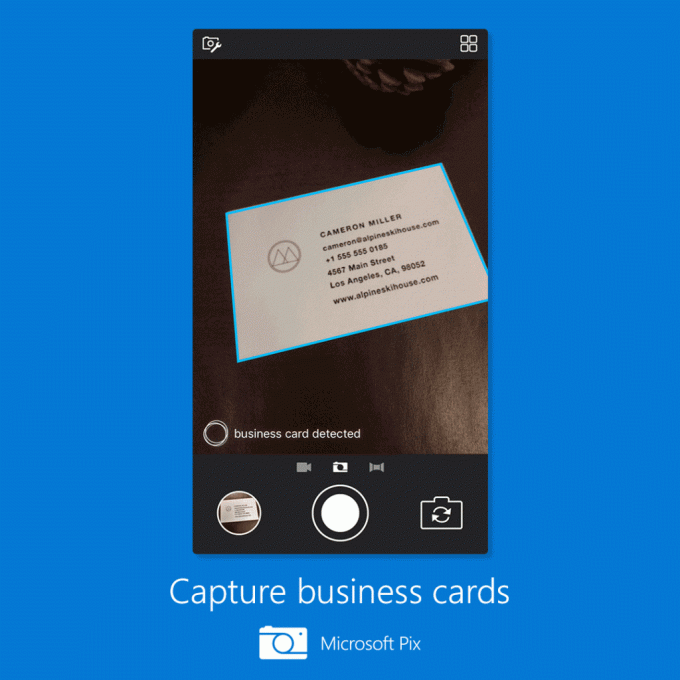
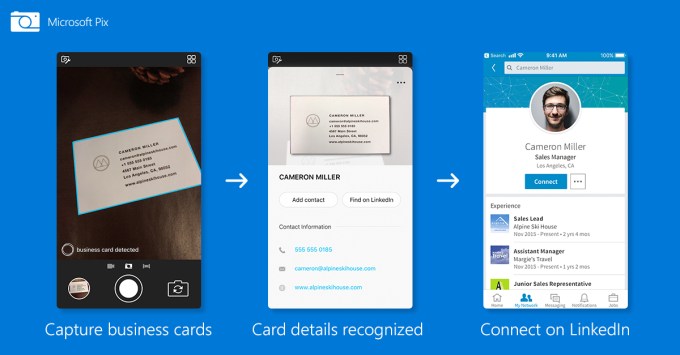
To take advantage of this option, you just launch the app and point it at the business card. Pix then automatically detects what it’s seeing, and asks you if you want to “Add Contact” or “Find on LinkedIn.”

When you tap to add the contact, Pix captures and organizes the contact information – like name, phone, address, and URL – into the correct fields, and adds the newly created contact to your iPhone’s Contacts app. If you opt for LinkedIn, you’re able to view the person’s profile in the LinkedIn app on your iPhone, and optionally add them to your list of connections.

The business card scanning feature, like others in Pix, leverages A.I. technology under the hood to enhance and improve the image. In the case of business cards, Pix is able to detect the edges of the cards, sharpen focus, and tweak the angle of the photo to render the image in a straight-on perspective so it can extract the information from the card.

Microsoft Pix can scan business cards to your contacts, find people on LinkedIn
The Pix update is just one of several ways Microsoft has integrated with LinkedIn since acquiring the company for $26.2 billion in 2016. It has also tied LinkedIn into its other products, including Office 365, Outlook.com, Dynamics 365, Word, and Windows 10.

The updated version of Microsoft Pix is rolling out today. You may not have it yet, as it has to propagate across the App Store, so keep your eyes peeled.

source:TechCrunch

Microsoft advances several of its hosted artificial intelligence algorithms
Microsoft Cognitive Services is home to the company’s hosted artificial intelligence algorithms. Today, the company announced advances to several Cognitive Services tools including Microsoft Custom Vision Service, the Face API and Bing Entity Search .

Joseph Sirosh, who leads the Microsoft’s cloud AI efforts, defined Microsoft Cognitive Services in a company blog post announcing the enhancements, as “a collection of cloud-hosted APIs that let developers easily add AI capabilities for vision, speech, language, knowledge and search into applications, across devices and platforms such as iOS, Android and Windows.” These are distinct from other Azure AI services, which are designed for developers who are more hands-on, DIY types.

The idea is to put these kinds of advanced artificial intelligence tools within reach of data scientists, developers and any other interested parties without any of the normal heavy lifting required to build models and get results with the myriad testing phases that are typically involved in these types of exercises.

For starters, the company is moving the Custom Vision Service from free preview to paid preview, which is the final step before becoming generally available. Sirosh writes that this service helps “developers to easily train a classifier with their own data, export the models and embed these custom classifiers directly in their applications, and run it offline in real time on iOS, Android and many other edge devices.”

Andy Hickl, who works in the Cognitive Services group as principal group program manager, says the tool is designed to help companies identify similar entities in an automated way such as not only recognizing that a particular picture is a dog, but that’s it’s a specific kind of dog or a dog that belongs to a particular person.

The Face API, which is generally available as of today, helps identify a specific person from a large group of people in an automated way. With today’s release the tool allows developers to create groups of up to a million people. Hickl says this is significant because up until now, many face recognition algorithms could only recognize a handful of faces, useful as far as it goes, but not truly scalable like this, he pointed out.

Finally, the Bing Entity Search algorithm enables developers to embed Bing search results in any application. So for example, you could retrieve search results within any tool narrowed down by any Bing entity such as image or website. This tool is generally available as of today.

Microsoft search results embedded in application
Microsoft search results embedded in application.
Photo: Microsoft
source:TechCrunch

Microsoft’s HoloLens is now available to rent
Microsoft has spent much of the past couple of years arguing its vision of an augmented reality future with the HoloLens. Now, it’s realizing that for potential buyers of the company’s enterprise-focused Commercial Suite edition, there’s some desire to try it out before they break out the corporate card.

Until now, the best way for interested companies to see whether Microsoft’s product was hype junk or something transformational was to plunk down $5,000. Well, now Microsoft has decided to partner with a company called Abcomrents, an event tech rental service, to let people get their feet wet and rent the HoloLens without making the full investment.

Why would people even want to do that? Microsoft posits that companies have shown interest in rentals so they “can evaluate before purchasing or increase their inventory temporarily to support tradeshows and events.” For now, the rental program is just available in North America, but Microsoft says they’re working to expand the availability of the program.

The company also announced in a post that they will be expanding general HoloLens availability to Singapore and the United Arab Emirates.

source:TechCrunch

The first product from the secretive, Google-funded augmented-reality startup has finally been revealed. Founder and CEO Rony Abovitz shares some key insights about Magic Leap One.

 The next wave of mixed-reality headsets?
It looks like a cross between Maz Kanata's goggles or Snap Spectacles evolved into steampunk gear. But Magic Leap, a company that's stayed in secrecy for years, finally has hardware to show off, and it looks like it'll be here in 2018.

The Magic Leap One is an augmented-reality headset, using light field display. And while I haven't tried it yet, Brian Crecente at Rolling Stone has. Based on his exclusive hands-on experience -- and the several other AR headsets and mixed-reality technologies I've tried in the past year -- we can put Magic Leap's surprise announcement in perspective, and talk about how it shakes up the emerging AR/VR landscape as we head into CES and 2018.

The controller has haptic feedback, and is more compact than Oculus Touch or Vive's controls
The controller has haptic feedback, and is more compact than Oculus Touch or Vive's controls.
Magic Leap

The Magic Leap One is a headset, a controller and a computer

The round-lensed goggles house the displays, audio and external camera sensors. A handheld controller with touchpad looks like an advanced version of the wands that come with the Samsung Gear VR and Google Daydream View's phone-based VR headsets. The system connects to a round computer that clips to your body and makes everything work.

It's self-contained and doesn't need to be tethered to a phone or PC. But we don't know a specific price or release date yet. There's a pair of glasses (called Lightwear), a belt pack (called Lightpack) and a controller.

Intense-looking, but also somewhat compact. Note the camera placement
Intense-looking, but also somewhat compact. Note the camera placement.
Magic Leap

There are a lot of cameras in the headset

Much like other mixed-reality and AR headsets, including the Microsoft HoloLens, the Magic Leap One has cameras that help track movement and map space. There are a number of cameras across the sides and bridge of the goggles, but Magic Leap hasn't mentioned much about how the tech works. The head-mounted sensors and cameras are self-contained, and there are no separate room sensors needed, as with VR systems like Vive and Oculus. In that sense, it's got something in common with Microsoft's HoloLens proposition.

The Lightpack is a processor and battery, and clips to your side
The Lightpack is a processor and battery, and clips to your side.
Magic Leap

How is this different from the Microsoft HoloLens?

It sounds like the Magic Leap is a more advanced method of displaying 3D images using light field technology, and it has its own specialized controller with haptics, unlike the HoloLens. The field of view, according to Brian Crecente, who tried it, is larger than the HoloLens... but still limited.

The most impressive trick the Magic Leap One can do seems to be how it handles scanning room environments and layering in holographic objects: Virtual things can now block real things, like they would in the real world. A demo Crescente saw involved a robot that was able to stand in front of someone else realistically. By comparison, if a person walks "behind" a virtual object in Apple's ARKit, they appear in front of it from the viewer's perspective, ruining the illusion.

The Magic Leap One also promises persistence of objects, mapping and remembering environments. Simultaneous location and mapping (SLAM), which builds a map of your environment and remembers it, has already been in use in other AR tech. Is Magic Leap's better?

What is a light field display?

The Magic Leap One is augmented (or, mixed) reality, and projects 3D holographic experiences into the real world. But it promises to do that with light field technology, which projects what's effectively a full 3D image onto your retinas that can be focused on in the same way that real objects can. According to Magic Leap founder Rony Abovitz, who answered some questions in a phone interview with CNET, "We've taken a very complicated problem and reduced it to a wafer," promising "low cost and high volume and reproducibility" of the chips involved.

Not Magic Leap: I tried Avegant's light field headset earlier this year, which enabled me to focus on objects
Not Magic Leap: I tried Avegant's light field headset earlier this year, which enabled me to focus on objects.
James Martin / CNET
I haven't tried the Magic Leap (yet), but I have tried another light field mixed-reality headset prototype from Avegant earlier this year. That demo wowed me. I was standing in a room, looking at a solar system projected in front of me, and I could focus on planets close to my eyes or on planets far off in the distance. A tank full of virtual fish let me walk up and examine a fish up close, and focus on the scales. It feels more natural than the flat focus you'd experience in something like the Microsoft HoloLens. Abovitz discusses a blend of analog and digital that can be perceived by our retinas, making the illusion work: "your retina is like a mixing board."

It's meant 'for creators'

The first version of the Magic Leap One that should arrive in 2018 is aimed at creators, mainly, said Abovitz. It's not just a development kit for just development types: sure, Abovitz says it's for game and app developers, but he says it's also for people like artists, sculptors and engineers.

Early demos are clearly aimed at the melting point between creativity and technology: a recent demo with Pitchfork showcases "music spirits" created by Icelandic music group Sigur Ros.

It could work with phones, or with phone content

Abovitz recognizes that a lot of people will want to work with 3D things made on their phones. The Magic Leap One sounds like a tool to bridge that content, maybe like how Microsoft imagines its mixed reality platform as co-existing in Windows. But, it also gets stranger: Abovitz says volumetric spaces called "prisms" can be able to be created quickly, even on other devices, and then shot into mixed reality and the Magic Leap.

"If you create something on a phone, we want a Magic Leap user to experience that object in a native way," he says. "The phone is a tiny portal. Magic Leap is the peak of the mountain to experience that thing." He imagines a "world of Magic Leap users, a world of phone users and a hybrid passability between ecosystems."

It won't do VR, yet

Rony Abovitz says that the Magic Leap One is aimed at mixing the real and virtual world together, but he envisions future versions of the Magic Leap being able to go just into VR-type experiences, too. "You could see future editions of Magic Leap that could go between analog and digital," says Abovitz. "[The Magic Leap] One is like the real world plus CG blended. As the portfolio grows, you should be able to [move between] virtual and physical seamlessly."

What does this mean for 2018, AR and MR?

Augmented reality jumped into the mainstream in 2017 thanks to fun demos on iPhones and Google's Pixel phones, but Magic Leap's sudden reveal points to bigger things happening next year. It's been years since the Microsoft HoloLens first showed its tech off, and the industry seems due for big movement. Avegant's light field headset, the Magic Leap One and who knows what else is in store? With a few years of VR having trained creators on how to develop virtual tools, maybe Magic Leap's approach to new mixed-reality interfaces and experiences are exactly where AR, VR and MR need to go next.

source:CNet

Silicon Valley once again is speaking out against President Donald Trump, this time over his plan to end the popular but controversial "Dreamers" program.

Hundreds of immigration advocates and supporters attend a rally and march to Trump Tower in support of DACA Wednesday
President Donald Trump has decided he will end DACA, a controversial Obama-era immigration program that offers undocumented immigrants who came to the US as children a chance to work and study without fear of deportation. And the tech industry is not pleased.

Despite DACA's popularity -- since its inception in 2012, about 800,000 people had signed up -- a group of state attorneys general threatened to challenge the program if Trump didn't rescind it himself by Sept. 5. On Tuesday, Attorney General Jeff Sessions announced the Deferred Action for Childhood Arrivals program would be rescinded.

Now tech industry leaders are joining members of Congress in criticizing Trump's decision.

Tech executives weren't the only ones speaking out against Trump of course. Both Obama and former Vice President Joe Biden spoke out about the decision as well.
This is just the latest move by tech leaders who have been increasingly flexing their political muscle in recent years, speaking out on everything from gay rights to early childhood vaccinations. Since Trump was sworn in as president on Jan. 20, they've been speaking out against him.

First, they opposed his controversial travel ban, and again when it was revised. They also rejected Trump's ban on transgender troops, announced in July. And a number of tech CEOs resigned from presidential advisory councils over Trump's handling of the rally of white supremacists, klansmen and neo-Nazis in Charlottesville, Virginia.

Now tech executives are banding together again to speak out for "Dreamers," a nickname for DACA recipients. Here's what they had to say:

FWD.us

A collection of tech's biggest names -- including Apple CEO Tim Cook, Amazon CEO Jeff Bezos, Google CEO Sundar Pichai, Uber CTO Thuan Pham, Airbnb CEO Brian Chesky and more than 300 others -- signed a group letter to Trump, as well as leaders in the House of Representatives and the Senate. It was sent last week, when rumors began circulating Trump planned to end the program.
As entrepreneurs and business leaders, we are concerned about new developments in immigration policy that threaten the future of young undocumented immigrants brought to America as children.

The Deferred Action for Childhood Arrivals (DACA) program, which allows nearly 800,000 Dreamers the basic opportunity to work and study without the threat of deportation, is in jeopardy. All DACA recipients grew up in America, registered with our government, submitted to extensive background checks, and are diligently giving back to our communities and paying income taxes. More than 97 percent are in school or in the workforce, 5 percent started their own business, 65 percent have purchased a vehicle, and 16 percent have purchased their first home. At least 72 percent of the top 25 Fortune 500 companies count DACA recipients among their employees.

Unless we act now to preserve the DACA program, all 780,000 hardworking young people will lose their ability to work legally in this country, and every one of them will be at immediate risk of deportation. Our economy would lose $460.3 billion from the national GDP and $24.6 billion in Social Security and Medicare tax contributions.

Dreamers are vital to the future of our companies and our economy. With them, we grow and create jobs. They are part of why we will continue to have a global competitive advantage.

We call on President Trump to preserve the DACA program. We call on Congress to pass the bipartisan DREAM Act or legislation that provides these young people raised in our country the permanent solution they deserve.
FWD.us is a political action group started four years ago by Facebook CEO Mark Zuckerberg to push for immigration reform.

Microsoft

Microsoft CEO Satya Nadella, who moved to the US from India three decades ago, took to (where else?) recently purchased LinkedIn to publish his statement last week as well.
For me, it comes back to two things: the enduring principles and values that have made the United States what it is, and my own personal story.

As I shared at the White House in June, I am a product of two uniquely American attributes: the ingenuity of American technology reaching me where I was growing up, fueling my dreams, and the enlightened immigration policy that allowed me to pursue my dreams.

There is no question in my mind that a priority must be to create more jobs and opportunity for every American citizen. On top of this, smart immigration can help our economic growth and global competitiveness.

As a CEO, I see each day the direct contributions that talented employees from around the world bring to our company, our customers and to the broader economy. We care deeply about the DREAMers who work at Microsoft and fully support them. We will always stand for diversity and economic opportunity for everyone. It is core to who we are at Microsoft and I believe it is core to what America is.

This is the America that I know and of which I am a proud citizen. This is the America that I love and that my family and I call home. And this is the America that I will always advocate for.
Brad Smith, the company's president and chief legal officer, also penned a blog post arguing that rescinding DACA would "not only negatively impact thousands of hardworking people across the United States, but will be a step backwards for our entire nation."
We are deeply concerned by news reports about changes to the Deferred Action for Childhood Arrivals (DACA) that are under consideration. These changes would not only negatively impact thousands of hardworking people across the United States, but will be a step backwards for our entire nation.

Let me explain why.

The roughly 800,000 "DREAMers" who are registered beneficiaries of DACA were brought to this country as young children. Although undocumented, these young people grew up in the United States, attended our schools, built careers and started businesses, bought houses, started families and became part of our communities. The DACA program did not grant them a permanent immigration status — it only provided a temporary reprieve from deportation, requiring renewal every two years. But it provided work authorization, allowing them to integrate as contributing members into our nation's workforce and society.

Ending DACA will drastically disrupt the lives of these individuals who willingly came forward to register with the federal government. They could lose their jobs and risk deportation. This repeal will also have significant economic consequences. Studies estimate that ending the program could cost the American economy $460.3 billion in GDP (gross domestic product) and $24.6 billion in Social Security and Medicare tax contributions over the course of a decade.

Our country will also lose the tremendous talent of these individuals. DACA recipients bring a wide array of educational and professional backgrounds that enable them to contribute in crucial ways to our nation's workforce. They are part of our nation's universities and work in every major industry. They are artists, advocates and health care providers. They help meet the needs of our communities and our companies.

We experience this in a very real way at Microsoft. Today we know of 27 employees who are beneficiaries of DACA. They are software engineers with top technical skills; finance professionals driving our business ambitions forward; and retail and sales associates connecting customers to our technologies. Each of them is actively participating in our collective mission to empower every person and every organization on the planet to achieve more. They are not only our colleagues, but our friends, our neighbors and valued members of the Microsoft community.

These employees, along with other DREAMers, should continue to have the opportunity to make meaningful contributions to our country's strength and prosperity. Instead of ending DACA, our policymakers and legislators should enact the DREAM Act or other permanent solution for DREAMers — a goal that continues to have bipartisan support.

Our country has always been a beacon of opportunity. If we are determined to preserve American leadership and excellence, let's build lasting solutions that extend dignity and opportunity while promoting our country's economic prosperity.
Following the announcement Tuesday, Smith put out a new statement.
We are deeply disappointed by the administration's decision today to rescind protection under the program for Deferred Action for Childhood Arrivals (DACA). As we said last week, we believe this is a big step back for our entire country.

The question for individuals, employers and the country is what we do now.

For Microsoft, the first step is clear. The administration has given Congress six months to replace DACA with new legislation. We believe this means that Congress now needs to reprioritize the fall legislative calendar and move quickly with new legislation to protect these 800,000 Dreamers. This means that Congress should adopt legislation on DACA before it tries to adopt a tax reform bill. This is the only way, given the number of legislative days Congress has scheduled over the next six months, we realistically can expect Congress to complete DACA legislation in time.

We say this even though Microsoft, like many other companies, cares greatly about modernizing the tax system and making it fairer and more competitive. But we need to put the humanitarian needs of these 800,000 people on the legislative calendar before a tax bill. As an employer, we appreciate that Dreamers add to the competitiveness and economic success of our company and the entire nation's business community. In short, urgent DACA legislation is both an economic imperative and a humanitarian necessity.

As this debate moves forward, we need to remember that these 800,000 individuals came to our nation as children. They grew up in this country. They attended our local schools and count millions of American citizens as friends. They obey our laws, pay taxes here and have registered voluntarily with the federal government for DACA relief. They are loyal to this country and contribute their time and money to local churches, schools and community groups. The Dreamers are part of our nation's fabric. They belong here.

That's why we believe a second point is also fundamental. Although we should all ask Congress to act within six months, we should be prepared for the possibility that it will not do so. Such a failure would not relieve anyone else in the country of the responsibility to act thoughtfully and wisely.

This is why we will work as needed with other companies and the broader business community to vigorously defend the legal rights of all Dreamers. For the 39 Dreamers that we know of who are our employees, our commitment is clear. If Congress fails to act, our company will exercise its legal rights properly to help protect our employees. If the government seeks to deport any one of them, we will provide and pay for their legal counsel. We will also file an amicus brief and explore whether we can directly intervene in any such case. In short, if Dreamers who are our employees are in court, we will be by their side.

We appreciate that even limited immigration legislation like DACA is complex, controversial and even difficult. We also appreciate that this issue arises at a time of other important national priorities and sharp divisions within Congress. But when it comes to DACA, there are too many affected people who contribute too much to our country for Congress to fall short. There are leaders on both sides of the aisle who have long championed this issue. And there is a growing list of supporters from across the country who want to see this get done. We're confident that Microsoft is but one of many companies and groups that will support them.

Apple

Cook said in a tweet that 250 Dreamers work at the consumer electronics giant. He also urged a solution "rooted in American values."
Following the announcement of Trump's decision, Cook sent a letter to Apple's employees saying he is "deeply dismayed" that Dreamers, including at Apple, may be "cast out of the only country they've ever called home."
America promises all its people the opportunity to achieve their dreams through hard work and perseverance. At Apple, we've dedicated ourselves to creating products that empower those dreams. And at our best, we aspire to be part of the promise that defines America.

Earlier today, the Justice Department announced that President Trump will cancel the Deferred Action for Childhood Arrivals (DACA) program in six months if Congress does not act to make the program permanent.

I am deeply dismayed that 800,000 Americans — including more than 250 of our Apple coworkers — may soon find themselves cast out of the only country they've ever called home.

DACA recognizes that people who arrived in the United States as children should not be punished for being here illegally. It lets these Americans, who have successfully completed rigorous background investigations, go to school, earn a living, support their families, pay taxes and work toward achieving their dreams like the rest of us. They are called Dreamers, and regardless of where they were born, they deserve our respect as equals.

I've received several notes over the weekend from Dreamers within Apple. Some told me they came to the U.S. as young as two years old, while others recounted they don't even remember a time they were not in this country.

Dreamers who work at Apple may have been born in Canada or Mexico, Kenya or Mongolia, but America is the only home they've ever known. They grew up in our cities and towns, and hold degrees from colleges across the country. They now work for Apple in 28 states.

They help customers in our retail stores. They engineer the products people love and they're building Apple's future as part of our R&D teams. They contribute to our company, our economy and our communities just as much as you and I do. Their dreams are our dreams.

I want to assure you that Apple will work with members of Congress from both parties to advocate for a legislative solution that provides permanent protections for all the Dreamers in our country.

We are also working closely with each of our co-workers to provide them and their families the support they need, including the advice of immigration experts.

On behalf of the hundreds of employees at Apple whose futures are at stake; on behalf of their colleagues and on behalf of the millions more across America who believe, as we do, in the power of dreams, we issue an urgent plea for our leaders in Washington to protect the Dreamers so their futures can never be put at risk in this way again.

Despite this setback for our nation, I'm confident that American values will prevail and we will continue our tradition of welcoming immigrants from all nations. I'll do whatever I can to assure this outcome.
Laurene Powell Jobs, wife of late Apple co-founder Steve Jobs, also spoke out.

Facebook

The world's largest social network has been at the center of a lot of political fights lately, but that hasn't stopped Zuckerberg from speaking out. "These young people represent the future of our country and our economy," he wrote. "They are our friends and family, students and young leaders in our communities."


Following Tuesday's announcement, Zuckerberg expressed his frustration, calling the decision "cruel."


Sheryl Sandberg, Facebook's outspoken COO who often lobbies on behalf of diversity and women's rights, penned a Facebook post criticizing Trump's administration by name, adding that she is "heartbroken and deeply concerned."


Google

The internet giant's CEO, Sundar Pichai, himself an immigrant from India, pushed congress to act.

Eric Schmidt, former Google CEO and now executive chairman of Alphabet, also spoke out.
YouTube head Susan Wojcicki also spoke out:

Twitter

Jack Dorsey, the CEO of Twitter and payments company Square who had not attended Trump's meeting with tech executives in December, called Trump's decision "cruel."

Uber

The ride-hailing company's new CEO, Dara Khosrowshahi, himself an Iranian immigrant, spoke out on Twitter after then announcement.
Uber's CTO Thuan Pham, who also signed the FWD.us letter, published a blog postafter the announcement.
When I was 10 years old, I left Vietnam with my mother and younger brother, crammed with 470 other people without life jackets onto an old fishing boat to Malaysia. It was a perilous and terrifying four-day journey—with major storms threatening to sink us, and pirates with guns and knives who robbed us and could kill us as well. We were the lucky ones who survived the 50% odds of that sea crossing. When we arrived in Malaysia, we were rejected as refugees and had to turn around and take another several days to reach Indonesia with our boat. When we reached the US as refugees, we had to start our lives over with empty hands, but it was the hope and promise of the American Dream that kept us going.

Immigrants often risk their lives for a chance at freedom and opportunity, and our country remains the world's beacon of freedom and opportunity. Immigrants have built and contributed to America since its very beginning, and are at the center of our social fabric and economic prosperity. My heart breaks to see so many people who are in the same situation today that I was in many years ago.

Today, the Trump Administration announced it will end the Deferred Action for Childhood Arrivals (DACA) program, which gave children of illegal immigrants the chance to stay in the US and contribute to their communities and the economy. I was proud to sign the FWD.us letter on behalf of Uber urging President Trump to preserve the program.

Our community has always been about what brings people of every background together. We'll continue to stand by immigrants who want nothing more than to contribute to our country and pursue the American Dream.

Lyft

The ride-hailing company's co-founders John Zimmer and Logan Green, who's also its CEO, tweeted that ending DOCA is wrong.

Airbnb

The short-term rental startup's cofounders Brian Chesky, Joe Gebbia and Nate Blecharczyk put out this statement:
We founded Airbnb based on the idea that our lives and our world are better when we accept each other. Those aren't just economic or business values. Those are the values America has been and should be all about.

Salesforce

Marc Benioff, the enterprise company's CEO, tweeted that DACA is good for business.

Mozilla

Denelle Dixon, chief business and legal officer for Mozilla, which makes the Firefox browser, put out a statement Thursday night:
We believe that the young people who would benefit from the Deferred Action for Childhood Arrivals (DACA) deserve the opportunity to take their full and rightful place in the U.S. The possible changes to the DACA that were recently reported would remove all benefits and force people out of the U.S. - that is simply unacceptable.

Removing DREAMers from classrooms, universities, internships and workforces threaten to put the very innovation that fuels our technology sector at risk. Just as we said with previous Executive Orders on Immigration, the freedom for ideas and innovation to flow across borders is something we strongly believe in as a tech company. More importantly it is something we know is necessary to fulfill our mission to protect and advance the internet as a global public resource that is open and accessible to all.

We can't allow talent to be pushed out or forced into hiding. We also shouldn't stand by and allow families to be torn apart. More importantly, as employers, industry leaders and Americans -- we have a moral obligation to protect these children from ill-willed policies and practices. Our future depends on it.

We want DREAMers to continue contributing to this country's future and we do not want people to live in fear. We urge the Administration to keep the DACA program intact. At the same time, we urge leaders in government to enact a bipartisan permanent solution, one that will allow these bright minds to prosper in the country we know and love.

Electronic Arts

The game company behind titles like Battlefield, Star Wars Battlefront and Madden NFL, signed the FWD.us group letter and also said it has a small number of DACA employees.
We are working closely with them and intend to help in any way that we can.

Consumer Technology Association

The organization that puts on the massive CES show every January, spoke out as well. This from Gary Shapiro, president and CEO:
Preserving DACA is the right thing to do. It also gives Congress an impetus to pass a humane immigration law that attracts and enables the world's best and brightest to innovate, build companies, create jobs and drive economic growth in the United States. Dreamers are an important part of this equation.

DACA recipients make our nation stronger and more economically competitive. They're employed at major tech companies such as Apple and Microsoft. They're innovating and paying their share into Social Security and Medicare. A report by FWD.us shows 91 percent of DACA recipients are employed, and at least 75 percent of the largest companies in America have a DACA employee.

Our representatives in Washington can make a real difference and create a better atomorrow for our nation and these hardworking dreamers. The time has come for a bipartisan solution that fixes our broken immigration system, defines a pathway for dreamers to earn a place in our society and addresses our nation's labor shortage. Inaction is not a winning immigration strategy.

TechNet

The tech industry lobbying group's president and CEO, Linda More, put out a statement shortly after Trump's decision was made public.
Ending DACA will be highly disruptive to the U.S. economy because of the impact on many young people currently working with legal work permits they acquired because of this program. Whether you agree with DACA or not, ending it without anything to replace it creates unnecessary uncertainty for our economy and for almost 800,000 young people in this country who have passed background checks, paid fees, and are contributing to our economy, pursuing their studies, or even serving in our military.

There is a broad and bipartisan consensus that we should not punish children for the actions of their parents. Leaders in both parties have long talked about finding a legislative solution to resolve this situation but have allowed policy disagreements and politics to lead to gridlock. The President's action now makes it an urgent priority for Congress to turn its sympathy for these young people into a law that ends the uncertainty they face.

Other tech leaders

Max Levchin, the former Paypal CTO and co-founder, who himself was born in the Ukraine, also spoke out.
Postmates CEO Bastian Lehmann took to the company's blog:
America's tradition of welcoming immigrants from around the world has not only made this nation a more vibrant, dynamic place — it has given us a tremendous competitive advantage. We embrace entrepreneurs, dreamers and everyone who wants to come here to work hard and build stronger communities. For me, as an immigrant, it was a place where having an open mind, tolerant hearts, and thinking differently was championed. It was a place where you could turn technology into opportunity — and help create thousands of jobs and entire new ways of doing business along the way.

Today, that dream was gutted.

By reversing a program — which grants people who were brought to the United States as undocumented toddlers & infants a path to live and work here legally — the Administration has turned its back on the very institution it purports to protect: the American community.

DACA currently protects 800,000 young people in those communities. Young people who are our neighbors and play on our high school football teams; young people who are paramedics in Houston and who stand up each day to pledge allegiance to our flag. They are small business owners, friends, and dreamers. They are Americans in their heart, in their minds, in every single way but one: on paper.

In a few months, these young individuals, who have come out of our shadows to contribute to our economy through DACA protections, will start to lose their ability to work legally and will risk immediate deportation. There is no doubt that all of us take offense to anyone who reaps the rewards of living in America without taking on the responsibilities of living in America. But today's action does not reform a system fraught with imbalance, nor does it encourage citizenship — it simply encourages callousness and prevents our country from realizing its full potential. Congress and the President must actually do some work and craft a legislative solution that gives Dreamers a pathway to citizenship. Inaction will not only destroy families, it will destroy everything that has always made this country great.
Tracy Young, CEO of construction software company PlanGrid, weighed in on Trump's decision.

source: CNET

A major security event has 20 keynote speakers, and only one is a woman. Experts say recruiting at events that exclude women keeps the field male-dominated.

Cisco Chairman and CEO John Chambers delivers a keynote address during the RSA Conference in 2009. This year, 19 out of 20 keynote speakers will be men
At a major cybersecurity event in April, the only woman out of 20 keynote speakers is a social commentator.

Her name is Monica Lewinsky, and she advocates to prevent cyberbullying.

The other 19 keynote speakers and moderators, who will present during the four-day RSA Conference in San Francisco, are men. Of those men, all but one are cybersecurity experts.

The lineup has frustrated people in the cybersecurity field, with Facebook's chief security officer, Alex Stamos, taking to Twitter to criticize the conference organizers for leaving women out of RSA's top speaking roles. He even suggested he'd host an alternate conference nearby with a host of women experts, at which his role would be to hand out popcorn.
Lewinsky said on Twitter that she found out about the all-male lineup this week, and told USA Today in a statement that she's asked organizers to do better. "I'm disappointed by this oversight but RSA has about six weeks until the conference, so I'm optimistic that the matter will be rectified by then," she said.

RSA Conference vice president and curator Sandra Toms said in an interview that the lineup is not finalized and more women could join the list of keynote speakers before the event begins. US Homeland Security Secretary Kirstjen Nielsen has been formally invited, for example, but isn't yet confirmed to speak. Other invitations to women keynote speakers are still pending, Toms said.

"We strive each year for a diverse speaking panel," Toms said.

The dustup reflects a persistent problem in tech that happens to be even worse in cybersecurity. Women work in just 11 percent of jobs in this field (PDF). That's bad because security companies say they can't hire skilled people fast enough. Alienating women with the potential to excel at cybersecurity could make us all less safe, especially as hackers continually hammer computer networks to steal our sensitive information.

It also comes as tech conferences continue to take heat for gender bias. In January, organizers of CES, a giant consumer electronics trade show in Las Vegas, took criticism for excluding women from their slate of speakers, too. And in 2016 at Defcon, a major hacking conference in Las Vegas, women complained of a hostile atmosphere that left them feeling unwelcome.

Who's responsible?

But who exactly is to blame for the lack of women at tech conferences and in cybersecurity jobs around the world? Well, nobody is raising a hand to take sole responsibility for that one.

Women cybersecurity leaders: RSA Conference can't find you
Pau Barrena/Getty Images
 Toms said the lack of diversity overall in cybersecurity makes it hard to find women for the conference. "We acknowledge that there is a lack of women in cybersecurity and it's part of a larger lack of diversity in the larger tech space."

So, it's the fault of the tech industry at large that RSA organizers couldn't fill any of those roles with women cybersecurity and tech experts. While that could sound like a dodge, it's not not true -- just look at the companies sponsoring the event.

After all, that's where most of the keynote speakers come from, including companies like Microsoft, Symantec and McAfee, plus RSA Security, a cybersecurity company owned by Dell that sponsors the conference but isn't the same entity that organizes the event. The SANS Institute is an educational sponsor, which Toms said was an "in-kind" arrangement in which the organization offered training presentations in exchange for space on the sponsor list.

Most of the speakers come from senior leadership positions in those sponsor companies. That senior leadership is in every instance a group that's mostly men. Here's how it breaks down at each company that's sponsoring the event and sending a keynote speaker:
  • Juniper Networks: Zero women.
    No women in an 18-person leadership team.
  • SANS Institute: Zero women.
    No women in a six-person faculty.
  • Symantec: 11 percent women.
    Two women in a 18-person leadership team.
  • RSA Security: 13 percent women.
    One woman in an eight-person leadership team.
  • Akamai: 13 percent women.
    Two women in a 15-person leadership team.
  • Microsoft: 19 percent women.
    Three women in a 16-person leadership team.
  • Cisco: 22 percent women.
    14 women in a 64-person leadership team.
  • IBM: 29 percent women.
    Six women in a 21-person leadership team.
  • McAfee: 30 percent women.
    Three women in a 10-person leadership team.
Neither IBM, McAfee nor the SANS Institute responded to requests for comment. Akamai, Juniper, Microsoft, and Symantec didn't provide a comment for this story. Cisco didn't provide a comment on the lack of women keynote speakers at the conference, but a spokeswoman said the company recognizes the shortage of women in the cybersecurity industry.

RSA Security (the company, not the conference) responded with the following statement from a spokeswoman. "RSA recognizes the need for diversity in the technology industry in general, which includes cybersecurity," the spokeswoman said. "We believe in creating a global business that harnesses the power of the best and brightest talent, regardless of their gender, background, religion, nationalities and race."

The conference organizers don't seem to be limited to keynote speakers from sponsor companies, though. Three keynote speakers don't appear to have direct ties to sponsor companies. Two of them are cryptography experts. Whitfield Diffie helped lay the groundwork for what would become known as the RSA public-key system, a tool that lets users send a coded message that only the intended recipient can read. Moxie Marlinspike is the creator of Open Whisper Systems, the company behind the encrypted chat app Signal.

The recruiting cycle

There could be a direct connection between how welcoming a conference is to women and who gets recruited to work at a cybersecurity company. In a report from last week on women in cybersecurity, business analysts at Forrester said companies currently "focus on recruiting from industry events that have been proven unwelcoming to women."

That creates a vicious cycle in which companies hire fewer females. That, in turn, could cause conferences to have a harder time finding women experts to speak at the next event.

Toms said the audience at RSA is typically 20 percent women, which is higher than the general population of women cybersecurity workers. What's more, its two events for young professionals and students attract even higher rates of women.

Cisco spokeswoman Robyn Blum said the company is a sponsor of the Women in Cybersecurity event taking place in March and is hosting an event next week focused on bringing young women into tech careers.

In a blog post about improving diversity in the cybersecurity workforce, Cisco's chief security and trust officer, John Stewart, said women still face too many obstacles in the field. "We have a long way to go for talent, skills and character to overcome gender as a qualification," he said, "especially in leadership and executive roles."

source:CNet News

China-based iCloud users are facing a change in  how Apple handles the privacy of their data

Apple is moving encryption keys for China-based users' data from the US to the Asian country. Some say that's bad for dissidents. Apple says the keys are safe.

China-based iCloud users are facing a change in  how Apple handles the privacy of their data
China-based iCloud users are facing a change in
how Apple handles the privacy of their data.
James Martin/CNET
Apple has privacy advocates worried over a change in how it protects the data of iCloud users in China, according to a pair of reports.

The data, such as messages, emails and photos, is shielded from prying eyes by encryption, which means it's coded. But Apple will begin storing the keys for the code not in the US, as it's done till now, but in China, say reports this week by Reuters and The Wall Street Journal.

That means Chinese authorities won't have to go through US courts to compel Apple to give them access to data. The move is a response to new laws in China, which say cloud services offered to citizens there must store data in the country and be operated by Chinese companies.

At the end of the month, Apple will begin shifting the data to China and partner with a local company with ties to the Chinese government. Apple hasn't said when the encryption keys themselves will be moved overseas.

Privacy advocates say the switch could mean trouble for political dissidents and others. Apple says, though, that the keys will be kept in a safe location and that Apple itself will maintain control of them. The company says it will hand over data only in response to valid legal requests from Chinese authorities and that it hasn't built in any backdoors for access.

An Apple representative told the news outlets that the company advocated against iCloud being subject to the new laws but was unsuccessful. The rep also said Apple decided that discontinuing the iCloud service in China would make for a bad user experience and "less data security and privacy for our Chinese customers."

Amazon and Microsoft also partner with China-based companies to offer cloud storage services there and tap in to the huge Chinese market. The two US-based tech giants declined to tell the Journal where encryption keys will be stored for those businesses.

Apple told the news outlets that it's sending warning of the switch-over to iCloud users in China. Users there can opt out of iCloud to avoid having their data stored in the country. The company also said it won't move anyone's data until they accept the new China terms of service. Users whose settings are configured for a different country, or for Hong Kong or Macau, won't have their data stored on Chinese servers. Reuters includes Taiwan on that list; The Journal doesn't.

Neither Apple nor Amazon immediately responded to CNET's request for additional comment. Microsoft declined to provide added comment.

Security: Stay up-to-date on the latest in breaches, hacks, fixes and all those cybersecurity issues that keep you up at night.

source: CNET

Firefox Quantum got a mecha-suit mascot

Graphics get faster in Firefox 58. Also new: better support for when you're on the mobile web.

Mozilla released on Tuesday a new version of its Firefox Quantum browser, boosting its graphics speed and improving a couple of new technologies designed to make the web more powerful.

The browser, version 58, is the first major update since Mozilla's recovery plan hit full stride in November with the debut of Firefox Quantum. A decade ago, Firefox was running circles around Microsoft's Internet Explorer, but the browser market has become much more competitive now with the arrival of Google's Chrome and mobile phones.

Speed is of the essence in Mozilla's recovery plan, and Firefox 58 does better than its predecessor in some graphics tasks by splitting work better across the multiple processor cores that computer chips have these days. The result should be scrolling that's smooth, uninterrupted by the stuttering that in computing circles goes by the disparaging term "jank."

There's evidence that the Quantum plan has brought new and return users to Firefox. But even if you aren't persuaded, the plan is important for the web. Firefox can push other browsers to get better, keep the web a neutral domain instead of the purview of a tech giant like Microsoft or Google, and advance new standards that make the web more useful.

For example, Firefox 58 helps with two new web technologies.

One, called WebAssembly, provides for dramatically faster web apps. Firefox 58 can get WebAssembly software running faster so you don't have to twiddle your thumbs waiting as long after clicking a link.

Another is progressive web apps (PWAs), an initiative that came out of Google to help make the web a better match for the apps we all drop on our phones. Following Chrome's footsteps, Firefox on Android can now let you turn a properly packaged website into an app icon on your phone home screen. Tap on it, and a browser-based app will run full screen, with no address bar or other distractions.

When Firefox detects a website that can become a progressive web app, it shows a home icon with a plus inside. Tapping it lets you add the PWA to your Android phone's home screen.
Even if you don't embrace the full concept of progressive web apps, the underlying technology can help other websites, for example by letting them work even when you don't have a network connection. Eventually, Google plans to revamp its G Suite apps so all browsers, not just Chrome, can work offline that way.

Under Firefox's covers, there's another speed boost on the way originally called WebRender and now officially Quantum Render. It should speed up graphics another big notch, but it's not due to arrive until Firefox 59 or 60. Mozilla updates its browser about once every six weeks.

One of Firefox 57's rough patches was that it moved to a new foundation for extensions, downloadable modules that customize your browser with tools to do things like block ads, manage passwords or fill out online forms. Firefox helped pioneer the technology, but Mozilla moved to a variation of Chrome's extension foundation and with Firefox 57 stopped supporting the older technology.

Since Firefox 57, though, daily installations of extensions have increased 29 percent, Mozilla said. And one popular extension from the old era, the security-focused NoScript, has now been adapted for the new browser technology.

In announcing Firefox 58, Mozilla also is touting an improvement that came with Firefox 57 -- the ability to block ad trackers. Built into many websites, ad trackers can dramatically slow down page-loading speeds as well as keep an eye on web-browsing behavior you might prefer to keep private. The blocking ability isn't on by default, but if you enable it in Firefox settings, you could see Firefox's average page-load time drop from 7.3 seconds to 3.2 seconds for the top 200 news sites on the web.

Blocking ad trackers is becoming increasingly common. The Brave browser, led by Mozilla and Firefox co-founder Brendan Eich, blocks those trackers (and ads) by default. And Apple's Safari, too, is getting more assertive in squelching ad-tracking technology.

source: CNET

Apple now relies on Google Cloud Platform and Amazon S3 for iCloud data
It’s no secret, Apple has been relying on third-party cloud companies for iCloud. And CNBC spotted an interesting tidbit in Apple’s own documents. The company now relies on Amazon S3 and Google Cloud Platform’s storage product to store iCloud data.

Back in 2016, CRN reported that Apple signed with Google for cloud storage. But Apple’s document represents the first official confirmation that this deal happened.

You can find the information in Apple’s iOS 11 security guide that was published in January 2018. The company mentions that user files are divided into tiny chunks and encrypted. The encryption keys and metadata information are stored on Apple’s own servers. But the encrypted files are stored on third-party services.

While users have no idea that Amazon and Google are managing their iCloud data, Amazon and Google can’t do anything with those files without the encryption keys. So it seems highly unlikely that Amazon and Google are looking at your data.

“The encrypted chunks of the file are stored, without any user-identifying information, using third-party storage services, such as S3 and Google Cloud Platform,” you can read in the document.

In the past, Apple has mentioned Microsoft Azure in its partners. The wording of the document isn’t really clear. Apple could be using more storage services without naming them directly.

In all cases, this is a great example of asymmetric competition. While Apple and Google are fighting really hard to grab market share of the smartphone market, Apple is also Google’s client. Apple also competes with Amazon and Microsoft in other areas. So Apple would need to step up its cloud hosting game to cut ties with its competitors altogether.

source:TechCrunch

The Dropbox IPO filing is here
It’s official, the Dropbox IPO filing is here.

Going public is a huge milestone for Dropbox and has been one of the most anticipated tech IPOs for several years now. The cloud storage company has been around since 2007 and has raised over $600 million in funding.

We knew that it had already filed confidentially, but the company has now unveiled its filing, meaning the actual IPO is likely very soon, probably late March.

The company says it will be targeting a $500 million fundraise, but this number is usually just a placeholder.

The filing shows that Dropbox had $1.1 billion in revenue for last year. This compares to $845 million in revenue the year before and $604 million for 2015.

The company is not yet profitable, having lost nearly $112 million last year. This shows significantly improved margins when compared to losses of $210 million for 2016 and $326 million for 2015.

Dropbox has been cash flow positive since 2016.

Dropbox, which has a freemium model, says it has 11 million paying users, just a small fraction of the over 500 million registered users who use its cloud services for free.

Its average revenue per paying user is $111.91.

The big question is whether the company will achieve the $10 billion valuation it raised in the private markets. Part of its success will be measured relative to Box, which went public in 2015 and will be considered a comparable.

The prospectus warns of the competitive landscape.
The market for content collaboration platforms is competitive and rapidly changing. Certain features of our platform compete in the cloud storage market with products offered by Amazon, Apple, Google, and Microsoft, and in the content collaboration market with products offered by Atlassian, Google, and Microsoft. We compete with Box on a more limited basis in the cloud storage market for deployments by large enterprises.
With the filing we see that the largest shareholder is Sequoia Capital, which owned 23.2% of the overall shares outstanding. This is a large stake. Accel owned 5% overall.

Founder and CEO Drew Houston owned 25.3% of the company.

The company is listing on the Nasdaq, under the ticker “DBX.”

Others vying to go public soon will keep an eye on the performance of Dropbox. Investors place weight on the “IPO window,” and view recent debuts as a test for appetite for tech listings.

Spotify is gearing up to go public around the same time, but will be shunning the traditional IPO process, by listing without doing a fundraise.

source:TechCrunch

With its SEC filing, the unicorn lets its user and revenue numbers out of the box

The company, one of the first of the Silicon Valley unicorns, says it has 11 million paying subscribers out of 500 million total registered users.

With its SEC filing, the unicorn lets its user and revenue numbers out of the box
With its SEC filing, the unicorn lets its user and
revenue numbers out of the box.
Dropbox
Dropbox hopes to upload 500 million files to its account. Little green files, with pictures of presidents on them.

The cloud-based file-storing and -sharing company submitted paperwork Friday to raise up to $500 million in an initial public offering.

Apple's Steve Jobs once famously wrote off the Dropbox service as a "feature, not a product," but that didn't stop the company from becoming one the first and largest Silicon Valley unicorns, or businesses valued at more than $1 billion.

Dropbox lets you easily upload computer files to a storage drive in the cloud. From there, you can access them on other computers or share them with friends and co-workers. There's a free version, as well as a "premium" subscription offering.

THINKING INSIDE THE 'BOX

The Dropbox IPO filing is here
Equity shot: Dropbox is going public, and Aaron Levie has some advice

In its IPO filing with the US Securities and Exchange Commission, Dropbox said it has 11 million paying subscribers out of 500 million total registered users in 180 countries. Its average revenue per paying user is $111.91. The service brought in $1.1 billion in revenue last year, the company said. That's up from $845 million in 2016 and $604 million in 2015.

Dropbox isn't profitable yet, though: It lost almost $112 million in 2017. That's less than the $210 million loss the year before and 2015's deficit of $326 million.

And it's not the only player in the market. In its filing, the company name-checks Amazon, Apple, Google and Microsoft as rivals in the cloud storage space. It further names Atlassian, Google and Microsoft as competitors when it comes to content collaboration. It also says it competes with Box in cloud storage used by large enterprises.

Other tidbits from the filing: Founder Drew Houston owns 25.3 percent of the company; the board includes former Secretary of State Condoleezza Rice and former HP CEO and onetime California gubernatorial candidate Meg Whitman; and the company will trade on the Nasdaq under the symbol DBX.

source:CNet

MKRdezign

Contact Form

Name

Email *

Message *

Powered by Blogger.
Javascript DisablePlease Enable Javascript To See All Widget