Researchers took part in the Ski Robot Challenge last month and the resulting videos – essentially quick cuts of robots in ski jackets totally whanging off the gates and spinning out in the powder. The Challenge, run by the Korea Institute for Robot Industry Advancement, is sort of a Winter Olympics for wonky androids.
The rules are pretty complex. According to Spectrum:
Each robot must be humanoid, with a minimum of 15 degrees of freedom including functional elbows and knees;
Each robot must be at least 50cm tall (measured from foot to shoulder);
Robots are required to use both skis and poles, and the poles must touch the ground when the robot is standing with its elbows bent;
The competition ski slope is 80m long and 20m wide, and teams have 3 minutes to complete it by slaloming through red and blue gates;
Each robot gets one point per passed gate. Point ties are broken by fastest time, and in the event of a tie there as well, the tallest robot wins.
Contestants included Taekwon V and the squat Skiro whose motto is “I’m the hero of Ski Robot Challenge!”
It also seems that each robot must be wearing a little jacket, a fact that makes this entire thing quite adorable. The winner was Taekwon V who made it down the hill without hitting the gates even in harsh winds and slippery conditions. Now all they need is some warm oil and some melted cheese and they’ve got a vacation brewing.
New space rocks in our neighborhood are found all the time, often just before they pay us a visit. You can watch the next fly-by right here soon.
A bus-size asteroid this week will zip by us at a distance that's less than a third of the length between the Earth and the moon. You can watch the sassy space rock, named 2018 DV1, whip past us right here starting late Thursday or early Friday, depending on your time zone.
The news of this ominous visitor might make some people freak out, but we get fly-bys like this several times a year that pass quietly without incident. In fact, one asteroid came almost three times as close to our planet on Jan. 18 and a pair of celestial wanderers made similar passes on a single day last month.
We also had another one slip between the moon and here on Monday, which the Virtual Telescope Project managed to photograph pretty clearly.
Italian astronomer Gianluca Masi, who's with the project, will be at it again later this evening when he hosts a live webcast of 2018 DV1's visit, starting at 9:30 p.m. PT. You can watch via the embedded feed above.
In recent years we've become more aware of the number of space rocks in our cosmic neighborhood, especially after one went completely undetected in 2013 before slamming into the atmosphere over Russia, blowing out windows and causing numerous injuries.
Over 15,000 near-Earth asteroids have been cataloged, but we continue to spot new ones all the time. NASA even has a spacecraft heading for a large asteroid right now so we can learn more about them and perhaps be better prepared if we ever come across one that's aimed to send us the way of the dinosaurs.
And this year is all about business. While the Samsung Galaxy S9 is going to be announced tomorrow at Mobile World Congress in Barcelona, Slashleaks shared the official promo video for the Samsung’s upcoming flagship device.
It’s a polished 3-minute video packed with information about the new phone. First, just like rumors said, it looks just like the Galaxy S8. There are some minor changes, such as the location of the fingerprint reader. But it’s going to feel just like holding a Samsung Galaxy S8.
This isn’t necessarily a bad thing as the Galaxy S8 was a great phone with a tall 18:9 display. If you want a well-designed Android phone, Samsung has some nice options.
When it comes to software features, the video shows an improved DeX dock. It lets you plug your phone to a display or a TV and turn it into an Android-powered desktop experience. It’s a good way to show presentations for instance. And because the dock is flat now, you can use the phone as a trackpad.
The video also says that the Galaxy S9 is water resistant and comes with a new translation feature. You can point the camera at text to translate it into a familiar language. This feature is powered by Google Translate as you can see in the corner of the screen in the video.
Samsung really insists on the business features of the device. The company wants you to think about the Galaxy S9 when it’s time to buy a bunch of new phones for your employees. There will be an enterprise edition with maintenance, extended guaranty and security updates for up to four years. You can also update the firmware of your employees over the air.
The 3-minute video probably only tells part of the story. That’s why we have a team on the ground in Barcelona to give you more details about the Galaxy S9 tomorrow.
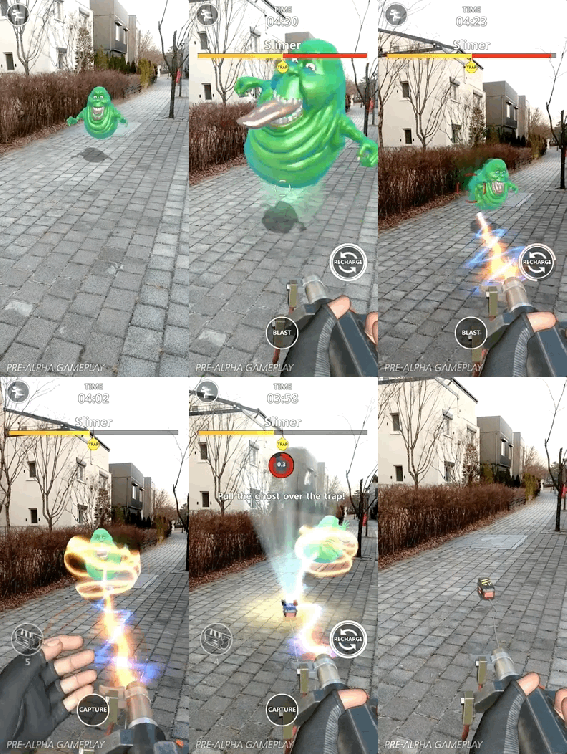
You’ll soon be able to trap Ghostbusters ghosts in augmented reality à la Pokémon Go.
A short demo of the game Ghostbusters World was showcased at Google’s MWC booth, highlighting functionality made possible by the public release of Google’s ARCoreaugmented reality platform. Details are pretty slim for a wide release date other than it’s “coming 2018”.
The title will call on ghosts from the franchise’s “films, TV shows, comic books, theme parks, and video games” according to a press release. Ghostbusters is obviously no Pokémon when it comes to the cult following behind it, but the game does seem like it could have some pretty similar gameplay to Pokeémon Go when it launches.
The studio behind the title, South Korea-based publisher FourThirtyThree Inc. has launched a number of popular games including Blade for Kakao, Monster Super League and Seven Guardians. The studio primarily seems to dabble in RPG style video games, and early footage makes it seem as though this mechanic will be present in Ghostbusters World. The title was also developed in conjunction with Sony Pictures Entertainment Consumer Products and Ghost Corps.
For what it’s worth from the short video they’ve shown it does really showcase what AR can add to the game, and how much more integrated with the environment the game is than past AR titles. Whether the title will embrace the location-based community style which made Pokémon Go a bit of a cultural phenomenon is unclear.
Though the announcement was made in conjunction with Google, the game will also be coming to iOS. The developers will be making more announcements about the game at next month’s Game Developers Conference.
Pups are peeing on the computers and life at Pied Piper is pretty much its normal chaotic state as season 5 approaches.
Erlich Bachman may be gone, but the "Silicon Valley" crew is perfectly capable of messing things up without him around. T.J. Miller, who played the egocentric Bachman, left the show after the fourth season ended last June, and his character was last seen floating in a happy haze in a Tibet opium den.
In the latest trailer, the Pied Piper crew doesn't even mention Bachman. They've got enough problems.
Richard (Thomas Middleditch) starts things out in the hospital. The company has added 50 "randos that we've never met," in Gilfoyle's words, to try and get their New Internet up and running. (You'll recall from the January trailer that those "randos" all watched a panicky Richard throw up.)
And apparently Richard has waived the company's "no dogs" policy, which leads to pups peeing on the computers and makes Dinesh barking mad.
Russian search and internet services giant Yandex has been working on its autonomous driving program, and its most recent achievement is a public self-driving pilot of its self-driving test car in Moscow, the first such test on public roads in the Russian capital.
Yandex had an additional degree of difficulty to contend with, too: Their recent testing, which kicked off in December of last year, included some days following heavy snowfalls, which are difficult conditions for any autonomous vehicle to navigate because of how they obscure road markers and other guiding indicators used by optical cameras systems, among other challenges.
As you can see, the car handled snow, ice, parked cars, traffic and even pedestrians even amid the wintery conditions, which is a key use case that autonomous vehicle technology providers will need to solve before the tech can be broadly adopted.
Beyond the snow, Yandex notes that Moscow also provides a terrific test bed for its AVs because of factors including high traffic volume, as well as pedestrian density on top of the variable weather patterns that come to the city across seasons.
MIT researchers are working on a new steering system for drones that uses uncertainty to ensure that they don’t hit obstacles as they fly autonomously. The system is a bit complex but it’s called NanoMap and it quite simply finds ways to get from point A to point B without crashing and while handling random objects in its path.
Spectrum describes the system in detail but basically the drone takes a depth measurement as it moves along a path. Each time it takes a measurement and is about to move forward it looks back at previous measurements which could include some information pertinent to the current motion. If it can’t find anything useful it slows down and assesses the area and if it does find previous information it keeps flying, avoiding obstacles as it goes.
Image: TechCrunch
This is important because current models require a drone to map its surrounding before becoming “confident” that it can handle flying around more quickly. This technique creates an on the fly map that lets the drone handle uncertainty as opposed to being ready in every situation. Further, this allows drones to zip between pillars or trees and base their next move on information gathered on the fly and not over time. From the study:
In testing, the researchers found that their uncertainty modeling really started to pay off when drift got much worse than 20 cm/s or so. Up to about 75 cm/s of drift, planning with NanoMap and incorporating uncertainty was able to keep the drone from crashing 97-98 percent of the time. With drift well over 1 m/s, the drone was only safe 10 percent of the time, but that was three times more robust than testing without uncertainty modeling. The press release sums it up overall:
If NanoMap wasn’t modeling uncertainty and the drone drifted just 5 percent away from where it was expected to be, the drone would crash more than once every four flights. Meanwhile, when it accounted for uncertainty, the crash rate reduced to 2 percent.
As they prepare to go for the gold, Lindsey Vonn, Mikaela Shiffrin and other team members have been using virtual reality to ski the actual runs of South Korea's Winter Games.
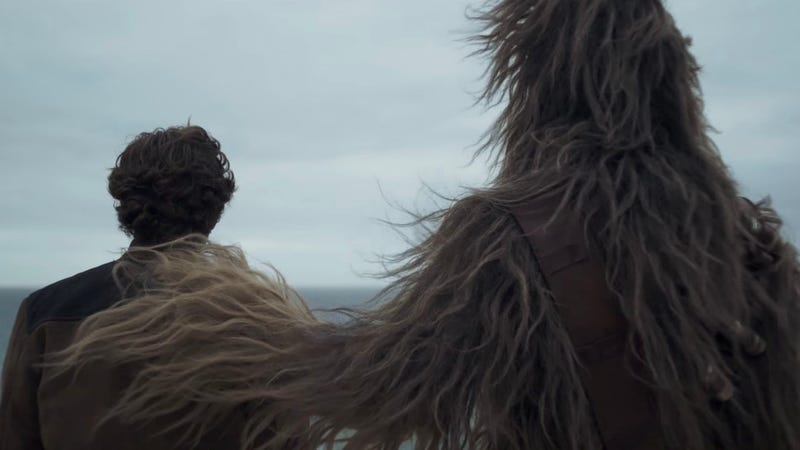
The next Star Wars movie is out in three months. THREE MONTHS. But up until now, we haven’t seen a single image from it. That changed during the Super Bowl, though, as Disney, finally, revealed the first look at Solo: A Star Wars Story.
I mean - that looks pretty great, right? Definitely has that Star Wars feel. Lando looks awesome. It gave me chills.
Official Footage From Solo: A Star Wars Story Lucasfilm
Directed by Ron Howard, Solo stars Alden Ehrenreich, alongside Emilia Clarke, Donald Glover, Thandie Newton, Phoebe Waller-Bridge, Woody Harrelson, Joonas Suotamo, and Paul Bettany.
As a transportation reporter, I’ve been in a lot of cars using either autonomous or semi-automated Advanced Driver Assistance (ADAS) features, both on public and private roads, and yet I’d never been in an accident during a demonstration drive for any of these features before now.
On Tuesday, January 30, myself and two TechCrunch video production staff were riding in a modified Hyundai Genesis equipped with technology created by autonomous systems startup Phantom AI, traveling south on Bayshore Freeway near Millbrae, CA.
In addition to the three TechCrunch staff, there were also two Phantom AI team members in the car, including founder and CEO Hyunggi Cho, and President and co-founder Chan Kyu Lee. Lee was at the wheel during the test, which was a demonstration of the startup’s Autopilot-like SAE Level 2 partial autonomous system, designed to maintain lane position, maintain distance between itself and vehicles ahead, and switch lanes automatically once directed using the turning indicator.
During the demonstration, while the L2 system was engaged and we were traveling at 60 MPH according to Phantom AI (though the human-machine interface in the video above shows 70 MPH as our set cruising speed), a pickup truck ahead dropped a poorly secured garbage bin from its cargo bed onto the roadway. The car in front, a white Nissan Rogue, applied the brakes to prevent hitting the trash bin, and our driver noticed the sudden stop and applied the brake in the Genesis with force to attempt to prevent a collision, but there was very little he could do at that stage and our car collided with the Nissan going approximately 20 MPH.
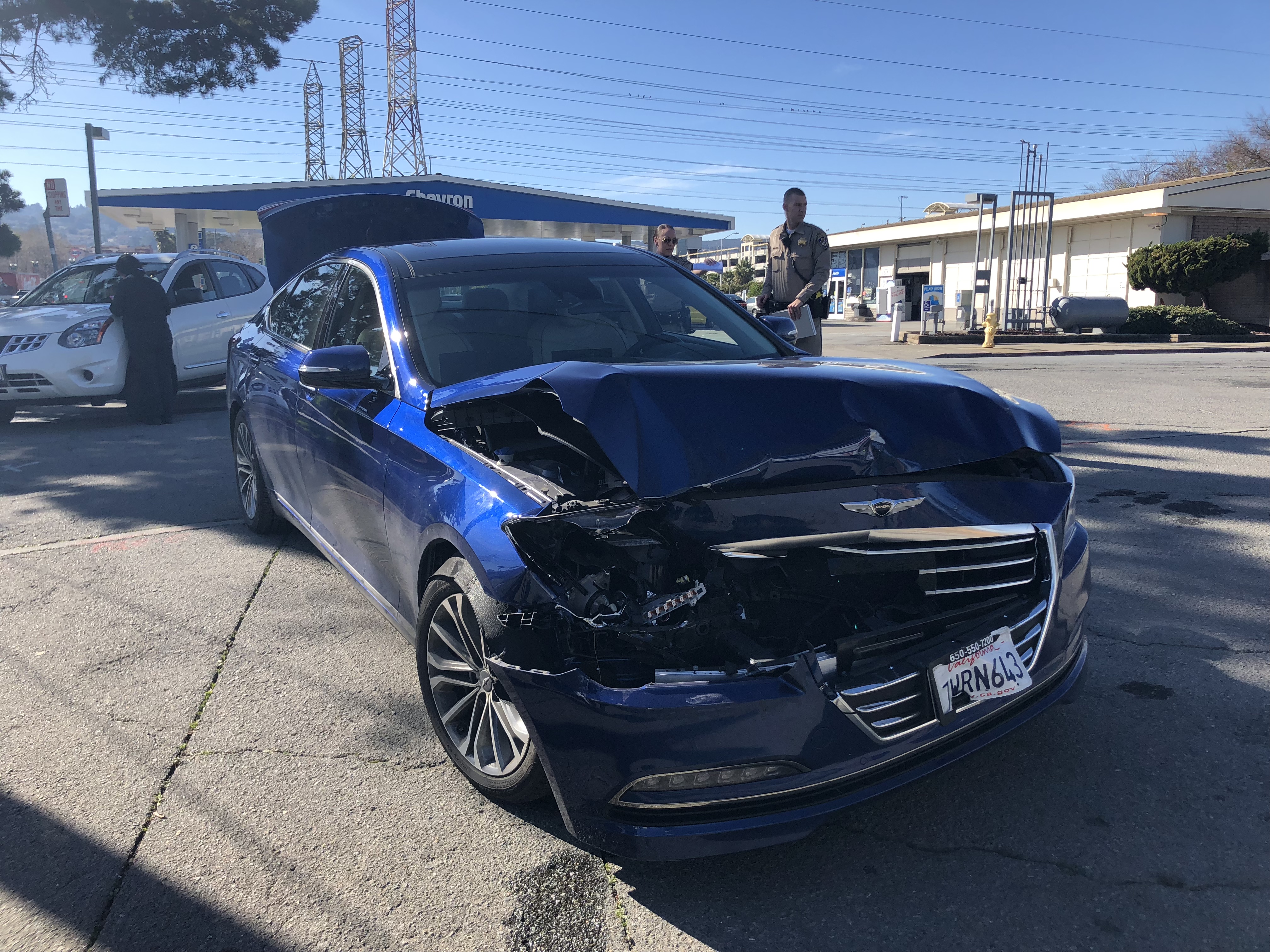
The Genesis suffered significant damage to the front end, as you can see above, though it was still technically drivable (but did begin leaking radiator fluid) and we first pulled to the shoulder as instructed by the California Highway Patrol, who were on the scene nearly immediately. We were then directed by the Patrol to a Chevron station just beyond a nearby exit, where we parked on the shoulder of a turnaround and gave our contact information to a patrolman, while the drivers involved provided full statements to the authorities.
Cho told us that the Automatic Emergency Braking system would’ve normally engaged at that point and prevented the collision, but it was disabled for the demo because it had been throwing too many false positives and was undergoing tuning. Lee’s manual disengagement, which resulted from pressing the brake pedal to the floor, as you can see in the video, didn’t occur fast enough for us to shed all our speed.
Cho immediately made sure no one was hurt (we weren’t, just shaken up) and after being cleared to leave the scene, we decided to follow through and move to an area of Foster City, where we rode in the startup’s Level 4 autonomous test car (a separate Genesis) around sparsely populated residential streets without incident. That may seem like an odd choice given we’d just experienced an accident riding in a car equipped with a different version of the company’s technology, but the follow-up demo was a separate system, speeds were much lower and there was a different safety driver at the wheel, and we were also honestly just all a little rattled and confused following the collision.
We provided Phantom AI with the opportunity to supply a full account of what occurred from their perspective, based on reviewing the data from the vehicle, and they supplied a breakdown of what occurred from their perspective, which you can read in full below. The video at the top of this article also documents the crash from within the vehicle, using a Rylo 360-degree camera. Footage was trimmed for length and exported to 1080P frames from a 4K 360-degree source automatically using Rylo’s software, and the license plate of the vehicle hit was obscured for privacy, but otherwise the footage is unedited.
We were conducting a demo of the Adaptive Cruise Control (ACC) feature, and Lane Keeping Assist (LKA) feature of our L2 system.
Our Automatic Emergency Braking (AEB) functionality was disabled for demo purpose.-
For a frame of reference we’ll use the moment of impact at t, and express the time line in t minus x seconds.
t minus 6: 50m apart from the front car; our car was cruising at 60MPH with L2’s Cruise Control feature active
t minus 6: A trash can from the pickup truck 2 or 3 cars apart started flying off the trunk
t minus 5: Our driver realized that something was up as the car in front abruptly decelerates
t minus 4 to t minus 3: Our driver began taking over the L2 system; braking started and our L2 system was disengaged (can be clearly seen in the HMI display)
t minus 3 to t: Braking was applied as strong as possible, with braking force : 5~6m/s^2 (you can see from the speedometer we went from 60MPH -> 25MPH for 3 seconds). As you can see the driver was doing everything he could within these 3 seconds, expecting an impact.
t minus 0: impact at ~20MPH
So our driver could’ve clearly had a slightly faster reaction time, applied brake 1-1.5 seconds earlier, and braked harder since the maximum possible braking of a vehicle is about 8m/s^2.
But at that instant since he had you, a reporter in the car, he was clearly overwhelmed and the anxiety caused the slight delay in reaction time for decision making.
In hindsight we should’ve enabled our emergency braking functionality, as this would’ve been a rare opportunity to test/demonstrate our automated braking system which would’ve braked harder than the human driver. What happened was an unfortunate minor incident that we had a human driving error which had we enabled our full system, could have been avoided.
The sharks are back. And this time, they’re as smart as they were last time.
Deep Blue Sea, a 1999 horror film about superintelligent killer sharks, is remembered for one thing: Samuel L. Jackson getting straight wrecked by a shark. Now, from the people that brought you Sharknado, Sharknado 2, and Sharknado: Heart of Sharkness, it’s getting a sequel.
Produced as a Syfy original movie, this direct-to-DVD sequel is being directed by Darin Scott, a director known for schlocky horror and, uh, several episodes of the late-night softcore anthology series Femme Fatales.
Does this sequel feature any of the original cast? Oh, heck no. Does it feature angry genius sharks, hungry for the flesh of man? You bet it does.
Check out the trailer below, courtesy of IGN. And for the record, no, I didn’t make up that last Sharknado movie title. It was a mockumentary.
Apple's first smart speaker finally emerges, well after Amazon's Echo speakers and the Google Home family dominated the conversation.
For Apple's HomePod, it's better late than never.
The smart speaker became available for advance orders in the online Apple Store in the US, UK and Australia on Friday. While you can typically put in an order for new Apple products at 12:01 a.m. PT, the HomePod wasn't available until just before 5:45 a.m. PT.
A little patience was required for Apple's latest product. The consumer electronics giant unveiled the HomePod at its developer conference in June and said it was slated to ship in December, but it ended up delaying the release to early this year. The device will hit stores Feb. 9.
The HomePod is available for $349, £319 or AU$499 in white and space gray. Apple has positioned it as a speaker first, smart device second. You'll be able to ask Apple's Siri voice assistant to do things like play a song on Apple Music, send a message to a friend through WhatsApp or control your smart lights. Later this year, you'll be able to link two HomePods together for multiroom listening and stereo sound.
Unlike recent iPhone launches, the HomePod didn't immediately sell out Friday, and the Apple Store didn't have glitches that prevented people from placing their orders. As of 5:45 a.m. PT, both the white and space gray versions of the speaker were still available, and the shipment date lists Feb. 9. Apple's hottest iPhone models have tended to sell out within minutes.
Anticipation for Apple's HomePod is likely nowhere near as high as demand for a new iPhone. Despite efforts to get into new markets like wearables and the smart home, Apple still makes about two-thirds of its sales from its smartphones.
Working against Apple's smart speaker is the popularity of Amazon's Echo and the HomePod's higher price compared to rivals. The speaker also doesn't easily stream music from third-party services like Spotify, and the number of other tasks you can ask of Siri is limited. Siri itself has been deemed a subpar voice assistant by researchers. And even though Apple is pushing HomePod's audio capabilities, that may not win over as many people as it hopes.
"There is not a large market for high-quality audio," Creative Strategies analyst Ben Bajarin said. "Most Echo owners are completely content with the sound quality and say it is 'good enough' for their needs."
Siri, can I buy a HomePod?
When Apple showed off the HomePod for the first time in June, it positioned its new device as a music experience rather than just a smart-home hub, ostensibly to "reinvent home music." It has better audio specs than other hub speakers and an A8 chip for processing (the same chip that's in the iPhone 7). It uses a wide-array mic that supposedly can hear you over the music, and naturally integrates with Apple Music. It can also control HomeKit devices.
Even if your iPhone conversations are all above board, here's how to make sure prying eyes or curious kids don't see more of your text messages than you want them to.
Star Wars and Sphero were a match made in heaven. The company had spent a few years in relative startup obscurity when Disney came along with the design for a new droid debuting in the upcoming trilogy. The resulting BB-8 remote control device changed the company’s fortunes overnight. With The Last Jedi a few months away, the companies are looking to recapture the magic with another brand new, spherical droid and the return of an all-time Star Wars classic.
Once again, Sphero is offering us the first long look at a droid set to debut in a new film. Until now, BB-9E’s only appearance was on some Lego Star Wars: Episode VIII packaging that leaked out early. The new droid looks a bit like the adorable BB-8 gone over to the Dark Side. As the naming convention implies, the robot comes from the same astromech series as BB-8 — albeit with a black paint job to suit the needs of the First Order and a conical head similar to the R5 droid.
From Sphero’s standpoint, this one wasn’t much of a leap. For the most part, creating the dark side droid just involved some aesthetic changes — though the company has included some nice new touches, like illuminating lights on the head that are powered via induction from its base. The droid also ships with what the company calls an “augmented reality platform” that is essentially a recessed piece of plastic that allows the robot to roll in place so you can play an AR game around it without it actually having to move. That will also start shipping with new BB-8s starting today. We’ve been playing around with the BB-9E here at the office, and the experience is pretty much exactly what you get with its predecessor. There are some pre-programmed moves, or you can drive it around with controls on the smartphone app. As with BB-8, controlling the little sphere takes some getting used to. I should note that the version we got isn’t completely finished — nor is the version that goes on sale tomorrow as part of Force Friday.
Like BB-8, the new droid will be updated regularly over the air. That means, among other things, that the company can essentially ship an unfinalized version. That’s not to say that it doesn’t work perfectly well (it does), it’s just that the droid doesn’t sound like it will in the movie. In true Star Wars fashion, Disney has decided to leave something up to the imagination here. Instead, the company offers up a rough approximation of the sorts of beeps the robot will ultimately get, with a firmware upgrade bringing movie sounds down the line.
Naturally, the company didn’t run into any of the same issues when looking for sound effects for its other new creation, the Sphero R2-D2. In fact, the startup’s CCO tells me that the team got full access to the Star Wars sound archive. Still, the sound effects are pulled entirely from Episode IV, meaning the R2 unit isn’t all battle worn from tangling with Jabba the Hutt and the like.
As with other recent Sphero toys like Spider-Man and Lightning McQueen, R2 is a step away from the core tech on which the company was built. But the toy does leverage a lot of the technology it built to make the original BB-8 far more well-rounded and lifelike than it had seemingly any right to be. The toy uses the same app as BB-8 — you can just keep adding droids to the lineup, and once all the firmware is in place, they’ll be able to interact with one another and the films while you watch. It’s kind of like MST3K, but with bleeps and bloops in place of jokes.
R2 uses the same basic control scheme as BB-8, as well. It’s a mixture of pre-programmed moves taken from the movie, from disappointment to excitement, to playing dead and touch-based movement. You also can move the head around independently. Seems like there’s good opportunity to install a camera there for reconnaissance — perhaps on a premium version, Sphero tells me.
R2-D2’s control scheme is much easier to master than BB-8. There’s something about trying to drive around a ball that’s hard to wrap your head around — no such issue with a droid that has a clear front and back. And the combination of movie sounds and pre-programmed moves makes for a really authentic experience. I’m probably biased in my old-school Star Wars fandom, but R2 is the one that really makes me jealous of kids these days. BB-9E and R2-D2 run $149 and $179, respectively. Neither are what you’d call cheap, but they’re both bound to sell at a brisk pace as Star Wars: Episode VIII The Last Jedi heads to theaters.
Sphero continues its partnership with Disney today, with the launch of a new toy based on the Marvel superhero Spider-Man. But where BB-8 and Lightning McQueen could move around the room, Spider-Man is more stationary — his real power involves holding conversations.
The simplest thing this Spider-Man can do is tell jokes — he seems to have an infinite simply of eye-rollers. If you just ask him to chat, he’ll start a conversation about random topics like school or dating. And as Sphero co-founder and Chief Software Architect Adam Wilson put it, he’s also “a storyteller,” describing his adventures to kids and asking them to participate in key moments.
You can see a few of my interactions with Spider-Man in the video above. Users are encouraged to try out different prompts and discover new modes of interaction — though there were plenty of times where Spider-Man would answer a different question from the one I asked, or he would just sit there silently.
The toy includes expressive LCD eyes, a microphone, a speaker and an accelerometer — so he’ll offer enthusiastic commentary if you pick him up and pretend to fight with him. There’s even an infrared sensor, allowing Spider-Man to go into “guard mode,” warning off any intruders who enter his owner’s bedroom.
Aside from using third-party speech recognition technology, Wilson said Spider-Man’s conversational engine was built “from scratch” — in essence, he’s “a full Android device” inside a superhero-shaped toy. (While your main interactions will be through voice, you’ll also need either an iOS or an Android app to control him.)
Wilson also emphasized the importance of privacy and security. He said Spider-Man is only listening when the spider on his chest lights up, and the user’s voice is never stored or shared. (The security measures are certified by AppliedTrust.)
It’s worth noting that while Spider-Man’s launch is timed to just a few weeks before the release of Spider-Man: Homecoming on July 7, he isn’t supposed to represent the movie version of the character, and he’s not voiced by Homecoming actor Tom Holland. (The fact that Homecoming will be distributed by Sony Pictures, not Disney, may have something to do with the toy’s lack of movie ties.) Still, Wilson said this Spider-Man comes with more than “100 comic books worth of content” and will also offer “tons of Easter Eggs.”
While Sphero has released a whole lineup of robotic, Internet-connected toys, it remains best-known for its BB-8 droid from Star Wars: The Force Awakens. Today it’s launching its next Disney tie-in — Ultimate Lightning McQueen.
This is a car that you can control from your iPhone or Android, based on the Owen Wilson-voiced character from Pixar’s Cars franchise. (Cars 3 is coming out on June 16.) Ultimate Lightning McQueen is available today for a price of $299.
“As our partnership with Disney has evolved, we’ve been able to start to look at further properties within the Disney portfolio,” explained Product Manager Jenica Watts. (Sphero’s initial connection to Disney was as part of the Disney Accelerator.) “One of the teams had the opportunity to build an amazing, lifelike Lightning McQueen.”
The idea of a remote-controlled car from Cars might not seem all that novel, but it looks like Sphero has put a lot of work into bringing the character to life. Probably the first thing you’ll notice is that his front windshield is an LCD screen displaying Lightning’s animated eyes. And he talks, too — Watts said this is the first time a speaker has been built into a Sphero toy, and there’s even an animatronic mouth that moves as he speaks.
There’s also a feature that Sphero calls “emotive suspension.” That means Lightning doesn’t just drive around — his left and right sides also twitch up and down with excitement, and he’ll speak and move in response to taps on his roof, hood and doors.
...
This was all supervised by Pixar’s Jay Ward, creative director for the Cars franchise, with advice from Bobby Podesta, supervising animator on Cars 3. The end result is that Ultimate Lightning McQueen has a real sense of personality — enough so that after we’d been charging him for a few minutes in the corner of the TechCrunch New York office, we had to put him to sleep because of his constant demands for attention. (To be fair, that’s probably what we should have done in the first place.)
As for his performance on the road, the smartphone app offers an intuitive interface for driving him around at speeds of up to 6 miles per hour, with support for reversing and drifting. I’m not exactly an experienced remote-controlled driver (some of my friends would say that I’m not much better with an actual car), but even so, I enjoyed crashing Ultimate Lightning McQueen around the Sphero demo space, and then around our office.
The only real difficulty I had was in the initial setup, where it took a couple of tries before I successfully paired my phone with Lightning and downloaded all the needed updates.
There are other features that I haven’t had a chance to test out yet. For one thing, Sphero says you can watch the Cars films with Lightning and he’ll offer his own commentary (his microphone your smartphone will pick up the movie’s audio). There’s also a Pit Stop Panic game that you can play on your phone. And the company says it has created more than 150 animations for Lightning to perform, which users can connect together into scripts through an “acting studio” in the app.
Usually, when you fall in love with a cool gadget depicted in the latest science fiction blockbuster, the best you can hope for is that maybe, maybe, some gifted entrepreneur will be inspired to bring it to life in the years to come.
For the most part, that’ll be true of Star Wars: The Force Awakens (coming this December, as if you hadn’t already marked your calendar). As far as I know, you won’t be able to bring home a real-life spaceship or light saber — but you can buy your own BB-8 droid, thanks to a collaboration between Disney and robotics startup Sphero.
To be clear, this BB-8 isn’t as big as the one depicted on-screen, and it probably won’t be quite as smart or independent. But hey, it’s a Star Wars droid that you can control from your smartphone or tablet, which is pretty freaking cool.
When Sphero’s Chief Creative Officer Rob Maigret demonstrated the BB-8 for me, he used his iPhone like a remote control, rolling the droid around the room. He also used his iPhone to give it voice commands — for example, telling it to go on patrol. (At that point it started moving around the room on its own, looking for enemies.) And through his iPhone camera, we could actually watch BB-8 broadcast holographic messages recorded by other users — perhaps inevitably, the message riffed on the “Help me, Obi-Wan scene” from the original Star Wars.
Maigret said that underneath the hood, BB-8 uses much of the same technology as Sphero’s existing robotic ball, but with upgrades like a new inductive charging system. (In other words, you don’t have to plug in the BB-8 to charge it. You just place it on its stand.) And of course it has the movie droid’s distinctive and weirdly endearing shape — a robotic head floating above a rotating ball.
Sphero’s BB-8 will be launching tomorrow, on “Force Friday,” and will retail for $150. That may be a little steep for a toy, but as Maigret put it, “We think of it as more of a droid than an actual toy. It’s not a disposable piece of plastic. This is a piece of technology. Other Sphero products have constant iteration, and this will be the same thing. It will constantly get better.” (For one thing, he said BB-8 will actually adapt to your personality over time.)
Maigret said the partnership started about 18 months ago, when Sphero was part of the Disney Accelerator. Disney CEO Bob Iger heard about the startup and became a mentor, eventually tasking the team with recreating the BB-8 from the film.
Maigret, formerly an executive at Disney Interactive, is also a mentor at the Disney Accelerator, and that’s how he joined Sphero. The startup’s vision, he said, is to create “connected entertainment robots.” By connected, he means “connected to us, connected to the Internet, they’re aware, and their fundamental purpose is to entertain us and to relate to us.” Among other things, these robots can become devices for storytelling and media consumption, he said.
In the case of BB-8, he talked about how Sphero actually created animated scenes that it wanted the droid to act out. Once those scenes were refined, the team “pumped them into the hardware,” turning animated storyboards into physical behavior.
Over time, Maigret predicted that users will be able to program their own custom BB-8 actions (though not necessarily with official support from Disney or Sphero).
“The thing is, it’s a robot, it’s a droid — and people will figure out how to hack it,” he said. “We think that’s a good thing. We don’t have a kit that comes out on day one for it, but people will put two and two together.”
Want to see BB-8 in action? Maigret also did an on-camera demo with TechCrunch’s Lucas Matney, which you can watch above. And you can learn more about BB-8 here.