Articles by "Technology"

The CC Aurora is actually pretty fun, as far as projectors go
I don’t review projectors. Projectors are boring. Even the good ones. They remind me of vacation slideshows and the film strips we had to watch in health class — neither of which I’m in a particular hurry to revisit in my adult life.

That said, I’ve always harbored some germ of a notion that some day I might buy one, to compensate for being one of those weirdos without a TV set. There’s something undeniably appealing about a big screen TV you can break out during movie night and then stash back into the closest of your one-bedroom New York City apartment.

XGIMI’s CC Aurora is the closest I’ve seen to fitting the bill — or, for that matter, being a projector that I could actually muster any reasonable amount of excitement about. From the looks of it, it’s kind of the perfect package for the apartment dweller: it’s compact, self-contained with a built-in speaker system and plays nicely with mobile devices.

The CC Aurora is actually pretty fun, as far as projectors go
Clearly I’m not alone here, either. The product scored $170,000 on Indiegogo — around three times its goal. The product’s clearly struck some kind of a chord with people.

I’ll say right off the bat that the CC Aurora is pretty nice looking, as far as projectors go. It ships in a lovely, fabric-covered carrying case that blends in nicely with Google’s line of home products. The projector itself is roughly the same dimensions as a tissue box, with a large leather strap on top for easy transport.

Up front is a speaker grill and a small panel the user slides down to expose the projector. Doing so also fires up the system, with the light switching on and fans whirring, in about six seconds. Up top are rubberized buttons for play/pause and volume, and four lights let you know what level of charge is left.

The CC Aurora is actually pretty fun, as far as projectors go
Holding down play/pause will also let you pair the system to an external Bluetooth speaker. I’d recommend that for any situation larger than a small room — in which case the on-board speakers are perfectly acceptable.

Around back is the charging port and headphone jack (if you want to get really intimate with a giant projector), HDMI out and a pair of USB inputs, if you’d like to hook it up directly to an external hard drive or thumb drive.

There are a bunch of different ways to play through the system. The simplest is probably downloading the iOS/Android app, which also doubles as controller. There’s actually a pretty nice controller included in the package, but really, why use it when you’ve got your phone.

Once the fairly painless setup process is done, you’ll see a menu on the screen, containing a handful of apps, including YouTube and an Office reader, which I suppose is handy if you need a projector for work-related purposes. There’s also a basic browser on there — that, like most of the apps, is a real pain to access with the remote. Entering addresses requires choosing one letter at a time from the menu.

The CC Aurora is actually pretty fun, as far as projectors go
You also can add services like Netflix, Facebook and the BBC through the mobile app. I’ll be honest, though, I spent most of my time with the projector streaming stuff using AirPlay on my desktop. You’ll essentially input the projector as an extended display — again, a fairly painless process, though you may have to futz with the resolution a bit to get things right.

On the whole, the setup works pretty smoothly. I did run into a few connection issues with the mobile device and system, and streaming from the desktop proved a bit spotty in places. At points, there was a lag between audio and video and the picture often looked a bit choppy. I’d recommend either going full mobile, or, if you’ve got a long enough cable, hardwire the thing. Also, there’s a tripod mount on the bottom — that’s definitely your friend. I had issues getting the projector straight and finding the right angle until I mounted it on the included tripod.

There are still some bugs to work out — no surprise, really, for a first-generation product. The product’s MSRP will be around $600 — a bit of a tall order if you don’t feel like you absolutely need a projector in your life (a statement I assume applies to most humans). It’s a compelling product, but I’d suggest waiting for the inevitable price drop.

And hey, you might be able to get one just in time for the summer, when you can take it up on the roof top or into your backyard to really put it through its paces.

source:TechCrunch

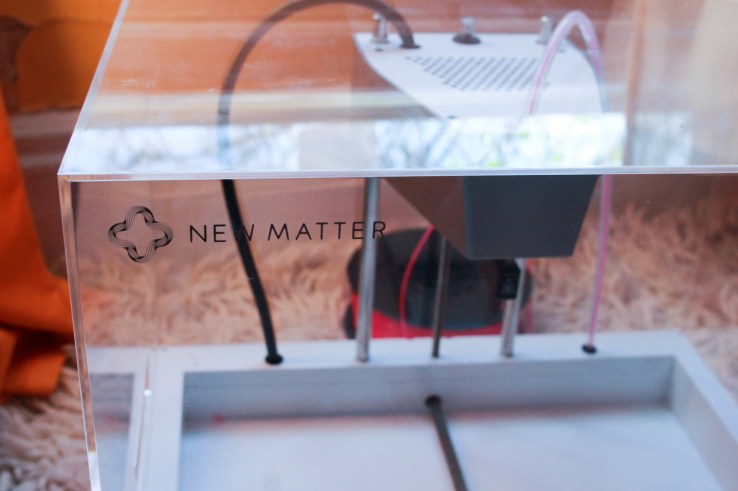
3D printing company New Matter is shutting down this month
Perhaps 2014 wasn’t the ideal time to get into the 3D printing game. After years of hype, the even the biggest names have been struggling to stay afloat. Pasadena startup New Matter is joining the growing list of companies who’ve unsuccessfully made a go at it, announcing that it will be closing up shop by the end of the month.

It’s not for lacking of trying — and the company’s MOD-t printer was met with decent reviews when it launched in 2016. In his writeup, John praised the pricing ($300 or $400, depending on where you picked one up) and ease of use, though added cautiously, “you get what you pay for.”

Initially funded on Indiegogo, the company went back to the crowdfunding well last year, this time taking to Kickstarter to pay for a Model 2. The project managed to exceed its goal in five days, but New Matter still pulled the plug. The company says it ultimately wanted to go back to the drawing board.

“We have always strived to listen closely to our customers’ feedback, and given the overall reaction to the MOD-t (2nd Gen),” New Matter wrote, “we decided that the best course of action would be to discontinue the Kickstarter campaign effective November 15, 2017, rethink our next generation offering, and return with additional updates in the coming year.”

By the holidays, the company was offering up its first-gen product for $200, which now appears like another red flag. The truth is that much of the shine has worn off consumer 3D printing, and even those companies that have found success have ultimately found it difficult or impossible to compete with low cost juggernauts like XYZ, which have simply undercut the competition.

In his announcement, New Matter CEO Steve Schell acknowledges that market difficulty was a major factor in the company’s decision to cease operations, writing, “It has become clear that our aspirations to transform the industry simple don’t fit profitably into the current market dynamics in desktop 3D printing.”

While it’s ceasing operations by end of month, the company will offer some technical support through the summer. After that, however, the machines will lose some functionality, so go forth and print like every day could be your last.

source:TechCrunch

Engineering against all odds, or how NYC’s subway will get wireless in the tunnels
Never ask a wireless engineer working on the NYC subway system “What can go wrong?” Flooding, ice, brake dust, and power outages relentlessly attack the network components. Rats — many, many rats — can eat power and fiber optic cables and bring down the whole system. Humans are no different, as their curiosity or malice strikes a blow against wireless hardware (literally and metaphorically).

Serverless software deployment to the cloud, this is not.

New York City officially got wireless service in every underground subway station a little more than a year ago, and I was curious what work went into the buildout of this system as well as how it will expand in the future.

That curiosity is part of a series of articles I’ve written on an observed pattern known as cost disease, the massively inflating costs of basic human services like health care, housing, infrastructure, and education. The United States spends trillions of dollars on each of these fields, massively outspending similar nations for little and often even negative gain.

Despite the importance of reining in costs, experts are befuddled at the underlying causes of cost disease amid a laundry list of potential factors, including complicated procurement processes, labor rules, underinvestment in software, productivity gains in affiliated fields, environmental regulations, and the list goes on.

I explored a bit about health care, and the skyrocketing costs in that field, despite the fact that few people in the industry understand those costs at all. Activity-based costing appears to be one potential solution there that startups are pursuing. I also looked at California High Speed Rail and the massively spiraling costs of that boondoggle, as well as some of the startups trying to improve efficiency in that category.

This past week, I explored the challenges of what appears at first glance to be a relatively simple problem: how do you get wireless service in New York City subway tunnels? Cellular technology is hardly novel, and transit systems throughout the world have been able to modernize in some cases more than a decade ago.

While riders may desperately want their YouTube videos underground, the real value of such a system is for the business operations of the Metropolitan Transportation Authority (the MTA, which operates the NYC subway among other commuter rail and bus systems). Ticketing systems, arrival time indicators, emergency services, and other critical services are all run through this wireless system.

There is in fact a startup working on the problem, Transit Wireless. The company was formed in 2005 to respond to a request for proposals from the MTA and filled with veteran telecom executives. The authority rewarded the contract to Transit Wireless, which now holds a 27-year license to operate cellular service in the subway system.

William Bayne, the CEO of the company, explained that an important component of the contract was that the company couldn’t rely on taxpayer funding. “Our license requires us to design, build, own, operate, and finance the network,” he said. Transit Wireless raised its own equity capital to cover the costs of deploying the system, and generates revenues as the service provider over the life of the license. In fact, MTA receives a stream of revenue from Transit Wireless as well.

The company faced a number of challenges in building out the system. The first challenge was that the installation could not disrupt transit customers. Bayne said, “We had to figure out how to deploy network and equipment while minimizing disruption of the transit system itself.” That meant working overnight when labor costs are higher, and also placed the company at the mercy of the MTA’s maintenance windows to install network equipment.

Even more challenging was securing the right equipment. The NYC subway “is a 110-year-old system with low ceilings and lots of water, and it wasn’t designed to embrace a lot of electronics,” Bayne said. Wireless equipment “had to withstand all of these changes in environmental conditions: cold, heat, water, brake dust. Everything had to be passively cooled and fully-enclosed so it didn’t ingest any of the environment into the equipment.” That specialized, “mil-spec” equipment doesn’t come cheap.

As with the story of any infrastructure, particularly in New York, rolling out wireless connectivity to 282 active underground stations was anything but cheap. The final cost of the rollout was north of $300 million for Transit Wireless, a dramatic increase from early estimates which said that the project would cost “up to $200 million.” As a private entity spending private dollars, the company obviously had enormous incentives to hold down costs.

Perhaps more importantly for riders and the MTA itself, the timeline of the project ended up dragging. The first six stations in the system began offering wireless services in September 2011, about six years after the original contract signing. In the MTA’s announcement, the remainder of the rollout was expected to happen “within four years,” but another six years would actually pass before all remaining underground stations got service around New Year’s Day 2017. In all, it took about twelve years from contract signing to project completion.

While the costs and time required to build out the network were significant, Transit Wireless believes that the infrastructure it has built will stand the test of time. It designed the system to be “future-proof” by installing a fiber optic backbone with significantly more capacity than needed to handle whatever new technology might come, such as 5G wireless services. It also built a series of five data centers that act as data infrastructure hubs for the subway system, potentially lowering the cost of offering new services in the future.

The company, whose network spans much of New York City, hopes to be a core provider of smart city services in the future. Bayne envisions a world where real-time information about transit systems could be fused together, giving consumers access to smart transportation solutions — think connecting Uber and Lyft to smart bikes, parking meters, and the subway system to create a seamless, adaptive transportation system.

In addition to the smart city initiatives, Transit Wireless obviously is eyeing the tunnels as one of the most important infrastructure challenges going forward. Given the age of the tunnel construction, they are much narrower than the engineering standards used today for modern transit systems. In some cases, installed equipment has to fit within just a handful of inches of space lest a moving train rip the equipment right off the wall. “We have to be extremely precise on how we deploy equipment in there to be very precise to stay within those clearance envelopes,” Bayne said.

Currently, the company is offering a pilot demonstration of tunnel service on the shuttle between Times Square and Grand Central Station, which launched in December.

The lessons of the rollout are ultimately a question of desires from transit customers (who also happen to be voters) — how badly do we want new infrastructure, and how much are we willing to be inconvenienced to get it? We can’t have nice things today and also want no schedule changes in a system that operates 24/7 every day of the year. Unless we as transit riders say loudly and clearly “inconvenience me today for a better tomorrow,” keep expecting the same compromises to happen.

source:TechCrunch

With $250 million, Peter Diamandis’ new startup is all about taking stem cells from placentas
Stem cells derived from a human placenta hold the key to unlocking a myriad of potentials in regenerative medicine and are the focus of X-Prize and Singularity University founder Peter Diamandis’ new endeavor.

Called Celularity, the startup is a spinout from Celgene, a global biopharmaceutical company creating gene therapies. Diamandis teamed up with Dr. Robert Hariri, the founder of Celgene Cellular Therapeutics, to create Celularity in the hopes of using stem cells found in the human placenta to quickly regenerate tissue and organs needed to treat cancer and other diseases. The idea is these types of cells can do a better job of helping us live longer, fuller, healthier lives.

It’s a wild proposal and, seemingly, the stuff of science fiction often tossed around in certain Silicon Valley circles — create a startup focused on a medical breakthrough to make us live forever — or at least much, much longer than we currently do. But stem cell technology has been around for some time.

Lab worker with human stem cells
Lab worker with human stem cells.
For decades stem cells have posed an ethical quandary as they’ve largely been harvested through discarded embryos. However, in just the last few years, science has discovered adult stem cells can come from a number of sources throughout the human body — including a woman’s placenta, shortly after giving birth.

Placental stem cells are even more important as they can be taken from any placenta and injected into any human without the risk of the body rejecting them, according to the company. And, because they are so abundant, treatments are potentially more affordable and can begin immediately.

But this is not the first time Diamandis has dipped his toe in longevity research. He cofounded Human Longevity Inc. in 2014 to focus on extending the human lifespan. Celularity extends his interests in this endeavor.

So far, the startup has conducted several clinical trials and treated “hundreds” of patients, Hariri tells TechCrunch. The next step is to try and gain FDA approval to roll these treatments out on a mass scale.

That approval may be just around the corner — possibly in the next 12-24 months, according to Hariri. That’s because “cellular medicine is intrinsically safe,” he says, adding the potential could have a “huge impact” on U.S. medicine.

So just how are Diamandis and Hariri obtaining these human placentas? Donations. Though some couples choose to keep (and later eat) their placental afterbirth, approximately four million human placentas are disposed of per year in U.S. hospitals.

While this strange, yet magical temporary organ is from a human mother, some states consider it to be a biohazard after birth and discard it as waste. Couples, by law, therefore cannot take and sell the tissue to Celularity or some other outfit hoping to use it up. But they can donate it.

That’s where Celularity comes in. The startup procures the placental tissue from hospitals willing to hand over would-be waste in the name of science.

Right now the field is pretty wide for Celularity, too. The company is only competing with a handful of others in the same space like Israeli biotech firm Pluristem. Though it seems to be the only player in the U.S. at the moment.

Add to that a whopping $250 million in new funding from several prominent investors and celebrities to help it grow, including well-known life coach Tony Robbins, John Sculley of Apple and Pepsi-Cola, former GV partner and founder Bill Maris, who now runs a new biotech funding venture Section 32, and Andrew Von Eschenbach, the former commissioner of the U.S. Food and Drug Administration.

Naturally, Celgene led the latest round, with cash infusions from United Therapeutics Corporation, Sorrento Therapeutics and Human Longevity, Inc. to boot.

One other big heaping help to the startup — Celularity owns and operates LifeBank USA, the world’s only repository of donated placenta cells and biomaterials. So, presumably, should any other companies want to do something similar in the U.S., they’d need to go through a subsidiary of Celularity first.

Celularity is sure to stay a large player in this field as it continues. It owns the whole chain from procurement to deploying treatments. It also holds 1,800 patents on the procedures.

“Our ultimate mission is to make 100 years old, the new 60, and to provide people with maximal aesthetic, mobility, and cognition as they age,” Diamandis said. “The 20 years of science, research, and intellectual property pioneered by my visionary partner Dr. Bob Hariri, is the cornerstone for the coming longevity revolution.”

source:TechCrunch

While you can't watch the 2018 Winter Olympics with your Google Home speaker, you can still use it to follow along. Here's how.

With the 2018 Olympic Games officially underway, it can be difficult to keep track of everything that's going on. While you can't necessarily watch the Olympics with your Google Home speaker (you'll need a media streamer or VR headset for that) you can still use Google Home to follow along and test your knowledge. Here's how.

Olympic athlete facts

Some of the Olympic athletes this time around may be new to you. If you find yourself wondering who is representing your country, you can just ask Google Home about them. Say things like:
  • "OK, Google, how tall is [athlete's name]?"
  • "OK, Google, how old is [athlete's name]?"
  • "OK, Google, where did [athlete's name] go to college?"
  • "OK, Google, how many medals has [athlete's name] won?"
  • "OK, Google, how much does [athlete's name] weigh?"
  • "OK, Google, where was [athlete's name] born?"
Google won't always have the answer, especially if the athlete is completely new or relatively unknown, but it's a good place to start.


Olympic facts

You can also ask Google Home for interesting facts about the Winter Olympics themselves. Say, "OK, Google, tell me a fun fact about the games in Pyeongchang."

It explained the term "snurfer," which is a combination of "snow" and "surfer," or what we now call snowboarding. And it told me about Francisco Fernández Ochoa, the first Spanish gold medalist in the Winter Games for giant slalom in 1972, and his sister, Blanca Fernández Ochoa, who became the first Spanish female Olympian to win a medal 20 years later.

Olympic Channel

Olympic Channel is an Assistant app that lets you play Olympic trivia, learn about athletes, and get the latest news.

To get started, just say, "OK, Google, let me talk to Olympic Channel." Follow the prompts (such as allowing Olympic Channel to get your name from Google), and then say something like, "Play a game" or "Tell me about Elana Meyers Taylor."

One feature, called News Feed, is not active just yet (since the games have just started), but should become functional once there's some news to go around, such as gold medals won and other happenings.

NBC Sports Trivia

There is also a Google Home game from NBC made specifically for the Winter Olympics. Just say, "OK, Google, open NBC Sports Trivia." It will ask you a mixture of five multiple choice and true-or-false questions each time you play.

Watch updates on Chromecast

Since NBC is the broadcasting partner for this round of Winter Olympics, you can use Google Home to stream news updates to a nearby Chromecast. Just say, "OK, Google, play NBC Sports on [Chromecast name]." The latest Olympic updates from the NBC Sports YouTube channel will play in reverse chronological order. Just know that you may also get some general sports updates along the way, as well.

Ask who won

The Google Blog also says you will be able to ask who won certain events . Just say something like, "OK, Google, who won the women's 1,000 meter speed skating in the Olympics?" or "OK, Google, who won mixed doubles curling in the Olympics?"

Just keep in mind that no events are over yet, so there are no winners to announce… yet.

source:CNet

The Trump administration is worried about China spying on US phone networks

The idea is that a centralized network could protect US communications from Chinese spying. But it might prove a hard sell.

National security officials working for President Donald Trump are considering building a superfast 5G network as an option to counter Chinese spying on US phones, according to a report published Sunday.

Details of the plans come courtesy of a PowerPoint presentation and memo produced by a senior National Security Council official seen and reported by Axios. An unnamed senior administration official confirmed the accuracy of the information late Sunday to Reuters.

A nationalized 5G network is currently under discussion at a low level in the Trump administration and won't be considered by the president for six to eight months, according to Axios. The network would be designed to counter Chinese threats to US economic and internet security, with emphasis on protecting emerging technologies reliant on 5G, such as self-driving cars and the internet of things.

Watch this:What the heck is a 5G network?

Such a network could be built and owned by the government, with infrastructure rented out to US carriers. This would be a significant departure from the current system, in which network providers build their own infrastructure and lease airwaves from the government.

The telecommunications industry has already been busy getting ready for a future built on 5G, the next-generation wireless technology that promises significantly better speed and coverage than current 4G networks.

While widespread implementation is likely still several years off, Verizon, the largest carrier in the US by number of subscribers, expects to begin commercial 5G operations as a broadband replacement service later this year. It's set to spend around $17 billion in 2018 on capital projects, which includes its work on 5G. AT&T said it plans to launch a mobile 5G network in a dozen markets by the end of the year.

China companies have their own 5G ambitions. Last week, mobile chip giant Qualcomm announced plans to build 5G phones as early as 2019 with some of the largest Chinese phone makers, including Lenovo (Motorola's parent), Xiaomi, ZTE, Oppo (OnePlus' owner) and Vivo.

'A costly and counterproductive distraction'

On Monday, FCC Chairman Ajit Pai -- a Republican appointed by Trump -- spoke out against the idea of a nationalized US network.

"I oppose any proposal for the federal government to build and operate a nationwide 5G network," Pai said in a statement. "Any federal effort to construct a nationalized 5G network would be a costly and counterproductive distraction from the policies we need to help the United States win the 5G future."
Fellow FCC Commissioner Michael O'Rielly likewise blasted the plan. Across the aisle, Sen. Mark Warner, a Democrat from Virginia, questioned the need for such a network.
While I'm glad that the Trump Administration recognizes that maintaining American leadership in the information age requires a significant investment commitment, I'm concerned that constructing a nationalized 5G network would be both expensive and duplicative, particularly at a time when the Administration is proposing to slash critical federal investments in R&D and broadband support for unserved areas,

he said in a statement.
Representatives of the White House didn't respond to a request for comment.

The plan also raises a number of questions, including how the government would build the network and what airwaves it would use to power the service. The next-generation network requires extensive amounts of wireless spectrum to enable its high speeds, as well as a comprehensive array of cellular radios, and it's unclear where it would get those resources. The FCC has actually auctioned off spectrumto private companies willing to build their own networks.

Still, a government-run network could theoretically let smaller companies rent capacity and offer competitive services, according to NewStreet Research analyst Blair Levin. The risk is that wireless providers may re-evaluate their own 5G investment plans with the prospect that the government could become a source of competition.

Pai says the best way forward is to push spectrum to the private sector and encourage companies to do their own thing.

"The market, not government," he said, "is best positioned to drive innovation and investment."

source:CNet

Elon Musk’s Boring Co. flamethrower is real, $500 and up for pre-order So that flamethrower that Elon Musk teased The Boring Company would start selling after it ran out of its 50,000 hats? Yeah, it’s real – and you can pre-order one now if you want need a ridiculous way to spend $500.

Musk revealed the flamethrower on Saturday, after some digging tipped its existence late last week. The Boring Company Flamethrower is functional, too, as you can see from this Instagram featuring some Boring Co. staff, presumably well safety trained, firing off two of the things IRL.

Elon Musk (@elonmusk)'in paylaştığı bir gönderi ()
Marketing copy for the flamethrower includes a “guarantee” that it will “liven up any party,” and a proclamation that it’s “world’s safest flamethrower,” in case you were concerned (you probably are not, if you’re ordering a flamethrower on the internet). The $500 fee doesn’t include taxes and shipping, which are added at checkout, and the initial shipments will come out in spring.

There’s also a disclaimer about international shipping incurring extra fees (and maybe seizure at the border?) plus, buyers will be required to review and accept a terms and conditions document prior to getting their flamethrower in the mail.

Elon Musk (@elonmusk)'in paylaştığı bir gönderi ()
The Boring Co. also sells a fire extinguisher, because they know how to make an upsell with specific relevance, and it’s $30, which they fully admit is more than you’d pay elsewhere. But it has a sticker. There’s not even a picture, so it probably doesn’t look all that impressive.

Musk’s Boring Company is literally a company focused on tunnel boring, but it seems like it’ll be a while before it has revenue or significant results (even if it’s already digging test tunnels). To fund the project until then, selling weird stuff with the company’s logo to Muskheads everywhere seems like a decent plan. Even if it contributes negatively to the sum total of working flamethrowers existing in the world.


source: TechCrunch

You can now preorder Apple's $349 HomePod

Apple's first smart speaker finally emerges, well after Amazon's Echo speakers and the Google Home family dominated the conversation.

For Apple's HomePod, it's better late than never.

The smart speaker became available for advance orders in the online Apple Store in the US, UK and Australia on Friday. While you can typically put in an order for new Apple products at 12:01 a.m. PT, the HomePod wasn't available until just before 5:45 a.m. PT.

A little patience was required for Apple's latest product. The consumer electronics giant unveiled the HomePod at its developer conference in June and said it was slated to ship in December, but it ended up delaying the release to early this year. The device will hit stores Feb. 9.

The HomePod is available for $349, £319 or AU$499 in white and space gray. Apple has positioned it as a speaker first, smart device second. You'll be able to ask Apple's Siri voice assistant to do things like play a song on Apple Music, send a message to a friend through WhatsApp or control your smart lights. Later this year, you'll be able to link two HomePods together for multiroom listening and stereo sound.

Unlike recent iPhone launches, the HomePod didn't immediately sell out Friday, and the Apple Store didn't have glitches that prevented people from placing their orders. As of 5:45 a.m. PT, both the white and space gray versions of the speaker were still available, and the shipment date lists Feb. 9. Apple's hottest iPhone models have tended to sell out within minutes.

Watch this:Apple HomePod: Everything to know before you buy

Anticipation for Apple's HomePod is likely nowhere near as high as demand for a new iPhone. Despite efforts to get into new markets like wearables and the smart home, Apple still makes about two-thirds of its sales from its smartphones.

Working against Apple's smart speaker is the popularity of Amazon's Echo and the HomePod's higher price compared to rivals. The speaker also doesn't easily stream music from third-party services like Spotify, and the number of other tasks you can ask of Siri is limited. Siri itself has been deemed a subpar voice assistant by researchers. And even though Apple is pushing HomePod's audio capabilities, that may not win over as many people as it hopes.

"There is not a large market for high-quality audio," Creative Strategies analyst Ben Bajarin said. "Most Echo owners are completely content with the sound quality and say it is 'good enough' for their needs."

Siri, can I buy a HomePod?

When Apple showed off the HomePod for the first time in June, it positioned its new device as a music experience rather than just a smart-home hub, ostensibly to "reinvent home music." It has better audio specs than other hub speakers and an A8 chip for processing (the same chip that's in the iPhone 7). It uses a wide-array mic that supposedly can hear you over the music, and naturally integrates with Apple Music. It can also control HomeKit devices.

source:CNet

Shadow launches its cloud computer for gamers in the UK
French startup Blade, the company behind Shadow, is launching its cloud gaming service in the U.K. Just like in the U.S., the company is starting with a pre-sale before accepting all customers.

For a flat monthly fee, you can rent a gaming PC in a data center near you. You can then access this beefy computer using desktop and mobile apps as well as the company’s own little box. It’s a full-fledged Windows 10 instance — you can install Steam, Battle.net or whatever you want.

And British customers will get the exact same specs. Each user gets a high-end dedicated Nvidia GPU — the company is currently using a mix of GeForce GTX 1080 and Quadro P5000. You also get 12GB of RAM, 256GB of storage and eight threads on an Intel Xeon 2620 processor. The company says it’s a high-end gaming machine worth around $2,100/£1,500.

Now let’s talk about pricing. You can get a Shadow instance for £26.95 per month with a one-year commitment, £32.95 per month for a three-month commitment and £39.95/month without any commitment. Even if you choose to commit, you don’t have to pay everything upfront — you’ll get charged every month. Plans cost nearly the same price in France and the U.S.

Finally, you can also get Shadow’s own little box that you can plug directly to your TV or a monitor. You can rent it for an additional £7.95 per month or pay £109.95 once. The first 500 British subscribers will get it for free.

Finally, make sure you have a fast and stable connection before subscribing to Shadow.

Source:TechCrunch

Knife-threatening app banned by Google

An app aimed at children that featured a voiceover making threats to cut them with a knife, has been banned by Google.

Blaze and the Monster Machines was removed from the Google Play Store following complaints from parents.

There is mounting pressure on firms to make their platforms safer for children.

One firm that offers real-time blocking software said Google "failed egregiously in its duty of care".

The unofficial app was based on a Nickelodeon show, also called Blaze and the Monster Machines.


Knife-threatening app banned by Google
The voiceover starts off in a friendly manner: "Hi kids, I'm your new friend! You see, I want to play with you kiddo. Maybe we could perform some fun games together."

It then takes a sinister turn: "You look afraid, is it this knife in my hands? Making you a little nervous? This knife is going to improve your look when it's sticking right out of you."

Following horrified reactions from parents, Google pulled the app, saying: "We have a set of policies designed to provide a great experience for users and developers and we act quickly to remove apps from Google Play that violate those policies."

Richard Pursey is chief executive of SafeToNet, a UK firm which offers to protect children from issues such as cyber-bullying, grooming and trolling with software that blocks such content in real-time.

He said:

While we applaud Google's response of taking the app down, it is simply too late. By the time content has been flagged to Google or any other app store, it will have been seen by millions of children.

Unfortunately, this forms a fairly common trend. For example, recently, YouTube removed a children's cartoon called Paw Patrol that showed children sleepwalking to their deaths.

This was viewed over three million times before it was removed. We have also seen clips of Peppa Pig drinking bleach and Elsa from Frozen using automatic weapons.
Children's charity the NSPCC urged parents to set up parental controls on their childrens' phones and have "regular conversations" with them about staying safe online.

The government is keen that social networks and other technology platforms take more responsibility for the content they carry.

In a speech at the World Economic Forum, Prime Minister Theresa May said that making tech firms into publishers was "very complicated" but asked whether there could be a new definition for them, which might make it possible to make them legally responsible for their content.

source: bbc

The social network said a new tool for spotting posts from a Russian troll farm will be available by the end of the year.

Facebook is creating a tool to let people see what Russian propaganda they may have followed.

Facebook says it's trying to be more transparent about how Russian agents used the social network to meddle with last year's US election.

On Wednesday, the social network said it's creating a tool that will let people see what content they liked or followed between January 2015 and August 2017 that came from Internet Research Agency, the Kremlin-linked troll farm that tried to influence Americans during the presidential campaign.

The tool will show you what you liked on both Facebook and Instagram, which Facebook owns. It will be available at Facebook's help center page by the end of the year.

It is important that people understand how foreign actors tried to sow division and mistrust using Facebook before and after the 2016 US election, the company said in a blog post.
Facebook has been under intense scrutiny for the role its platform played in the election. In September, CEO Mark Zuckerberg disclosed Facebook sold $100,000 worth of ads to Russian-linked accounts. Later that month, Facebook said Russian-backed content, which includes also includes unpaid "organic" posts, was seen by more than 126 million people on the social network. That number goes up when you include content on Instagram.

Facebook, along with rivals Google and Twitter, was grilled by lawmakers over the matter earlier this month during three congressional hearings on Capitol Hill.

The tool will have limitations. It will only notify you if you directly followed or liked an IRA post, not if a post from the group simply showed up on your feed because a friend liked it, according to Bloomberg.


source: CNET

MKRdezign

Contact Form

Name

Email *

Message *

Powered by Blogger.
Javascript DisablePlease Enable Javascript To See All Widget