Articles by "Internet"

Fake cryptocurrency lists 'Ryan Gosling' as its graphic designer

A cryptocurrency with Ryan Gosling as the graphic designer? That doesn't seem right...

On the face of it MIROSKII looks like any normal initial coin offering for a brand new cryptocurrency.

Buzzwords, "banking without bankers", a team of cryptocurrency experts working together on a new piece of ground breaking technology. Great stuff.

But then you scroll down its list of advisors and notice something a bit weird.

Is that... Ryan Gosling?

Meet Kevin Belanger, an "[e]xperienced graphic designer with a clear focus on identities and illustration." He is apparently working on MIROSKII. He also looks a lot like Ryan Gosling. That's because his profile picture is literally a stock image of Ryan Gosling.

So is Ryan Gosling working on an ICO for a brand new cryptocurrency?

No, he is not.
For background, an "ICO" is an "initial coin offering". An ICO allows potential buyers to invest in a cryptocurrency before launch. ICOs are used to help fund the development of a new currency. If the technology is legitimate, it can be good to get in early before it starts getting traded freely on exchanges.

But the MIROSKII ICO appears to be an elaborate fake.

The MIROSKII ICO (and the Gosling connection) was intially brought to our attention by Jackson Palmer, the founder of Dogecoin, who we profiled as part of our Blockchain Decoded series.

It was initially uncovered by Twitter user @CryptoShillNye.
Incredibly, it looks as though almost everyone on MIROSKII's list of advisors is fake.
From our own research, Perry Henderson is listed on the site as a "Blockchain enthusiast", a CEO of multiple online companies, but a quick Google search uncovered this: Perry Henderson is actually a real estate agent from Texas.

Joel Hermann ("Founder of Mysterium Network" and a "[h]uge technology fan") is actually Ben B. Rubinowitz, a practicing lawyer from New York.

Claus Wahlers has just completed a list of all the people apparently advising MIROSKII and their actual real identities.

So far every single person on the team he's looked into is "fake".

For example, "Mark Anderson" is Christopher Cane, the image was taken from his Twitter profile. Craig Gulledge is Peter Roper, a business developer. Many others appear to be taken from stock images.

Perhaps the most disturbing part of this story: MIROSKII appears to have raised $833,000 already. We have no real way of verifying at this point if the money raised is a legitimate figure.

Most likely it's not legitimate, but we have no way of telling at this point. We've attempted to get into touch through MIROSKII's social media, but we've yet to hear back and don't expect to hear back at this point.

source:CNet News

As net neutrality rules expire, changes may start to creep into how your internet works. Not everything you hear is quite true though.

AT&T has opposed the FCC's 2015 net neutrality rules. And as the rules are set to expire, some supporters of the regulation are nervous AT&T and other ISPs could abuse their power on the net
The Federal Communications Commission's 2015 net neutrality rules will officially be dead in a matter of weeks. So naturally, people are anxious about what that means for the internet as we know it today.

It's this anxiety and fear that's likely fueling recent blog posts stating that AT&T is rolling out so-called "internet fast lanes."

But is it true? Is AT&T carving out lanes on the internet and offering the speediest service to the highest bidder, while leaving all other internet traffic relegated to "slow lanes"?

Not exactly. AT&T hasn't introduced a new service that explicitly prioritizes one type of traffic over another.

"The author is getting the two distinctly different concepts mixed up," an AT&T spokesman said by email.

But that doesn't mean that it isn't offering other services that might run afoul of the strict net neutrality restrictions that are set to expire next month.

CNET has put together this FAQ that explains what's really going on and why consumers should still keep an eye on whether AT&T is playing nice with competitors on the internet.

What is net neutrality again?

Net neutrality is the idea that all traffic on the internet is treated equally. In 2015, the FCC under then-President Barack Obama adopted a set of rules that made sure broadband companies couldn't block or slow down access to websites. The rules also prevented internet service providers from creating fast lanes.

Watch this:Beer helps explain battle brewing over net neutrality

What exactly are internet fast lanes, anyway?

Internet fast lanes could be created if ISPs charge internet companies like Google or Netflix so that their services reach customers faster than other services on the net. That is, they'd be giving priority access to some services and not others.

Net neutrality supporters fear that anyone who can't or won't pay a fee will be relegated to congested "slow lanes." Think of it like priority boarding on an airplane. People who pay for first class get the best, roomiest seats and are guaranteed space for their luggage, while everyone else who could only afford coach is crammed in the back of the plane and can barely carry on a toothbrush, let alone a bag.

It's this idea of creating an internet of haves and have-nots that led the FCC in 2015 to ban these paid priority services as part of its net neutrality rules.

But is paid priority always bad?

Not necessarily. AT&T and others point out that some services are so time- and delay-sensitive, they just don't work if packets are held up by network congestion. Self-driving cars, remote surgery and virtual reality are all examples of real-time interactive technologies that would require guaranteed levels of service. AT&T's executive vice president of government affairs Bob Quinn argued in a blog post this week that the 2015 ban on these services meant companies couldn't experiment with services that require end-to-end network management, which he said is bad for innovation.

"I think we can all agree that the packets directing autonomous cars, robotic surgeries or public safety communications must not drop. Ever," he said. "So, let's address concerns around paid prioritization without impacting those innovations."

What about those reports suggesting AT&T is starting to offer paid priority services?

This is where things get confusing. AT&T doesn't currently and hasn't yet announced any service that offers priority over the internet. What AT&T announced last week -- and what some news outlets confused as paid priority-- was an expansion of a program it calls "sponsored content."

Under this business model, AT&T allows a company to pay it for data charges that a customer incurs while using that company's service. So instead of the customer paying for the data, the company pays for it.

"Sponsored content is delivered in the same manner as other third-party content," an AT&T spokesman explained. "The only thing that changes under this model is that the sponsored content does not impact the user's data plan."

Here's how it works. Let's say you offer a streaming video service. Video eats up tons of data. Since mobile customers pay for the data they use, you as a video provider may want to pay for your customers to stream your service without having to worry about paying for the data charges, thus providing customers an incentive to use your service over someone else's that incurs data charges.

AT&T began offering this service for its postpaid customers (those who pay at the end of every month) in 2014 before the 2015 net neutrality rules were adopted. And it just expanded the program to its prepaid customers last week.

Do sponsored content services violate the 2015 net neutrality rules?

No. In fact, the FCC specifically said sponsored content, in a practice known as "zero rating," is not prohibited under the rules. It recognized that there could be benefits to consumers, such as lower cost of service. But the agency also realized that depending on how the plans were structured, it could also put competitors at a disadvantage.

This is especially concerning since broadband companies like Comcast and AT&T own a lot of content, which means they also compete with companies like Amazon or Netflix. So a broadband company, which also owns the network, could offer its services free of charge to customers, while competitors might not be able to afford to offer the same low price because they don't own the underlying infrastructure.

The FCC saw this potential conflict and included a broadly defined "general conduct" rule, so it would have the authority to examine any practice that causes "unreasonable interference" or that "disadvantages" competitors.

Did the FCC ever think AT&T's service was problematic?

Yes. Within a year of the rules being adopted, the FCC, then controlled by Democrat Tom Wheeler, launched an investigation into programs offered by AT&T, T-Mobile and Comcast. It later added Verizon to the investigation. In January 2017, the agency issued a report stating AT&T and Verizon had violated the general conduct rule.

The biggest problem the FCC had with AT&T's sponsored data program was that it had priced its own DirecTV Now service so aggressively that it unfairly disadvantaged competitors. Since AT&T controlled the network, it didn't have to "charge" DirecTV, its own streaming service, the same rate it would charge a company like Netflix to deliver the same amount of data streams. And because Netflix would likely have to pay more to offer its video streams for free on AT&T's network, customers would end up paying more for Netflix than they would DirecTV.

"All indications are that AT&T's charges far exceed the costs AT&T incurs in providing the sponsored data service," the report stated.

AT&T argued it didn't violate the net neutrality rules and also said that the general conduct rule was way too broad.

Why is AT&T still offering this service if it violates the rules?

The short answer is that the Democrats lost the White House. The FCC's report came out in January 2017, just days before Donald Trump was inaugurated as president and Republicans took over the agency. After Ajit Pai became chairman of the agency, one of the first things he did was close the investigation into AT&T and the other companies over zero rating. And the agency took no action.

"Going forward, the Federal Communications Commission will not focus on denying Americans free data," Pai said in a statement at the time. "Instead, we will concentrate on expanding broadband deployment and encouraging innovative service offerings."

And then late in 2017, the Republican-led FCC voted to overturn the earlier net neutrality rules.

Why should I care about this now?

As the 2015 net neutrality regulations are erased from the rule books, net neutrality proponents fear there will be no rules of the road to prevent AT&T and other large broadband companies from doing whatever they want online. This could mean offering paid priority services that might devolve into internet fast lanes. And the company could develop other business models, like sponsored content, that favor their own businesses over competitors' offerings.

AT&T and others argue they have no plans to discriminate against competitors or limit their customers' internet access. They argue that customers will benefit if the companies can experiment with different business models.

The question consumers must ask is whether we can take broadband companies at their word. Republicans on the FCC seem to believe we can. Democrats, net neutrality advocates, and a slew of online companies, from Google to Etsy, say no way.

One thing is clear: Everyone will be watching very closely what AT&T and others do next.

source:CNet News

Now any corporate customer signed up to G Suite can use the new messaging app with dedicated chat rooms.

Google's messaging app, Hangouts Chat, comes out of beta
Google's messaging app for groups -- Hangouts Chat -- used to be only for people in the company's early adopter program. But this week, Google is releasing it to any corporate customer who wants to use it.

Hangouts Chat lets co-workers, or any group of people, message each other in dedicated chat rooms. People can also share files, photos and videos. These messages can either be private or shared with various groups.

"From direct messages to group conversations, Chat helps teams collaborate easily and efficiently," Scott Johnston, director of product management for Google Drive, wrote in a blog post Wednesday. "With dedicated, virtual rooms to house projects over time -- plus threaded conversations -- Chat makes it simple to track progress and follow up tasks."

This may sound familiar. That's because there are already a lot of other services like this out there, such as Slack, Microsoft Teams and Dropbox, which aim to make work meetings and collaboration easier.

Hangouts Chat is included in Google's G Suite (the company's cloud-based productivity and collaboration platform that businesses pay for), and therefore is deeply integrated with other Google apps like Calendar, Drive and Docs.

People who want to use Hangouts Chat need to be signed up to G Suite. It will become available over the next week. People can access Hangouts Chat via a web browser client or through an app on iOS and Android.

Security: Stay up-to-date on the latest in breaches, hacks, fixes and all those cybersecurity issues that keep you up at night.

source:CNet News

Perhaps better as Microsoft Search

Commentary: Recently, Microsoft began to feature its own name on Bing Translator. Perhaps it's time for the Bing brand to be retired.

Technically Incorrect offers a slightly twisted take on the tech that's taken over our lives
Perhaps better as Microsoft Search
Perhaps better as Microsoft Search?
Microsoft
I contacted Microsoft and asked a simple question: "Am I going bonkers?"

I felt the company's spokeswoman all too readily to reply "you must be the last to know," before I added: "Has your Bing Translator page suddenly been featuring a big Microsoft logo?"

You see, very occasionally, I lurch to Bing just to see what's going on there. And last week, when I clicked onto its Bing Translator link, I was confronted with a big "Microsoft Translator" at the top.

I felt sure I hadn't seen this before. Hence, my inquiry to Redmond.

"You aren't going bonkers," the company's spokeswoman told me. "There were in fact some recent branding changes to make it clear it [Bing Translator] was powered by the same tech used across the other Translator apps, API and live feature."

This was soothing to my soul, though a further explanation from the spokeswoman gave me an idea.

"It's the same Microsoft Translator technology as before," she said, "available via the Bing search engine."

Which, because my soul has mischievous parts, told me that someone at Microsoft might be beginning to wonder whether the Microsoft brand isn't much stronger than Bing.

Does anyone really have a deep, abiding respect for the Bing brand? Somehow, if ever I've heard the brand name being used, it seems to be in the context of a joke.

That doesn't mean the service itself is to be derided. It does suggest, though, that the brand name doesn't incite passion or excesses of reverence.

The Microsoft brand, on the other hand, has become much stronger under Satya Nadella's stewardship. It's gained respect. Especially when the company showed off its Surface Studio in 2016 and made Apple's offerings look decidedly bland.

Where once Microsoft was a joke in an Apple ad, now it's a symbol of a resurgent company that's trying new things and sometimes even succeeding.

The funny thing about Bing is that it's not an unsuccessful product -- at least not as unsuccessful as some might imagine.

Last year, Redmond said it has a 9 percent worldwide search market share, enjoying a 25 percent share in the UK, 18 percent in France and 17 percent in Canada.

And look at the US. Microsoft says it has a 33 percent share here.

Wouldn't it be reasonable to think that going all the way with Microsoft branding and letting Bing drift into the retirement home for funny names might be a positive move?

Wouldn't you rather try Microsoft Search than Bing Search?

I asked the spokeswoman the question. Is this little so-called branding change on Translator the harbinger of bigger things to come? source:CNet

Fake news is not the real problem
It’s the Internet’s fault, we’re told. Brexiters and Remainers, Republicans and Democrats — every side of every political dispute now lives in its own separate reality, bellowing “fake news!” at every attempt to breach their borders of belief. The fragmentation of the media, coupled with the filter-bubble effect and the dominance of Facebook and Google, means that we no longer share any consensus view of reality.

…But I saw The Post this week, and it struck me: we never did. We used to have an imposedview of reality, not a consensus one. As the movie makes clear, editors and Cabinet members palled around weekly, and implicitly agreed on what news would and wouldn’t be fed to the public. (See also Chomsky’s Manufacturing Consent.) The moral crisis of the time came from the realization that the government was lying to its pals in the media, and had been for a very long time.

If that sounds like ancient history, remember that Iraq was not particularly different from Vietnam: in both cases, the White House (and, this time, Downing Street) lied through their teeth to the people; the media accepted and promoted those lies; and a war which consumed hundreds of thousand of lives, and trillions of dollars, ensued. Donald Trump may be the most personally vile President of all time, but his presidency has not (at least yet) been anywhere near as catastrophic as those of Richard Nixon or George W. Bush.

However. The other assumption implicit in traditional journalism was that their job was to provide evidence to the American people, who would then judge it, adjust their views, and vote accordingly. It was assumed that people had an engineering mindset, where one’s worldview can and will be adjusted by new evidence. That mindset, that willingness to allow contrary evidence to adjust what you believe, is why science and engineering work. It is arguably why democracy works, too.

And it would work in a world of fake news. Again, falsified evidence is not new. The US government falsified (by omission) the evidence about Vietnam for a very long time. Politicized “yellow journalism” dates to at least the nineteenth century. But the assumption was that people in general would try to see its falsehoods and inconsistencies, or at least grudgingly accept their existence when they were pointed out. Fake news is a problem that could and would be fixed by a genuine, widespread, good-faith desire for true news.

The real problem isn’t fake news; it’s that people have given up on that search for truth. The real problem is that the engineer’s mindset, wherein one weighs the available evidence, and accept and incorporate new evidence even if it contradicts what you previously believed, has never been more rare. (I’m not pretending it was ever remotely universal; I’m just saying that there was enough of it, barely, for democracy to work more-or-less as intended.)

No longer. The engineer’s mindset has been replaced by the lawyer’s mindset, wherein you pick a side in advance of getting any evidence, and then do absolutely everything you can to belittle, dismiss, and ignore any opposing data, while trumping up every scrap that might support your own side as if it were written on stone tables brought down from the mountain by Moses. I mean no disrespect to the legal profession: some of my favorite people are lawyers, including the one I married. The legal approach is an excellent means of getting to the truth of hard and confrontational matters —

— assuming it is done in the court of some sort of thoughtful, knowledgeable, and relatively impartial judge. But that court doesn’t exist in a democracy, or, rather, the democracy is the court … and so, in order for democracy to work, it requires the engineer’s mindset. The UK, the USA, and other countries seem to have seen that way of thinking wither below a crucial critical mass, to their great and growing cost.

So there’s a certain irony in blaming the tech industry for this, when tech is, for all its many flaws and blind spots, perhaps the last remaining bastion where the engineer’s mindset is (at least in theory) celebrated. Maybe we are in fact to blame; I’d certainly be interested in seeing evidence to that effect.

Maybe it’s the lack of a post-Cold-War common enemy. Maybe it’s a natural evolution of a decadent empire, or a natural reaction to the increasing complexity and incomprehensibility of the world. Maybe it’s the 1% and the finance industry fomenting conflict to distract from their parasitical oligarchy. Regardless, let’s consider the distinct possibility that the so-called scourge of “fake news” is merely a symptom, not the problem.

source:TechCrunch

Google’s Big Ad-Blocking Update Comes to Chrome Tomorrow: Here’s What We Know
It’s been in the works for nearly a year and Google’s great ad-pocalypse is now upon us. On Thursday, the Chrome browser will begin to automatically filter out ads that don’t meet certain quality standards. Your browsing experience is about to change a little bit. Here’s what you need to know.

In April of last year, the news first broke that Google planned to integrate some form of ad-blocking into its browser that would be on by default. Since then we’ve seen a gradual rollout of the feature, beginning with the ability to mute autoplay videos with sound on the sites of your choosing. Now, Google going all-in with a set of criteria for what ads will be kosher in Chrome.

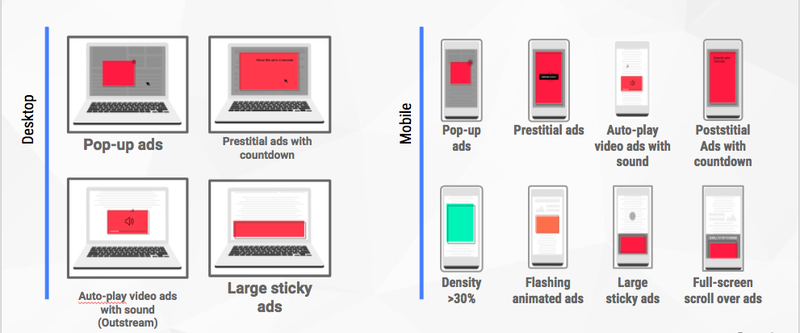
Along with its fellow ad giant Facebook, Google is a member of the Coalition for Better Ads, an industry group that has performed research on what forms of web advertising annoys people the most. It’s created a list of the 12 types of web experiences that should ideally be avoided by advertisers. Now Google is going to enforce that list with Chrome, which is used by over half of all people accessing the web with a browser.

The 12 ad types that Google Chrome will block by default
The 12 ad types that Google Chrome will block by default.
Image Source:Coalition for Better Ads
On Wednesday, the company published a blog post detailing how the system will work. Initially, Google will take a sample of various pages on a specific domain and analyze whether that page is serving any of the offending ad categories. It’ll be given a score of “Passing, Warning, or Failing.” Sites that don’t manage to get a passing grade will be notified by Google and they can review an ad experience report for details on what needs to change. If a site ignores multiple warnings, its ads will be blocked by default after 30 days.

If a user visits a site that’s being filtered by Chrome, they’ll see a message in the address bar that gives them the option to still allow ads—on mobile, users will see a pop-up at the bottom of the screen that will give them the same option. Yes, pop-up ads are blocked, and Google will be informing you with a pop-up notification.

There’s plenty of reason to celebrate this change. The internet is getting harder to navigate, and more annoying with advertisers demanding more obtrusive experiences every day. Google claims that since it kicked off this initiative, “42% of sites which were failing the Better Ads Standards have resolved their issues and are now passing.” So it seems that a lot of site owners got the message before it could even become a problem.

There’s also cause to be skeptical of Google’s altruistic goals. Sure, it’s telling advertisers not to be evil, but it’s also hoping that a better experience will mean fewer people feel the urge to download a third-party ad blocker. That’s good for the internet, which is largely funded by ads. But it’s particularly good for Google, which controls around 42 percent of the US digital ad market and 75.8 percent of the search ad market, according to research from eMarketer. It wouldn’t be so great if Google, with all its power, decided to follow in the footsteps of services like Adblock Plus, which offers companies the opportunity to pay their way onto an acceptable ads list. Representatives for Google have assured us on multiple occasions that the company isn’t offering any kind of paid whitelisting now, and isn’t planning to do so. But things could change.

For now, enjoy the better web before Google fully consumes it all and does whatever it wants.

source:Gizmodo

MKRdezign

Contact Form

Name

Email *

Message *

Powered by Blogger.
Javascript DisablePlease Enable Javascript To See All Widget