Articles by "Apps"

Keyo modernizes housing with rent auto-pay that boosts your credit

Today in dense urban areas, tenants frequently change apartments as their income grows and they tire of different neighborhoods...
T
here’s nothing we spend more money on for a worse experience than housing. Keyo wants to fix all of it. The audacious startup envisions a world where a building’s other tenants get $20 to show you an available apartment on your schedule. Where you auto-pay your rent online and it improves your credit score. Where you get local business perks and can communicate maintenance requests through an app by renting in a Keyo location. And where it’s all free because landlords pay Keyo to fill their units faster.

It’d seem like a crazily ambitious startup idea if it wasn’t already working. Keyo has 4,300 units under management in Brooklyn. And now it’s ready to come out of stealth with a $2.5 million seed fundraise led by a Silicon Valley fixture it won’t disclose that follows Keyo’s $1 million friends-and-family round.

“Renting hasn’t changed much. It needs to,” declares founder Kiran Bellubbi. “You pay rent on time and get nothing in return.”

Bellubbi might have come from the music world, not real estate, but he’s studied in the art of redefining a behavior pattern. His app Band of the Day usurped the traditional music blog, running for five years and winning runner-up to Instagram for Apple’s App of the Year in 2011. Bringing his total fundraise to $10 million, Bellubbi pivoted Band of the Day into Applauze, a concert ticket app that combined official and secondary sales so you could always see the show. Applauze was secretly acquired in 2016 by a joint venture between Azoff MSGE & Live Nation.

Keyo modernizes housing with rent auto-pay that boosts your credit
Keyo faces the daunting challenge of changing the behavior of landlords who either have been collecting checks the same way for decades, or use property management software designed for them but not necessarily the tenant. But similar to how Uber recruited BLACK-car drivers by enticing them with mobile customer demand, Keyo could incentivize landlords by getting prospective residents to demand its perks.

How Keyo works

Today in dense urban areas, tenants frequently change apartments as their income grows and they tire of different neighborhoods. High prices to buy a home and the desire to delay having kids are leading people to rent for longer. “Twelve to 20 percent of inventory churns every year,” says Bellubbi. “I have no allegiance to a building. I just leave.” Keyo gives them a reason to stay.

Keyo modernizes housing with rent auto-pay that boosts your credit
Bellubbi brought the idea for Keyo to me six months ago when it was just a crowdsourced door-opening service that paid locals to show you an available apartment whenever you wanted. Rather than hassle with coordinating a time with a real estate broker, you could preview apartments in the app and go see them immediately. But Keyo needed a better way to get control of properties.

Now Keyo has blossomed into a full-scale software-as-a-service for landlords, targeting small-to-medium-sized renters with 20 to 5,000 units. It’s either full-featured or trying to do too much, depending on your perspective.

Keyo modernizes housing with rent auto-pay that boosts your credit
The iOS and Android apps are free for tenants, and the pitch to them has five key(o) parts:
  • On-Demand Apartment Viewings – Keyo pays the building’s super, another resident or even the current tenant $20 to act as “scouts” to show you available apartments so you don’t have to wait for a specific real estate broker to be able to meet you
  • Online Rent Auto-Pay – Tenants don’t have to deal with remembering to send checks because Keyo connects with their bank for ACH payments
  • Credit Score Improvement – Paying rent on time qualifies as a way to boost your credit score, but most landlords don’t go through the trouble of integrating with the credit agencies the way Keyo does
  • Local Perks – Being a Keyo tenant is like joining a club that gets you discounts at nearby gyms, dry cleaners and coffee shops looking to attract long-term business from nearby residents
  • In-App Maintenance Requests – Instead of nagging your landlord or super to fix something via annoying phone calls and emails, you can easily file requests through the Keyo app, and they can send back building announcements
The idea is that these benefits will generate demand for Keyo apartments, more quickly filling those already available. “Last month you paid 2,500 and got nothing back,” says Bellubbi. Keyo hopes the benefits spur tenants to ask their landlords to sign up and pay $5 per month per unit. They also pay Keyo one month’s rent per rentee it delivers. That might sound like a lot, but that fee plus paying the scout can be up to 40 percent lower than paying a real estate broker the standard 1.5 months rent.

Keyo modernizes housing with rent auto-pay that boosts your credit In return, Keyo’s software gives landlords:
  • A Faster Way to Fill Units – Keyo lists a building’s available units on top sites for no cost while tracking and optimizing the landlord’s ads
  • Tenant Marketing Analytics – Landlords can see exactly which units they have available when, which sites are driving leads and how often people are visiting them
  • Simplified Paperwork – Tenant applications, credit checks, background checks, digital contract signing and lease management all happen for free instead of being passed on as fees to the tenant, which can suppress demand
This offering has led Keyo to sign up 4,300 units in 60 buildings in Brooklyn. Next year it’s looking to expand into more markets.

But first it will have to convince more landlords to modernize or replace their whole software stack. That could be scary with so much money at stake, and some might just want a piece of the suite like the credit-building rent auto-pay. They also might not want any Keyo branding on their building. Expansion beyond the densest cities will be a slog.

Meanwhile, there are plenty of landlord software options. Yardi, appFolio, RealPage and MDSGo are all focused on property management. They have big budgets, brands and track records. But many cater toward larger enterprise real estate titans, and don’t focus on the customer experience with bonus perks.

The millennial generation and beyond want everything to be mobile. In an era when all your subscriptions pay themselves, having to stamp and mail a physical check on time is a pain. And because people are renting for longer instead of buying housing, they don’t have the same opportunities to build up solid credit. By using rent auto-pay and credit as a wedge, Keyo could pry open a lucrative market that hasn’t kept up with the times.

source:TechCrunch

Microsoft Pix can scan business cards to your contacts, find people on LinkedIn
LinkedIn used to have its own business card scanning app, CardMunch, which served a useful purpose in a world where paper cards simply refuse to die. But that app was shut down back in 2014, with LinkedIn suggesting users move to Evernote instead. Today, Microsoft is bringing back business card scanning – but this time, not with a dedicated card scanner app, but with its multipurpose, A.I.-powered camera app, Microsoft Pix.

Since its launch in 2016 as an iOS app that helps you take better pictures, Microsoft has increasingly found more productivity-related uses for Pix. In September, for example, the app was updated to include a way to snap better photos of documents, post-its, whiteboards, and yes, business cards.

But with today’s update, Pix’s business cards smarts are being upgraded – this time with a LinkedIn integration. In the latest version of the iOS app, Pix includes a new business card feature that will add new contacts both to your iPhone’s address book, as well as to your LinkedIn account.

Microsoft Pix can scan business cards to your contacts, find people on LinkedIn
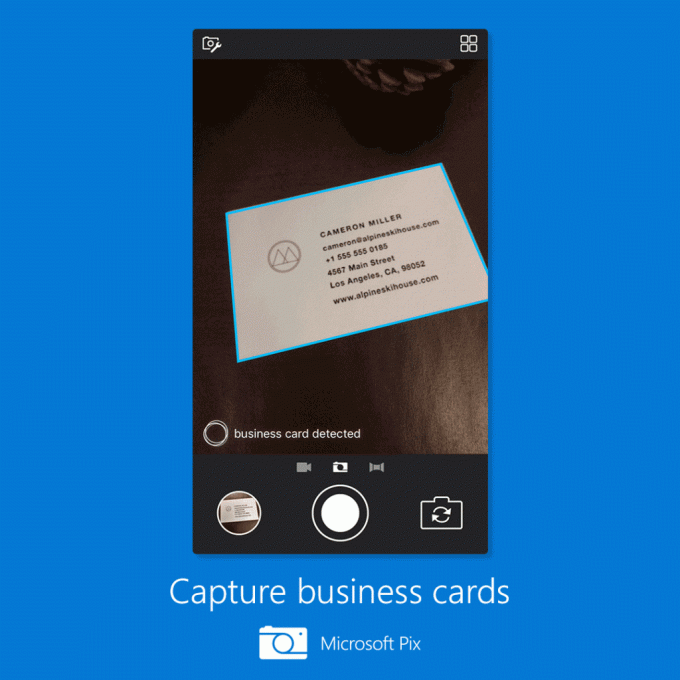
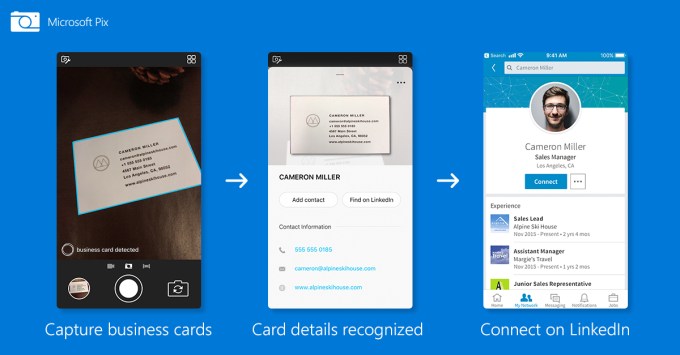
To take advantage of this option, you just launch the app and point it at the business card. Pix then automatically detects what it’s seeing, and asks you if you want to “Add Contact” or “Find on LinkedIn.”

When you tap to add the contact, Pix captures and organizes the contact information – like name, phone, address, and URL – into the correct fields, and adds the newly created contact to your iPhone’s Contacts app. If you opt for LinkedIn, you’re able to view the person’s profile in the LinkedIn app on your iPhone, and optionally add them to your list of connections.

The business card scanning feature, like others in Pix, leverages A.I. technology under the hood to enhance and improve the image. In the case of business cards, Pix is able to detect the edges of the cards, sharpen focus, and tweak the angle of the photo to render the image in a straight-on perspective so it can extract the information from the card.

Microsoft Pix can scan business cards to your contacts, find people on LinkedIn
The Pix update is just one of several ways Microsoft has integrated with LinkedIn since acquiring the company for $26.2 billion in 2016. It has also tied LinkedIn into its other products, including Office 365, Outlook.com, Dynamics 365, Word, and Windows 10.

The updated version of Microsoft Pix is rolling out today. You may not have it yet, as it has to propagate across the App Store, so keep your eyes peeled.

source:TechCrunch

This eQuoo app games you to into learning useful psychological skills
Mental health is one of the biggest issues of recent times, with Kendall Jenner, Emma Stone, Lady Gaga and even The Rock opening up about their mental health issues. Even the royal family has got in on the act, setting up the Heads Together charity. And it’s not just a fleeting issue. The World Health Organisation says depression will overtake cancer as the world’s main ‘global disease burden’ by 2030.

So it’s not surprising that meditation apps like Calm are going gangbusters amongst consumers. However, meditation and brain training apps are targeted towards cognitive skills. These skills can help with concentration and dementia, for example, but won’t allow you to have better and deeper relationships.

So it’s interesting that a new app has launched to tackle the thornier problem of how to improve your emotional intelligence. That’s the hope of new app startup eQuoo now launched on the Apple App store and Google Play.

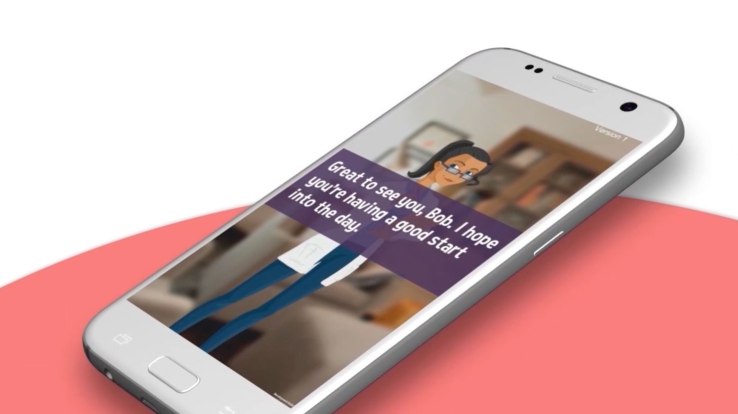
eQuoo is an emotional fitness game that aims to teach you psychological skills in a fun and engaging way. You get to use those skills in a choose your own adventure game, but they are for real-life situations as well.

Founder Silja Litvin (a psychologist) says she was inspired to create the game because “emotional intelligence is more important than IQ when it comes to success in the workplace. If you know how and why you react and feel the way you do, you can navigate through stressful situations and relationships much better.”

Equoo has raised an Angel round, and the investors include Julian Pittam (Investor to Disciple Media, which just raised $4 million), Pierre Andurand and other angels.

As a child, Litvin moved from sunny Southern California to the less-than-sunny Luxembourg and was bullied at school. But things changed when her older sister got a body-language book for her birthday. “The idea that there was a science – a manual, so to speak – about why people did what completely blew my 12-year- old mind. That’s when I decided to become a psychologist: I wanted to spread the good news. eQuoo essentially helps you build up people skills.” Her team also includes, Med Buckey (CTO), Professor Markus Maier (Head of research) and James O’Brien (Lead developer).

In the game, a character, Dr Joy (named after Sigmund Freud – Freud is joy in German) walks you through the learning session. eQuoo allows you to practice the skills in the learning part of the game; unlock a level in the game which leads you to a choose your own adventure story where you need to use the skills to win; gives you feedback on your personality through the Big Five personality test’ let’s you share your personality feedback on social media; learn more about the skills you possess on a deeper level; and anything you learn becomes part of your psychological ‘tool-box’.

The startup opened the Beta on in Australia and New Zealand and has a weekly growth rate of 19% and a 4.8 rating in the app store. Phase one will be building advertisement and subscription, but after that, it plans to work with insurance companies as a mental health game that prevents anxiety and depression.

source:TechCrunch

Facebook-owned Onavo quietly launches Bolt App Lock, a data-tracking app that locks other apps
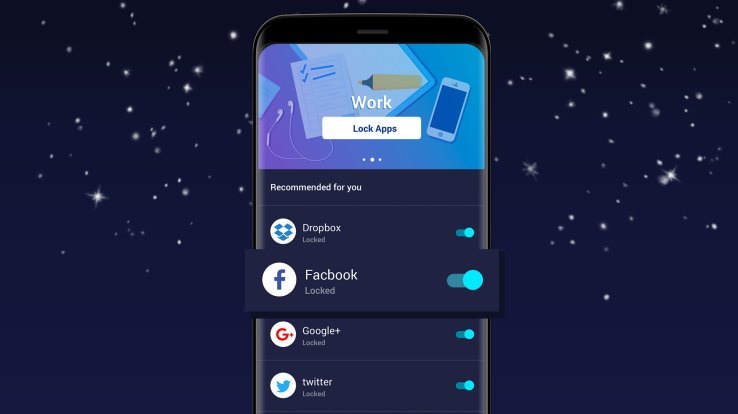
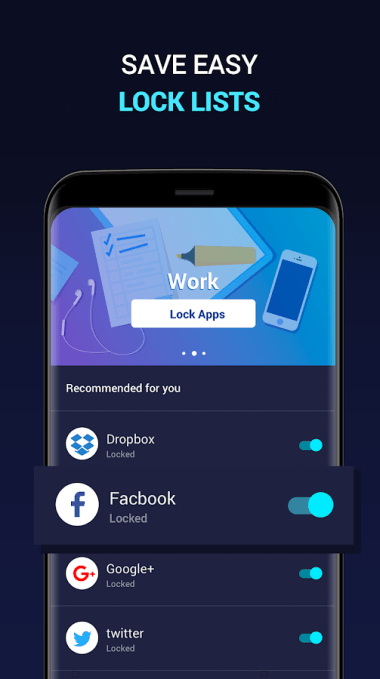
Onavo, the data-security app maker Facebook acquired in 2013 in order gain insights into mobile user activity across apps, has quietly launched a new app aimed at Android users called Bolt App Lock. Instead of offering a VPN, Bolt App Lock is a tool that lets you lock down any app you don’t want others to be able to open, using a PIN code, pattern, or your fingerprint.

Apps that help users lock other apps is a popular category on Android, where you can today find dozens of similar solutions – though largely from unknown companies save for a few, like Keepsafe or Norton, for example. Like the others in this space, the Bolt app lets you lock down other apps that contain personal information, such as private photos or payment details.

Facebook-owned Onavo quietly launches Bolt App Lock, a data-tracking app that locks other apps
With the resources of Facebook behind it, Onavo appears to have built a more polished, modern alternative to the existing apps.

But Onavo – and Facebook’s – primary interest isn’t on personal security. It’s about finding a way on users’ phones in order to monitor mobile activity and learn what new apps could be taking attention away from Facebook’s social network.

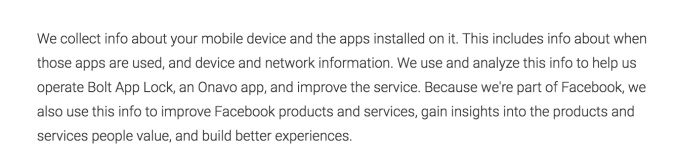
This is disclosed at the bottom of the app’s listing on Google Play, which explains that, as a Facebook company, Onavo will “collect info about your mobile device and the apps installed on it” and share that with Facebook.

Bolt App Lock’s disclosure regarding data collection
Above: Bolt App Lock’s disclosure regarding data collection
Data on mobile app usage has helped Facebook better compete with rivals like Snapchat – like when it saw how Instagram’s launch of a Stories-like feature was working to slow down Snapchat’s user growth, for instance. It also likely helped to inform Facebook’s newer acquisition of the buzzy teen compliment app tbh, which soon led to a new Facebook Q&A feature, inspired by tbh.

To attract users to its Onavo VPN, Facebook recently began advertising the app directly within Facebook’s main navigation on iOS, under the menu item “Protect.” When clicked, the link would take you to the download page for Onavo Protect on the App Store. The company has also featured a similar “Protect” link in its Facebook app for Android in the past. (We’re not currently seeing the option on Android, but your mileage may vary as Facebook’s apps are continually being tweaked and updated.)

But in order to gain these sorts of insights, Facebook needs a user base willing to install Onavo’s app. That may be more difficult to achieve these days, though.

After TechCrunch broke the news of Onavo’s appearance on iOS, a number of outlets directly warned users not to install the app. (See, for example: Gizmodo’s “Do Not, I Repeat, Do Not Download Onavo, Facebook’s Vampiric VPN Service” or Wired’s “Don’t trust the VPN Facebook wants you to use.”)

Until the backlash over Onavo Protect dies down, a new app like Bolt App Lock could give Facebook a different means of expanding Onavo’s user base, and therefore, Facebook’s access to mobile user data.

The app also hasn’t made an appearance in Facebook’s app, the way Onavo Protect did – at least not as of yet. We asked Facebook if that’s the eventual plan, but haven’t heard back.

Bolt App Lock launched on March 5, 2018, according to data from Sensor Tower. It’s not yet showing on the Onavo homepage as one of the company’s products. The app is a free download on Google Play.

source:TechCrunch

Facebook has signed a deal to stream 25 afternoon MLB games
Filed under moves that are potentially groundbreaking with big implications but with quite small numbers, Facebook has signed an exclusive deal with the MLB to stream 25 afternoon games, according to Bloomberg.

The deal is a bit reminiscent of the one Twitter signed for Thursday Night Football back in 2016 to stream games that are outside of the range of primetime football (usually reserved for Sundays and Monday Night Football). There have been some gripes about how fewer people are watching Thursday Night Football, so it also seems somewhat reminiscent in that respect that Facebook was able to sign a deal for games that are not so critically important outside of the normal primetime games.

That being said, blackouts for MLB games are a big of a nightmare (there’s a long thread by my colleagues complaining about this internally), and getting a deal like this on Facebook could potentially get people to pop in during the afternoon to watch the games. It could also help Facebook users get accustomed to the notion that Facebook is a spot to watch your afternoon baseball games, helping the company build that cachet that would help it negotiate further deals down the line. That the games are exclusive is another potentially big deal with big implications down the line for platforms like Facebook or Twitter, despite there being thousands of MLB games a year.

Regardless of the success of platforms like Twitter and Facebook (and Amazon in snatching the Thursday Night Football deal away from Twitter last year) getting these games on their platforms, the big primetime moments still elude those platforms and are all but locked up by incumbents. These deals are expensive — in 2016, the NCAA extended its agreement with Turner and CBS to air the NCAA Division I Men’s Basketball tournament, which had a price tag of $8.8 billion — and it’s hard to know whether Facebook or Amazon would be able to secure good deals for these kinds of games. There has been some activity at the startup level to disrupt networks like ESPN, which have traditionally been the host of many games in leagues like the NBA and NCAA college basketball games, such as Overtime raising $9.5 million.

Facebook’s first game will be on April 4 between the Philadelphia Phillies and the New York Mets, if you’re into either of them for whatever reason. MLB.com projects the Houston Astros will win 98 games next season, while the Los Angeles Dodgers will win 94. Houston won the World Series in 2017 in seven games over Los Angeles.

source:TechCrunch

Mario can now guide your route in Google Maps
It’s Mario Time! Beloved gaming character Mario is coming to Google Maps, thanks to a partnership between Google and Nintendo ahead of Mario Day, March 10. (MAR10…get it, Mario?) In addition to the various deals and sales on Nintendo games, the mustachioed plumber will also make an appearance in Google Maps’ navigation, if you opt in to have Mario accompany you on your journey.

The feature, which Google announced this morning, is available in the latest update in the Google Maps app on both iOS and Android.

After entering in your destination, you’ll notice a yellow question mark “?” icon at the bottom right of the app’s screen. Tap this, and you’ll get a prompt to enable “Mario Time.”

Mario can now guide your route in Google Maps
From then on, the navigation arrow in Google Maps will instead be Mario – who, in his little red go-kart, will then be your companion for your entire trip. The integration will be available for a full week, says Google, so you can enjoy using Mario for longer than just on Mario Day alone.

You can also choose to screenshot your route and share it to @GoogleMaps on Twitter and Instagram with the hashtag #MarioMaps, Google suggests. But of course, don’t share personal details like your work or home address, if you do so.

Mario can now guide your route in Google Maps
This isn’t the first time Google has had a little fun with Google Maps, as you may recall.

The company has in the past unleashed Pac-Man on city streets in Maps, let Google Maps streetview users go inside Doctor Who’s TARDIS, and has let you travel by Loch Ness Monster, among other things. Plus, Google and Nintendo have worked together before on silly stuff like this, as with the April Fool’s day prank involving the “launch” of Google Maps 8-bit for NES.

But in this case, adding Mario to Maps feels more like a brand advertisement, rather than just a fun trick. We asked Google if that was the case. However, a company spokesperson confirmed that no money exchanged hands in its business deal with Nintendo.

The Mario feature will begin rolling out today – so make sure you’ve got you’ve got the latest version of Google Maps installed if you want to try it out.

source:TechCrunch

YC-backed Playbook wants students to make plans online, hang out offline
Social planning apps have yet to take the world by storm. A handful of these apps tried and failed years ago, and even Swarm decided to ditch that methodology and focus on location logging.

But a new Y Combinator-backed company seems to be picking up traction. And shockingly enough, the winning ingredient seems to be location! Location! Location!

The startup is called Playbook, and its main focus is to let you see what people around you are doing so you can join them offline. In fact, the company doesn’t want you to spend much time in the app at all. But what differentiates Playbook most is that the app is focused on college campuses.

In fact, you might see some similarities between Playbook and another social app’s runaway success. Just like Facebook, the Playbook founders (Luke Heine, Raphael Rouvinov, and Sean Sullivan) attended Harvard and Heine originally built the app (then just a simple spreadsheet) to see where his friends would be over the summer. The original premise back in 2014 was that students could travel cheaply during the summer if they knew where there friends would be and could crash on the couch a few nights.

Eventually, Heine built out a rough website and expanded the Summer Playbook service to thirteen other schools while still attending Harvard, during which time he met Rouvinov.

In 2016, Heine and Rouvinov rebuilt the site from scratch and started work on an app. Instead of focusing primarily on summer travel plans, the app focuses on what people are doing in their every day lives.

Once a user has signed up for the app, they can post their plans (or, a play) to the rest of the people on campus using the app. Plays can range from going for a run to a party to studying in the library or simply grabbing lunch.

“We saw an opportunity not around scheduling time in advance but spontaneously,” said Heine. “We reckoned that while the 5 friends we message might not be able to play basketball in 15 minutes, someone on campus we know would, if only they knew not only that I was around but also that I wanted to play basketball.”

You can share these plays with specific groups or the entire campus, or even to other schools nearby. The app is being piloted at Harvard (launched in February), and Playbook plans to launch at Princeton, Wellesley, Yale-NUS, and the University of Michigan.

Last summer, around 2400 people from 230 universities across 126 countries signed up for the desktop site, with around 1600 conversations started. Since launching the app on February 11 of this year, there are 244 users on the app with 30 percent checking back every day.

Playbook has raised a total of $120K from Y Combinator.

source:TechCrunch

Square’s Cash app now supports direct deposits for your paycheck
It seems like each new feature Square adds to its Cash app brings it one step closer to being a de-facto bank account for its users.

Case in point, the app just rolled out support for ACH direct deposits, meaning users can now get their paycheck or other deposits put directly into their Cash app balance.

Like other features in the peer-to-peer payments app setting up direct deposits is almost too simple. After accepting a disclosure you’re given an account number and routing number, which is all an employer needs to start making direct deposits. Users get a notification when deposits hit their account, and all funds get added to their normal Cash app balance – meaning it can be sent to a friend, spent using a debit card, used to buy bitcoin or withdrawn to another account.

This feature combined with the Cash app’s debit card now means that the app can essentially provide all the basic functions of a bank account, assuming you don’t need to deposit checks or do complex things like wire transfers.

Don’t be surprised to see younger users who are already using the Cash app just use this direct deposit feature instead of opening a traditional bank account when they start their first job. Plus, features like these could also make the app useful for people living in underbanked communities or who those just feel generally underserved (or overcharged) by traditional financial institutions.

Since Square doesn’t (yet) have a bank charter, they’ve had to get creative by partnering with banks to build features like their debit card and direct deposits. While their debit card is issued by Sutton Bank it seems like the direct deposit feature is being powered by Lincoln Savings Bank, which is giving Cash app users a routing number and a new account number to use for deposits. Partnerships like these between FinTech companies and FDIC-insured banks are common, considering how difficult it is for a technology company to get its own bank charter.

source:TechCrunch

Snap is reportedly laying off around 100 employees
Snap is laying off around 100 employees that are part of its engineering staff, according to multiple reports from CNBC and Cheddar.

The company expects to lay off as many as 100 people in the engineering department, according to those reports. It’s another sign of potentially re-aligning efforts as it looks to remake itself into something that’s differentiated from products like Instagram, which is repeatedly copying many of Snap’s core features like Stories. With that constant risk of copying at stake, Snap has had to make some drastic moves, like re-design the app to bucket together certain use cases in certain screens and hopefully keep users coming back over and over again.

In February, Snap CEO Evan Spiegel basically said the app’s redesign is here to stay and that users just need to get used to how the new app works and feels. Spiegel has said over and over that Snap is a camera company, and appears to be trying to keep that the case as there is reportedly a redesign of its Spectacles camera glasses in the works. But that may require rejiggering of the teams working on it, and layoffs often come as a result of trying to recalibrate the expectations and investment in certain areas of the company.

The company is coming off a significant quarter that’s led the stock to skyrocket, paring back some of the significant losses it sustained through 2017 after it went public. But the company is still worth around $22 billion, which is now lower than Twitter’s market cap. Snap has given up a lot of the gains it got from that earnings report, though it still appears to be in better shape than it was last year. The company has struggled to show growth and that it can continue to snap up new users, with its pitch being that it can keep users around for much longer and keep them much more engaged.

Snap is reportedly laying off around 100 employees
Snap in January laid off around two dozen employees, and rounds of layoffs like these can happen when a company is trying to set itself up for a new direction — now that it has a responsibility to public shareholders that may require some significant moves to outmaneuver competitors like Instagram. Amid all this, there appear to be some positive signals for Snap regarding growth despite the significant redesign and a lot of backlash over it.

source:TechCrunch

TechCrunch’s Messenger bot gets smarter and more conversational
The best bot on Messenger just got better. We’ve teamed up with Chatfuel and Bitext to add Bitext’s NLP Middleware to the TechCrunch Messenger bot. This enhanced version adds functionality for conversational interaction, improved natural language understanding and unique features like negation understanding. You can check out our new and improved Messenger bot here.

To get a better understanding of what the new functionality looks like in action, here are some examples of what the latest version of the bot can do.

1) Understands more natural language queries

More complex but natural queries, like “do you have anything about Google”; “give me Facebook news” or “show me the latest about SpaceX” are now recognized by the bot.

2) Conversational double intent

You can now use the word “and” to search for news that shares multiple characteristics. For example, you could type “I want news on Microsoft and Apple” to find news that specifically mentions both companies. Another example would be “show me news about Messenger and bots.”

3) Conversational negation

This allows you to exclude certain items in your search. For example, if you wanted to see news about Amazon but didn’t want to see anything about Whole Foods you could type “I want news about Amazon but not Whole Foods.” Another example would be “show me news about Apple but not iPhones.”

We’re also looking into adding some other updates, including conversational pagination and video search. There’s also a possibility that we might bring this bot to Slack. More to come soon.

You can check out our new and improved Messenger bot here.

source:TechCrunch

Google’s messaging strategy may still seem chaotic to many, but the basic tenet of how it wants the public to think about Hangouts, Hangouts Meet, Hangouts Chat, Allo and Duo is that Allo/Duo are for consumers and Hangouts Meet/Chat are for business users. Hangouts itself is meant to… actually, I don’t know what it’s meant to be now and I’m not sure Google does either. What I do know, though, is that you are probably neither an Allo nor Duo user, even though both are perfectly competent messaging and video chat apps. Just in case you do use Duo, though, here’s some good news: You can now leave voice and video messages when nobody picks up your call (or politely declines to talk to you).

Google’s Duo video chat app gets video- and voicemail
Duo users can now leave up to 30-second messages and your contact will see them in the Duo app. After watching the video or listening to the message, your contact can call you right back, at which point you can decide if you want to pick up the call or just let it go to videomail, too.

Google notes that all messages are end-to-end encrypted and that the update will start rolling out to Android and iOS users today, and that all users worldwide should see it within the next few days.

While I don’t think Google’s Allo/Duo strategy is working, or that mainstream users are even aware of it, Duo is a perfectly fine video chat app that puts a few interesting twists on this concept. Just like with Allo, though, none of my friends are on it and Hangouts already has a perfectly good video chat option.

source:TechCrunch

Micropodcasting? Facebook tries Voice Clip status updates
More intimate than text but easier to record than video, Facebook hopes voice could get people sharing more on its aging social network. And internationally where users may have to deal with non-native language keyboards, voice lets them speak their mind without a typing barrier.

Facebook is now testing Voice Clips as a status update option with a small percentage of users in India. First spotted by Abhishek Saxena, Facebook confirms to TechCrunch the presence of the new feature. As a spokesperson tells us, “We are always working to help people share and connect with their friends and family on Facebook in ways that are authentic to them. Voice Clips gives people a new medium through which to express themselves.”

Facebook has spent years struggling to get people to share more unique personal content on the app instead of generic news article links that audiences can find elsewhere, like on Twitter. Original content broadcasting declined 21 percent year-over-year as of mid-2015, and was down another 15 percent as of mid-2016, The Information reported. Original content has shifted to Facebook’s Instagram, but also competitors like Snapchat with its immersive full-screen Stories.

Micropodcasting? Facebook tries Voice Clip status updates
The danger for Facebook is that it becomes a place for drab life events like people getting a new job, and mindless viral link sharing. Facebook has tried to combat this by prioritizing friends in the News Feed, downranking public and news publisher content and introducing its own Facebook Stories feature. Yet still Facebook saw its first-ever decline in U.S. and Canada daily active users in Q4 2017, losing 700,000 — though that was contributed to by new changes that demoted viral videos.

Voice Clips could let people share compelling, deeply personal content even if they’re home and not anywhere interesting, don’t have video capture or editing savvy, aren’t attractive on screen or lack a nice smartphone camera. Making people less self-conscious about what they share is partly why Facebook introduced ephemeral Live broadcasts, and augmented reality masks that cover your face.

Facebook already offers private Voice Clip sharing through Messenger, but the popularity of podcasting has exploded in recent years. If Twitter made blogging into microblogging, perhaps quick shares to the News Feed could let Facebook pioneer micropodcasting.

To access the new feature, users select “Add Voice Clip” from the status update composer menu that includes photo uploads, location check-ins and more. They see a waveform of their voice while they record, and can talk for as long as their device storage allows without a specific limit from Facebook. Users then can preview their clip (but not edit it), and share it to the News Feed where friends can hit play to listen while watching the waveform animation. But unlike some audio apps, users can’t close Facebook and keep listening because technically the clip registers as a video.

Micropodcasting? Facebook tries Voice Clip status updates
It makes sense to start in India, which features 22 popular languages. Typing in a second tongue can be difficult. Last year Google added support for 11 additional Indian languages to its Gboard keyboard app to adapt to the market. Facebook wants to keep growing despite hitting saturation in some of its core Western markets, and India’s population of 1.3 billion is highly appealing.

If the Voice Clips feature proves popular, it could roll out elsewhere, just as Facebook is getting more serious about voice. It’s building a smart speaker code-named Aloha to be released as Portal, Cheddar reports. It’s easy to imagine users dictating Voice Clip status updates to Portal without ever having to open their phone or check that their words were properly transcribed. Facebook wants to encompass all the ways we share, and voice is perhaps our most instinctual communication medium.

source:TechCrunch

Spotify plays the long game with Family and Student Plans even as revenue per user drops
Spotify’s “Family Plan,” a variation of which launched in 2014, as well as its “Student Plan” appear to be driving a significant portion of the company’s growth and improving retention, as the company points to it multiple times in its filing for a direct listing on public markets today.

But that also comes at a cost of decreasing the amount of revenue it actually gets from each premium subscriber. In the filing, Spotify indicates that the fee for a family plan — which costs $14.99 per month — can be actualized over as many as six accounts total (though it might not always be six). The premium user consists of the one master premium account, which pays for the subscription, and up to five sub-accounts for family members. Spotify is also pointing to its student plan, which costs $4.99 a month, as another contributing factor to those pressures. This means that even though Spotify is gathering more premium users, the actual revenue it generates from those users can drop over time.

And, indeed, that’s what’s happening, according to the filing. Spotify said its premium average revenue per user was around €5.24 in 2017, compared to €6.00 in 2016 and €7.06 in 2015. Spotify recognizes in the filing (“Family Plan” is mentioned nearly three dozen times) that this is partly due to the family plan. But at the same time, churn — a significant metric for subscription services that shows how many users are coming and going — is dropping each year and the number of hours users are listening are significantly increasing. Churn was 7.5% in 2015, and it’s down to 5.1% in 2017, content hours have more than doubled in that time from 5.4 billion hours to 11.4 billion hours.

Here’s the boilerplate from the filing:
The rate of net growth in Premium Subscribers also is affected by our ability to retain our existing Premium Subscribers and the mix of subscription pricing plans. We have increased retention over time, as new features and functionality have led to increased User engagement and satisfaction. From a product perspective, while the launches of our Family Plan and our Student Plan have decreased Premium ARPU (as further described below) due to the lower price points per Premium Subscriber for these Premium pricing plans, each of these Plans has helped improve retention across the Premium Service. As a result, while Premium ARPU declined by 9% from 2015 to 2016 and 14% from 2016 to 2017, in part due to the launch of the Family Plan in 2016, Premium Churn declined by 1.1% from 7.7% in 2015 to 6.6% in 2016 and declined by an additional 1.1% from 6.6% in 2016 to 5.5% in 2017. With the growth in higher retention products, such as our Family Plan and Student Plan, we believe these trends will continue in the future.
All this is more or less part of a long game for Spotify, which is looking to go public in the U.S. amid significant and increasing competition for premium subscribers from companies like Apple or Google. Those two companies also own the App Store platform and therefore could be the decision-makers in the economics of operating on mobile devices, which means that there’s pressure for Spotify to snap up as many users as possible — even if it means making less money per user. Spotify has acknowledged in its public filing, too, that Apple and Google represent a significant risk in this sense.

source:TechCrunch

Even with double the subscribers, Spotify says Apple will always have an edge owning the app store
Spotify just filed for a direct listing in the U.S., sidestepping the traditional IPO process, and now we’re starting to see some of the true financial guts of the company — and some of the significant risks it faces from challenging services from Apple and Google.

Apple, for example, charges apps a percentage of revenue for subscriptions processed through the App Store. Apple Music, meanwhile, will always deliver Apple 100% of the subscription revenue that it receives from subscribers (sans record fees and all that kind of stuff, of course). Apple, too, has a direct integration with its iOS devices and also a huge amount of brand recognition even though Spotify is a massive service. Spotify says it has 159 million monthly active users and 71 million premium subscribers, while Apple has 36 million paying subscribers as of February 2018.

Here’s the full boilerplate from the filing:
Our current and future competitors may have higher brand recognition, more established relationships with music and other content licensors and mobile device manufacturers, greater financial, technical, and other resources, more sophisticated technologies, and/or more experience in the markets in which we compete.

In addition, Apple and Google also own application store platforms and are charging in-application purchase fees, which are not being levied on their own applications, thus creating a competitive advantage for themselves against us. As the market for on-demand music on the internet and mobile and connected devices increases, new competitors, business models, and solutions are likely to emerge.
As owners of the platforms themselves, Apple and Google will always be able to dictate the terms. And while Spotify is a massive service, its success still hinges on users listening on their mobile devices. It may be able to build a strong brand and create some inertia against potential changes from Apple that could incite user backlash, but at the end of the day, Apple runs the system where its users actually get the service.

As Apple begins diversifying its revenue streams to create a services branch that the company likes to say will be the size of a Fortune 100 company, music is increasingly becoming a core part of that. Google, too, owns its app store platforms, and will recognize 100% of the revenue from its own service. We haven’t seen the full potential of these companies’ approaches to the music space, in particular with Apple Music which appears to be steadily growing, but Spotify is clearly recognizing it as an existential threat.

source:TechCrunch

Peanut, the matchmaking app for moms, launches a community feature called Peanut Pages
Peanut, the app referred to as “Tinder for moms” because it connects mothers by letting them swipe each other’s profiles, is launching a new community discussion feature. Called Peanut Pages, it’s meant to give mothers a better alternative to Facebook Groups, Quora and other social platforms.

Since its launch almost exactly one year ago, Peanut has built a userbase of 300,000 moms (and some dads) who have swiped profiles over 19 million times and sent more than one million messages to each other. Though Peanut’s matchmaking feature quickly gained traction among moms eager to find real-life mom friends, Peanut Pages faces formidable competition because there are already tons of places for online parenting groups.

Many Facebook users default to its groups, while people who hate Facebook can find communities on Reddit, Quora and other platforms. Co-workers have private Slack channels and neighbors can arrange playdates or find babysitters on Nextdoor. So how will Peanut Pages stand out from the fray?

“I think that is exactly the issue,” Peanut co-founder and chief executive officer Michelle Kennedy said in an email interview. “Social has become so broad. The landscape is so fragmented. All of that incredible resource, knowledge, sharing, is being lost, or is not accessible by all women, because there is no one central repository.”

Peanut wants Pages to become that central repository. Since other social networks aren’t designed specifically for mothers, Peanut wants to give women who have different interests, identities and parenting styles their own platform instead of lumping them into the same category.

“Peanut has always been, at its heart, about connecting women, who happen to be mothers,” Kennedy explained. “Our existing users already know that our style, the way we interact with our users, is not about being ‘mommy,’ it’s about being themselves, and as part of that, being a mother. We continue to reflect this through Pages.”

Peanut, the matchmaking app for moms, launches a community feature called Peanut PagesIn addition to discussion boards moderated by power users called MVPs, or “Most Valued Peanuts,” Peanut Pages also complements the matchmaking part of the app by encouraging meetups with polling and scheduling features

“We’ve already seen users who are testing sharing details about March for Our Lives [the anti-gun violence rally scheduled to take place in Washington D.C. next month] and discussing whether they will be joining. I think that’s a really interesting social statement, that women want to use our platform to connect in real life, but also on issues which matter to them,” said Kennedy.

One problem Facebook Group users frequently run into are privacy concerns. Though a closed or secret group might seem safe, everything you post is still connected to your profile and can be screenshotted and shared. This is especially concerning for people seeking support about sensitive parenting issues. To reassure members, Peanut Pages allows anonymous posts, but it does not allow people to reply anonymously to keep them accountable for what they write.

Peanut is currently available only in the United States, Canada and the United Kingdom. Even though it’s seen interest in other markets, Kennedy says the company will continue focusing on its existing communities before expanding. Another thing it remains dedicated to is serving women and giving them a safe place to connect online.

“I worked in the dating industry for many years, and I am very aware of the dynamics between users, and safety,” said Kennedy, whose resume includes key roles at Bumble and Badoo. “You know, when we launched, I received hate mail because we were a product for women only (I don’t think those messages were from women). I was blown away, can’t we have our own product? Our own community?”

Many fathers, especially stay-at-home dads, are also in search of dedicated communities, so Peanut may do dad-oriented things in the future (several of its team members are fathers), but “we have to start somewhere, and our focus is motherhood as a part of womanhood,” Kennedy says.

source:TechCrunch

Bump is a peer-to-peer marketplace for streetwear
As the streetwear and sneaker industry continues to explode in popularity, we’re seeing more and more startups popping up to service the industry — all from slightly different angles.

Meet Bump, a peer-to-peer take on a streetwear marketplace. Founded six months ago in the U.K. and now part of Y Combinator’s Winter ’18 batch, the startup already has more than 200,000 users buying and selling limited-edition streetwear from brands like Supreme and Kith.

After signing up, anyone can create a listing or buy an item — all prices are set by sellers, who pay a 6 percent transaction fee to Bump and 2.9 percent fee to PayPal on all sales. Users can sort by price, size, category or brand — and also can follow specific sellers and “like” items too.

There’s also a messaging feature so you can talk to the seller and potentially negotiate on price. Bump says more than 5.5 million messages have been sent on the platform so far, and the majority of purchases involve some type of back and forth and negotiation before being completed. Not only does talking to the seller make buyers feel more comfortable, it also creates a sense of community where users can just chat about streetwear and develop relationships for future purchases. This is especially important in the streetwear world, where getting the newest items is all about the connections you have.

Speaking of getting new items, the app also has a “proxy” category, where users can list their “camping services,” i.e. charge you money to wait in line to buy limited-edition items, then ship them to you. This service is surprisingly popular, and Bump provides a platform to arrange these services where users have PayPal’s buyer protection as a fallback option in case anything goes wrong.

Bump is a peer-to-peer marketplace for streetwear
The most notable difference between Bump and competitors like GOAT and StockX is that Bump doesn’t physically inspect and verify the items sold on their platform before they are shipped to a buyer. Instead, they rely on moderators and crowdsourcing to police the platform and report/block any listing that’s a fake.

Of course, this sounds easier said than done — especially with how good the quality of fakes are becoming these days. But Jack Ryder and Sam Howarth, co-founders of Bump, explained that their moderators are hard-core streetwear experts and typically know these items inside and out — meaning they know exactly what to look for when spotting a fake.

And while anyone can flag a listing as fake, historically most are taken down by moderators before they are even around long enough to be seen by buyers. Fake sellers are banned and also have their device ID blocked, effectively removing them from the platform. There’s also an eBay-style review system, so sellers can build up positive reviews to signal that they’re a trustworthy seller.

Ryder and Howarth said these precautions result in a “negligible” fraud rate in the low single digits. But, of course, this isn’t perfect, and there’s always going to be a little more risk buying on a peer-to-peer marketplace than directly from the retailer or through a platform that verifies each item by hand.

For this reason Bump will probably (at least initially) be used by more savvy streetwear buyers who at least have some personal knowledge of the item they’re trying to buy. But anyone who does receive a fake item is able to receive a full refund via PayPal’s buyer protection services, which processes payments for the startup via their Marketplace Program.

While the startup admitted it may need to eventually look into a physical authentication service as the platform grows, the marketplace aspect does allow for a much wider range of goods to be sold. For example, a scroll through Bump reveals a Supreme Shovel, an Off-White T Shirt and Yeezy Shoes — all on the same page. This is a wider variety compared to services like GOAT, where product categories are more limited — as of now that platform still only supports sneakers.

Even though Bump was started in the U.K., about 45 percent of users are now from the U.S., and there’s a decently high percentage of transactions occurring across countries. Essentially buyers are happy to pay a slightly higher shipping price to score an item they’d otherwise not be able to get.

Bump is available on iOS now, and you can check it out here.

source:TechCrunch

Product Hunt launches no-spam tech news digest app Sip
“We didn’t want to create another app thirsty for attention” writes Product Hunt CEO Ryan Hoover. So instead of a constant stream of fresh stories and alerts, Product Hunt today is releasing what’s essentially a tech industry newsletter in iOS and Android form. Sip distills the day’s big headlines into a set of Twitter Moments-esque slideshows delivered via silent notification at 5pm.

Combining explanations, commentary tweets, links to news outlets, Product Hunt pages, and polls, Sip offers a bite-sized alternative to long-winded articles. Skewing trendy, not wonky, you’ll find Sip highlighting 2018’s most innovative companies, Elon Musk selling flamethrowers, or Uber’s new bus killer.

“Our ultimate goal is to create an experience people want to come back to every day that might appeal to those that don’t already use Product Hunt” Hoover explains. It’s essentially a user growth play, rather than a revenue driver for the startup bought by AngelList for around $20 million in 2016. “As I shared earlier in the year with the community, we’re aiming toward profitability and have made some great progress through various initiatives, but Sip is not one of them. We don’t have plans to monetize Sip in the short term as we focus on growing its user base.”

Product Hunt launches no-spam tech news digest app Sip
With Facebook purposefully reducing the amount of news surfaced by its feed, Twitter full of bots and trolls, and Google Reader gone, people need better ways of keeping up with the world. Like Reddit, Hoover sees Product Hunt as a community first, though one that “has always played a role in delivering news”.

Doubling down here could unlock new demographics. Not everyone gravitates towards the site to discover the latest beta tests, hackathon projects, Chrome extensions, and fledgling startups. But the top stories about tech’s titans, our social media society, and the hottest new apps have become must-read news for many. Sip could become their gateway into the Product Hunt fold.

Product Hunt launches no-spam tech news digest app Sip
“Sip is an experiment” Hoover tells me. “The app was designed and built by Chad on our team to give us an opportunity to surface different types of content and stories that wouldn’t necessarily inside Product Hunt today.” Sip already has 3000 people signed up for its beta. The app will have to compete with traditional tech sites and their emails, the constant flow of Twitter and other social apps, various newsletters like Hacker Noon, and reader apps like Feedly and Flipboard. But Sip is set apart by boiling down the news into snackable nuggets.

Product Hunt needs to continue finding ways to engage the younger, scrappier techies at the core of its audience. Launched in 2013 as a newsletter, the startup’s buzz peaked in 2014 and 2015 after it raised a $7 million round led by Andreessen and was accepted into Y Combinator. Its parties in San Francisco became legendary, drawing over 1000 people with a line around the block. These were the heady days of mobile, when tech was still an underdog to some degree and the backlash about its ills had yet to surge.

Product Hunt launches no-spam tech news digest app Sip
Product Hunt CEO Ryan Hoover(left) at TechCrunch Disrupt SF 2014
After years of the crowd-ranking daily product launches on its site, fatigue seems to have set in since AngelList bought Product Hunt. While well-aligned, Product Hunt lost some of its cool by joining up with more dignified tech adults. Last year it launched Ship for helping startups release their products, and an Ask Product Hunt recommendations feature. Hoover even debuted his own $3 million Weekend Fund. Yet Product Hunt’s luster has waned. Though in a much glitzier venue, this winter’s Product Hunt party saw no line out the door. They weren’t even checking RSVPs.

The next generation of Product Hunters might not be as religiously bound to their phones, delighted by a non-stop barrage of alerts. Instead, they seem to value an undistracted sense of flow and more mindful tech usage. Sip could appeal to them. “My phone is often warm with alerts” says Hoover. “Many app creators overwhelm their users with numerous push notifications throughout the day or even unwelcome text messages. We don’t want Sip to add to the clutter.”

source:TechCrunch

UberEats Driver Kills Customer During Delivery in Atlanta
Police in Atlanta are searching for an Uber Eats driver who allegedly shot and killed a 30-year-old man after delivering his food. Police have not released a description of the driver, but say that he was using a white Volkswagen to make his delivery.

The victim, identified as Ryan Thornton, reportedly exchanged words with the Uber Eats driver after Thornton received his meal at a Buckhead apartment complex around 11:00pm on Saturday. Thornton was shot “several times” and was taken to a local hospital where he eventually died of his wounds.

The local NBC affiliate in Atlanta reports that Thornton recently graduated from Morehouse College with a degree in political science and had just taken a new job.

“We are shocked and saddened by this news,” an Uber spokesperson told Gizmodo in a statement. “We are working with Atlanta Police, and our hearts go out to the families of those involved.”

It’s against Uber company policy for drivers to carry weapons of any kind, though it’s unknown if the company ever conducts random checks to see if its drivers are complying. Uber’s safety policies have been repeatedly criticized in the past for being too lax.

Uber Eats, an offshoot of the Uber taxi service, establishes contracts with restaurants in major cities to provide delivery drivers. Uber Eats drivers are often Uber taxi drivers as well. The Uber Eats service has expanded rapidly in every major US city, competing in an already crowded market of third-party delivery services like Seamless, GrubHub, and Postmates.

Drivers for Uber Eats are considered independent contractors rather than employees of Uber, though they must pass a basic background check. Uber’s global taxi service has seen its fair share of murder and assault by drivers since it was launched by former CEO Travis Kalanick in 2009, but this is believed to be the first death at the hands of an Uber Eats delivery driver.

Gizmodo has reached out to the Atlanta Police Department for more information about the investigation and will update this post when we hear back.

source:Gizmodo

Google’s Tez payments app now lets users handle their utility bills and more
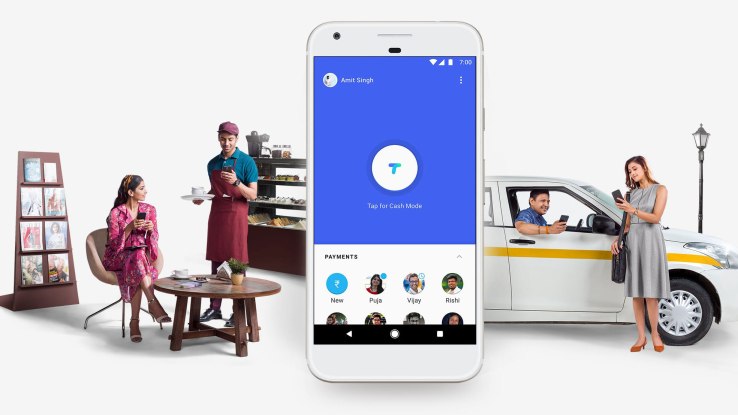
Google’s Tez payment service in India has got a major update that allows users to pay their utilities and other bills via the app.

The service was launched last September for iOS and Android and it initially allowed for payments between bank accounts using India’s UPI (Unified Payments Interface) protocol. Now the app has gotten support to pay for bills from more than 80 organizations — including national/state electric, gas and water, and TV/internet services — with more to come soon.

In the case of recurring bills, the app will send a notification when a new payment is due and fetch the bill. The app also lists previous bills paid, and it supports multiple accounts. The feature is available under the ‘new payment’ tab as outlined in the video below.

Tez clocked 12 million users in December, just three months after launch, but Google has yet to provide an updated figure.

The bill payment feature comes at an opportune time. WhatsApp, the Facebook-owned messaging app used by over 200 million people in India, began rolling out peer-to-peer payments in the country with the potential to massively disrupt the status quo. India is WhatsApp’s largest single country based on users, and the payment feature has been a year in the making prior to its release.

Tez, a far more modest arrival, has also made waves, and this new update is one that is likely to make it hugely useful. Others in the field, include Paytm and MobiKwik, already include bill payment, peer-to-peer transfers and more.

source:TechCrunch

Sqreen wants to become the IFTTT of web app security
French startup Sqreen recently launched a Security Hub with dozens of plugins to put you in control of the security of your web app. In many ways, it feels like enabling tasks on popular automation service IFTTT.

Sqreen participated in TechCrunch’s Startup Battlefield and Y Combinator’s current batch. The vision of the product hasn’t changed. Sqreen lets you protect your web service with little effort from your side.

Big companies have dedicated security teams that protect services, try to run attacks to find weaknesses and more. Smaller companies don’t necessarily have enough time and money to build a dedicated team. But your product is still vulnerable to SQL injections, XSS attacks and brute-force attacks.

Sqreen isn’t a firewall. You just have to install a library package on your server and add a couple of lines at the top your source code to require the Sqreen module in your application.

Once this is done, Sqreen monitors attacks in real time without a big performance hit — the startup says there’s a 4 percent CPU overhead. Sqreen now works for web apps in Node.js, Ruby, PHP, Python or Java.

In addition to protecting you against common attacks, Sqreen makes security recommendations so that you can regularly fix vulnerabilities. And with GDPR coming soon, tech companies have a greater responsibility when it comes to protecting customer data and disclosing hacks.

Customers wanted to know more about what Sqreen was doing. That’s why Sqreen launched a security hub with documented plugins.

“All security vendors are very secretive,” Sqreen co-founder and CEO Pierre Betouin. “Usually, you can’t test the product and you have no information on what they do. We were like this at the beginning of Sqreen. Our positioning was really ‘install our library and we’ll cover a range of security features.’”
...
You can find a plugin to protect you against SQLite injections, vulnerable dependencies, XSS Javascript injections in various frameworks, bot activity, etc.

Sqreen will recommend plugins for your app depending on the technologies and frameworks you’re using. You can then enable or disable each plugin and configure notifications on Slack or PagerDuty for instance.

In the future, you can imagine that third-party companies could contribute to this marketplace and add new plugins. Sqreen is also working on other plugins related to email abuse and payment page protection.

In addition to those new features, Betouin is moving to San Francisco and opening an office there. Companies like Front, Mindbody, BlaBlaCar, Triplebyte, Toptal and Algolia are now using Sqreen.

source:TechCrunch

MKRdezign

Contact Form

Name

Email *

Message *

Powered by Blogger.
Javascript DisablePlease Enable Javascript To See All Widget