RightEye’s portable eye-tracking test catches concussions
They say the eyes are the windows to the soul, but physiologically speaking, they’re really windows to the brain.
T
hey say the eyes are the windows to the soul, but physiologically speaking, they’re really windows to the brain.
RightEye looks through that window to detect common but often subtle vision issues resulting from concussions and other brain troubles. Its quick, portable eye-tracking station can tell in minutes whether you should see a doctor — or look into becoming a pro ball player.
It turns out there’s quite a lot you can tell from how someone’s eyes move. We may not notice it ourselves, but we all vary in how and how well we execute a number of basic tasks, from flicking our eyes back and forth to smoothly tracking a moving target. For instance, your eyes may over-correct, fail to line up correctly, or track up or down when moving along a straight line.
For healthy individuals, these variations fall within a safe range, just part of the ordinary differences between bodies. But certain patterns well outside the baseline can be strong indicators of things like concussions and eye muscle problems — and even Parkinson’s and Autism-spectrum conditions.
RightEye
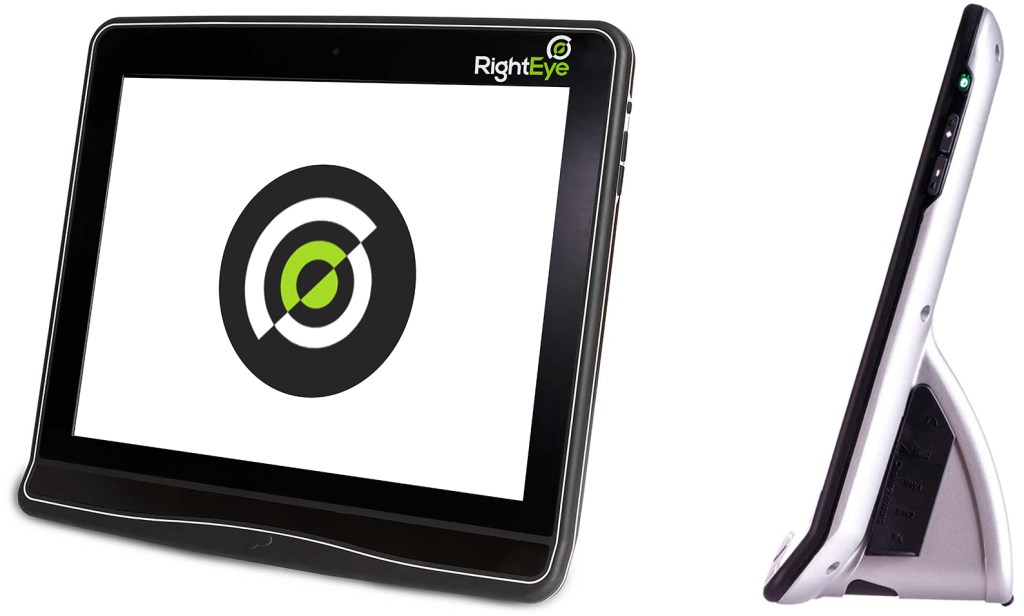
RightEye tracks these movements with a custom device that looks a bit like an all-in-one desktop; it uses a Tobii eye-tracking module built into a single-purpose computer loaded with a library of simple tests. A basic EyeQ (as they call it) test takes five minutes or so, with more specialized tests adding only a few more, and results are available immediately.
To give you an idea: one test in game form has you defending a space station, destroying incoming ships by looking at them. But certain colored ships you must not destroy — meaning you have to detect them in your peripheral vision and avoid looking at them. In another test, you flick your eyes rapidly between two targets appearing on opposite sides of the screen, demonstrating accuracy and functioning saccades (micro-corrections made by your eye muscles).
Each eye is tracked independently, and their performance as a matched pair is evaluated instantly. An easy-to-understand results sheet shows their actual movements and how (if at all) they deviate from the baseline.
It’s compact and can run on battery for some 8 hours, making it ideal for deployment outside hospitals or the like: anywhere from school nurse’s office to the sidelines of an NFL game, even in the home.
I tested the device out myself at CES (my vision is just OK, but I want a rematch), and later chatted with Barbara Barclay, RIghtEye’s President. The two most exciting applications of the technology, as judged by her enthusiasm anyway, are in identifying vision-related cognitive problems in kids and in creating a sort of eye fitness test for sporting persons.
Say a child is having trouble learning to read, or perhaps can’t pay attention in class. The immediate thought these days is frequently ADD. But it’s more than a little possible that it’s a vision problem. A subtle difference in how the eyes track, perhaps one going off the horizontal when tracking a line of text, could easily make reading on the page or blackboard frustrating or even painful. What 3rd-grade kid would keep at it?
RightEye
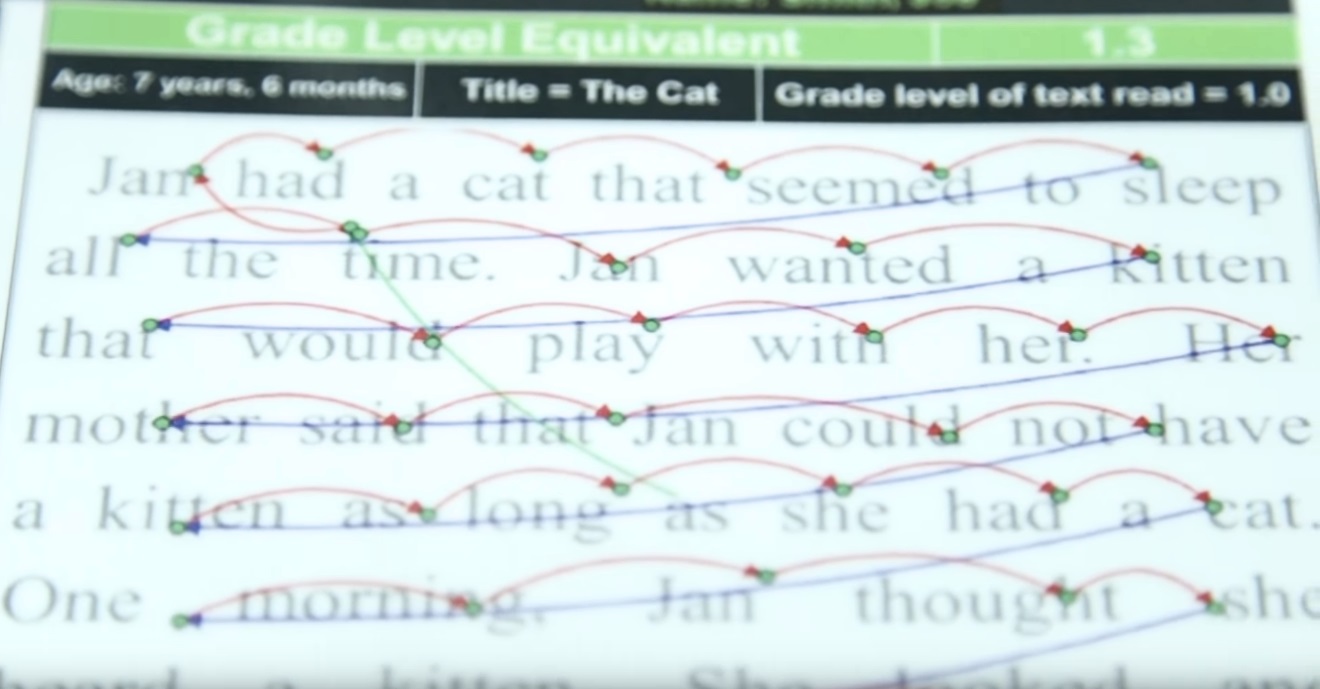
A reading-focused test tracks how the eyes move along a line of text.
This isn’t some groundbreaking new idea — but reliably and objectively evaluating individual eye movements was only something you could do if you went to see a specialist, perhaps after other explanations for a behavior didn’t pan out. RightEye’s test practically runs itself and can detect or eliminate the possibility of vision problems in minutes. Honestly, I think a kid might even find it fun.
Barclay has personal experience with this, her own daughter having had health issues that only after multiple false starts were found to have their root in a relatively simple vision problem the system indicated.
In 2016, RightEye acquired the rights to a pair of tests based on research linking eye movement patterns to Parkinson’s and Huntington’s diseases, as well as Autism spectrum conditions. It’s not a magic bullet, but again, the quick and easy nature of the tests make them ideal for routine screening.
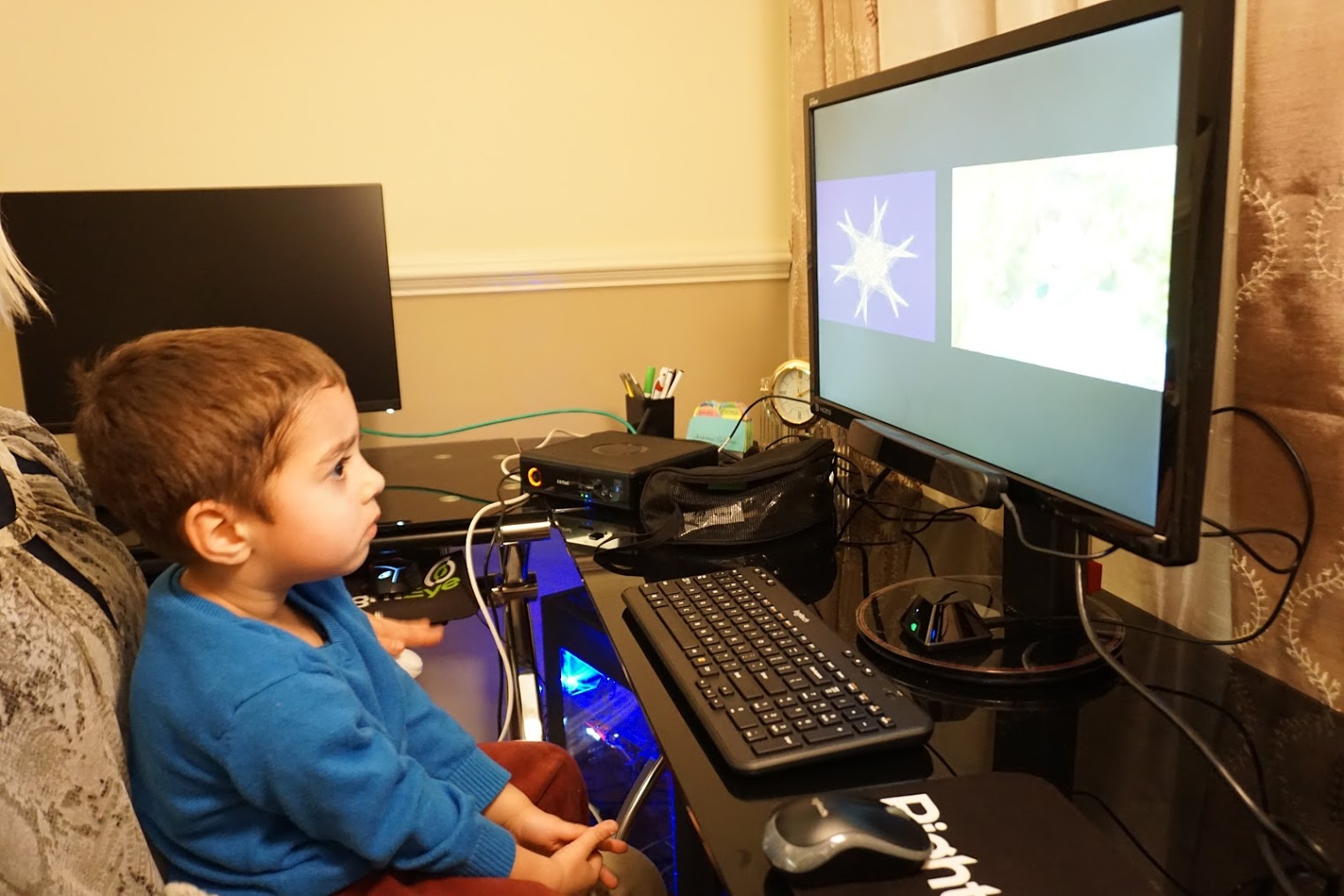
The Autism spectrum test is for children aged only 1 to 3, and watches eye movements between images of people and images of geometric shapes. Lingering on the shapes more than the people, it turns out, is a good indicator that at the very least the kid should receive further testing.
RightEye
The Parkinson’s and Huntington’s tests watch for the more well understood patterns that accompany the motor degeneration found in those afflictions. They can be administered to people of any age and have (using earlier eye-tracking setups) contributed to many identifications of the diseases.
On a very different, but perhaps more immediately remunerative, note, Barclay told me that the test also works as a way to find outliers on the other end: people with what amounts to super-vision.
It’s entirely possible that someone could take the test and their results will show that they have faster, more accurate saccades, quicker target acquisition, and better continuous object tracking than the baseline. That’s a heck of an asset to have if you’re batting, fielding, goalkeeping, playing tight end — pretty much anything, really.
RightEye
Examples of a healthy eye movement report (left) and concussed one (right).
It’s also a heck of an asset to have if you’re a scout or coach. If Lopez is catching great on the left side of the field but not the right, you can look into the possibility that he’s having trouble tracking the ball when looking over his left shoulder, his eyes all the way to the right.
Not only that, but you can test for effects of concussions or other traumas right there on the field if they’re having trouble. Given how widespread such injuries are and the immense danger of repeated concussions, testing early and often could literally save lives.
Right now, Barclay told me, 7 MLB teams are using RightEye tech for player assessments. As for the medical side of things, she said the company currently has 200 clients. The new hardware should help boost that number.
Perhaps more importantly, it has the backing (and therefore clout) of VSP, the country’s largest vision insurance company. That’s both a tremendous vote of confidence and a major in — nothing gets people using a system faster than knowing it’s covered by their existing insurance.
Phil DeFranco is betting on a new cryptocurrency called Props to help stoke a YouTube rival that rewards both creators and fans.
This is part of "Blockchain Decoded," a series looking at the impact of blockchain, bitcoin and cryptocurrency on our lives.
Phil DeFranco has 2.2 billion views on YouTube. If each one were a penny, the stack could loop around the planet once and then some.
Now imagine if every view and every "like" on YouTube deposited a penny in a piggy bank, one that's broken open daily to pay both fans and stars.
YouTube star Philip DeFranco is advising and investing in a new cryptocurrency aiming to rebuild the ecosystem for online video. Frazer Harrison/Getty Images
That's the basic idea behind Props, a cryptocurrency that aims to reward anyone who contributes to a new social live-video app called Rize. Anytime you stream, you can earn Props. Every time you get a "like," you can earn Props. If a friend of yours joins, you earn Props.
Theoretically, it's a YouTube where the only participant notgetting a payday is YouTube itself.
"The biggest part is just removing the middleman as much as possible," DeFranco, an adviser to and investor in Props, said in an interview last month. "The thing that's really exciting about Props is that it's creator-forward first."
Like cryptocurrency-based social network Steemit, Props and Rize are aiming to create a new ecosystem in which blockchains and tokens recompense everyone whose contributions make the network worth visiting. It's one of the many uses of blockchain, a technology best-known for underpinning bitcoin but used in a wide range of applications, such as tracking prescription drugs, tracing organic foods and ensuring the legitimacy of elections.
Props payouts are based on a formula that evaluates how valuable your contribution is: A stream with thousands of viewers will work out to more Props than you'll earn from a live-video chat with friends in a virtual living room. You can convert Props to dollars, you can use them to send virtual gifts on Rize, or you can hold onto them if you believe they'll rise in value.
Props is one of the latest cryptocurrencies to crop up after the massive attention garnered by the likes of bitcoin and Ethereum, and another example of how their foundational technology -- blockchain -- is poised to change your life.
Blockchain paradox
Blockchain is a technology designed to hard-wire trust and security into transactions. But the irony of blockchain and cryptocurrency is that they're so unfamiliar and confusing to the average person, they've created a breeding ground for scams and mistrust.
DeFranco's advocacy for Props, for example, brings him adjacent to the dubious realm of celebrity cryptocurrency endorsements.
Socialite Paris Hilton and boxer Floyd Mayweather, for instance, have hyped cryptocurrencies to their large followings. "I'm gonna make a $hit t$n of money on August 26th," Mayweather said on his Instagram account in July, four months before the Securities and Exchange Commission issued a warning to token-touting celebs. If stars don't detail how they're benefiting from a token offering, they could be breaking the law, the agency said.
DeFranco isn't exactly tweeting about the $hit ton of l00t he's going to score with Props. "I'm talking about this because it's something that I believe in," he said. "I actually plan on using it. It's not a cash grab for me."
Paris Hilton publicized a cryptocurrency last year by tweeting about it. Cole Bennetts/Getty Images
DeFranco, whose news commentary channel on YouTube has 6 million subscribers, is an adviser to the team launching both Props and Rize, which opens to the public Feb. 23 as the first place Props will be earned and paid.
He's staying on the legitimate side of the fence, he said, by being transparent and encouraging people to research Props' white paper. In cryptocurrencies, he said, "you have a lot of situations that people really are just being blinded by hype."
As payment for his role as adviser, DeFranco has been awarded Props during a token distribution event. (Longtime YouTuber Casey Neistat is another Props adviser and was also awarded tokens.) DeFranco is personally investing some of his own money in Props too, but he's keeping the amount private.
"While he is open to discussing what he's invested in, he doesn't disclose actual details of the deals," a representative said in a follow-up email, after DeFranco deferred to his legal team when asked about how much he's investing.
A new model
Ultimately, DeFranco was attracted to Props because of its mission to toss out the current model divvying up the riches of online video and rebuild it based on rewarding creators foremost, rather than enriching a tech giant, he said.
Props and Rize are being launched by the same team behind YouNow, a social live-video app. YouNow has 42 million registered users and has generated $50 million in sales of virtual goods, such as paid "likes" that help the receiving broadcaster trend on the network.
Adi Sideman, the founder and CEO of YouNow, said he wanted to decentralize the current business model of user-generated video, in which big entrenched players rely on creators and users to generate billions of dollars in value. Typically, that value goes back to founders and investors, while some creators get a cut and users get zero.
Karthik Kannan, a management professor at Purdue University's Krannert School of Management, said Props' pedigree, having descended from the same team behind YouNow, lends the new ecosystem legitimacy. YouNow has already built a virtual market of coins and gold bars, without a cryptocurrency foundation that many of its users take part.
"This isn't any random company," he said. "This YouNow community has some credibility already."
Phil DeFranco and YouNow CEO Adi Sideman discuss Props, a cryptocurrency being created by YouNow's team. YouNow
Launching a cryptocurrency can sometimes be a sneaky way to raise a bunch of money and jet, but the way YouNow has devised Props and Rize indicates that the company is creating its cryptocurrency in good faith.
"They could have gone and stolen a golden egg, but they already have an ecosystem that was laying golden eggs," Kannan said. "They will probably generate more value by letting that ecosystem flourish."
Make no mistake, online video creates riches. Google's YouTube, the biggest digital video source in the world, booked an estimated $10.7 billion in revenue last year, according to analyst Michael Nathanson of MoffettNathanson. Like many sites, YouTube gives a cut of that back to people who run ads next to their videos -- but it keeps a large portion of those ad revenues to itself, and it takes a cut of the "tips" that viewers can give to creators, like a Super Chat donation during a live stream.
But some complain that systems like YouTube, which wouldn't exist without users voluntarily posting their creations and ideas, don't return a fair amount of value to those contributors.
Still, the wider cryptocurrency universe is too much of a complicated mess even for DeFranco, who built his name on plain-English explanations of complex cultural news.
"It's the reason why I haven't done an 'explaining cryptocurrency' video," he said. "I'd have to do a 30-minute video to make sure I didn't sound like an asshole."
Cryptocurrencies so far haven't lived up to their promise as digital cash for buying goods and services. Whether that happens someday is anyone's guess.
This is part of "Blockchain Decoded," a series looking at the impact of blockchain, bitcoin and cryptocurrency on our lives.
Ever the tech enthusiast, Bert Green decided to start accepting bitcoin at his Chicago storefront in 2013, becoming one of the first art galleries in the US to accept the digital currency as payment.
Things didn't work out as planned.
"It's hardly ever happened," he said, recalling just two sales using the cryptocurrency over the past four years at his gallery, Bert Green Fine Art. "People do not transact in bitcoin."
Green's experience isn't unique. Despite bitcoin and other digital currencies being billed as -- you know -- currencies, they've instead turned into investment vehicles or stores of wealth. That shift appears to have sped up last year, when bitcoin's priceskyrocketed from $1,000 last February to nearly $20,000 by December -- causing cryptocurrency to become a topic at the family dinner table.
This lack of spending with cryptocurrencies could limit their future potential. Bitcoin, ethereum and other digital currencies may remain in the realm of investors and crypto enthusiasts, instead of becoming long-sought universal monies that people use every day and can be spent at any store or website around the world.
Even after bitcoin's price tumbled this year, chances that it could reach that promise are anyone's guess.
"That is the $64,000 question, that is, what's the next narrative for bitcoin?" said Nick Colas, co-founder of the independent research firm DataTrek Research, who's been following cryptocurrencies since 2012. "It's really hard to pin down and that's why the price is so volatile."
The headaches of bitcoin lunch
Things weren't always this way. Back in 2013, bitcoin was being trumpeted as the next, new currency, unfettered by governments, easily movable across borders and anonymous for users.
Looking to take part in this new concept, Kashmir Hill, now a senior reporter in San Francisco for Gizmodo Media Group, spent a week that year living solely on bitcoin, writing about her experience for Forbes. It was a giant pain just finding retailers that would accept the currency.
She did the same experiment a year later and found more retailers accepted the digital tokens, but she bumped up against plenty of other problems. One day, she tried to buy lunch at a local market that accepted bitcoin. Her payment didn't go through so she left starving, she said. The transaction completed about two hours later and she had to go back the next day to get her meal.
In another situation, Hill said she bought a bunch of strangers dinner at a sushi restaurant in 2013 for 10 bitcoin, the equivalent at the time of $200. The price of those bitcoin today would be roughly $93,000.
"I just don't know how I could again spend this currency that could be worth so much more," she added. "I think I would be going crazy while doing it."
Hill's experiment revealed a bunch of annoyances with spending with bitcoin. It's only accepted in a small fraction of retailers, and using it to buy stuff isn't all that simple, often requiring sending funds from one digital wallet to another using an online address called a public key. Plus, cryptocurrency fans don't want to part with their digital tokens for fear they'll miss out on the next big run-up in prices.
One of the best-known examples of missed opportunities with bitcoin came from one of the earliest transactions using the currency. In 2010, when bitcoin was worth a fraction of a penny, Florida software programmer Laszlo Hanyecz agreed to pay someone 10,000 bitcoin for two Papa John's pizzas.
"Those are the two most expensive pizzas in the history of the planet," Colas said. (This week, they'd be worth approximately $93 million -- or $46.5 million per pie.)
With so few people agreeing to part ways with their bitcoin, some retailers have stopped accepting it. For instance, the gaming company Valve in December said it would stop taking the currency on its Steam service, citing its high fees and volatility.
The e-retailer Overstock.com started accepting bitcoin in 2013 and now takes dozens of cryptocurrencies as payment, including Dash, Monero and litecoin. Despite that, the company said roughly 0.25 percent of its revenue comes from purchases using cryptocurrencies.
Julian Plyter, co-founder and CEO of the Manhattan ice-cream sandwich shop Melt, said his business has made just 75 transactions with bitcoin between 2014 and 2017. But, he added, many of those transactions were with journalists curious how bitcoin buying works.
Better on the dark web
Slow bitcoin sales aren't a drag for everyone, though. Lior Rachmany, CEO of Dumbo Moving in Brooklyn, started accepting bitcoin, ethereum and litecoin a few months ago.
While these crypto-sales make up just 5 percent of his business, he likes using digital money because transactions are irreversible, ensuring he'll get paid for a move without fear a customer will charge back the transaction. Plus, past moves have the potential of accruing in value as bitcoin prices rise and some international customers found it easier to use, he said.
He's now planning on selling some of his company's crypto reserves for cash to stock up on equipment ahead of the summer moving season. "I think that's the way of the future, less politics behind the money," Rachmany said. "And I think everybody should get on it."
These benefits for retailers, of course, can also be seen as disincentives for consumers.
One area that bitcoin is still regularly used for transactions is the dark web. Thanks to the currency's anonymity, it's found a following for money laundering, murder for hire, drugs and ransomware.
On a daily basis, an estimated 20 percent of overall bitcoin transfers -- roughly $50 million to $60 million -- are for illicit activity, according to Lance Morginn, CEO of Blockchain Intelligence Group, a Vancouver-based company that tracks suspicious bitcoin activity.
That reputation of being tied to illegal activities is another hurdle for bitcoin in reaching the mainstream. Morginn, whose clients include the US Department of Justice, said his company is working to cut down on that problem. In the future, he suggested, the currency may need to become less anonymous to thrive.
Green, the art gallery owner, stocked up on some bitcoin in the early days and now tends to use his reserves the same way as most other crypto fans. At times, he's traded it a bit between different cryptocurrencies and when business is slow he'll sell some to make ends meet. But for the most part he just holds onto it.
"I'm not spending it," he said. "I'm not using it for stuff, because I see a long-term value in holding it."
Here’s everything you need to know about the technology powering the bitcoin cryptocurrency today and, soon, a myriad of services that will change your life.
This is part of "Blockchain Decoded," a series looking at the impact of blockchain, bitcoin and cryptocurrency on our lives.
These days, we're having a harder and harder time trusting each other.
Trust is an essential part of ordinary living, whether it's picking mechanics based on Yelp reviews, sliding credit cards into gas station fuel pumps or heeding our doctor's advice. But our trust has been eroding for years. In the US, only 33 percent of us felt we could trust our government in 2017 -- a decline of 14 percentage points from 2016, according to Edelman's annual trust barometer study. Trust in businesses dropped from 58 percent to 48 percent, too, while media (fake news!) and social networks also took a hit.
That's a problem. The less trust you have, the harder everything becomes. Did that job candidate really graduate from college? Did your brother-in-law really repay that loan?
But there's an unlikely solution that might help restore enough faith in strangers to make our lives a bit easier: an encryption technology called blockchain.
Blockchain is best known as the technology behind the cryptocurrency bitcoin -- a digital currency whose value soared above $19,000 over the last year before slumping to half that when the frenzy subsided. But blockchain is so much more, potentially easing the doubts and uncertainties that dog so much of life -- whether buying a used car from a stranger, having faith that a piece of fruit really is organic, or knowing that a prescription drug isn't counterfeit. Blockchain, in effect, hard-wires trust into transactions or data that we might otherwise be more cautious about.
"It's revolutionary," said Mark Siegel, an investor at Menlo Ventures.
Bitcoin's value has soared and plunged over the last year, and it's hard to separate the sensible from the scams among the 1,500 other cryptocurrencies. But blockchain has enjoyed more stable appeal.
Indeed, staid companies like IBM, Microsoft and Intel are offering blockchain as just another software tool to get business done. Other companies dabbling in blockchain include Goldman Sachs, Nasdaq, Walmart and Visa.
A lot of that revolution could be invisible to you, taking place inside and among businesses. But it's potentially a very big deal. Analyst firm Gartner estimates thatblockchain will provide $176 billion in value to businesses by 2025 and a whopping $3.1 trillion by 2030.
How does blockchain actually work?
OK, strap yourself in, because this gets a bit hairy.
A good place to start is the name: a blockchain is an ever-growing set of data blocks. Each block records a collection of transactions -- for example, that you now hold the title to the car you bought or that you paid a car dealer to get it.
IBM and Maersk have a partnership to use blockchain to smooth shipping operations. A single blockchain can help exporters, shipping companies, port authorities and importers cooperate. Maersk
That may sound simple, but here's a difference between blockchain and the Department of Motor Vehicles. Today, the government stores the information on its own central computer. Blockchains, though, distribute it across a group of computers -- maybe even thousands of them. Each has its own copy of the blockchain transactions.
That decentralization and synchronization means no single party controls the data. If one business sells an asset to another, each sees the same data. There's no need for lawyers at one company to call the other if their accounting databases disagree, because there's only one accounting database.
Cryptography -- mathematical methods of keeping data secret and proving identity -- now enters the picture when it comes to recording transactions. Blockchain uses the same cryptographic key technology that keeps hackers from sniffing your credit card number when you type it into an e-commerce website. One digital key ensures only you can enter a transaction to the blockchain involving your assets, and another digital key lets someone else confirm it really was you who added the transaction.
"You can take a network of parties that didn't have prior experience working with each other -- that didn't have reason for trust -- and still find a way to build a transaction record or a history of the truth," said Brian Behlendorf, executive director for the Linux Foundation's Hyperledger project for blockchain software.
Indelible ink
Another fundamental part of the blockchain is called immutability -- its resistance to tampering or other changes. To understand it, you need to understand another cryptographic concept called the hash.
A simplified illustration of blockchain's nitty-gritty workings G2 Crowd
Hashing reduces data to a bunch of seemingly random characters -- for example, the hash of the phrase "the quick brown fox" is "9ECB36561341D18EB65484E833EFEA61EDC74B84CF5E6AE1B81C63533E25FC8F" using an encoding method called SHA-256. Tweaking just one letter in the phrase produces a completely different hash, and you can't go backward to figure out the original data from the hash.
With blockchain, hashes are linked together so any minute change is immediately visible, not just for the block housing it but for all other blocks added later. With red flags that big for changes that small, you can see why auditors would get excited.
"It's like doing the crossword puzzle in ink instead of pencil," said Marie Wieck, head of IBM's 1,500-employee blockchain group. "You will see if you change your answer to 3 across from moon to star."
That's no fun for embezzlers accustomed to hiding behind dodgy or altered records. Cryptocurrencies can offer anonymity to criminals, which is why it's been popular for things like the Wannacry ransomware that locked up people's computers until they paid up. But blockchain makes it easier to find the digital scene of the crime -- especially with private blockchains that networks of business partners can set up to cooperate.
Mining madness
The process for locking down a block onto the blockchain so it can't be changed, at least today, is called mining.
And it's a problem.
Here's how it works. When you and others announce transactions to a blockchain network, computers on that network race to solve a complicated mathematical puzzle based on those transactions. A computer that succeeds announces it to the network, and the transaction is accepted if other computers verify that none of the assets in question were already used. That's what'll keep you from selling the same concert ticket twice on a blockchain-based ticket market. (Citizen Ticket andActive Ticketing are working on this.)
Cryptocurrency mining computers like this Antminer S9 from Bitmain may look modest, but when stacked by the thousands there's immense horsepower to make today's blockchains work. Bitmain
But today's mining approach, called "proof of work," has huge drawbacks.
For one thing, mining works most profitably on powerful computers that consume immense amounts of electrical power. For example, bitcoin mining today uses about as much power as the country of Singapore, enough to power 4.4 million houses, according to cryptocurrency analyst firm Digiconomist. That amount is growing.
For another, transactions are relatively slow. Blockchain transactions can race past transactions that rely on middlemen and reconciliation procedures, like escrow accounts for home purchases or international money transfers. But bitcoin transactions can take about 10 minutes, which is why cryptocurrencies today aren't useful for just buying something in a store.
There's lots of work to free blockchain from the problems of transaction speed and energy consumption, though. One idea, "proof of stake," uses no significant computing power and looks to be the future for the Ethereum Project, which is responsible for the ether cryptocurrency.
If bitcoin was the first generation of blockchain and Ethereum the second, there are a number of people hoping their project will catch on as the third.
Tezos, for example, hopes to build in better governance so its technology can move forward without the troubles bitcoin and Ethereum have suffered, said Tezos CEO Kathleen Breitman, speaking at the Techonomy conference in November -- though ironically, Tezos has suffered governance problems of its own with a spat over its own management. Another challenger is Dfinity. Its chief scientist, Dominic Williams, promises transaction speeds 600 times faster than Ethereum, which today is only a bit faster than bitcoin.
But ether has popularized a newer idea called smart contracts. These are programs that run on the Ethereum network and take automated if-this-then-that actions. For example, a smart contract could look for the highest bid in an auction at a certain time and automatically transfer ownership rights to the auction winner.
Bitcoin is based on blockchain technology. The surging price helped generate new interest that's withstood the recent plunge in bitcoin value. Yahoo Finance
"When companies sign a contract, it's enforced by a judge or lawyers in a court," said Vipul Goyal, an associate professor in Carnegie Mellon University's cryptography group. "Smart contracts are enforced by cryptographic mechanisms in the code. Enforcing the contract is much cheaper and much faster -- almost instant."
With smart contracts, blockchain could help automate lots of computing operations, including ones humans never touch. Your electric car could wait for favorable electricity prices before deciding when to charge itself from the grid, solar panels or in-home batteries, then the blockchain could handle accounting among all the parties.
Goyal expects blockchain will help automate all sorts of transactions. For example, if it's used to register your car purchase, that could trigger a cascade of other operations, like transferring the car's cryptographic keys that let its owner unlock the car.
"This is much more efficient than going to the DMV and filling out paperwork," he said. "It's also more secure, because these keys cannot be forged. The seller can't make copies of the key and try to steal the car."
The ties that bind
Expect to see blockchain showing up in particular where there are groups of interlinked organizations. That could include one company and its suppliers, or it could be consortiums of competitors and and their suppliers.
The basic attention token, developed by browser maker Brave Software, uses blockchain to oversee online ad payments that can flow among advertisers, publishers and anyone using its browser. Brave Software
Another blockchain project comes through browser startup Brave, which relies on the technology to change online advertising in a way that improves performance and privacy while giving browser users a cut of the proceeds. Blockchain accounting, using a digital payment mechanism called the basic attention token (BAT), enables direct payments among advertisers, publishers and browser users -- for example an advertiser paying a publisher or a reader making a small one-off payment for a news article without buying a subscription.
It's transparent, so anyone can see exactly how many BATs were transferred and check that Brave didn't illicitly siphon any off, Brave CEO Brendan Eich said.
But for companies averse to sharing data with competitors, blockchain's transparency is a difficulty. There are mechanisms for handling the challenge, Behlendorf said.
Another way blockchain could bring many parties together is property records.
There are thousands of counties in the US, each with its own record of who owns what. One startup, Propy, hopes to digitize those records, mirroring the records initially the way title companies do, but also storing them on the blockchain, said CEO Natalia Karayaneva.
If county clerks saw the benefit, they could gradually move to the system -- it's decentralized, not Propy's own database. Propy hopes to profit by taking a percentage of the sales it facilitates, but at the same time, it also hopes to cut purchasers' costs -- for example by eliminating the thousands of dollars that title insurance can cost.
Overinflated expectations are nothing new to the tech industry, though, and there are enough serious players engaged that it's hard to dismiss blockchain as all sizzle and no steak. Expect a winnowing as reality sets in.
She points out plenty of other areas where blockchain falls short of its promises. The immutability comes at a cost, lacking some of the mechanisms for recourse found in today's slower processes. Companies cooperating to set up their own private blockchains, rather than using public ones like Ethereum, must have some trust already to set up rules for access and governance.
Here's another hitch: getting everybody on board. For example, Automaker Renault hopes for a blockchain to lock down car maintenance records. After all, who wouldn't want to know if the used car you're thinking of buying made lots of trips to the repair shop? It turns out the seller may not share your enthusiasm for that much transparency.
So it's not perfect. But it doesn't have to be. Blockchain just has to be better than what we have today. There are a lot of underhanded cryptocurrency dealings, but regulators are now reining in abuses, said Rick Levin, chairman of the financial technology and regulation team at the AmLaw law firm Polsinelli. Likewise, engineers are hammering out improvements to blockchain and big names like Nasdaq and Goldman Sachs are embracing it.
"I don't think it's just going to vanish," Levin said. "There's too much energy behind this."
Chadwick Boseman -- known for playing characters forging new ground -- takes on another trailblazing role as Marvel's king of Wakanda.
C
hadwick Boseman has made a career playing pioneers who've had to fight to make their way in the world. In "42," he showcased the quiet dignity of baseball's first black major league player, Jackie Robinson. In "Get On Up," he gave us the man behind the music legend James Brown. And in this year's "Marshall," he brings life to Thurgood Marshall, the first black Supreme Court justice, during his crusade for civil rights early in his career.
So it's no surprise Boseman, 41, would play another trailblazer -- T'Challa or Black Panther, the first black mainstream comic book hero, created in 1966 by Stan Lee and artist Jack Kirby. In Marvel Studios' "Black Panther," which hits theaters this month, Boseman plays the king of the fictional African nation of Wakanda, the world's most technologically advanced, and secretive, country.
T'Challa rules a country grappling with whether to make its presence known to the world and whether to allow in outsiders, eager to exploit its cache of vibranium, a strong, vibration-absorbing metal used to create Black Panther's suit. At the same time, he has to fend off enemies who want to remove him from the throne.
"Everybody has heard the line, 'It's hard for a good man to be king,'" the actor tells me. "Sometimes you have to do bad things or you maybe need to do bad things so there's justice, so there's peace."
Boseman and I had two conversations this summer, in which he talked about creating a new role model for kids, how "Black Panther" may get people to rethink women in tech, and why he's a cautious fan of smart technologies. Here's an edited transcript of our conversations.
Q: When we saw Black Panther in "Captain America: Civil War," he had become king of Wakanda after seeking to avenge his father's death. You've called him an antihero. Why is that?
Boseman: He has the attributes of a hero, but has difficult decisions, difficult choices. Sometimes there's no right answer. Everybody has heard the line, "It's hard for a good man to be king." I think there's a sense of all the complications of being a good leader. At times it feels like "The Godfather." It's complicated to do what's right. It's complicated to follow the traditions. It's complicated to do something new. It's complicated when you have to deal with who should live and who should die.
Mark Mann
Sometimes you have to do bad things or you maybe need to do bad things so there's justice, so there's peace.
So like "The Godfather," it's a story of people trying to figure out a place for themselves in a complex world? What kind of a movie is this to you?
Boseman: It is definitely a superhero movie. There are going to be action scenes, and some stuff is going to blow up. [laughs]
The thing I love about Marvel in general is that they deal with people. They deal with the human being first: Who is inside the suit? Who is the person that obtained this power or this ability?
This movie is about how you use power. What do you do when you get power? In this case, you're talking about someone taking the throne. But all superhero movies are about a person who has extreme power. They can disappear. They do tricks or they can jump really high. Whatever it is, that ability gives them an advantage. The only difference between a hero and the villain is that the villain chooses to use that power in a way that is selfish and hurts other people.
Mark Mann
What do you like about this character?
Boseman: I love that he thinks about other people. He's not afraid to hear wise counsel. I think there is some fear of being wrong. I identify with that, with his plight, his personality. And I love him because the fantasy of playing a ruler -- you never get to do that. You never get to explore what that is. It's fun having power and having a say in what happens to the people around you.
Black Panther is notable for being the first black superhero in mainstream comics, and now the star of a big-budget action film. You've said this is a good moment in history for this movie to be made. Why?
Boseman: It's just this tremendous opportunity, not just for me but for all of us really to get out of our boxes. It's not just black people getting out of their boxes. Everybody is excited about the opportunity to do something that we should have already done. People are excited about seeing new stuff, but I think they're extra excited about seeing stuff they should have seen already.
It pulls from various ideologies. It pulls from the blacks-in-science idea, from a nationalist idea, it pulls from a collective-world idea. There's something that will influence people in a particular way. It took all of this time to come to fruition in a larger way, but now the world is right, the world is able to receive that. It's just a special thing.
When they call you and say, "So you want to play Black Panther?" if you know what Black Panther is, there's no way in the world you're going to say no because there's a lot of opportunity for magic to happen.
Mark Mann
Were you a comic book fan when you were a kid?
Boseman: Not when I was a kid. Unfortunately for some reason that didn't come into my sphere. But in college, that's when I first was put on to Black Panther. Even before I got the role, there was the idea I would love to play that one day.
Did you miss having role models like Black Panther when you were growing up?
Boseman: You don't know what you're missing if you haven't experienced it. People of African descent, most of us grew up accepting and loving Spider-Man. I still love Spider-Man. I still love the Incredible Hulk. I still have those characters that were white role models, superheroes, heroes -- whatever you want to call it. You basically had no choice but to accept those. You might have created other superheroes in sports or in politics, but there was never that renowned, widely accepted superhero in the same way.
But you don't know if you've never experienced it. In the same way, kids now [won't] say, "There will never be a black president." There are kids that that's all they know.
And now you're a role model and an action figure.
Boseman: I love it. You see how much it means. There was one kid [fighting cancer] who used the Black Panther as sort of his inspiration. He saw himself as a Wakandan, he saw himself as having the spirit of Wakanda in his fight. The fact that he chose you, that's the world he lives in. It does mean a lot.
What do you think it says that Black Panther was created in 1966 by two white men -- Stan Lee and artist Jack Kirby?
Boseman: Yes, the idea came from Stan Lee, and it came at a time ironically that the totem of the panther was actually part of our revolutionary spirit. It was just something right about that time that these men were on that wavelength. What I think it speaks to is the fact that Stan Lee is just open enough to catching the revolutionary spirit, even as a white man.
Mark Mann
You spent a lot of time thinking about how the king of an advanced African nation speaks, specifically your accent, your intonation. Tell us about it
Boseman: People think about how race has affected the world. It's not just in the States. Colonialism is the cousin of slavery. Colonialism in Africa would have it that, in order to be a ruler, his education comes from Europe. I wanted to be completely sure that we didn't convey that idea because that would be counter to everything that Wakanda is about. It's supposed to be the most technologically advanced nation on the planet. If it's supposed to not have been conquered -- which means that advancement has happened without colonialism tainting it, poisoning the well of it, without stopping it or disrupting it -- then there's no way he would speak with a European accent.
If I did that, I would be conveying a white supremacist idea of what being educated is and what being royal or presidential is. Because it's not just about him running around fighting. He's the ruler of a nation. And if he's the ruler of a nation, he has to speak to his people. He has to galvanize his people. And there's no way I could speak to my people, who have never been conquered by Europeans, with a European voice.
Describe Wakanda to people who don't know anything about Black Panther.
Boseman: It's a utopia. It's not just an African utopia -- it's a utopia. It's a place where spirituality and science do not war with each other.
Black Panther is surrounded by strong women. There's a long-running debate in the tech industry about whether women are smart enough to be in tech.
Boseman: Do they really think that women are not smart enough? [laughs] Women are so much smarter than men most of the time. [laughs] It's crazy to think that you go to work and all of a sudden you get smarter. When you go home, your wife is obviously smarter than you. [laughs] She gives better directions. She can multitask better. You know you can't beat her, whatever it is. It's like, "I'm not going to argue with any of that." Your woman is always smarter. She can catch you in your lies. [laughs]
You've said that Letitia Wright, who plays your sister Princess Shuri in this movie, will change people's perception of women in tech. How?
Boseman: If anyone doesn't think there's a place for women in tech, it's completely demolished in this movie.
Her role is the most important. In the comic book, T'Challa is a scientist and a king, but my sister is the whiz kid. She is the one with that gift. She's the Tony Stark of Wakanda. She's witty, she's cool, she's funny. Now, T'Challa is good in science too, but she's the whiz. That's the way the story's been told forever. T'Challa is technologically sound. He's a scientist as well, but she's the minister of technology.
Nakia (Lupita Nyong'o, left) rounds a corner with Princess Shuri (Letitia Wright), whom Boseman calls the "Tony Stark of Wakanda." Marvel Studios
When you think about the most technologically advanced society, what do you imagine?
Boseman: For me, technology is not about gadgets. Technology is essentially your ability to enhance your lifestyle beyond the norm. What I would love to see is for technology and nature to find a way to merge. If that happens in our society, we will have gone to a different place and we can advance the species.
What do you mean?
Boseman: If we're going to build a rocket to go to outer space and go to the moon, how do we do that in a way where it doesn't destroy the Earth? How do we build weapons that won't destroy the Earth? Or the better way, how do you live in a society that doesn't need weapons at all? How can we advance in this computer age without having landfills filled with the parts from those things? That to me, that's advanced.
Are you a gadget guy? Do you have a smart house?
Boseman: I don't have a smart house. My house is very dumb. [laughs] I do use my phone often -- I have no choice. I'm not one of those guys who walks around with a flip phone who doesn't want to be connected. There are times when I'm tech-friendly and there are times when I personally do want to shut everything off because I'm more creative when I shut off.
Looking forward to self-driving cars?
Boseman: I'm not so keen on letting my car drive itself. But I like the idea that it can catch me if I sleep. Even simple things like the fact that we have apps where we can call cars for ourselves instead of getting in the car and driving drunk. I love that. That's really dope stuff.
This story appears in the winter 2017 edition of CNET Magazine.
London cabbies have to memorize every street in the city before they can get behind the wheel of a taxi. To them, it brings a critical advantage that GPS-wielding Uber could never provide.
London's black cabs are a crucial part of the city's character, on par with a double-decker bus or a "Mind the Gap" sign.
Hop in a taxi and your experience will typically feature the following: a chatty driver with opinions on almost everything, a route that takes what feels like a hundred turns, and no dashboard GPS device to guide the cabbie through the city's labyrinthine streets.
For all that, you can thank the Knowledge, a 153-year-old system for memorizing every street and landmark in a six-mile area of central London. The Knowledge requires all cabbies to navigate between any two points in the city entirely from memory. Hopeful drivers study for three to fours years, traverse London on a motor scooter to learn the shortest routes across town and are required to pass a series of intense oral exams -- all before they can get behind the wheel of a taxi. It's a process unmatched anywhere in the world.
Before you can drive one of these, you have to learn every street in London. Andrew Hoyle/CNET
Created in 1865 for horse-drawn carriages, the Knowledge has survived the automobile and London's explosive growth into a global city. These days, though, technology is presenting the Knowledge with new challenges. Anyone can access a GPS device to get around, and though they also ply London streets performing a similar job, Uber drivers don't have to learn the Knowledge to earn a license (they only have to pass a less stringent map reading test). Cabbies complain that makes for an unequal playing field, but the drivers I spoke with aren't fazed. They proudly defend the Knowledge and insist they couldn't do their job as well without it.
But that doesn't mean they're not adapting.
A student at the Wizann Knowledge school studies runs through London. Kent German/CNET
Back to school
To better understand how cabbies learn the Knowledge, I visited Wizann, a Knowledge school near London City Airport where hopeful cab drivers can get extra help. Dean Warrington, the school's founder and a former cabbie, let me attend an hour-long evening class. With its fluorescent lights and dull-patterned carpet, the classroom looks like any other. Except, that is, for the large maps of London on two walls, and, on top of each student's desk, another map covered in plastic film.
The purpose of the class is to review a few runs, or the routes through London that cabbies have to learn. Each student has a list of runs that were asked about during the previous day in appearances, or the one-on-one oral exams with the London transit authority that are part of the Knowledge process. Warrington calls out the first one: Willesden Junction to Angel Underground station. The 13 students (12 men and one woman) lean over their maps to trace the run with dry-erase markers.
As a fellow student traces his directions on a map, hopeful driver Jake Whincup calls out a run across southern London from memory. Kent German/CNET
Next to me is Jake Whincup, a physical education teacher by day and Knowledge student by night. He talks for a few minutes with the student sharing his table about the best way to go, but when he settles on a route, he closes his eyes and slowly calls out the turns from memory. His focus is so powerful, I'm sure that if I could peer into his brain, I'd see synapses firing. It's mesmerizing to watch.
As Whincup works, Warrington stops to talk to another student, Hussein (he declined to give his surname). As they talk about whether it's best to always go over or under Regent's Park (always go under), Warrington gently corrects Hussein's first set of turns.
Wizann student Hussein draws a run that was called at an appearance the previous day. Kent German/CNET
"Every run you take, the beginning and end are most important," Warrington says, drawing on Hussein's map. "You can't muck up the beginning."
Warrington then calls on a few students to plot their runs. When no one gets it exactly correct, he spills out the directions as casually as if he were a waiter rattling off salad dressing choices. A debate breaks out over whether you can turn left on a certain road (remember, you're driving on the left). Whinchup uses Google Streetview on his phone to check for sure.
At the Sherbet Knowledge school, Joe Pearson shows how students use a fabric cord to draw a straight line between two points. Andrew Hoyle/CNET
Later, as he tracks a different run (Wandsworth County Court to Belsize Park Underground station), Whincup uses a fabric cord to draw a straight line between the two points. Warrington says the idea is to use that line as a guide when planning your run and try to keep as close to it as possible.
"The shortest distance matters," he says. "You can go further from the straight line as long as it's the shortest route."
Wizann founder Dean Warrington (left) urges his students to always take the shortest route between two points, even if it's not the fastest route. Kent German/CNET
The Knowledge at work
Hop in a black cab (they're officially called "Hackney Carriages") to see The Knowledge in action. Name your destination and you'll typically get a nod in response. True story: In the three years I've lived in London, I can count on one hand the times when the driver didn't immediately recognize where I wanted to go.
Even when you don't get an instant nod, the Knowledge quickly takes over. Rather than admitting outright that they don't know your address, London cabbies will ask questions to clarify. It's a common trick to narrow down the mass of the city to a specific area. A nearby major road is usually enough.
Any taxi ride in London involves many turns, but the goal is not to travel too far from a straight line between the origin and destination. Kent German/CNET
"I'll guarantee that with all my drivers, if I ask them to take you to any road in London, they will ask you one question: 'Where is that off?,"' says Asher Moses, a cabbie for 28 years and the CEO of Sherbet, a company that rents taxis and runs a Knowledge school. "That's all we need to identify that road instantly."
Mick Smith, a driver for 28 years, says that even for the tiniest lane, he needs to go there only once to remember it later. "When you're out on the road all the time, it sort of slots in. Getting there is never the problem, but the more information a taxi driver has, the better."
Taxi driver Asher Moses says that London without the Knowledge would be like London without the red bus. Andrew Hoyle/CNET
The Knowledge really kicks into gear once your ride starts. London cabbies can't go a few blocks without making a turn -- then another and another till you think you're going in a circle. They'll use the narrowest alleys, rail station approach roads and pretty much anywhere that the cab can fit to get to your destination.
If variables like road works or the ever-present traffic suddenly get in the way, they'll compute a new direction without having to ask a GPS screen. Sometimes, they'll tell you where they're going or ask if you prefer a specific route. As a passenger, it can be a challenge to relax and remember that a seemingly circuitous route doesn't mean that you're lost or getting ripped off. Sure, that can happen -- I had a ride recently where even I knew a shorter way -- but it's rare.
Though cabbies and Knowledge students occasionally use GPS and paper maps as a reference tool, their minds become their ultimate guides. Andrew Hoyle/CNET
Keeping calm on a twisting ride is an understandable challenge for tourists, but the proliferation of mapping apps has caused even longtime Londoners to ask questions.
"Now with technology, you got people sitting in the back of the cab using Google Maps," Smith says. "And because you're not driving what it says on their thing, people say, 'Why are we going this way?'"
Cabbie Mick Smith says he needs to go somewhere in London only once to remember it later. Kent German/CNET
Technology as a tool
Even if it can make a passenger restless, GPS has emerged as a tool for some cabbies. Tony Norris, a cabbie for 31 years and a teacher at the Sherbet Knowledge school, will sometimes use it to initially locate an unfamiliar address before letting the Knowledge take over.
"I don't know every point in London and I don't know every street in London," he says. "But if [a GPS device] tells me a street that I don't know is near Fulham Broadway, I'll get you there. That's the difference for me -- I haven't got to sit there and drive with one hand looking at a map."
Joe Pearson stands in a classroom of Sherbet London's Knowledge school. Andrew Hoyle/CNET
Joe Pearson, a hopeful cabbie currently studying the Knowledge at Sherbet, says that even though it isn't reliable all the time, he uses Google Maps to help learn new runs. "If I'm desperate and I need it, I'll take a quick look."
That's fine, Moses says, but replacing the Knowledge with a GPS device would change fundamentally London's character. "Taking away the Knowledge would be like taking away the black cab, the red bus and the telephone boxes," he says. "Eventually, yes, [taxis] might become electric vehicles without drivers, but until then I don't see a time without the Knowledge."
Smith says Transport for London, the city agency which administers the Knowledge, could change its scope to a smaller area of London, but it will always be relevant since it gives him a grounding that technology can't replace. "There's not a doctor or an attorney that doesn't use a reference book," he says. "People always talk about using GPS over the Knowledge, but if your phone doesn't work, you still have to have the basics."
Norris has a slightly different take: Taxis would survive without the Knowledge, but killing it would be a terrible thing. The Knowledge lets cabbies deliver a level of service unmatched anywhere in the world, he says, both because they always know where to go and because the appearances teach them how to interact with passengers.
"Over the years there was talk about technology and computerizing [the Knowledge], but what they lose by doing that is they don't have the one-to-one scenario," Norris says. "It's how you deal with the public. If they want to call you a rotten old so-and-so, well, then you have to say to them, 'Well, my mother loves me, and that's all I worry about.'"
London's taxi drivers send Uber a message
Sit back and relax
Until driverless taxis really arrive, it's difficult to imagine London without the black cabs just as they are. It was a cold, rainy night when I attended Wizann, and I opted for a taxi over a longer Underground ride home. As I approached a taxi rank, the driver of the front cab rolled down her window. "Hop in, love," she said. "It's not a night for a walk, but it's warm inside."
I gave my Bermondsey address, but it was clear that my street, a two-block long lane not far from the River Thames, didn't immediately register. She asked a question to narrow down the location and then another. Still no go. But when I gave her the name of an adjacent major road, it's as if I could hear the gears of the Knowledge lock into place in her head.
"Of course," she said, "I know right where that is."
Minutes later we were on our way past Canary Wharf without a wrong turn. I just sat back and enjoyed the ride.
Who do we call to get the last week of our lives back?
Rep. Devin Nunes, the godfather of disappointment, released his memo on Friday, capping off another chapter in the life of the California congressman and chairman of the House Intelligence Committee who exists solely to ingratiate himself to President Trump. The memo is positioned as some sort of smoking gun that stops just short of claiming the FBI colluded with the Clinton campaign to stop Donald Trump from becoming president. But the central premise around the memo—that a controversial dossier was used to launch a politically motivated FBI investigation into members of the Trump team—is totally contradicted by what the memo actually says.
First, the memo states that the FBI’s FISA warrant for Carter Page—a Trump campaign foreign policy adviser likely only hired because all the not-super-creepy conservative thinkers had boarded the #NeverTrump train—was acquired after the Trump campaign began distancing themselves from Page and referring to him as an “informal adviser” who “does not speak for Mr. Trump or the campaign.”
And there we go. The only date that matters. Confirms that all of this happened *after* Page left the campaign. What a waste of everyone's time this whole episode was. pic.twitter.com/UEQhzSDOtW
— Pwn All The Things (@pwnallthethings) 2 Şubat 2018
So this warrant will not help further the narrative that the FBI was spying on the Trump campaign, an allegation for which the president—who has absolute constitutional authority to declassify information whenever the hell he wants—has produced zero evidence.
The memo further indicates that the FISA warrant was granted, in part, due to allegations raised in the dossier authored by former British spy Christopher Steele. It indicates that the FBI would not have pursued the warrant without the dossier and it notes that Steele was not a fan of President Trump. None of this is explosive. And the notion that the Steele dossier alone is enough to convince four judges on the Foreign Intelligence Surveillance Court (FISC) to grant a warrant is patently ridiculous.
The warrant was reauthorized three times, according to the memo, even after the controversy surrounding it exploded in the press. Applications for FISA warrants are rigorous; there’s simply no way the court kept reauthorizing the Page warrant solely based on the dossier.
This #NunesMemo is profoundly unimpressive. It is rife with implicit assumptions but even if every single one of them broke in favor of Nunes and Trump it still is scarcely scandalous given the way the FISA process actually operates.
The allegation that Steele didn’t like Trump is easy enough to believe—more than half the country didn’t vote for him, so a lot of people don’t like him. But nowhere does the memo indicate that Steele faked, forged, or doctored any information presented to the FISC. It also doesn’t show that his political views led him to actively compromise the integrity of his work.
The argument that we should be suspicious of Steele because he didn’t like Trump is a bad one: Should courts only acknowledge information from sources who favor the president? Only people who voted for Donald Trump can testify to character? As far as takes go, this one’s pretty bad. Steele apparently doesn’t like Trump—so what?
Steele’s political leanings might matter politically, but suggesting they matter legally is a big stretch.
The memo claims that the FBI didn’t alert the surveillance court to Steele’s bias. But that point is being strongly refuted by the Democrats, who wrote a memo of their own, which wasn’t released because the Nunes and the Republicans on the House Intelligence Committee prevented it. The FBI, meanwhile, claims the narrative portrayed in the memo is misleading because of “material omissions of fact that fundamentally impact the memo’s accuracy.”
Finally, all the way in the last paragraph, the memo notes that information about Trump campaign adviser George Papadopoulos, who pleaded guilty last October to lying to the FBI, “triggered” the FBI’s counterintelligence investigation into Russia. “There is no evidence of any cooperation or conspiracy between Page and Papadopoulos,” it says. Even if so, references to Papadopoulos seem to undermine the central point Nunes is trying to make: that the investigation into Trump campaign associates stemmed from a dossier written by a guy who apparently didn’t plan on joining one of the president’s golf clubs.
That’s it? Dishonest and misleading memo wrecked the House intel committee, destroyed trust with Intelligence Community, damaged relationship with FISA court, and inexcusably exposed classified investigation of an American citizen. For what? DOJ & FBI must keep doing their jobs.
The FBI and the Justice Department vehemently opposed the release of the memo, and for good reason. Investigators rely on information received by human sources, many of whom will only speak to the FBI if they can do so in strict confidence. The memo doesn’t appear to compromise any confidential sources, but publishing it could, nevertheless, undermine faith sources have in the FBI’s ability to keep a secret.
That members of Congress were able to release information about a classified warrant and for blatantly political purposes is truly startling.
The memo goes on to report that Steele began communicating with members of the press about details contained in the dossier at the instruction of his employer, Fusion GPS. Doing so may have burned his bridges with the FBI, but what this proves otherwise is anyone’s guess.
Are we to believe that if the dossier was *so* central and important to the FISA and it was based on nothing else, a judge -– a human being who watches TV and reads the papers – would have never questioned it and the FBI/DOJ could have just kept "tricking" the court? 🙄
Republicans will find ways to spin the memo as explosive and damaging to the FBI’s credibility, and there are some who will praise Nunes’s actions, but the political cost of releasing the memo will extend far beyond the news cycle. It’s hard to imagine any of the FBI’s some 35,000 employees are pleased with either the White House or the GOP right now.
The Republican Party has always prided itself on being the party that demonstrates the utmost respect and loyalty for law enforcement. They kind of fucked that up today.
You can read the memo here, and an annotated version here. But once you do, be warned, you will not get those precious moments of your life back.