Search Result For "tesla"

The Falcon Heavy backlash and the public trust
I watched the Falcon Heavy launch this week. Not as an accredited journalist, from an observation tower, but as one of the masses on Alan Shepard Beach twelve miles south. Watched it arc across the sky; watched the two boosters return safely to the landing pads like a video game; heard the sonic booms. And then, over the next few days, I watched the opprobrium rain down:
Some of it, to be clear, came from people I admire and respect. They do not appreciate Elon Musk’s Charmingly Whimsical Titan schtick, or his nascent bromance with Jeff Bezos. They look at reports of Tesla’s shitty treatment of its factory workers, and reports of Amazon’s shitty treatment of its warehouse workers, and conclude that Musk and Bezos — and, by extension, other tech titans too, guilty of surveillance capitalism, attention fragmentation, and truth decay — represent the apogee of a shitty exploitative system, rather than a new frontier in human achievement.

(It’s worth noting that Tesla says its factory achieved industry-average safety in 2017.)

Whether or not Musk’s critics are right, they are not especially politically effective. Most people do not share the belief that a process must be morally pure before its results can be celebrated; they can be jubilant about the Falcon Heavy and question Tesla’s treatment of its workers at the same time, without the one invalidating the other. When people celebrate the Falcon Heavy they are celebrating human achievement in general; undercutting this says, semiotically, “as a human being, your good achievements are irrelevant, only your mistakes matter,” which is not exactly a popular approach.

Perhaps this is why, while both the left and the right are aiming brickbats aplenty at Silicon Valley, they don’t (yet) seem to be hitting their target. According to the 2018 Edelman Trust Barometer study, the tech industry has in fact become the single most trusted institution in America, holding steady at 75% for five years now, which is pretty remarkable given that the title of the study is “America In Crisis” and it begins:
In a year marked by turbulence at home and abroad, trust in institutions in the United States crashed, posting the steepest, most dramatic general population decline the Trust Barometer has ever measured. It is no exaggeration to state that the U.S. has reached a point of crisis that should provoke every leader, in government, business, or civil sector, into urgent action. Inertia is not an option, and neither is silence. The public’s confidence in the traditional structures of American leadership is now fully undermined and has been replaced with a strong sense of fear, uncertainty and disillusionment.
The semiotics of the Falcon Heavy launch, and its criticism, are awkward in a different way, though. The launch itself (more precisely, its relative shoestring budget, courtesy of reusable boosters, and resulting drastic cost reduction for space launches) may result in, or at least trigger, a genuine new era in space — what my friend Casey Handmer calls the era of post-scarcity heavy lift launch.” This is spectacular and wonderful if you have even a passing interest in space exploration and travel.

But semiotically, those struggling back on Earth look at the tech industry, the only part of our society that actually seems to work effectively in this era of kleptocratic governments, slowly withering media, loss of faith in religion, and failing dinosaur businesses; and they see its leaders’ eyes fixed firmly on space exploration, or artificial intelligence, or life extension, while all but ignoring the day-to-day struggles of anyone not part of the 20% of the population that is slowly separating itself — economically, culturally, and geographically — from the massed 80% of the precariat.

It’s not that tech’s critics hate us. On the contrary. It’s that they want us to think about, and work on, today’s real-world problems as well as tomorrow’s faraway ones. They may overstate our ability to change things; tomorrow’s problems still have technical solutions, while today’s tend to require political change. But even so, they think we’re currently doing too little, and I think they may have a point.


source:TechCrunch
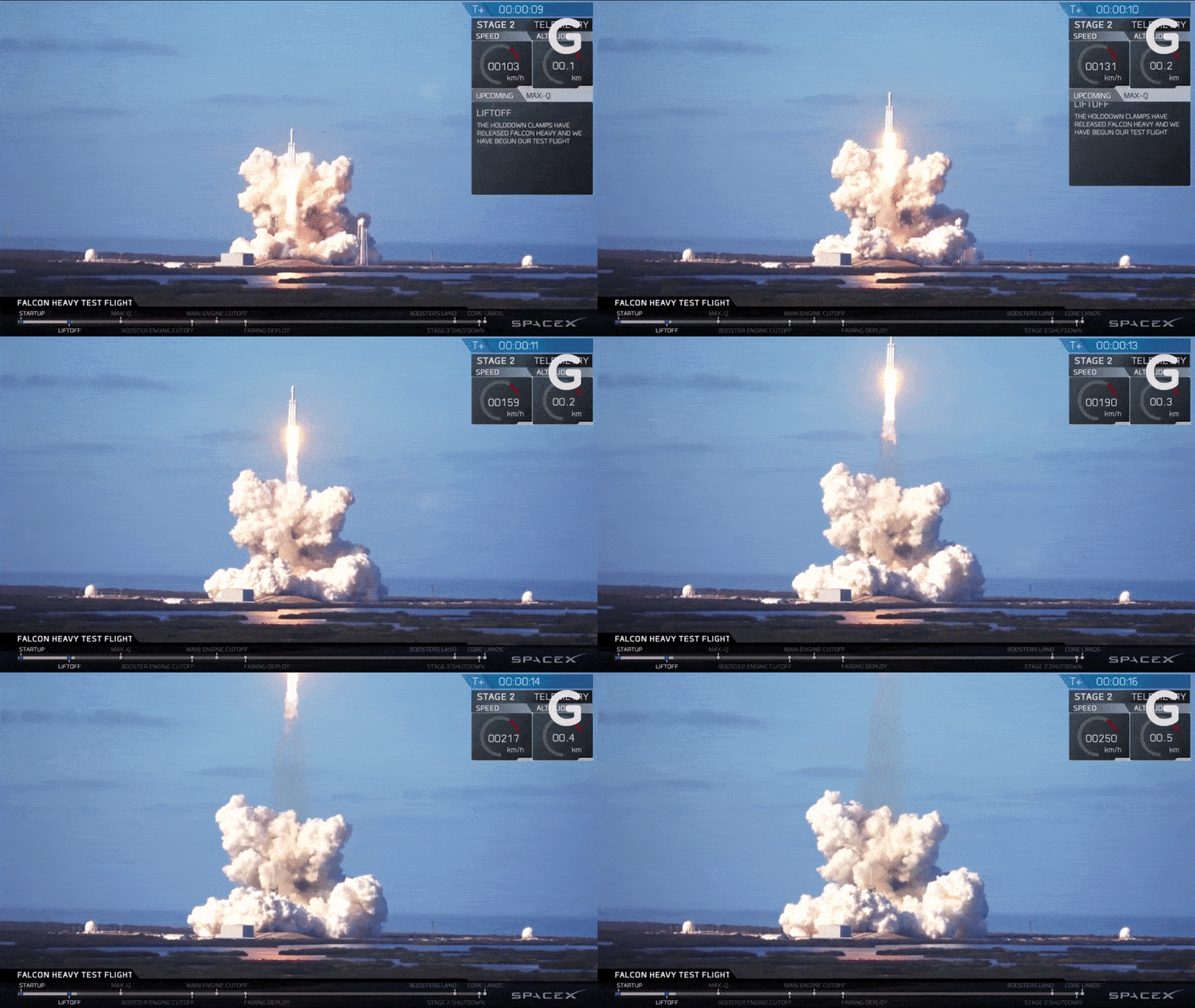
Image: SpaceX

SpaceX made history Tuesday afternoon by launching its first Falcon Heavy—and Elon Musk’s personal Tesla Roadster—into space, ushering in a new era for the aerospace company.

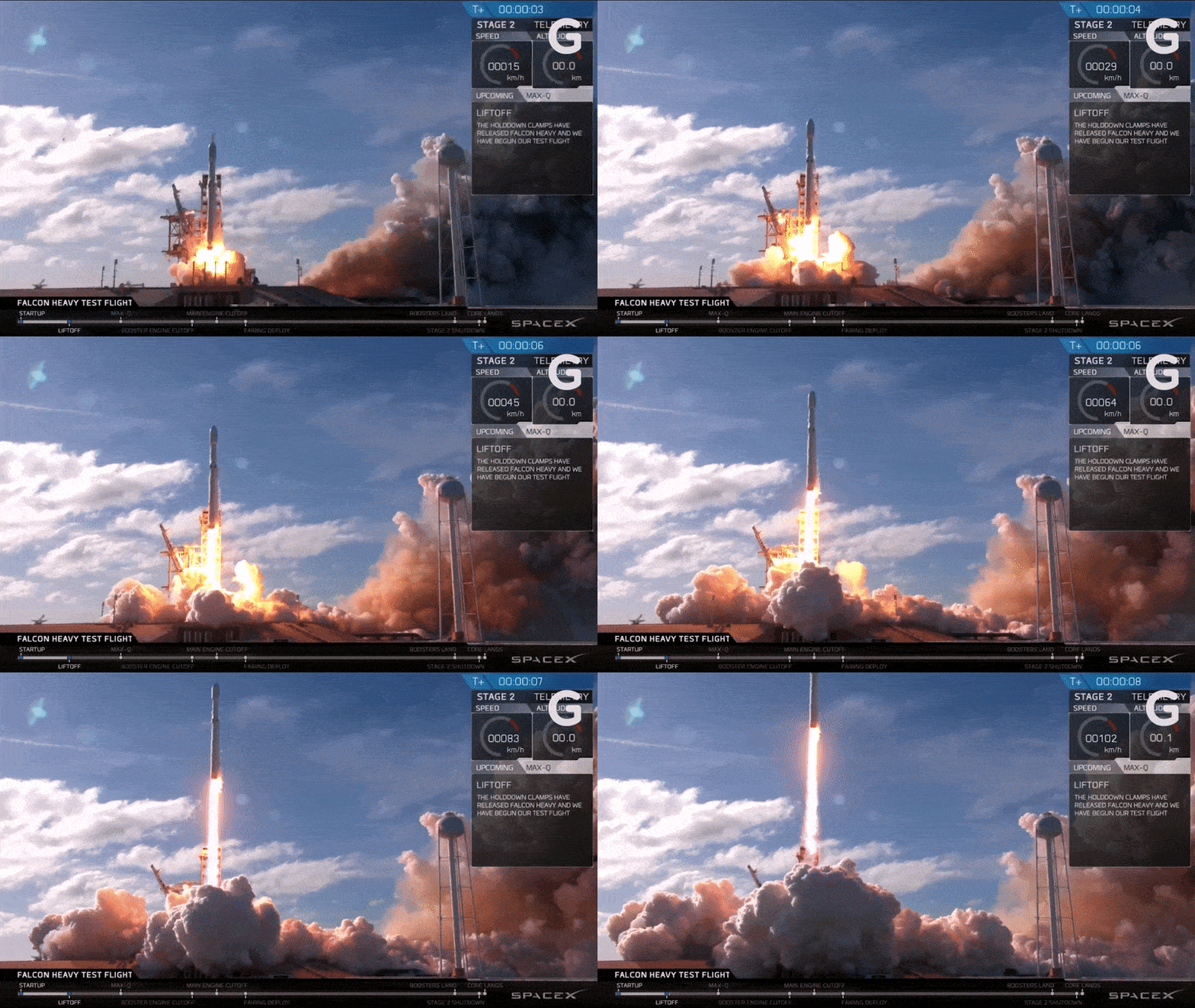
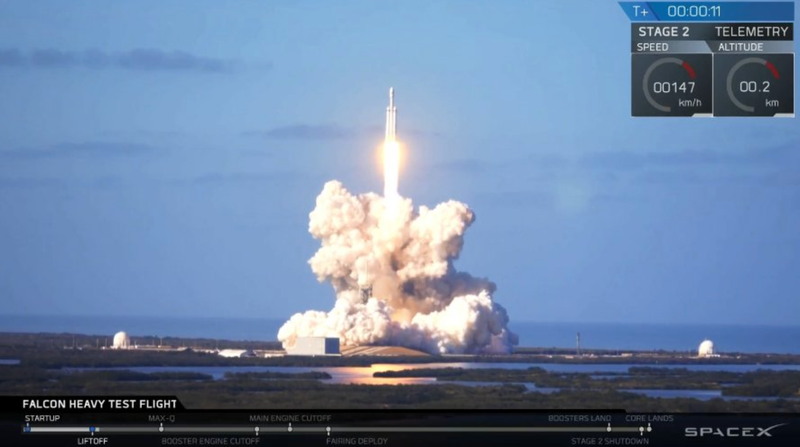
At 3:45 pm EDT, and with just 15 minutes left in today’s launch window, the Falcon Heavy thundered upwards from launchpad 39A at the Kennedy Space Center in Cape Canaveral, Florida, leaving a billowing trail of smoke behind it.

Image: SpaceX
Image: SpaceX
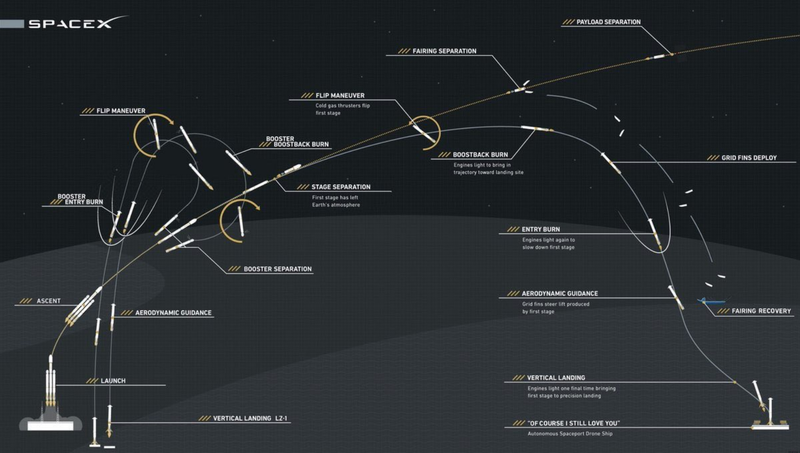
Thousands of onlookers cheered on as the rocket lifted off and drifted out of view. Cameras showed the “core” section of the rocket shedding its two Falcon 9 boosters approximately three minutes after lift off, both of which managed to make successful landings back on Earth. Following a flip maneuver, the late stage booster jettisoned its cargo, performing an atmospheric re-entry prior to its own vertical landing attempt on the barge, Of Course I Still Love You. The fate of the core is still not known.

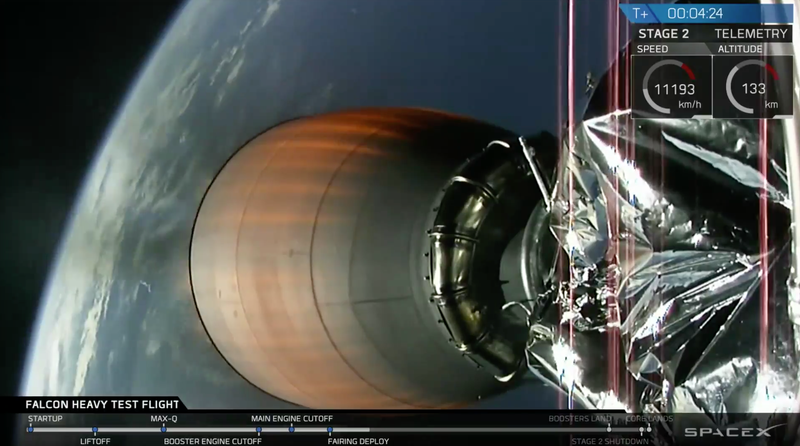
In a tweet, SpaceX said the “second stage engine cutoff as planned,” with Elon Musk adding that the upper stage “will spend 5 hours getting zapped in Van Allen belts & then attempt final burn for Mars.”

Image: SpaceX
Image: SpaceX
More powerful rockets have been launched before, including the Saturn V rocket that was used during the Apollo missions, but the Falcon Heavy is now the most powerful operational rocket in the world. This beast can generate more than five million pounds of thrust at liftoff, and carry 141,000 pounds of cargo to low Earth orbit. SpaceX originally designed the rocket to carry humans into space, including potential missions to Mars, but Musk now saysthe Falcon Heavy will never involve human passengers—a task that will be delegated to a larger space-transportation system called the Big Falcon Rocket, or BFR, which is currently in development.

Stage 2 booster working nominally.
Image: SpaceX
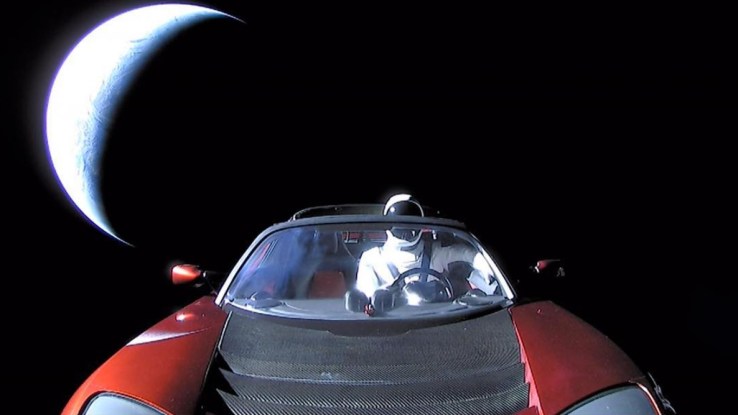
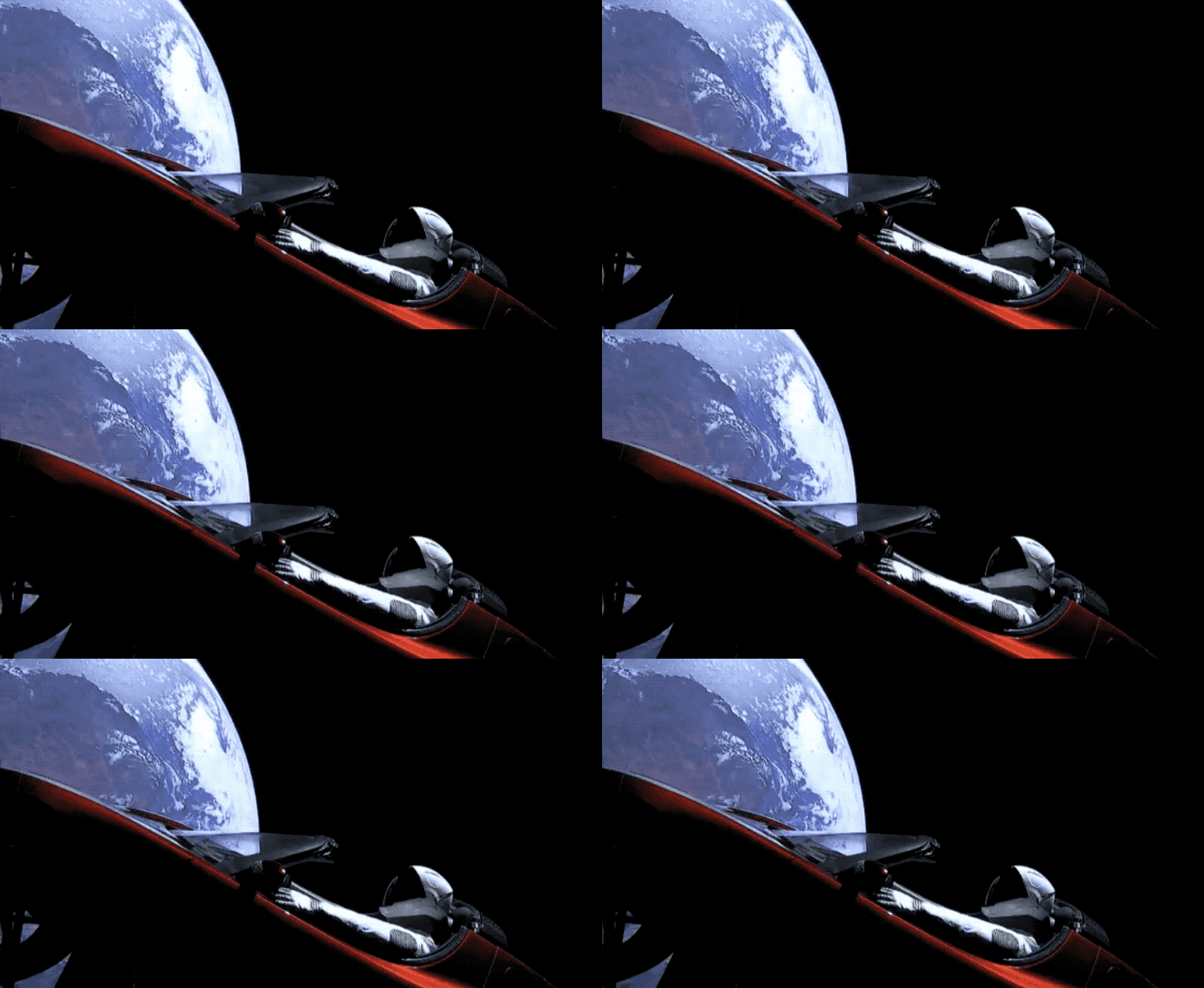
True to his word, SpaceX CEO Elon Musk shot his Tesla Roadster into space, along with a dummy named Starman behind the wheel. The car is headed towards an elliptical orbit that will see it drift in space for hundreds of millions of years. (a live view of Starman can be seen here)

Article preview thumbnail
Read this:Elon Musk Actually Shot A Tesla Roadster Into Space
It’s too early to know if everything went exactly as SpaceX planned, but given fears of an explosion or crash, today’s events must be considered a big success. The Elon Musk-led company can now prepare for future launches, including commercial contracts that could see a second launch in just a few months.

Synchronized landings of the side boosters
Synchronized landings of the side boosters.
Image: SpaceX
SpaceX
Image: SpaceX

Here’s the launch in its entirety.


Looking ahead, SpaceX can now proceed with its first commercial and U.S. Department of Defense contracts, which could happen in the next several months.

More to come as this is a developing story.

source:Gizmodo

Starman has gone dark
Starman and his space Tesla have sent their last selfie from Earth orbit, Elon Musk announced. The car and its mannequin driver launched yesterday atop the Falcon Heavy rocket will eventually escape Earth orbit and travel outwards through the solar system — but not in a hurry.

Elon Musk posted the “last pic” of Starman and on Instagram, though it’s such a nice frame that one suspects it’s probably the best of its last final minutes. At a press conference yesterday, he prepared us all for the inevitable shutdown of the most strangely fascinating live stream since Puddle Watch.

“The battery’s going to last about 12 hours from launch, roughly,” he said. “After that it’s just going to be out there in deep space for maybe millions, maybe billions of years, who knows? Maybe discovered by some alien race that’ll be like, ‘What were they doing? Did they worship this car?’ Why did they have a little car in the car?’ ”

(There was a toy Tesla Roadster with a toy guy in it glued to the dash.)

It’s not really clear when it actually went offline, but it was an enjoyable time while it lasted. Some questioned Musk’s motives in turning the launch into a sort of two-fer PR stunt promoting his other big company, but he said it really was just done in the spirit of fun.

Starman has gone dark
SpaceX Falcon Heavy Tesla Roadster Driver
Image: TechCrunch
“It’s silly and fun, but silly and fun things are important,” he said. “It’s literally a normal car in space. I like the absurdity of that. Normally they’d launch a block of concrete or something, that’s boring.”

Starman and the car will continue their slow outward movement, and will eventually cross the orbit of Mars and then enter the asteroid belt, where it seems likely it’s going to get nailed by one of the many, many rocks there. But depending on the angle of its orbit, it might also leave the ecliptic and avoid death by smashing.

Either way, it won’t be for many years. We’re not sure what the Roadster’s velocity is, but it ain’t fast, and Mars is quite a distance away. It may be decades or centuries before it gets far enough to be in danger. Assuming Elon Musk has discovered the secret of eternal youth by then, he’ll probably ‘gram that too.

source:TechCrunch

Here’s how to keep track of Elon Musk’s Roadster and Starman in space
Elon Musk’s Starman, the mannequin driver of the Tesla Roadster SpaceX launched aboard its Falcon Heavy rocket, is taking a trip around our solar system, in a large elliptical orbit that will bring him relatively close to Mars, the Sun and other heavenly bodies. But how to track the trip, now that the Roadster’s onboard batteries are out of juice and no longer transmitting live footage?

Thanks to the work of Ben Pearson, a SpaceX fan and electrical engineer working in the aerospace industry, who created ‘Where is Roadster,’ a website that makes use of JPL Horizons data to track the progress of the Roadster and Starman through space, and to predict its path and let you know when it’ll come close to meeting up with various planets and the Sun.

The website tells you the Roadster’s current position, too, as well as its speed and whether it’s moving towards or away from Earth and Mars at any given moment. It’s not officially affiliated with SpaceX or Tesla, but it is something Elon Musk is apparently using to help remember where he parked his galactic ride.
At least he can stop freaking out about leaving it onboard the Heavy just before launch.

source:TechCrunch

Will computers get better at cybersecurity than humans? Experts hope the answer is yes.

Rise of the hacking machines
I'm seated in a giant ballroom where vast rows of chairs face seven glowing supercomputers. Each liquid-cooled rack of servers is lit with a different color. The crowd of a couple hundred people cheers the computers on toward victory.

Though they stand on a dais at the Paris Las Vegas resort as still as statues, the computers are locked in heated battle with each other. Commentators on a jumbo screen offer a play by play of the invisible battle.

"The race for third is very tight," says Hakeem Oluseyi, an astrophysicist, in a rousing voice.

ForAllSecure's team Mayhem stands as a silent sentinel in the DARPA Cyber Grand Challenge.
Laura Hautala
Funded by DARPA, the government agency that commissions far-out research for the US Department of Defense, this is the Cyber Grand Challenge.

The computers are competing to be the best at a tedious and challenging task that human cybersecurity researchers do every day: find a bug in a software program, then fix it. Right now there aren't enough skilled people to do that job, so this technology could take pressure off IT departments everywhere struggling to stay on top of vulnerabilities in their computer systems.

The number of vulnerabilities in computer software running in the world is impossible to know. Cybersecurity firm Symantec estimated in its 2016 report on internet security threats that researchers across the industry found more than 5,500 new vulnerabilities in 2015 alone. Those bugs tend to stick around, as programmers copy-paste outdated software into new products, and users like you and me forget to update our software.

This new technology, experts say, will also give cyberdefenders a much needed advantage in a war that right now heavily favors the bad guys. It's much easier to find one bug and exploit it than to defend against every single possible weakness in a computer system. This competition hopes to flip that script.

"The idea is, you find it before the bad guys do," said David Brumley, CEO of startup ForAllSecure, which is developing a product in line with this concept. Brumley's team Mayhem is competing tonight with an algorithm based on the ForAllSecure product.


Team ForAllSecure, winner of the DARPA Cyber Grand Challenge
Team ForAllSecure, winner of the
DARPA Cyber Grand Challenge,
Las Vegas, August 2016.DARPA
Still, the technology is a little eerie. As I move closer to the seven competing computers, I can't help but feel like these might be our new cyber overlords.

I'm not alone in this worry. In a tweet, SpaceX and Tesla boss Elon Musk compared the DARPA project to the creation of Skynet, the technology that launched the robot wars described in the "Terminator" movie series. Spoiler alert: That story ends in nuclear disaster.

Who knows? This may be the last story I ever write.

Small steps to computer autonomy

All right, it's probably too soon to panic. Cybersecurity experts are still taking baby steps in adopting the technology called machine learning. The term refers to a broad range of techniques, all of which amount to humans taking their hands off the steering wheel and letting computers drive.

Machine learning is already at work defending our computers, noticing when a hacker has broken in. That might sound basic, but humans aren't very good at doing that.

The average time it takes US companies to realize they've been hacked is 146 days, according to a February report from cybersecurity firm FireEye. That number is actually an improvement from previous years, but it's still enough time for hackers to make a lot of mischief.

Take the data breach at Target in 2013, which compromised credit card details of 40 million customers. Experts say it could have been stopped much earlier. In fact,Bloomberg reported the programs guarding Target's computer systems noticed something was wrong and notified the IT department right away.

The problem was, that notice was lost in all the other warnings sent out that day. There are just too many suspicious things happening on a given computer system at any one time for a team of human beings to sort through.

"You're looking for a needle in a stack of needles," says Caleb Barlow, vice president of IBM Security. His company is training its Watson artificial intelligencetechnology to analyze blog posts, academic journals and news articles about cybersecurity threats. The goal is to have Watson apply what it learns to real-life cybersecurity incidents, offering advice to teams of humans.

DARPA Cyber Grand Challenge computer competitors
DARPA Cyber Grand Challenge computer competitors,
Las Vegas, August 2016.DARPA
Several other companies are developing computer algorithms that can sort out the false alarms from the real emergencies. Right now, the technology requires a feedback loop with human experts. The program makes its best guess as to what's dangerous, and humans can go in and tell the computer if it got that right.

Eventually, experts say, the computers won't need us.

Computers helping computers

The Cyber Grand Challenge aims to take machine learning tools far beyond finding a hacker in a machine. Rather than sitting around waiting to be hacked, this technology could automatically fix the software bugs that let hackers in.

The seven teams competing Thursday came from universities and cybersecurity companies, each bringing a computer that can run a specialized algorithm without human interference. In 96 rounds of competition, the computers looked at code provided by the contest organizers in search of vulnerabilities. Then they patched the code and sent it back to run on a test computer.

To fix the problem, the supercomputer has to do some reasoning, according to Tim Bryant, technical lead for the Deep Red team, whose members work at cybersecurity company Raytheon. It looks at the code and says, "Here's what we think the program was supposed to have done," Bryant said.

There's also gamesmanship. The algorithms steal patches from each other and change their approach based on how they can score the most points.

But really, is this a good idea?

So what is it that Elon Musk and I are afraid of? This sounds great. Supercomputers will fix all our software flaws, and hackers will be left out in the cold. Musk himself is investing in artificial intelligence, so maybe he was just kidding. Heh.

But if a computer can fix a problem in my software, couldn't it just as easily exploit the problem? Make a few changes, and you're not looking at supercomputers that protect us from hackers. You're looking at supercomputers that are hackers.

Brumley acknowledges this is a valid concern. Still...

"I don't think that's a bad thing," he says. "Like any tool, you have to deploy them ethically."

I guess we'll just have to trust Brumley, because in a nail-biting finish, his ForAllSecure team wins Thursday's competition. All hail our new supercomputer overlord.

source: CNET

Silicon Valley's "Middle Class" Problems

In a Suburb, Sunny Palo Alto, more than 2000 local businesses and earns up to $400,000 a year but they still describe themselves as "middle class".

Silicon Valley's "Middle Class" Problems
You are correct. This is Silicon Valley where people earning several times the national average.

According to a survey by the local press Palo Alto Weekly, inhabitants of this suburb, who is at least seven times richer than the average "middle class" in America, when it comes to living Palo Alto, they can’t consider themselves “privileged class.”

In the survey conducted by Palo Alto Weekly with more than 250 participants between December 2017 and January 2018, about a third of participants ranging from $10,000 to $399,999 identifying as "middle class."

Less than 10 percent of participants identified as "lower middle class,” but the annual income of this group included people who earns about $350,000 a year.

In this suburb, home to technology giants such as HP, Tesla, Google and Facebook. And with that comes wealth can not be regarded as modest. Another one said “While hundreds of millionaires live in Palo Alto, how can we define ourselves as superior class?”

For more: Palo Alto Weekly

Google’s custom TPU machine learning accelerators are now available in beta
Google’s Tensor Processing Units (TPUs), the company’s custom chips for running machine learning workloads written for its TensorFlow framework, are now available to developers.

The promise of these Google-designed chips is that they can run specific machine learning workflows significantly faster than the standard GPUs that most developers use today. For Google, one of the advantages of these TPUs is that they also use less power, something developers probably don’t care quite as much about, but that allows Google to offer this service at a lower cost.

The company first announced Cloud TPUs at its I/O developer conference nine months ago (and gave access to them to a limited number of developers and researchers). Each Cloud TPU features four custom ASICs with 64 GB of high-bandwidth memory. According to Google, the peak performance of a single TPU board is 180 teraflops.

Google’s custom TPU machine learning accelerators are now available in beta
Image: TechCrunch
Developers who already use TensorFlow don’t have to make any major changes to their code to use this service. For the time being, though, Cloud TPUs aren’t quite available at a click of a button, though. “To manage access,” as Google says, developers have to request a Cloud TPU quota and describe what they want to do with the service. Once they get in, usage will be billed at $6.50 per Cloud TPU and hour. In comparison, access to standard Tesla P100 GPUs in the U.S. runs at $1.46 per hour, though the maximum performance here is about 21 teraflops of FP16 performance.

Google’s reputation for machine learning will surely drive a lot of new users to these Cloud TPUs. In the long run, though, what’s maybe just as important is that this gives the Google Cloud a way to differentiate itself from the AWS’s and Azure’s of this world. For the most part, after all, everybody now offers the same set of basic cloud computing services and the advent of containers has made it easier than every to move workloads from one platform to another. With the combination of TensorFlow and TPUs, Google can now offer a service that few will be able to match in the short term.

source:TechCrunch

MKRdezign

Contact Form

Name

Email *

Message *

Powered by Blogger.
Javascript DisablePlease Enable Javascript To See All Widget