Search Result For "emoji"

We're No. 2! Winning four Razzie Awards, the animated film and its stinker reviews made Patrick Stewart's talking-poo emoji proud.

Is there an emoji for when you win something (smiley face!) but it's something really embarrassing (blushing face!) but still you win a lot of it (blushing smiling face?)? If so, roll it out, because "The Emoji Movie" could use it.

On Saturday, the day before the 2018 Academy Awards, the Golden Raspberry Awards for the worst movies of the year were handed out, and "The Emoji Movie," whose stars included Patrick Stewart voicing a piece of talking poo, is truly No. 2. Er, No. 1, if you like.

The 2016 animated movie not only claimed worst picture, it also won worst screenplay, director and "worst screen combo." That last award was given to "any two obnoxious emojis" from the film, beating out competitors including "Johnny Depp and his worn-out drunk routine" from "Pirates of the Caribbean: Dead Men Tell No Tales," and "any combination of two characters, two sex toys, or two sexual positions" from "Fifty Shades Darker."

The plot summary sounds like something a fourth-grader scribbled down as a last-minute creative-writing assignment, but here it is:

"The Emoji Movie" features T.J. Miller. formerly of "Silicon Valley," as Gene, a young "meh" emoji who faces problems because he can make multiple faces, not just the one he's expected to produce. He meets up with many different emojis in Textopolis, a digital city inside the phone of a teen named Alex. Stewart, of "Star Trek" fame, lends his proper British accent to the piece of poo emoji, and deadpan comic Steven Wright voices Gene's father, another "meh" emoji.

The Razzies also named Tom Cruise as worst actor for "The Mummy," and Tyler Perry claimed the worst actress award for "BOO! 2: A Madea Halloween." Kim Basinger won worst supporting actress for "Fifty Shades Darker," and Mel Gibson won worst supporting actor for "Daddy's Home 2." The "Baywatch" film received the award for the "Razzie Nominee So Bad You Loved It."

"The Emoji Movie" has earned its honors. The film has an "overwhelming dislike rating" at CNET sister site Metacritic and a weak 9 percent critical approval rating at Rotten Tomatoes.

2018 sci-fi, fantasy and geek movies to get excited about


source:CNet News

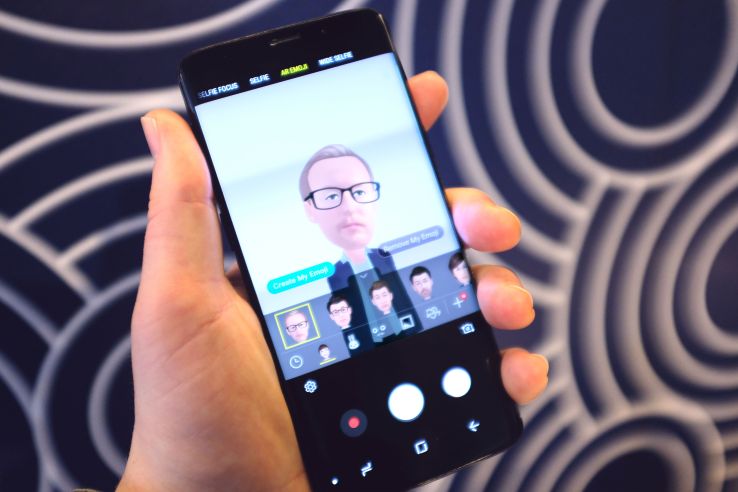
Samsung’s AR Emoji taps creepy avatars and Disney characters to compete with Animoji
We’ve known for a while that Samsung’s been planning an Animoji competitor for its latest handset. Now that we’ve actually seen (the admittedly clunkily named) AR Emoji in action, we can testify to the fact that it’s some combination of compelling and creepy.

Samsung’s AR Emoji taps creepy avatars and Disney characters to compete with Animoji
That last part first. Like the iPhone X, the Galaxy S9 takes advantage of its on-board face scanning technology to offer up an animated emoji that corresponds to the user’s facial movements, so you can send animated messages, sing cartoon character karaoke and the like. But, as is Samsung’s wont, the phone takes things an extra step, mapping more than 100 points in the user’s face and building a 3D avatar.

Once the scan is complete, users can customize it from a selection of hair styles, clothes, glasses and the like, before firmly taking up residence in the uncanny valley. The custom AR Emoji isn’t as adorable as Apple’s animals or benign as Nintendo’s Mii avatars. Instead, it straddles that uncomfortable line between cartoon and realistic 3D scan a bit uncomfortably.

It’s first generation, of course, and I’d expect that the company should smooth that line out a bit by the time the Galaxy S10 or even the new Note rolls around. For now, however, it’s a little uncomfortably creepy for my own taste. There’s good news on that front, however. The company’s offering up some default cartoon options — including a rabbit that’s a bit more anthropomorphic than Apple’s offering.

Samsung’s AR Emoji taps creepy avatars and Disney characters to compete with Animoji
But Samsung’s got one big secret weapon on its side. The company no doubt ruffled some feathers at Apple’s big glass spaceship today when it announced a partnership with Disney, bringing the entertainment goliath’s beloved cartoon characters to its emoji offering. The company’s bringing Mickey, Minnie and the Pixar’s Incredibles to the mix.

It seems like a bit of a curveball that Disney opted to partner with Samsung, rather than Apple this time out — after all, the two companies have worked together in the past on things like the Mickey Mouse watch face. And of course, there’s been a fair amount of executive overlap between the two companies, between Steve Jobs’ involvement with Pixar and the fact that Robert Iger currently sits on Apple’s board.

Of course, those sorts of things aren’t a guaranteed promise of partnership, and Disney looks like it’s not trying to play favorites with content partnership. Take, for example, the media company’s licensing of Star Wars content for AR stickers on the Pixel 2.

source:TechCrunch

Best Windows 10 apps this week

Two-hundred-and-sixty-eight in a series.

Welcome to this week's overview of the best apps, games and extensions released for Windows 10 on the Windows Store in the past seven days.

Depending on which service you believe when it comes to Windows 10's usage share, the operating system either overtook Windows 7 last month or did not.

As always, if I missed an app or game that has been released this week that you believe is particularly good, let me know in the comments below or notify me via email.

Discounts this week

The following list is a selection of the best deals. Make sure you check out the Store for all offers.

Some apps are discounted for more than one week. Only new apps and games are listed below. Check out the previous post in the series for past offers that may still be valid.
  • GamiFlux, a PC game streaming app, for $0.99
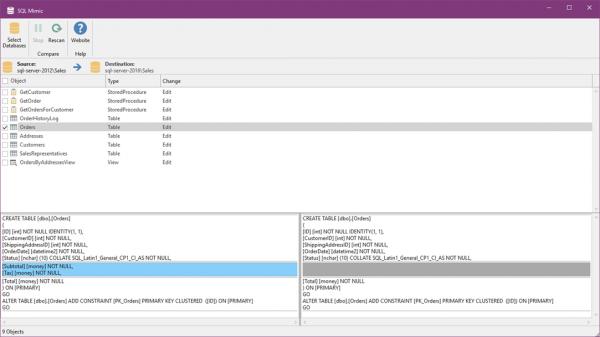
  • SQL Mimic, compare SQL Server database schemas, for $4.99

Notable apps and games

SQL Mimic ($4.99)

Best Windows 10 apps this week
SQL Mimic is a SQL comparison application that supports SQL Server 2012 and newer.

You may use it to compare the schemas of two SQL Server databases to find differences.

vDrum 2018 ($1.99)

Best Windows 10 apps this week
vDrum 2018 is not a virtual reality app even though one might think it is. The app displays a drum kit on the screen that you may play on using the mouse, keyboard, or touch.

It is rather simplistic right now as it does not feature play-along songs or any kind of instructions or tutorials.

WhatsApp Desktop

Best Windows 10 apps this week
WhatsApp Desktop is now available on the Windows Store officially. You need to link it to your WhatsApp account to read messages and interact with contacts using your Windows 10 PC.

A mobile phone with WhatsApp is required for that as you cannot use WhatsApp Desktop as a standalone app.

The main advantage that WhatsApp Desktop offers is that chats displays on a larger screen and that you may use the keyboard to type messages.

The functionality is well replicated. You can attach files or photos, mute contacts, delete chats, or bombard someone with Emoji.

wTorrent

Best Windows 10 apps this week
wTorrent is another free BitTorrent client for Windows 10. The client is basic in nature when you compare it to desktop torrent clients such as uTorrent or qBittorrent but quite powerful when you compare it to other torrent apps in the Store.

It supports magnet links and torrent files, and you can set up ports, encryption, IP blocking and other features using it.

App updates

NotePadX update brings tab support and usability improvements.

source:BetaNews

Facebook confirms test of a downvote button for flagging comments
How can Facebook promote meaningful interaction between users? By letting them downvote inappropriate comments to hide them. Facebook is now testing a downvote button on a limited set of public Page post comment reels, the company confirms to TechCrunch. But what Facebook does with signals about problematic comments could raise new questions about censorship, and its role as a news editor and media company.

A Facebook spokesperson tells TechCrunch Facebook that the motivation behind the downvote button is to create a lightweight way for people to provide a signal to Facebook that a comment is inappropriate, uncivil, or misleading.

Here’s the statement Facebook provided: “We are not testing a dislike button. We are exploring a feature for people to give us feedback about comments on public page posts. This is running for a small set of people in the U.S. only.”

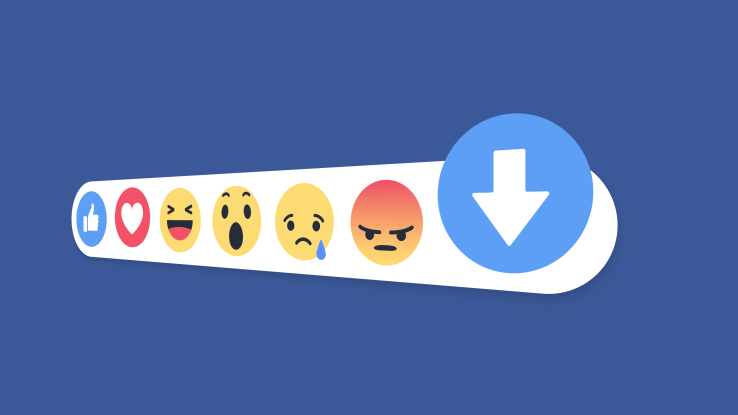
This is what the downvote button looks like up close:

Facebook confirms test of a downvote button for flagging comments
Facebook confirms test of a downvote button for flagging comments.
Image: TechCrunch
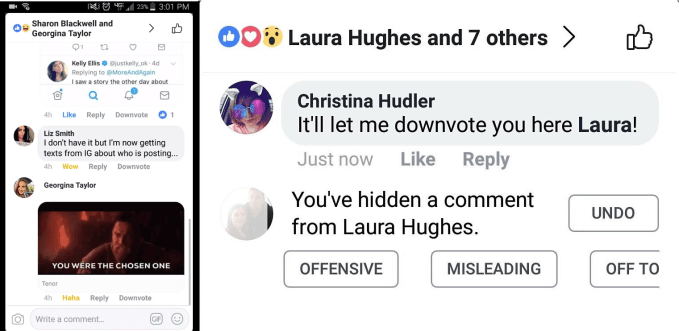
When tapped, the downvote button hides a comment, and gives users additional reporting options like “Offensive”, “Misleading”, and “Off Topic”. Those could help Facebook figure out if the comment is objectionable, a form of “fake news”, or just irrelevant. Facebook already has a “Hide” button for comments, but it’s usually hidden behind the drop-down arrow on comments rather than immediately clickable.

Here you can see the downvote button on a comment thread, plus what happens when you click it. The screenshots come from Christina Hudler.

Facebook confirms test of a downvote button for flagging comments
Facebook confirms test of a downvote button for flagging comments.
Image: TechCrunch
According to Facebook, this is a short-term test that doesn’t affect the ranking of the comment, post, or Page. It’s designed as a way to give feedback to Facebook, not the commenter, and there will be no publicly visible count of how many downvotes a comment gets. The test is running for 5% of Android users in the U.S. with language set to English. The downvote button only appears on public Page posts, not on posts by Groups, public figures or users. There’s currently no plan to expand the test as is.

Not A Dislike Button

A dislike button has long been the most requested Facebook feature, but Facebook has never given in.

Back in 2015, CEO Mark Zuckerberg responded to a Q&A question about it, saying:
We didn’t want to just build a Dislike button because we don’t want to turn Facebook into a forum where people are voting up or down on people’s posts. That doesn’t seem like the kind of community we want to create.
Instead, Facebook built the Reactions options that let you respond to posts and comments with love, wow, haha, sad or angry emoji. Facebook also built reactions into Messenger with the option to give messages a thumbs-up or thumbs-down so you could show agreement or disagreement.

Facebook confirms test of a downvote button for flagging comments
Facebook confirms test of a downvote button for flagging comment.
Image: TechCrunch
But the new downvote button is the closest Facebook has come to actually giving people a dislike button. Downvoting was popularized on Reddit for crowdsourcedcomment ranking. Reddit co-founder Alexi Ohanian weighed in on Facebook’s version via Twitter:
The downvote button ties in with Facebook’s recent push to enhance its users’ well-being by prioritizing News Feed content that drives meaningful interactions instead of passive, zombie browsing. That led Facebook to show fewer viral videos, which in turn contributed to a 700,000 user decrease in U.S. and Canada daily active users — its first decline ever anywhere — and Facebook’s slowest DAU growth rate it’s ever reported.
But one way Facebook could generate more meaningful interaction without losing time on site could be by ensuring the most interesting comments are at the top of posts. Facebook already ranks comments by relevancy based on Likes and replies. But the downvote button could ensure that if objectionable comments rise up and stall discussion, Facebook will know.

That could eventually lead to a way for Facebook to bury these comments, or the people that post them. However, this will only open up more questions about censorship and what qualifies as inappropriate at a time when Facebook is already struggling to manage its responsibilities as what Zuckerberg calls “not a traditional media company.”

source:TechCrunch

Will the mockery of Apple continue

Commentary: Samsung keeps insisting that Apple is always behind. With the release of the Galaxy S9, how true might that be?

Technically Incorrect offers a slightly twisted take on the tech that's taken over our lives.

Will the mockery of Apple continue
Will the mockery of Apple continue?
Samsung / YouTube screenshot by Chris Matyszczyk / CNET
It was the ad that took mockery to an exalted level.

Released last November to coincide with the launch of the iPhoneX, here was Samsung wantin everyone to believe that it was the inventive brand, while Apple was the label of sad sheep and retrograde lovers.

Samsung was, in its own eyes, first with just about every single development in phone design since, well, smartphones were invented.

Apple merely copied. And late, too.

With the Galaxy S9 being launched this week, will Samsung still be able to claim this?

If you look at the teaser ads for the S9 that the Korean company released last week, they featured the camera, the camera and the camera.

Oh, and an emoji variant. Which some Apple faithful might think of as copying Animoji with a little twist.

Oddly, this apparent emphasis on the camera and Animojis coincides precisely with what a T-Mobile salesman told me were the biggest selling point of the iPhone X: selfies and Animojis.

Is this what we've come to? Phone companies selling their devices by giving humans more ways to imaginatively express their self-regard?

Of course, it may be that Samsung has some pulsating surprise that it's saving for the February 25 launch day.

Yet the rumors collected by my colleague Justin Jaffe so far don't point to a phone that will give Samsung a new reason to claim its (supposedly) obvious creative superiority over Apple.

Yes, there might be a more entertaining unlocking tool or perhaps a virtual fingerprint reader, but will these be sufficient to add a new chapter to Samsung's Apple-mocking?

Samsung didn't immediately respond to a request for comment.

Some might see an acknowledgement of an essential parity between the two brands in the naming of the new phone.

It seems to be the Galaxy S9. Not, say, the S10. Or even, to tweak Apple further, the S11. Is a 9 somehow slightly lesser than a 10? I mean, a X?

Psychology can play strange tricks on vulnerable human minds.

Personally, I'd rather like Samsung to reveal something the rumor mills haven't uncovered. There's always something delightful about companies defying the constant online chatter, renderings and photographing of supposedly new phones.

Mischievous Apple-persons, though, might muse that the most enjoyable surprise for them would be if the S9 had a notch.

source:CNet

SpaceX is ready to launch a test of its planned  satellite internet service aboard a Falcon 9 rocket

Elon Musk's rocket company has been working on getting satellite broadband off the ground for years. Now the Falcon 9 is set to launch the first test.

SpaceX is ready to launch a test of its planned  satellite internet service aboard a Falcon 9 rocket
SpaceX is ready to launch a test of its planned
satellite internet service aboard a Falcon 9 rocket.
SpaceX
For the second time in recent days, SpaceX has delayed the launch of a rocket carrying prototype satellites for its planned broadband internet service.

The Falcon 9 is now set to blast off Wednesday, just a few weeks after SpaceX launched its huge Falcon Heavy rocket for the first time.

More than three years ago we learned Elon Musk and his rocket company were working on developing satellites to provide low-cost internet access around the world. Correspondence between the company and the Federal Communications Commission revealed that the first pair of demonstration satellites for the company's Starlink service will finally be launched into orbit.

The main payload for the launch from Vandenberg Air Force Base in California will be the Spanish government's Paz satellite, designed to capture imagery of the Earth down to the single-meter scale. But there had been unconfirmed reports for several weeks now from space industry sources like NASASpaceFlight.com that a secondary passenger on the flight would be the Starlink demonstration setup.

SpaceX itself has been relatively mum about the debut of its Starlink satellites, and about the entire program itself. However, a letter from SpaceX to the Federal Communications Commission, posted to the FCC website Monday, makes it pretty clear what will be aboard the Falcon 9 when it launches.

The letter refers to two satellites, called Microsat-2a and Microsat-2b, that will be launched as a secondary payload on the Paz mission. The FCC granted SpaceX a license in November to launch this pair of satellites as part of a test mission. In its application, the company describes the test objectives: Putting that all together: SpaceX is testing internet broadband satellites that will be launched along with the Paz satellite.

Last Wednesday, FCC Chairman Ajit Pai gave his endorsement to SpaceX's application to operate two huge constellations of broadband satellites. The company has secured approval for the two test satellites, but the broader application for Musk's larger ISP vision is still awaiting a decision.

The launch had originally been scheduled for Saturday, but was postponed to Sunday and then again until Wednesday to allow "additional time to perform final checkouts of upgraded fairing," according to a tweet from SpaceX.

A release from Vandenberg confirmed that the launch is scheduled for Wednesday at 6:17 a.m. PT and that "the Falcon 9 and payload remain healthy."

SpaceX declined to make an official comment about the broadband project prototypes.

Even so, Joy Dunn, the company's "senior manager of new product introduction," did drop this emoji-based hint earlier this week on Twitter:
SpaceX hopes to have its global internet service up and running by the middle of the 2020s. Other public filings have revealed that the company hopes revenue from becoming an ISP could help fund its vision of a Mars colony.

If that pans out, spreading internet memes about Mars could eventually help us pay to get there. It's almost poetic.

Humans on Mars: An atlas of plans to land on the Red Planet

...

source:CNet

Facebook should actually be Tinder too

...You like them, they like you, you both find out and get connected...
T
here’s beauty in the double-blind opt-in. That’s the way you match with someone on Tinder. You like them, they like you, you both find out and get connected. But to date, the feature’s largely been trapped in dating apps that match you with randos or that not everyone wants to be on. That means this anti-loneliness technology is leaving some people out.

Facebook, meanwhile, is on a newfound quest to stimulate “meaningful interactions,” not just passive content consumption. Its latest attempt is a ham-handed Meetups feature. It surfaces big groups of friends saying some might want to hang out with you, and asking if you’re interested. If you both say yes, it connects you over Messenger.

The idea behind Meetups is smart, but the execution is a mess. Because Meetups ambiguously shows multiple people at once, sends aggressive notifications to participate and encompasses all kinds of relationships, the results are meaningless. You don’t know if someone “chose you” because they actually like you, want to chill platonically, actually were approving of another friend shown at the same time or were just mindlessly clicking through after getting an alert to try the confusing feature.

Facebook should actually be Tinder too
Image: TechCrunch
For years I’ve been writing about how Facebook and Messenger should build an offline availability indicator for finding out who’s free to spend time with in person. Messenger’s new test of “Your Emoji,” where you can put a beer mug, or dinner plate, or briefcase on your profile pic for 24 hours to indicate what you’re up to or interested in doing, is a much better approach.

But it’s not designed for dating. And let’s be real. Finding a significant other is the source of some of the most meaningful interactions you’ll ever have. If Facebook can be the matchmaker, it will accomplish its mission while earning tremendous good will from those paired up. And unlike dating apps that become needless to people once they successfully get into a relationship, it doesn’t matter to Facebook if you never use the feature again.

Facebook should actually be Tinder too
Image: TechCrunch
That’s why Facebook should build a “Matchmaker” feature into its profiles.

It’d be completely voluntary from the start. If you’re romantically interested in someone, you could hit a button on their profile that they’ve opted in to displaying. If they hit the button on yours too, Facebook lets you both know.

Here’s the tricky part, or technically, the simple part. Facebook shouldn’t blast you with tons of notifications teasing that someone likes you. It shouldn’t try to get you to guess who it was from a short-list of people. And it shouldn’t push you to swipe through all your friends. It should be subtle. Otherwise, some users, especially women who typically get the majority of inbound interest from men on dating apps, may feel pestered, ogled or even objectified. That’s why many people stray away from sleazy dating apps like Bang With Friends that try to match you via your social graph.

Some will surely cringe at the idea of Facebook getting more deeply involved with our romantic lives. Others might think it’s redundant with Pokes, walls, messages and other ways to connect, even though those are either unclear signals or lack the privacy and protection against unwanted advances of double opt-in. And, understandably, some just wouldn’t want to mix romance into a friendship platform. There’s certainly the risk of creepy dudes following up via message like “I right-swiped you…” Getting this wrong could drive people away from Facebook all together.

But done right, Facebook Matchmaker would hardly exist for anyone who doesn’t want it. It wouldn’t generate tons of unrequited “Yes” swipes. And it’d only result in rare matches. But those matches would be meaningful, because they weren’t coerced, and they didn’t occur on an app designed for finding one-night hookups. They’d be people from whom you already accepted friend requests, in your network, with whom you might already have a lot in common.

Facebook should actually be Tinder too
Image: TechCrunch
I’m increasingly hearing from friends over 30 that they’re anxious they won’t ever find a partner. But we’ve lost many of the other cultural institutions that used to pair us up 100 years ago.

Globalization of opportunity leads people to leave their home towns. Secularization and the rise of science mean fewer people are connected through places of worship. Multi-generational housing has fallen out of fashion so young adults don’t live with parents and grandparents who could match them with a partner. The positive shift toward women pursuing their own careers leads some to push marriage to later in life. People are spending longer on higher education and prioritizing jobs over family.

And now when we feel lonely, when we might have sought in-person companionship, we have phones full of feeds, memes and games to keep us company.

Facebook’s made it easier than ever to “feel connected,” endlessly scrolling through friends’ photos, while actually allowing us to isolate ourselves. Matchmaker is its chance to fulfill the most fundamental purpose of what we used to call “social networks.”

source:TechCrunch

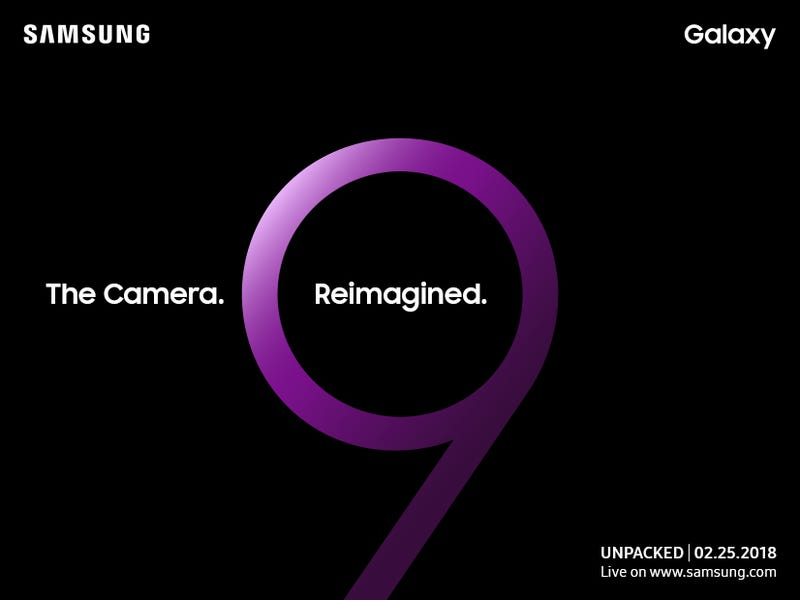
With Mobile World Congress coming up at the end of the month, the smartphone world is ramping up to peak hype in preparation for the Samsung Galaxy S9’s expected debut there on February 25th. The rumors are flying so we scoured the net and gathered up the most credible leaks and rumors to give you the best idea of what Samsung will announce in just a couple of weeks.

Design

One of the most confusing things about the Galaxy S9 based on early leaks and renders is that the front of Samsung’s new flagship is going to look almost identical to the Galaxy S8—right down to the curved display and the rounded corners on its screen. Even the arrangement of the sensors and cameras built into the top bezel look unchanged.
However, it’s a slightly different story around back, as Samsung has moved the S9’s fingerprint sensor to a more central location below the rear camera, rather than off on the right side like you get on the Galaxy S8. Additionally, the camera stack is aligned vertically, instead of horizontally, which gives the S9’s back a more symmetrical appearance. Everything else seems like it is pretty much the same as the Galaxy S8, including the brushed aluminum band holding the front and back glass panels together, and Samsung’s retention of the dedicated Bixby button on the left.

For those wondering about color options, Evan Blass claims the S9 will be available in midnight black, lilac purple, titanium gray, and coral blue.

Specs

Inside, the Galaxy S9 is expected to come with Qualcomm’s latest mobile processor, the Snapdragon 845, which would the first time this chip has been featured in a consumer device. Memory and storage for the S9 will stay at 4GB and 64GB respectively. However, VentureBeat claims the S9+ should get a small bump up to 6GB of RAM and 128GB of storage standard. The S9 and S9+’s OLED screens will remain the same size, at 5.8 and 6.2-inches, and should sport the same 2960 x 1440 resolution as well.

A nice upgrade, according to SamMobile, is that it seems the S9 will have stereo speakers, which should deliver a much richer audio experience than the mono setup on the S8. Finally, also according to Evan Blass, Samsung has wisely decided to retain a headphone jack for the S9, which should be a big boon for people who don’t want to deal with wireless headphones.

New Rear Camera

Despite the lack of official specs or info, Samsung is already teasing the power of the S9’s new camera. Based on yet more info from Evan Blass, that confidence might not be unwarranted, as it seems the S9 will feature the world’s first adjustable aperture camera on a smartphone that can switch between f/1.5 (which would also widest aperture on a smartphone) and f/2.4 on command. On top of that, there are reports from SamMobile saying that the S9 will have a new super slowmo feature that can record video at up to 480 frames per second at 720p. Meanwhile, the S9+ will also feature a second rear camera with 2x optical zoom similar to the one found on the Galaxy Note 8.

Other New Features
Here’s Everything We Think We Know About Samsung’s Galaxy S9 So Far
Image: SamCentral
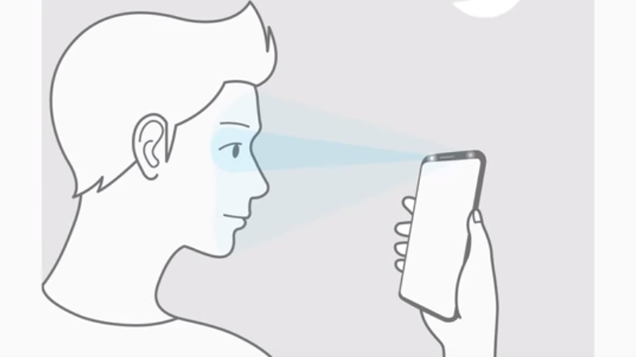
Currently, the S8 already has iris scanning and facial scanning biometric security options. But according to SamCentral, on the S9, Samsung will combine the two to create what it’s calling Intelligent Scan, which seems to be the company’s answer to Apple’s Face ID. Based on a teardown of the Note 8’s Oreo update, Intelligent Scan should leverage eye and face recognition to offer better security, while also enabling another new feature that people are calling 3D emojis.

That’s right, after Apple included Animoji on the iPhone X, it seems Samsung has come up with its own version of animated emojis that react to your facial movements. According to ETNews, the S9 will be able to create 3D characters based on a persons’s face, which can be used in place of emoticons in specific messaging apps. However, 3D emoji is currently just a placeholder name, while we wait for Samsung to announce something more official on February 25th.
The last big change is a new version of Samsung’s DeX Station, which has evolved from a standup dock-like affair to something more padlike. The pad will come with all the necessary ports to hook up a mouse, keyboard and an external display, so that you can transform the S9 into a mini desktop of sorts. Fingers crossed it improves on the last version.

Price and Availability

This last topic is the subject of some major trepidation, because in the fall, both Samsung and Apple released the most expensive phone each company has ever made in the $900 Galaxy Note 8 and the $1000 iPhone X. And unfortunately, based on rumors coming out of both South Korea and the UK, it seems like the price of the Galaxy S9 is going up too.

Based on rumored pricing in Asia and Europe, I’m estimating that the Galaxy S9 will go for between $775 and $800, which would be a significant jump up from the $700 to $720 the Galaxy S8 cost when it came out last year (prices varied slightly depending on the carrier). Meanwhile, the larger S9+ will most likely command its typical $100 premium over the standard model. This would make the S9 the most expensive Galaxy S yet, which probably isn’t too surprising for anyone keeping tabs on recent smartphone trends, but it is a bit worrying.
Here’s Everything We Think We Know About Samsung’s Galaxy S9 So Far
Image: Samsung
As for when you’ll actually be able to buy one, @evleaks claims that pre-orders will go live on March 1st, with orders shipping out two weeks later on March 16th. This would be one of the earliest Galaxy S launches in recent history, which is good for anyone who has been holding off on buying a new phone, and should ensure that Samsung is the first phone maker out there selling the next generation of phones.

So will the S9 be enough to steal the thunder away from Apple iPhone X? It’s hard to say yet, but if those camera rumors are true, that could be enough put Samsung back on top. Either way, I’ll be on the ground in Spain at Mobile World Congress covering all the news, so check back starting Feb 25th for the latest.

source:Gizmodo

MKRdezign

Contact Form

Name

Email *

Message *

Powered by Blogger.
Javascript DisablePlease Enable Javascript To See All Widget