Latest Post

Keyo modernizes housing with rent auto-pay that boosts your credit

Today in dense urban areas, tenants frequently change apartments as their income grows and they tire of different neighborhoods...
T
here’s nothing we spend more money on for a worse experience than housing. Keyo wants to fix all of it. The audacious startup envisions a world where a building’s other tenants get $20 to show you an available apartment on your schedule. Where you auto-pay your rent online and it improves your credit score. Where you get local business perks and can communicate maintenance requests through an app by renting in a Keyo location. And where it’s all free because landlords pay Keyo to fill their units faster.

It’d seem like a crazily ambitious startup idea if it wasn’t already working. Keyo has 4,300 units under management in Brooklyn. And now it’s ready to come out of stealth with a $2.5 million seed fundraise led by a Silicon Valley fixture it won’t disclose that follows Keyo’s $1 million friends-and-family round.

“Renting hasn’t changed much. It needs to,” declares founder Kiran Bellubbi. “You pay rent on time and get nothing in return.”

Bellubbi might have come from the music world, not real estate, but he’s studied in the art of redefining a behavior pattern. His app Band of the Day usurped the traditional music blog, running for five years and winning runner-up to Instagram for Apple’s App of the Year in 2011. Bringing his total fundraise to $10 million, Bellubbi pivoted Band of the Day into Applauze, a concert ticket app that combined official and secondary sales so you could always see the show. Applauze was secretly acquired in 2016 by a joint venture between Azoff MSGE & Live Nation.

Keyo modernizes housing with rent auto-pay that boosts your credit
Keyo faces the daunting challenge of changing the behavior of landlords who either have been collecting checks the same way for decades, or use property management software designed for them but not necessarily the tenant. But similar to how Uber recruited BLACK-car drivers by enticing them with mobile customer demand, Keyo could incentivize landlords by getting prospective residents to demand its perks.

How Keyo works

Today in dense urban areas, tenants frequently change apartments as their income grows and they tire of different neighborhoods. High prices to buy a home and the desire to delay having kids are leading people to rent for longer. “Twelve to 20 percent of inventory churns every year,” says Bellubbi. “I have no allegiance to a building. I just leave.” Keyo gives them a reason to stay.

Keyo modernizes housing with rent auto-pay that boosts your credit
Bellubbi brought the idea for Keyo to me six months ago when it was just a crowdsourced door-opening service that paid locals to show you an available apartment whenever you wanted. Rather than hassle with coordinating a time with a real estate broker, you could preview apartments in the app and go see them immediately. But Keyo needed a better way to get control of properties.

Now Keyo has blossomed into a full-scale software-as-a-service for landlords, targeting small-to-medium-sized renters with 20 to 5,000 units. It’s either full-featured or trying to do too much, depending on your perspective.

Keyo modernizes housing with rent auto-pay that boosts your credit
The iOS and Android apps are free for tenants, and the pitch to them has five key(o) parts:
  • On-Demand Apartment Viewings – Keyo pays the building’s super, another resident or even the current tenant $20 to act as “scouts” to show you available apartments so you don’t have to wait for a specific real estate broker to be able to meet you
  • Online Rent Auto-Pay – Tenants don’t have to deal with remembering to send checks because Keyo connects with their bank for ACH payments
  • Credit Score Improvement – Paying rent on time qualifies as a way to boost your credit score, but most landlords don’t go through the trouble of integrating with the credit agencies the way Keyo does
  • Local Perks – Being a Keyo tenant is like joining a club that gets you discounts at nearby gyms, dry cleaners and coffee shops looking to attract long-term business from nearby residents
  • In-App Maintenance Requests – Instead of nagging your landlord or super to fix something via annoying phone calls and emails, you can easily file requests through the Keyo app, and they can send back building announcements
The idea is that these benefits will generate demand for Keyo apartments, more quickly filling those already available. “Last month you paid 2,500 and got nothing back,” says Bellubbi. Keyo hopes the benefits spur tenants to ask their landlords to sign up and pay $5 per month per unit. They also pay Keyo one month’s rent per rentee it delivers. That might sound like a lot, but that fee plus paying the scout can be up to 40 percent lower than paying a real estate broker the standard 1.5 months rent.

Keyo modernizes housing with rent auto-pay that boosts your credit In return, Keyo’s software gives landlords:
  • A Faster Way to Fill Units – Keyo lists a building’s available units on top sites for no cost while tracking and optimizing the landlord’s ads
  • Tenant Marketing Analytics – Landlords can see exactly which units they have available when, which sites are driving leads and how often people are visiting them
  • Simplified Paperwork – Tenant applications, credit checks, background checks, digital contract signing and lease management all happen for free instead of being passed on as fees to the tenant, which can suppress demand
This offering has led Keyo to sign up 4,300 units in 60 buildings in Brooklyn. Next year it’s looking to expand into more markets.

But first it will have to convince more landlords to modernize or replace their whole software stack. That could be scary with so much money at stake, and some might just want a piece of the suite like the credit-building rent auto-pay. They also might not want any Keyo branding on their building. Expansion beyond the densest cities will be a slog.

Meanwhile, there are plenty of landlord software options. Yardi, appFolio, RealPage and MDSGo are all focused on property management. They have big budgets, brands and track records. But many cater toward larger enterprise real estate titans, and don’t focus on the customer experience with bonus perks.

The millennial generation and beyond want everything to be mobile. In an era when all your subscriptions pay themselves, having to stamp and mail a physical check on time is a pain. And because people are renting for longer instead of buying housing, they don’t have the same opportunities to build up solid credit. By using rent auto-pay and credit as a wedge, Keyo could pry open a lucrative market that hasn’t kept up with the times.

source:TechCrunch

Microsoft Pix can scan business cards to your contacts, find people on LinkedIn
LinkedIn used to have its own business card scanning app, CardMunch, which served a useful purpose in a world where paper cards simply refuse to die. But that app was shut down back in 2014, with LinkedIn suggesting users move to Evernote instead. Today, Microsoft is bringing back business card scanning – but this time, not with a dedicated card scanner app, but with its multipurpose, A.I.-powered camera app, Microsoft Pix.

Since its launch in 2016 as an iOS app that helps you take better pictures, Microsoft has increasingly found more productivity-related uses for Pix. In September, for example, the app was updated to include a way to snap better photos of documents, post-its, whiteboards, and yes, business cards.

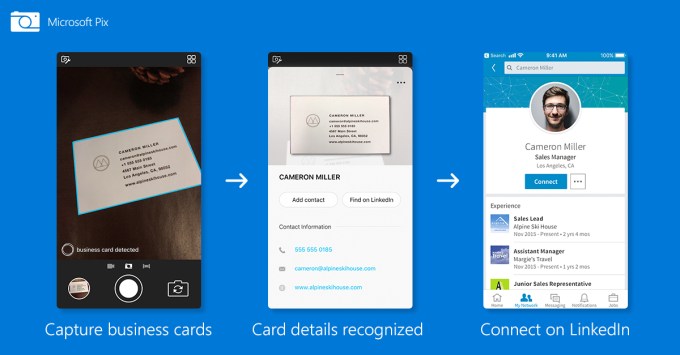
But with today’s update, Pix’s business cards smarts are being upgraded – this time with a LinkedIn integration. In the latest version of the iOS app, Pix includes a new business card feature that will add new contacts both to your iPhone’s address book, as well as to your LinkedIn account.

Microsoft Pix can scan business cards to your contacts, find people on LinkedIn
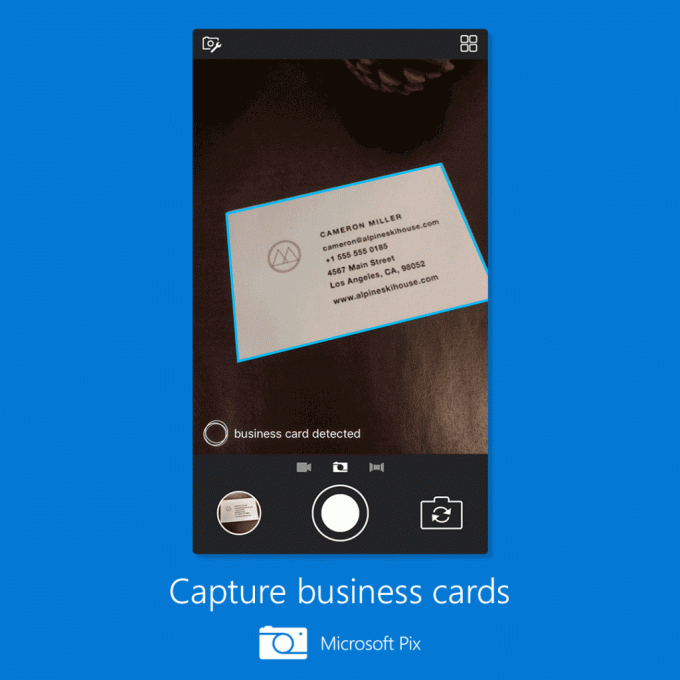
To take advantage of this option, you just launch the app and point it at the business card. Pix then automatically detects what it’s seeing, and asks you if you want to “Add Contact” or “Find on LinkedIn.”

When you tap to add the contact, Pix captures and organizes the contact information – like name, phone, address, and URL – into the correct fields, and adds the newly created contact to your iPhone’s Contacts app. If you opt for LinkedIn, you’re able to view the person’s profile in the LinkedIn app on your iPhone, and optionally add them to your list of connections.

The business card scanning feature, like others in Pix, leverages A.I. technology under the hood to enhance and improve the image. In the case of business cards, Pix is able to detect the edges of the cards, sharpen focus, and tweak the angle of the photo to render the image in a straight-on perspective so it can extract the information from the card.

Microsoft Pix can scan business cards to your contacts, find people on LinkedIn
The Pix update is just one of several ways Microsoft has integrated with LinkedIn since acquiring the company for $26.2 billion in 2016. It has also tied LinkedIn into its other products, including Office 365, Outlook.com, Dynamics 365, Word, and Windows 10.

The updated version of Microsoft Pix is rolling out today. You may not have it yet, as it has to propagate across the App Store, so keep your eyes peeled.

source:TechCrunch

This eQuoo app games you to into learning useful psychological skills
Mental health is one of the biggest issues of recent times, with Kendall Jenner, Emma Stone, Lady Gaga and even The Rock opening up about their mental health issues. Even the royal family has got in on the act, setting up the Heads Together charity. And it’s not just a fleeting issue. The World Health Organisation says depression will overtake cancer as the world’s main ‘global disease burden’ by 2030.

So it’s not surprising that meditation apps like Calm are going gangbusters amongst consumers. However, meditation and brain training apps are targeted towards cognitive skills. These skills can help with concentration and dementia, for example, but won’t allow you to have better and deeper relationships.

So it’s interesting that a new app has launched to tackle the thornier problem of how to improve your emotional intelligence. That’s the hope of new app startup eQuoo now launched on the Apple App store and Google Play.

eQuoo is an emotional fitness game that aims to teach you psychological skills in a fun and engaging way. You get to use those skills in a choose your own adventure game, but they are for real-life situations as well.

Founder Silja Litvin (a psychologist) says she was inspired to create the game because “emotional intelligence is more important than IQ when it comes to success in the workplace. If you know how and why you react and feel the way you do, you can navigate through stressful situations and relationships much better.”

Equoo has raised an Angel round, and the investors include Julian Pittam (Investor to Disciple Media, which just raised $4 million), Pierre Andurand and other angels.

As a child, Litvin moved from sunny Southern California to the less-than-sunny Luxembourg and was bullied at school. But things changed when her older sister got a body-language book for her birthday. “The idea that there was a science – a manual, so to speak – about why people did what completely blew my 12-year- old mind. That’s when I decided to become a psychologist: I wanted to spread the good news. eQuoo essentially helps you build up people skills.” Her team also includes, Med Buckey (CTO), Professor Markus Maier (Head of research) and James O’Brien (Lead developer).

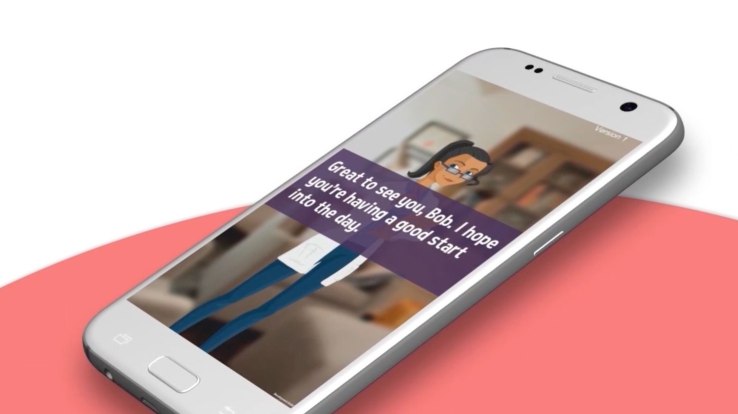
In the game, a character, Dr Joy (named after Sigmund Freud – Freud is joy in German) walks you through the learning session. eQuoo allows you to practice the skills in the learning part of the game; unlock a level in the game which leads you to a choose your own adventure story where you need to use the skills to win; gives you feedback on your personality through the Big Five personality test’ let’s you share your personality feedback on social media; learn more about the skills you possess on a deeper level; and anything you learn becomes part of your psychological ‘tool-box’.

The startup opened the Beta on in Australia and New Zealand and has a weekly growth rate of 19% and a 4.8 rating in the app store. Phase one will be building advertisement and subscription, but after that, it plans to work with insurance companies as a mental health game that prevents anxiety and depression.

source:TechCrunch

Facebook-owned Onavo quietly launches Bolt App Lock, a data-tracking app that locks other apps
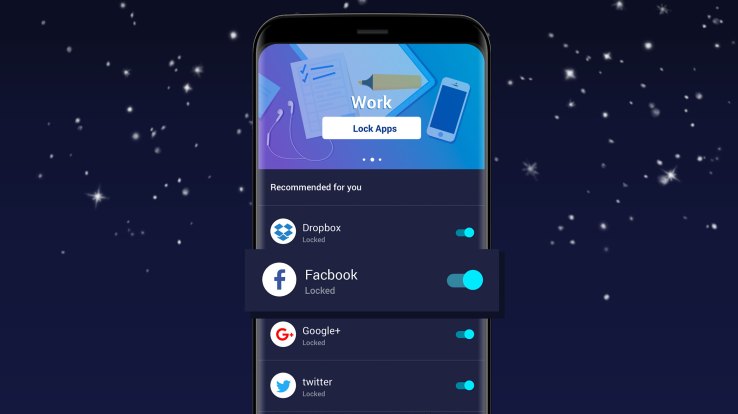
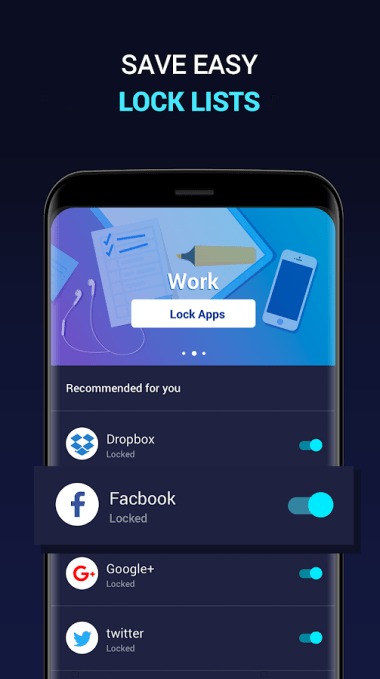
Onavo, the data-security app maker Facebook acquired in 2013 in order gain insights into mobile user activity across apps, has quietly launched a new app aimed at Android users called Bolt App Lock. Instead of offering a VPN, Bolt App Lock is a tool that lets you lock down any app you don’t want others to be able to open, using a PIN code, pattern, or your fingerprint.

Apps that help users lock other apps is a popular category on Android, where you can today find dozens of similar solutions – though largely from unknown companies save for a few, like Keepsafe or Norton, for example. Like the others in this space, the Bolt app lets you lock down other apps that contain personal information, such as private photos or payment details.

Facebook-owned Onavo quietly launches Bolt App Lock, a data-tracking app that locks other apps
With the resources of Facebook behind it, Onavo appears to have built a more polished, modern alternative to the existing apps.

But Onavo – and Facebook’s – primary interest isn’t on personal security. It’s about finding a way on users’ phones in order to monitor mobile activity and learn what new apps could be taking attention away from Facebook’s social network.

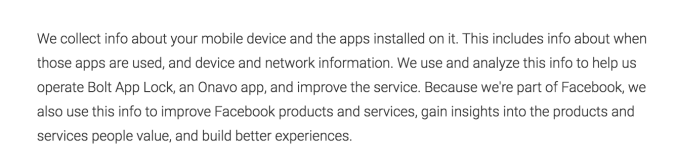
This is disclosed at the bottom of the app’s listing on Google Play, which explains that, as a Facebook company, Onavo will “collect info about your mobile device and the apps installed on it” and share that with Facebook.

Bolt App Lock’s disclosure regarding data collection
Above: Bolt App Lock’s disclosure regarding data collection
Data on mobile app usage has helped Facebook better compete with rivals like Snapchat – like when it saw how Instagram’s launch of a Stories-like feature was working to slow down Snapchat’s user growth, for instance. It also likely helped to inform Facebook’s newer acquisition of the buzzy teen compliment app tbh, which soon led to a new Facebook Q&A feature, inspired by tbh.

To attract users to its Onavo VPN, Facebook recently began advertising the app directly within Facebook’s main navigation on iOS, under the menu item “Protect.” When clicked, the link would take you to the download page for Onavo Protect on the App Store. The company has also featured a similar “Protect” link in its Facebook app for Android in the past. (We’re not currently seeing the option on Android, but your mileage may vary as Facebook’s apps are continually being tweaked and updated.)

But in order to gain these sorts of insights, Facebook needs a user base willing to install Onavo’s app. That may be more difficult to achieve these days, though.

After TechCrunch broke the news of Onavo’s appearance on iOS, a number of outlets directly warned users not to install the app. (See, for example: Gizmodo’s “Do Not, I Repeat, Do Not Download Onavo, Facebook’s Vampiric VPN Service” or Wired’s “Don’t trust the VPN Facebook wants you to use.”)

Until the backlash over Onavo Protect dies down, a new app like Bolt App Lock could give Facebook a different means of expanding Onavo’s user base, and therefore, Facebook’s access to mobile user data.

The app also hasn’t made an appearance in Facebook’s app, the way Onavo Protect did – at least not as of yet. We asked Facebook if that’s the eventual plan, but haven’t heard back.

Bolt App Lock launched on March 5, 2018, according to data from Sensor Tower. It’s not yet showing on the Onavo homepage as one of the company’s products. The app is a free download on Google Play.

source:TechCrunch

Facebook has signed a deal to stream 25 afternoon MLB games
Filed under moves that are potentially groundbreaking with big implications but with quite small numbers, Facebook has signed an exclusive deal with the MLB to stream 25 afternoon games, according to Bloomberg.

The deal is a bit reminiscent of the one Twitter signed for Thursday Night Football back in 2016 to stream games that are outside of the range of primetime football (usually reserved for Sundays and Monday Night Football). There have been some gripes about how fewer people are watching Thursday Night Football, so it also seems somewhat reminiscent in that respect that Facebook was able to sign a deal for games that are not so critically important outside of the normal primetime games.

That being said, blackouts for MLB games are a big of a nightmare (there’s a long thread by my colleagues complaining about this internally), and getting a deal like this on Facebook could potentially get people to pop in during the afternoon to watch the games. It could also help Facebook users get accustomed to the notion that Facebook is a spot to watch your afternoon baseball games, helping the company build that cachet that would help it negotiate further deals down the line. That the games are exclusive is another potentially big deal with big implications down the line for platforms like Facebook or Twitter, despite there being thousands of MLB games a year.

Regardless of the success of platforms like Twitter and Facebook (and Amazon in snatching the Thursday Night Football deal away from Twitter last year) getting these games on their platforms, the big primetime moments still elude those platforms and are all but locked up by incumbents. These deals are expensive — in 2016, the NCAA extended its agreement with Turner and CBS to air the NCAA Division I Men’s Basketball tournament, which had a price tag of $8.8 billion — and it’s hard to know whether Facebook or Amazon would be able to secure good deals for these kinds of games. There has been some activity at the startup level to disrupt networks like ESPN, which have traditionally been the host of many games in leagues like the NBA and NCAA college basketball games, such as Overtime raising $9.5 million.

Facebook’s first game will be on April 4 between the Philadelphia Phillies and the New York Mets, if you’re into either of them for whatever reason. MLB.com projects the Houston Astros will win 98 games next season, while the Los Angeles Dodgers will win 94. Houston won the World Series in 2017 in seven games over Los Angeles.

source:TechCrunch

Mario can now guide your route in Google Maps
It’s Mario Time! Beloved gaming character Mario is coming to Google Maps, thanks to a partnership between Google and Nintendo ahead of Mario Day, March 10. (MAR10…get it, Mario?) In addition to the various deals and sales on Nintendo games, the mustachioed plumber will also make an appearance in Google Maps’ navigation, if you opt in to have Mario accompany you on your journey.

The feature, which Google announced this morning, is available in the latest update in the Google Maps app on both iOS and Android.

After entering in your destination, you’ll notice a yellow question mark “?” icon at the bottom right of the app’s screen. Tap this, and you’ll get a prompt to enable “Mario Time.”

Mario can now guide your route in Google Maps
From then on, the navigation arrow in Google Maps will instead be Mario – who, in his little red go-kart, will then be your companion for your entire trip. The integration will be available for a full week, says Google, so you can enjoy using Mario for longer than just on Mario Day alone.

You can also choose to screenshot your route and share it to @GoogleMaps on Twitter and Instagram with the hashtag #MarioMaps, Google suggests. But of course, don’t share personal details like your work or home address, if you do so.

Mario can now guide your route in Google Maps
This isn’t the first time Google has had a little fun with Google Maps, as you may recall.

The company has in the past unleashed Pac-Man on city streets in Maps, let Google Maps streetview users go inside Doctor Who’s TARDIS, and has let you travel by Loch Ness Monster, among other things. Plus, Google and Nintendo have worked together before on silly stuff like this, as with the April Fool’s day prank involving the “launch” of Google Maps 8-bit for NES.

But in this case, adding Mario to Maps feels more like a brand advertisement, rather than just a fun trick. We asked Google if that was the case. However, a company spokesperson confirmed that no money exchanged hands in its business deal with Nintendo.

The Mario feature will begin rolling out today – so make sure you’ve got you’ve got the latest version of Google Maps installed if you want to try it out.

source:TechCrunch

There’s a shakeup on Qualcomm’s board amid Broadcom’s hostile takeover attempts
Things have not been so rosy for Qualcomm over the past few months, whether you are looking at an ongoing legal dispute between the chipmaker and Apple or Broadcom’s aggressive attempts to acquire the company.

Now, Qualcomm is saying its executive chairman, Dr. Paul E. Jacobs, will no longer serve as executive chairman for the company’s board of directors. He’s going to remain a director, but with all that’s happened related to its dispute with Apple, its attempts to wave off Broadcom, and also its efforts to get through its acquisition of NXP as quickly as possible, it would make sense for at least some move for the chairman to show shareholders that they are aware of the issues and are looking to change things up.

The company said it is discontinuing the role of executive chairman, and also naming a new independent director Jeffrey Henderson who will serve as the non-executive chairman. It’s a lot of weird semantics here, but the end result is that the board is bringing on someone independent as a kind of signal to shareholders that they are ready to make some changes in light of the issues the company has dealt with and Broadcom’s tender offer to buy it.

You might recall some of this happening recently with Uber, where pending the massive investment with Softbank, the company assembled what my colleague referred to as a “Frankenboard.” As Uber CEO Travis Kalanick was on his way out and the company was trying to get fresh funding from Softbank, the board got a lot of new independent directors as it tried to establish some sense appeasement its existing shareholders.

Qualcomm delayed its annual shareholder meeting, which was set to take place Tuesday this week where investors would meet and Broadcom would be making an aggressive stand to work around the company’s existing management in order to acquire it. Throughout the weeks leading up to it, the companies have basically been duking it out of PR statements on their investor relations pages (though this is what we see on the outside), and may now see the need to find some way to appeal directly to the company’s shareholders ahead of the meeting now scheduled to take place in around a month. Qualcomm delayed the meeting pending a regulatory review by the CFIUS, but it still has been part of an ongoing saga.

source:TechCrunch

Porsche’s electrification to lead to most powerful 911 to date, says CEO The storied 911 will not be immune from Porsche’s electrification plans and that could be a good thing. The car company’s CEO recently told Autocar that the hybrid 911 “will be the most powerful 911 we’ve ever had; 700 bhp might be possible.” Count me in (as long as someone buys it for me).

Porsche already makes 911 models above the 700 mark so it’s likely CEO Oliver Blume was referring to a non-performance version of the 911.

There was a time when anything but an air-cooled 911 was considered a disgrace. A hybrid drivetrain will likely be met with similar outcries. In the end, Porsche has to adopt measures to keep up with performance trends and meet fuel economy regulations. A hybrid system can likely do both.

Porsche has been playing with performance hybrid powertrains for several years including the Panamera Turbo S E-Hybrid that outputs 680 hp thanks to a 136-HP electric motor — that’s up from the 550 hp 4.0-liter V8 also available. Most notable the 2013-2015 Porsche 918 Spyder showed Porsche was able to make a gas, electric car worthy of the Porsche nameplate.

A hybrid 911 would sit alongside Porsche’s upcoming pure EV lineup that currently includes a sedan and crossover.

As far as a hybrid 911, it’s expected after the next version of the 911, which puts its release around 2020 or 2021.

source:TechCrunch

YC-backed Playbook wants students to make plans online, hang out offline
Social planning apps have yet to take the world by storm. A handful of these apps tried and failed years ago, and even Swarm decided to ditch that methodology and focus on location logging.

But a new Y Combinator-backed company seems to be picking up traction. And shockingly enough, the winning ingredient seems to be location! Location! Location!

The startup is called Playbook, and its main focus is to let you see what people around you are doing so you can join them offline. In fact, the company doesn’t want you to spend much time in the app at all. But what differentiates Playbook most is that the app is focused on college campuses.

In fact, you might see some similarities between Playbook and another social app’s runaway success. Just like Facebook, the Playbook founders (Luke Heine, Raphael Rouvinov, and Sean Sullivan) attended Harvard and Heine originally built the app (then just a simple spreadsheet) to see where his friends would be over the summer. The original premise back in 2014 was that students could travel cheaply during the summer if they knew where there friends would be and could crash on the couch a few nights.

Eventually, Heine built out a rough website and expanded the Summer Playbook service to thirteen other schools while still attending Harvard, during which time he met Rouvinov.

In 2016, Heine and Rouvinov rebuilt the site from scratch and started work on an app. Instead of focusing primarily on summer travel plans, the app focuses on what people are doing in their every day lives.

Once a user has signed up for the app, they can post their plans (or, a play) to the rest of the people on campus using the app. Plays can range from going for a run to a party to studying in the library or simply grabbing lunch.

“We saw an opportunity not around scheduling time in advance but spontaneously,” said Heine. “We reckoned that while the 5 friends we message might not be able to play basketball in 15 minutes, someone on campus we know would, if only they knew not only that I was around but also that I wanted to play basketball.”

You can share these plays with specific groups or the entire campus, or even to other schools nearby. The app is being piloted at Harvard (launched in February), and Playbook plans to launch at Princeton, Wellesley, Yale-NUS, and the University of Michigan.

Last summer, around 2400 people from 230 universities across 126 countries signed up for the desktop site, with around 1600 conversations started. Since launching the app on February 11 of this year, there are 244 users on the app with 30 percent checking back every day.

Playbook has raised a total of $120K from Y Combinator.

source:TechCrunch

Volkswagen’s head of electric mobility says China will drive autonomy roll-out
What’s the biggest motivating factor behind automakers embracing autonomous vehicles and self-driving? You might think ‘safety’ or maybe even consumer demand, but in truth the biggest driver might be China and its incentivization programs for automakers.

Much like China’s rules for qualifying for subsidies and restrictions on selling vehicles in market have led to automakers around the world investing massively in building out and maturing their electric vehicle operations, Volkswagen’s head of its eMobility model line Christian Senger says that China’s forthcoming rules will spur autonomy’s introduction to the market, too.

During a journalist roundtable at the 2018 Geneva Motor Show in Switzerland, Senger noted that indicators suggest an upcoming intelligent vehicle rules from Chinese regulators will provide big incentives in the way of subsidies to automakers who includes specific levels of automation in their production cars. For VW in particular, that’s a huge motivator, since the automaker has 13 percent market share in China as a brand, and 20 percent if you could the Volkswagen Group at large, including sub-brands like Audi and others.

“Right now you need to have electric drive train, a minimum range, and local production and then you get subsidies,” Senger explained. “There are a lot of indicators that this will now change that also the level of automated driving is a required premise to get subsidies. So the future of our market success is also dependent on our self-driving abilities.”

Every automaker in the world right now is rushing to shape up their electric program, even if in past they’ve been a bit laggard in this regard (Toyota is a great example) and the specific cause is the relatively hard line China is taking in this area with regards to subsidies, incentives and in-market sales rules. Per Senger, we should watch very closely for the very same thing to happen with automated vehicles of all levels over the course of the next few years.

The bottom line here is interesting: Where goes China, so goes the automotive industry, at least for the foreseeable future.

source:TechCrunch

Square’s Cash app now supports direct deposits for your paycheck
It seems like each new feature Square adds to its Cash app brings it one step closer to being a de-facto bank account for its users.

Case in point, the app just rolled out support for ACH direct deposits, meaning users can now get their paycheck or other deposits put directly into their Cash app balance.

Like other features in the peer-to-peer payments app setting up direct deposits is almost too simple. After accepting a disclosure you’re given an account number and routing number, which is all an employer needs to start making direct deposits. Users get a notification when deposits hit their account, and all funds get added to their normal Cash app balance – meaning it can be sent to a friend, spent using a debit card, used to buy bitcoin or withdrawn to another account.

This feature combined with the Cash app’s debit card now means that the app can essentially provide all the basic functions of a bank account, assuming you don’t need to deposit checks or do complex things like wire transfers.

Don’t be surprised to see younger users who are already using the Cash app just use this direct deposit feature instead of opening a traditional bank account when they start their first job. Plus, features like these could also make the app useful for people living in underbanked communities or who those just feel generally underserved (or overcharged) by traditional financial institutions.

Since Square doesn’t (yet) have a bank charter, they’ve had to get creative by partnering with banks to build features like their debit card and direct deposits. While their debit card is issued by Sutton Bank it seems like the direct deposit feature is being powered by Lincoln Savings Bank, which is giving Cash app users a routing number and a new account number to use for deposits. Partnerships like these between FinTech companies and FDIC-insured banks are common, considering how difficult it is for a technology company to get its own bank charter.

source:TechCrunch

All of Oculus’s Rift headsets have stopped working due to an expired certificate
Someone at Oculus screwed up pretty badly today: An expired certificate appears to have soft-bricked all of the company’s Rift VR headsets, with users still unable to fire up software on the devices and no word of an incoming fix from the company yet.

Issues were first reported several hours ago on Reddit, where a post on the topic has already garnered hundreds of comments. The problem seems to have resulted from Oculus failing to update an expired certificate with the update, which is now leaving users with an error message saying that the system “Can’t reach Oculus Runtime Service.”

Update:
The company has confirmed that the problem is a result of “an issue with our software certification…”

Users are not happy.
The embarrassing issue has left the company’s flagship device unusable. This comes as the company continues to deliver major software updates that it announced at its most recent developer conference. This issue is a bummer to gamers who aren’t going to get to play the titles they’ve purchased until the issue is resolved — but it’s a much less forgivable issue for commercial users who use the headset.

Oculus co-founder Nate Mitchell confirmed on Twitter that there was an issue affecting the company’s Rift headset.
We’ve reached out to Oculus for more details.

Some users are reporting that they’ve been able to get things back up-and-running by messing with their system clock, but this is generally a bad solution and can often screw up a lot of things, so it’s probably best to wait for a patch from Oculus.

An Oculus staffer on the company’s forums further confirmed the issues, apologizing on behalf of the company. “Our teams apologize for any inconvenience this may be causing you and appreciate your patience while we work on a resolution. We’ll share more updates here as we have them. Thanks.”

source:TechCrunch

Snap is reportedly laying off around 100 employees
Snap is laying off around 100 employees that are part of its engineering staff, according to multiple reports from CNBC and Cheddar.

The company expects to lay off as many as 100 people in the engineering department, according to those reports. It’s another sign of potentially re-aligning efforts as it looks to remake itself into something that’s differentiated from products like Instagram, which is repeatedly copying many of Snap’s core features like Stories. With that constant risk of copying at stake, Snap has had to make some drastic moves, like re-design the app to bucket together certain use cases in certain screens and hopefully keep users coming back over and over again.

In February, Snap CEO Evan Spiegel basically said the app’s redesign is here to stay and that users just need to get used to how the new app works and feels. Spiegel has said over and over that Snap is a camera company, and appears to be trying to keep that the case as there is reportedly a redesign of its Spectacles camera glasses in the works. But that may require rejiggering of the teams working on it, and layoffs often come as a result of trying to recalibrate the expectations and investment in certain areas of the company.

The company is coming off a significant quarter that’s led the stock to skyrocket, paring back some of the significant losses it sustained through 2017 after it went public. But the company is still worth around $22 billion, which is now lower than Twitter’s market cap. Snap has given up a lot of the gains it got from that earnings report, though it still appears to be in better shape than it was last year. The company has struggled to show growth and that it can continue to snap up new users, with its pitch being that it can keep users around for much longer and keep them much more engaged.

Snap is reportedly laying off around 100 employees
Snap in January laid off around two dozen employees, and rounds of layoffs like these can happen when a company is trying to set itself up for a new direction — now that it has a responsibility to public shareholders that may require some significant moves to outmaneuver competitors like Instagram. Amid all this, there appear to be some positive signals for Snap regarding growth despite the significant redesign and a lot of backlash over it.

source:TechCrunch

Bitcoin price drops 10% as hackers exploit Binance’s API keys
Welcome to another rollercoaster day for the cryptocurrency community. In just a few minutes, bitcoin price crashed from $10,740 to $9,690, which represents a 10.8 percent crash.

As always, it’s a bit hard to know for sure what’s happening. But one company in particular is having a bad day. Cryptocurrency exchange Binance has spotted some unusual activities and halted withdrawals.

Binance is one of the biggest exchanges out there. According to CoinMarketCap, it’s one of the 4 biggest exchanges for the top cryptocurrencies when it comes to traded volume.

Bitcoin price drops 10% as hackers exploit Binance’s API keys
Many people noticed something highly unusual with Viacoin happening right before the crash. There was a huge increase in buy orders for Viacoins on Binance. In just a few minutes, Viacoin’s market capitalization jumped from $64 million to $159 million

Binance looked into it and noticed unauthorized sell orders. “We are investigating reports of some users having issues with their funds. Our team is aware and investigating the issue as we speak,” the company wrote on Reddit. “As of this moment, the only confirmed victims have registered API keys (to use with trading bots or otherwise). There is no evidence of the Binance platform being compromised.”

Bitcoin price drops 10% as hackers exploit Binance’s API keys
So it seems like a third-party service or app got compromised. Users of that third-party app were relying on API keys to control Binance accounts. A hacker may have developed a bot that submits orders at the same time (7:00 AM Pacific).

While the Binance team halted withdrawals, it might be too late. It’s also possible that the hacker already had a big position in Viacoin on another exchange. The hacker could have sold a big pile of Viacoins shortly after manipulating the price on Binance.

In all cases, it proves once again that security is a big issue when it comes to cryptocurrencies. Don’t store your coins on an exchange. Use a hardware wallet or a wallet that lets you control the private keys.

Disclosure: I own small amounts of various cryptocurrencies.

source:TechCrunch

TechCrunch’s Messenger bot gets smarter and more conversational
The best bot on Messenger just got better. We’ve teamed up with Chatfuel and Bitext to add Bitext’s NLP Middleware to the TechCrunch Messenger bot. This enhanced version adds functionality for conversational interaction, improved natural language understanding and unique features like negation understanding. You can check out our new and improved Messenger bot here.

To get a better understanding of what the new functionality looks like in action, here are some examples of what the latest version of the bot can do.

1) Understands more natural language queries

More complex but natural queries, like “do you have anything about Google”; “give me Facebook news” or “show me the latest about SpaceX” are now recognized by the bot.

2) Conversational double intent

You can now use the word “and” to search for news that shares multiple characteristics. For example, you could type “I want news on Microsoft and Apple” to find news that specifically mentions both companies. Another example would be “show me news about Messenger and bots.”

3) Conversational negation

This allows you to exclude certain items in your search. For example, if you wanted to see news about Amazon but didn’t want to see anything about Whole Foods you could type “I want news about Amazon but not Whole Foods.” Another example would be “show me news about Apple but not iPhones.”

We’re also looking into adding some other updates, including conversational pagination and video search. There’s also a possibility that we might bring this bot to Slack. More to come soon.

You can check out our new and improved Messenger bot here.

source:TechCrunch

SEC says cryptocurrency exchanges are an unregulated mess
The U.S. Securities and Exchange Commission has issued a warning on cryptocurrency exchanges. The SEC says that many exchanges are currently unregulated and can do whatever they want with your money. As an investor, you should be extremely careful. As a company running an exchange, you should expect a crackdown soon.

The SEC first assumes that cryptocurrencies and tokens offered through ICOs are securities. As securities, cryptocurrency exchanges should follow the same rules as every exchange. They should register through the SEC as a national securities exchange, an alternative trading system (ATS) or a broker-dealer.

But the SEC says that the current situation is a mess. “The SEC staff has concerns that many online trading platforms appear to investors as SEC-registered and regulated marketplaces when they are not,” the SEC wrote. “Many platforms refer to themselves as ‘exchanges,’ which can give the misimpression to investors that they are regulated or meet the regulatory standards of a national securities exchange.”

Many exchanges have set up their own rules when it comes to listing new cryptocurrencies, but the SEC has no say in this process and can’t guarantee that those are safe investments.

Similarly, the SEC never reviews trading tools on cryptocurrency exchanges. For instance, if you submit a limit order on an exchange, you have to trust the exchange that it’ll strictly follow your order. The exchange could give priority to bigger investors or screw up the order book without any consequence.

The SEC also reminded cryptocurrency exchanges that they’re supposed to register as an ATS for example. After Circle’s acquisition of Poloniex Nathaniel Popper saw a confidential Circle presentation. Circle plans to work with the SEC to register Poloniex:
“The SEC was very favorable on this approach and indicated that they would not pursue any enforcement action for prior activity,” Circle wrote. “They said we are the first and only company in the space to approach them, and were very progressive on working closely with us.”

So it seems like there could be a grace period for U.S.-based exchanges before an eventual crackdown. But many U.S. investors rely on foreign exchanges to trade cryptocurrencies. It’s unclear how the SEC plans to protect U.S. investors from creating accounts on foreign exchanges.

Here’s the SEC’s list of questions to cryptocurrency investors to help them pick an exchange:
  • Do you trade securities on this platform? If so, is the platform registered as a national securities exchange (see our link to the list below)?
  • Does the platform operate as an ATS? If so, is the ATS registered as a broker-dealer and has it filed a Form ATS with the SEC (see our link to the list below)?
  • Is there information in FINRA’s BrokerCheck ® about any individuals or firms operating the platform?
  • How does the platform select digital assets for trading?
  • Who can trade on the platform?
  • What are the trading protocols?
  • How are prices set on the platform?
  • Are platform users treated equally?
  • What are the platform’s fees?
  • How does the platform safeguard users’ trading and personally identifying information?
  • What are the platform’s protections against cybersecurity threats, such as hacking or intrusions?
  • What other services does the platform provide? Is the platform registered with the SEC for these services?
  • Does the platform hold users’ assets? If so, how are these assets safeguarded?
Disclosure: I own small amounts of various cryptocurrencies.

source:TechCrunch

Microsoft wants to help developers bring their AI models to the desktop
Microsoft today announced its AI Platform for Windows developers, a new set of tools that will soon help developers to bring the machine learning models they trained in the cloud to their desktop apps. The AI platform in Windows 10, which will launch with the next major version of Windows, will make use of the GPU on your local machine and allows developers to run their models in real time and without the need for a round trip to the cloud.

“What we are building really completes the story for Microsoft from an AI perspective,” Microsoft Partner Group program manager Kam VedBrat told me. In the past, Microsoft talked a lot about its machine learning infrastructure in the cloud and the tooling it built around this. With this, developers can now easily build their models in the cloud, using their framework of choice and then easily integrate these models with their desktop apps, using Visual Studio and some of the other tooling Microsoft is building for this.

At the core of this is Onnx, a project that is backed by Microsoft, Facebook and Amazon. It allows developers to convert Caffe2, PyTorch, CNTK and other models into the Onnx format to move them between frameworks as necessary.

Microsoft will also allow developers to build image recognition models with the Azure Custom Vision Service and export them for use in Windows ML. Unlike working with traditional framework, a developer doesn’t need to know about the intricacies of building machine learning models to do this. All they need to do is give the service their tagged training data.

These models then make use of the silicon that’s available to them in any given machine, which most likely means a DirectX 12 graphics card or, if that’s not available, the CPU. But the platform will also offer a flexible API for accessing other hardware, including future Intel Movidius vision processing units, for example.

The advantage here, Microsoft corporate VP Kevin Gallo told me, is not just lower latency and increased privacy for your users’ data, but also cost. Running these models in the cloud does, after all, incur a cost that can quickly add up. When they run on the desktop, though, that’s a non-issue.

Starting with the next preview of Visual Studio 15.7, developers can simply add an ONNX file to their Universal Windows Platform (UWP) apps and Visual Studio will generate a model interface for the project. Microsoft will also make tooling for previous versions of Visual Studio available and it’ll add this capability to the Visual Studio tools for AI, too.

source:TechCrunch

Google’s messaging strategy may still seem chaotic to many, but the basic tenet of how it wants the public to think about Hangouts, Hangouts Meet, Hangouts Chat, Allo and Duo is that Allo/Duo are for consumers and Hangouts Meet/Chat are for business users. Hangouts itself is meant to… actually, I don’t know what it’s meant to be now and I’m not sure Google does either. What I do know, though, is that you are probably neither an Allo nor Duo user, even though both are perfectly competent messaging and video chat apps. Just in case you do use Duo, though, here’s some good news: You can now leave voice and video messages when nobody picks up your call (or politely declines to talk to you).

Google’s Duo video chat app gets video- and voicemail
Duo users can now leave up to 30-second messages and your contact will see them in the Duo app. After watching the video or listening to the message, your contact can call you right back, at which point you can decide if you want to pick up the call or just let it go to videomail, too.

Google notes that all messages are end-to-end encrypted and that the update will start rolling out to Android and iOS users today, and that all users worldwide should see it within the next few days.

While I don’t think Google’s Allo/Duo strategy is working, or that mainstream users are even aware of it, Duo is a perfectly fine video chat app that puts a few interesting twists on this concept. Just like with Allo, though, none of my friends are on it and Hangouts already has a perfectly good video chat option.

source:TechCrunch

Which wireless headphone is right for you? Find out how the BeatsX and Bose SoundSport Wireless stack up in our real-world comparison.

If you're looking for a new wireless Bluetooth headphone, you've probably looked at one of the two big names out there: Beats and Bose.

Both the BeatsX and the Bose SoundSport Wireless headphones are $149 in the US, share similar specs and design. How do you decide which one's right for you? (International pricing is slightly different for both: the BeatsX is £130 in the UK and AU$200 in Australia, while the Bose goes for £140 and AU$249).

Whether you're working out in the gym or just using them to soundtrack your daily commute, these headphones are designed for being active. We're going to take the two neckbuds and compare how they look, how they sound and how they perform on the go.

Watch this: The BeatsX battle it out against the Bose Soundsport...

Design and durability

Unlike truly wireless earbuds, both the Beats and the Bose have a wire to connect them together. The Beats buds are magnetized so they clip together when not in your ear, while the Bose has a detachable clip on the wire that secures it to your clothes.

Bose claims to be water and sweat resistant, while Beats is not officially labelled as such.

Here's what we like and dislike about the design of each.

BeatsX

  • It's smaller and lighter in the ear than the Bose
  • Tip selection is extensive. You get three different designs in varying sizes
  • It's comfortable to wear around your neck when not in use

Bose SoundSport Wireless

  • It sticks out of the ear more than the Beats
  • You only get three different sizes of wing tips in the box
  • Buttons on the remote are easy to feel and use without looking
Both stayed put in our ears when running as long as we chose the right wing tip. We didn't feel like either would fall out easily. If you're going for the Beats though, you may want to go with a darker color option because they collect dirt and makeup.

Connectivity and controls

Both Bluetooth earbuds work with iOS or Android. The BeatsX has Apple's W1 chip that makes them faster to pair with newer iOS devices. Just press the button on the wired remote and wait for a pop-up to appear on your iPhone. It's that easy. The Bose has NFC so you can tap and pair with Android phones.

To test the range of the headphones, we took a pair each out onto a soccer field to see how far we could get from the phone before the signal dropped out. While our test was not scientific, it gave us a good real-world indicator of how far they can get.

After doing this test multiple times, the Bose generally got further from the phone than the Beats before the sound cut out completely (slightly before the halfway point on the field). While the Beats cut out earlier, playback was intermittent and kept cutting in and out. When we turned to face the phone and walked backwards, the Beats pulled further away from the Bose -- but let's be honest, this isn't how you'd actually walk.

Both headphones have a remote on the wire to adjust the volume, accept or reject calls, skip tracks and even summon your assistant.

Sound quality

Want good sound isolation? Beats has the edge here as they block out ambient noise better when you wear with the in-ear tips. Bose has a more open design so you hear more of the outside world.

But sound can be subjective so here's what we liked about each.

BeatsX

  • Lexy: I appreciated the sound isolation so I didn't have to have the volume cranked up so loud when I was on the bus. But I found the Beats sounded a bit flatter overall than the Bose which were slightly clearer and had better bass.
  • Vanessa: The in-ear tips allow you to really immerse yourself in the music, but if you're on the go this may not be a good thing. Outside of the office, I would change out the tips for the less intrusive option and then the sound quality wasn't as good.

Bose

  • Vanessa: The design on these feels like the best of both worlds, you can still hear the outside world when running or biking without sacrificing sound quality.
  • Lexy: I found they had more definition between mids and bass than the Beats, even if I had to turn the volume up a bit more to compensate for outside noise

Battery life and charging

Beats has the edge when it comes to battery life: 8 hours compared to 6 hours on the Bose. Beats also charges faster. It uses Apple's Lightning port and will give you two hours of playback with just a 5-minute charge. The Bose uses Micro-USB and only give you about one hour of playback after charging for 15 minutes.

But Bose is better about letting you know how much juice you have left. It has an audio alert that tells you as as soon as you turn it on and an LED that changes color from green to amber to blinking red when you're running low on juice. The Beats also has an LED indicator that changes from white to red, but it's tiny, so you're better off checking on your phone. And auto-power off doesn't work consistently -- so many times we'd forget to turn them off and end up draining the battery completely.

Bose also comes with a companion app so you can see the battery level and change the auto-time off duration.

And our winner is?

Lexy: Sound quality is my number one priority, so I would probably go with the Bose despite the bulkier design. The open design and the sweat resistance are also a plus for working out.

Vanessa: I like the fact that I can wear the Beats around my neck all day, and the fact that I can charge them for 5 minutes and still use them on my commute to work, so for me these would be a lot more practical.

source:CNet News

Imagine two Amazon Dash buttons sewn into specialized, limited-edition marketing gimmicks. Welcome to the return of the Pie Top.

Pizza Hut's new shoes order pizza and pause your TV
I'm not here to tell you why pizza-ordering, TV-pausing shoes exist. But, here we are.

Pizza Hut created a marketing stunt of specialized sneakers last year that could order a pizza (Pizza Hut only, of course) with a press of a large button on top.

This year, these shoes have returned: Pie Tops II, as they're called. Sneaker collectors take note: they're a limited run of 50, created by the Shoe Surgeon, a custom sneaker designer in Los Angeles. Pizza Hut's run of Pie Tops last year were made the same way.

The shoes are red or wheat-colored. They pair with Bluetooth to the Pizza Hut app to basically do one-press ordering. Also, these shoes add another button that pairs with certain cable TV set-top boxes to pause live television... a one-button remote.

Pizza Hut's new shoes order pizza and pause your TV
Wheat pizza shoes.
Paul Mcgeiver
If you're desperate to buy a pair of Pizza Hut sneakers, they'll be available to order on March 19 on HBX, until the very limited run ends. In the meantime, I'm actually going to try wearing a pair and see if they actually work well to pause TV.

It's a marketing stunt timed to March Madness. It's absurd. Of course, branded weirdness has been around for years now, like the Doritos MP3 player bag or an unfolding pizza turntable. At least these are actual shoes.

Plenty of other smart shoes already exist in the world. GPS-enabled safety ones, training ones and fitness ones. Add some volume controls and voice, and maybe the next Pie Tops could be... never mind.

source:CNet News

MKRdezign

Contact Form

Name

Email *

Message *

Powered by Blogger.
Javascript DisablePlease Enable Javascript To See All Widget