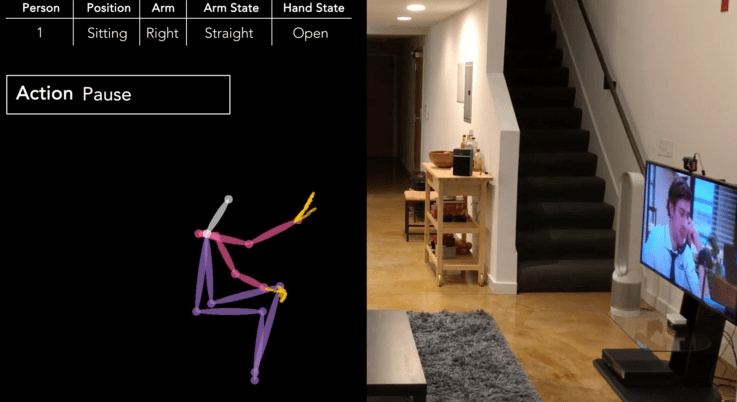
Voice assistants may be the hottest thing since sliced bread when it comes to controlling your $60 wifi light bulbs, but Piccolo is launching out of the latest Y Combinator class with a desire to put a camera in every smart home that can translate your physical motions and gestures into commands.
The company’s “Vision Assistant” product works pretty simply, users place the camera in their house and then once they get it fixed in position, they fire up the app and drag boxes over the internet-connected appliances or TVs or lights. From there, the Piccolo camera is basically looking to record your geometry through what’s called skeletal tracking — don’t worry it’s not using an X-ray or anything — which puts your movement into a model that tracks your body position. From there, the device will know where you’re pointing your hand and can interface with the compatible smart home item. It does more than just turn stuff on and off, they’re experimenting with gestures to fast forward through a Netflix show, change modes on the fan, etc. etc.
Founders Marlon Misra and Neil Raina started studying the technologies behind Piccolo through an interest in self-driving cars. The pair of buddies emerged from taking Udacity’s self-driving program in 2016 with an interest in perceptual engines and their far-flung capabilities, an interest which eventually turned to controlling the smart home with body movements.
The team isn’t aiming to replace your Echo or Google Home, this product would very much be sitting in parallel as a camera that can also control your home. This also means that they have to build support for each smart home product they want to control. The startup is currently in the pilot program phase and they’re hoping to launch via a crowdfunding campaign in the future. (You can join a waitlist on their site to get deets on when exactly)
There are definitely limitations from the existing setup, namely that it’s all pretty 2D at the moment and because of this, things seem like they would get pretty wonky if you had a bunch of smart home products stuffed into your casa. The team said that a hefty chunk of what they’re working with is subject to change and that they’re looking at the possibility of adding something like a depth camera.
One of the company’s biggest hurdles is likely getting people to feel comfortable tossing an internet-connected camera in their homes, but while people are skeptical of Google and Amazon because they have a pronounced interest to tailor ads as tightly as possible, the founders tell me they feel like they may have an advantage simply because they are a scrappy upstart that doesn’t have the scale or diverging interests of their competitors.
Other like Leap Motion have attempted (time and time again) to get hand movement controls for tech products to take off. Where Piccolo says its advantage is, is that their technology works from a further distance so you won’t need one of these things attached to every appliance in your home. In an effort to cut down on false positives, the team is currently leading users to raise their hand straight up and then point straight to the object. This is ultimately not that much lower-effort than telling Alexa to kill the lights, but the team’s ultimate ambitions are focused on getting the tracking tight enough that they can tell what you want from minor hand movements.
It’s early days but as computer vision advances bring new functionality to things like smart security cameras, there’s reason to see that the indoor camera could be the key to finding the full potential of the smart home assistant as well.
Google is bringing gadget maker Nest back under its control as the search giant battles rivals Amazon and Apple in the rapidly expanding smart home market. A big part of the change: Making it easier to add Google's artificial intelligence technology and Assistant -- a digital helper that competes against Amazon's Alexa and Apple's Siri -- into new Nest products.
The world's largest search engine has staked its future on building Google smarts into devices beyond smartphones. On Wednesday, Google said Nest was part of its plans and would no longer operate as a separate division that lived in the outer orbit of parent company Alphabet's "Other Bets" group of projects.
Instead, Nest rejoins the Google mothership -- the part of Alphabet that houses search, YouTube, Android mobile software and other moneymakers. Nest, acquired by Google in 2014, had been operating outside of Google, the only profitable division of Alphabet, for the past three years.
Under the new org structure, Nest CEO Marwan Fawaz reports to Google's hardware chief, Rick Osterloh, a former Motorola executive who took charge of all Google's consumer devices in 2016. That includes Google Home smart speakers, Pixel smartphones and Chromecast streaming devices.
Nest CEO Marwan Fawaz says the company has shipped 11 million products to date. James Martin/CNET
"All of Google's investments in machine learning and AI, they can very clearly benefit Nest products. It just makes sense to be developing them together," Osterloh said in an interview Tuesday, which included Fawaz and took place in a meeting room designed to look like a home, complete with a kitchen and a washer-dryer setup. "It's the natural thing to evolve to."
Nest's brand, known for its 2011 internet-connected thermostat, isn't going anywhere, Osterloh and Fawaz said. In fact, the two drilled home the message that the reunion of the teams will "supercharge Nest's mission," as Fawaz put it. They used the word "supercharge" at least five times during our 40-minute interview at Nest headquarters in Palo Alto, California.
Fawaz said Nest has shipped more than 11 million products since its first thermostat went on sale in 2011. Since it's been part of "Other Bets," Alphabet doesn't call out how much money Nest makes or loses.
The biggest change: Making Google's AI technology a staple in future Nest products. I asked if that means making every new Nest device an access point for the Google Assistant. That integration is "core to the strategy," said Fawaz, but nothing is set in stone. Nest has already begun building the Assistant into devices like its Nest Cam IQ indoor camera.
Nest and Google have already plotted out and finalized their hardware roadmaps for 2018, but in the next two years, they'll start co-developing products. Google also plans to offer more bundled packages for Nest and Google devices, like one deal last year that paired Nest products over $100 with a free Google Home Mini. Fawaz said people could also eventually use their Google accounts with their Nest app.
One thing that isn't changing: Nest, which won't say how many employees it has, will keep its offices in Palo Alto, instead of moving to the Googleplex in nearby Mountain View.
The decision to merge Nest with Google comes as tech's biggest companies work to infuse their software into every aspect of people's lives, from their cars to homes. People will spend $1 trillion on the so-called "internet of things" by 2020, according to Gartner. And they'll spend over $50 billion on smart home tech in 2022 -- up from $31 billion this year -- according to Statista.
But right now the gateway drug is smart speakers. Amazon dominates that world with its Echo devices, owning 69 percent of the market. Google is far behind with 31 percent, according to a report by Consumer Intelligence Research Partners. Apple, meanwhile, officially enters the market when its new HomePod speaker goes on sale Feb. 9.
Nest was previously a semi-independent unit of Alphabet, Google's parent company. CNET
Nest's reunion with Google isn't a complete surprise. In November, The Wall Street Journal reported that Google was considering bringing Nest back into the fold. Osterloh and Fawaz said the merger has been in the works for the last few months. Since the two groups already partner on supply chain operations, packaging and event launches, it made sense for them to be one unit, they said.
Being under the same org chart also makes it easier for Nest to use Google's AI technology, the foundation for its Assistant and the key to new products like its Google Lens and Google Photos services.
"We've leveraged AI capabilities from Google in the past, especially in the computer vision space and facial recognition," Fawaz said. "Being part of the Google family, we get closer to that."
'The whole world is shifting'
A lot has changed since Google bought Nest for $3 billion nearly four years ago. That same year, Amazon introduced its Echo smart speaker, a surprise hit and a big slap to Google and Apple, which were already working on voice search. Google followed in 2016 with Home, a smart speaker that promised to put Google's leading search engine a few voice commands away. And this week, reviews went up for Apple's HomePod, a $350 Siri-enabled smart speaker that Apple touts as having better audio quality than its rivals.
Google has bulked up its hardware efforts in other areas too. Osterloh, former president of Motorola, was tapped two years ago by Google CEO Sundar Pichai to create a new consumer device effort. Though Google has always dabbled in hardware -- think the Nexus Q media player or Chromebook laptops -- Pichai wanted to prove the company was all-in this time around. Under Osterloh, Google unveiled its first branded phone, the Pixel, in October 2016 to rival Apple's iPhone and Samsung's Galaxy. It also added a virtual reality headset, a Wi-Fi router and new Chromecast video and audio streamers to its "Made by Google" product lineup.
Maybe the biggest sign that Google no longer considers hardware a hobby is its $1 billion investment in smartphone manufacturer HTC, which brings to Google over 2,000 HTC engineers -- many of whom already worked on the Pixel phone. The deal officially closed last week.
Google also put on a show last month in Las Vegas at CES, the world's largest consumer electronics conference. In past years, Google has typically laid low while its manufacturing partners, including Samsung and LG, made all the noise. But this year, the company set up a massive stage to showcase its gadgets and plastered the words "Hey Google" -- one of the trigger phrases for the Google Assistant -- over the Las Vegas Monorail. White-suited Google workers greeted showgoers in booths across the conference floor with the sole aim of telling them about how Google Assistant worked with various gadgets, from TVs to headphones.
Nest will be joining Google's hardware division, led by former Motorola executive Rick Osterloh. James Martin/CNET
Meanwhile, after a two-year slump in which it didn't enter new product categories, Nest in September added devices and services, including the Nest Hello smart doorbell and the Nest Secure alarm system.
"It's just a logical move," said Bob O'Donnell, an analyst with Technalysis. "The whole world is shifting. Amazon did a good job of recognizing an opportunity. Others are recognizing it and adjusting accordingly."
Hey, Alexa
When it comes to their smart home rivalry, Google and Amazon haven't been afraid to play hardball -- sometimes at the expense of customers.
Amazon, the world's largest online retailer, doesn't sell Google Home. Instead, searching for that product on Amazon brings results for other products, including the e-commerce giant's rival Echo speaker. Amazon sells some Nest products, like the smart thermostat and smoke detector, but not others, such as the Nest E, a cheaper $170 version of its thermostat, or the Nest Secure alarm system. Also, after banning sales of Google's Chromecast streamers two years ago, in December Amazon agreed to bring them back.
Google, meanwhile, cut off YouTube from working on Amazon's Echo Show video device and Fire TV. And at CES, Google tapped partners including Sony to introduce four new video devices with the Assistant built-in to compete with the Echo Show.
Google has made big investments in hardware with its Google Home line of products. CNET
Google, Amazon and Apple know getting adoption for their voice assistants is the key to future riches. Over 5 billion devices that support digital assistants, including Alexa and Google Assistant, will be in use by consumers in 2018, according to IHS Markit, with nearly 3 billion more added by 2021. Of those devices, 39 million will be smart speakers, up from about 27 million units sold in 2017.
That all raises the question: Will Nest's closer relationship with Google mean Nest products stop working with Amazon Alexa?
"This announcement doesn't change that," Fawaz said. "If there are any changes in the future, we'll certainly make sure it's the right decision for consumers."
I pressed them again about the potential for this new arrangement to change the relationship with Amazon.
"I would call Amazon and ask them," Osterloh said. "We don't know. We want to work with Amazon in an open, transparent, symmetrical way. Hopefully they want to do the same. We're continuing discussions with them on that."
(We're checking with Amazon and will update this story when we get a response.)
A rocky tenure
When Nest appeared in 2011, it was a novel enterprise from a leader with a storied pedigree. Nest co-founder and former CEO Tony Fadell became known as the Godfather of the iPod after he played a key role, with Steve Jobs, in developing the seminal music player. Following Fadell's departure from Apple in 2010, he and Nest co-founder Matt Rogers focused on reinventing another market. The answer: a smart remake of home thermostats. The idea was to create a whole suite of forgotten household products that had been reimagined for the internet era. The startup announced its second product, the Nest Protect smoke detector, in 2013.
In 2014, Google bought Nest. That was, in part, to inject the search giant with some of the product magic Fadell brought with him from Apple. But Nest's tenure at Google has been rocky. There was public drama after Nest paid $555 million for Dropcam, maker of the security camera it eventually turned into the Nest Cam. After the buyout, Dropcam CEO Greg Duffy left the company and has since called the acquisition a "mistake." Under Nest, more than 50 Dropcam employees resigned. Duffy has said Dropcam's product roadmap was derailed.
When Google created Alphabet in August 2015, Nest became its own division, alongside other units including Google, the moonshot factory X and health tech company Verily.
It was Nest, though, with its own brand, team and offices, that was supposed to be the model for how the new Alphabet structure would work. But instead of becoming the Platonic ideal for an Alphabet company, Nest underwent more scrutiny. Meanwhile, Alphabet CFO Ruth Porat tightened spending at the "Other Bets."
Fadell stepped down in 2016, and Fawaz took his place. Fawaz and Osterloh met in 2012 while both working at Motorola. Google briefly owned Motorola before selling it off to Lenovo for $3 billion in 2012, but neither executive came to Google as a direct result of that acquisition.
Today, all Fawaz will say about Nest's past is that the stories were "a bit exaggerated."
As for the way Alphabet is set up, Fawaz defended it. "Each bet is different. We have different journeys," he said. "In this particular case, Rick and I came together and said, '[Nest rejoining Google] makes sense.'"
"Other bets will have different journeys. They can have a different outcome," Fawaz added. "There's not one size that fits all in the model."
Nest co-founder Tony Fadell says Google hurt its smart assistant efforts when it spun off the maker of net-connected gadgets not long after acquiring it.
Google's announcement this week that it's bringing Nest back under its wing has some former employees of the smart-thermostat maker saying the company never should've been spun off in the first place.
Tony Fadell, co-founder and ex-CEO of Nest, said both companies' efforts in connected gadgets were hurt when Google made Nest a separate business less than two years after acquiring it. Google bought Nest in 2014 for $3.2 billion, and the spin-off happened in 2015 during the restructuring that created the Alphabet holding company.
"From the outside it looked like Nest was the perfect poster child for Alphabet," Fadell told CNBC in an interview Friday, "but at the same time, separating it was undoing the thing that was most essential for both companies -- figuring out how to make them work together."
On Wednesday, Google said Nest would no longer operate as a separate divisionunder Alphabet's "Other Bets" group. Instead, it's rejoining Google as the tech powerhouse looks to work its artificial intelligence technology and smart assistant into new Nest products. That effort comes as rival Amazon unleashes a bombardment of Echo gadgets equipped with its Alexa smart assistant and Apple touts its HomePod smart speaker, which relies on Siri.
But Fadell, who left Nest in mid-2016 amid questions regarding sales goals and workplace culture, told CNBC that bringing Google's AI smarts to Nest gadgets had always been the point.
"Nest was acquired by Google for a specific reason," Fadell told the network. "I pitched it as 'We are the senses and you are the brain.'"
Two other former Nest employees, who wished to remain anonymous, told CNBC that after the Alphabet restructuring, Google and Nest staffers weren't properly encouraged to work together. The two teams were also kept in the dark about each other's projects, even when those efforts were similar, and even after Amazon began gobbling up the smart-home market with its Echo and Alexa products. Google reportedly tried to sell Nest in 2016 but abandoned that effort.
"I think it would have helped had the [mergers and acquisitions] team put something in place in the early days to structure and incentivize Google and us in a way that would have led to more cooperation," one of the ex-employees told the network.
"It was like a soap opera," one of the former staffers said.
A culture clash might have been involved. Fadell, an ex-Apple executive and disciple of Steve Jobs, is known as the godfather of the iPod, and played a key role in the development of the iPhone. His joining the search giant was seen by many as Google co-founder Larry Page's attempt to inject his company with Apple's storied hardware sensibility. But Apple's rigid and secretive culture is a stark contrast from Google's open and experimental one.
Fadell told CNBC he'd like to see Google's effort to marry its AI technology to Nest products succeed this time around.
"For the sake of Nest customers and talent," he said, "I hope they follow through on their commitment they made to us four years ago instead of trying to sell it off like they did just two years ago."
Apple's first smart speaker finally emerges, well after Amazon's Echo speakers and the Google Home family dominated the conversation.
For Apple's HomePod, it's better late than never.
The smart speaker became available for advance orders in the online Apple Store in the US, UK and Australia on Friday. While you can typically put in an order for new Apple products at 12:01 a.m. PT, the HomePod wasn't available until just before 5:45 a.m. PT.
A little patience was required for Apple's latest product. The consumer electronics giant unveiled the HomePod at its developer conference in June and said it was slated to ship in December, but it ended up delaying the release to early this year. The device will hit stores Feb. 9.
The HomePod is available for $349, £319 or AU$499 in white and space gray. Apple has positioned it as a speaker first, smart device second. You'll be able to ask Apple's Siri voice assistant to do things like play a song on Apple Music, send a message to a friend through WhatsApp or control your smart lights. Later this year, you'll be able to link two HomePods together for multiroom listening and stereo sound.
Unlike recent iPhone launches, the HomePod didn't immediately sell out Friday, and the Apple Store didn't have glitches that prevented people from placing their orders. As of 5:45 a.m. PT, both the white and space gray versions of the speaker were still available, and the shipment date lists Feb. 9. Apple's hottest iPhone models have tended to sell out within minutes.
Anticipation for Apple's HomePod is likely nowhere near as high as demand for a new iPhone. Despite efforts to get into new markets like wearables and the smart home, Apple still makes about two-thirds of its sales from its smartphones.
Working against Apple's smart speaker is the popularity of Amazon's Echo and the HomePod's higher price compared to rivals. The speaker also doesn't easily stream music from third-party services like Spotify, and the number of other tasks you can ask of Siri is limited. Siri itself has been deemed a subpar voice assistant by researchers. And even though Apple is pushing HomePod's audio capabilities, that may not win over as many people as it hopes.
"There is not a large market for high-quality audio," Creative Strategies analyst Ben Bajarin said. "Most Echo owners are completely content with the sound quality and say it is 'good enough' for their needs."
Siri, can I buy a HomePod?
When Apple showed off the HomePod for the first time in June, it positioned its new device as a music experience rather than just a smart-home hub, ostensibly to "reinvent home music." It has better audio specs than other hub speakers and an A8 chip for processing (the same chip that's in the iPhone 7). It uses a wide-array mic that supposedly can hear you over the music, and naturally integrates with Apple Music. It can also control HomeKit devices.
Most of us tend to think people trying to open the door when we’re away want to steal stuff. Amazon.com would like to change that assumption.
The e-commerce giant shelled out a reported $1.1 billion this week to acquire Ring, a developer of Wi-Fi-connected door bells. The move follows the rollout last year of Amazon Key, a smart lock and camera system for in-home deliveries to customers who don’t want packages sitting outside.
But Amazon’s not the only one placing high value on front-door tech. In the age of on-demand delivery, service providers have long seen the typical low-tech door as an impediment to expansion. Smart-lock developers and home security companies also have been putting resources into the space, alongside a number of venture investors.
As we reported a few months ago in an overview of smart-lock and building access investments, the way people open the front door hasn’t changed much in a century. Most of us still get in by turning a flat metal key into a lock. Visitors ring old-fashioned door bells. And there’s commonly no digital record of who came or why.
There’s a lot of money going into changing that status quo. Since last year, venture investors have poured more than $200 million into an assortment of companies with businesses and technologies tied to keys, locks and building access. To date, those companies have more than $500 million, according to an analysis of Crunchbase funding data.
Ring, which raised $200 million in venture funding, is one of two heavily funded companies to be acquired in recent months. In October, August Home, a smart-lock developer that had raised more than $70 million in venture funding, sold to ASSA ABLOY Group, the largest global supplier of door opening products, for an undisclosed sum.
There’s good reason to think the up cycle for smart locks and entry systems has further to go. For one, to a large degree, lock and building access-related investments are an extension of the connected home space, and growing adoption of connected home systems provides a major entry point for key and door tech.
Many legitimate businesses also want an easier way to get through the door. After all, delivering things to customers’ doors, either inside or out, constitutes an industry with a collective valuation in the trillions of dollars. Amazon.com alone is valued at more than $700 billion.
Additionally, anecdotally, it does appear urban humans over recent decades are trending toward greater laziness. Increasingly, people want their laundry, meal kits, produce, shaving supplies and pet treats delivered to their doors. Just as we used to think of going to the store as a pain, we will soon consider stepping outside to pick up a package as the height of inconvenience.
Those trends might not be great for the state of humanity. But they are bullish indicators for the smart lock industry.
A day after Google said it's bringing the smart home company back under its control, the Nest co-founder says he's departing.
Nest co-founder Matt Rogers says he's leaving the maker of smart home gadgets.
The move comes a day after Google's parent Alphabet said it was reuniting Nest with Google. The search giant said the move was aimed at infusing more of Google's machine learning and artificial intelligence technology into Nest's product line, which includes a smart thermostat and smoke detector.
Rogers will stay on the through the transition, but after that, he'll depart to devote more time to Incite.org, a venture firm and lab he co-founded.
Here's his statement:
After almost nine incredible, intense years working to build Nest, I've decided to begin my transition to dedicate more of my time to Incite.org, as well as to start thinking about the next adventure. In the coming months, I'll be working closely with Google's Hardware leads to define the 2019 roadmap and to ensure a smooth integration of Nest into Google's Hardware group.
Nest has been an amazing journey and the honor of my career to build. Together with the Nest team and our partners, we've helped save over 19 billion kWh of energy, helped save a number of lives -- both human and pets -- with Nest Protect, and helped families feel more safe at home with Nest Secure and Nest Cam. And along the way, we managed to build the leading brand in the connected home space. I could not be more proud of what we have accomplished and can't wait to see what's next for Nest.
Rogers, Nest's chief product officer, co-founded the company in 2011 with former CEO Tony Fadell, after leaving Apple the year before. The two played key roles in the development of the iPod. Rogers was also one of the first engineers of the original iPhone and iPad.
The departure of Rogers, Nest's last remaining co-founder, marks the close of a chapter for the company. Google bought the buzzy startup in 2014 for $3 billion, in an effort to bring more hardware chops to the search giant. But Nest's tenure there has been rocky. Fadell left the company in 2016 after much turmoil and public drama. For example, he feuded with Greg Duffy, CEO of Dropcam, the smart camera company Nest bought later that year. After Duffy left Nest, he called his decision to sell the company a "mistake."
Fadell was replaced with Marwan Fawaz, a former Motorola executive. On Wednesday, Alphabet said it was reuniting Nest with Google, after three years of Nest being a semi-independent unit. As part of the change, Fawaz will now report to Rick Osterloh, the head of Google's hardware division, responsible for all the company's consumer devices, including the Google Home smart speaker and Pixel smartphones.
Rogers on Thursday said he'll be focusing on Incite, an investing organization that has three arms, each of which focuses on a different area. Incite Ventures is a fund that backs "mission-driven enterprises;" Incite Labs is a nonprofit that extends grants for charitable, educational and scientific purposes; and Incite Politics organizes and supports "initiatives to pass legislation and elect candidates who approach our country's issues from a fresh perspective."
You'll see Amazon's Alexa dominate the New York Toy Fair as toymakers figure out how to use the digital assistant to add new sound experiences to games.
Alexa, shall we play a game?
Amazon's smart assistant is making her way into playtime, with Mattel and other toymakers adding Alexa voice commands to products to enhance game play. Several such toys are due this fall, and this weekend some will be on display at the ginormous New York Toy Fair.
In many of these products, you can't actually play against Alexa. Instead she's a guide, keeping score, reading rules and setting the mood with sound effects and music.
In an age when parents are accustomed to syncing toys with smartphone apps, it's not much of a leap for companies to want to leverage smart speakers. Industry watchers expect Amazon's Echo speakers to be in more than 66.3 million US households by 2022.
Why make your own voice recognition system and battle privacy worries when you can use one already trusted in millions of homes?
"We know that more than one in five parents of connected children own a voice-controlled internet-connected smart speaker," said Sven Gerjets, Mattel's chief technology officer. "Nearly all parents who have a smart speaker feel comfortable with their child using it."
Mattel's first dip into Alexa isn't geared toward young kids, though. It's a puzzle-solving game for adults called Escape Room in a Box: The Werewolf Experiment. It costs $29.99 on Amazon. Having an Echo isn't required, but it does add ambiance by playing a spooky soundtrack while also acting as a timer and a source for hints.
Alexa is required to play Sensible Object's "When in Rome," a travel trivia game out later this year. Sensible Object
London-based Sensible Object is taking a similar approach with its upcoming voice-augmented board game Voice Originals: When in Rome. The travel trivia game, to be priced at $29.99, uses voice actors and sound effects as the players explore the world. Alexa, and eventually Google Assistant and Apple's Siri, will help keep track of scores and will give guidance on rules. (Basically all the boring things.)
"No one wants to be the guy or girl that reads the rules and tells people they are doing something wrong," said Alex Fleetwood, chief executive and founder of Sensible Object.
But playing with Alexa means having to invoke her name throughout the game with the correct trigger phrase. "Alexa, which team is winning?""Alexa, ask Escape Room for a hint." "Alexa, this isn't my suitcase."
One startup is getting around that.
Novel Effect, based in Seattle, created a way for music and sound effects to play when parents are reading a classic book to their kid. No one wants to interrupt the middle of a bedtime story with Alexa commands, though. In "Where the Wild Things Are," when Max cries out to let the wild rumpus start, he's not asking Alexa for permission.
So Novel Effect is collaborating directly with Amazon to make the actual words from the books be the trigger words for sound effects (as long as you first activated the Novel Effect skill program).
Right now Novel Effect exists as an iOS app. But CEO Matt Hammersley says that when his Alexa program launches, it'll be smoother and quicker than opening up the app.
Voice over visuals
Voice assistants can replace the need to stare at a smartphone screen. The Play Impossible Gameball is a Bluetooth-connected foam outdoor ball stuffed with sensors. A smartphone app displays challenges for tossing the Gameball around, and and it keeps track of your progress and speed. Later this year, Play Impossible wants to just let Alexa keep track of your prowess.
Scout, the latest voice-recognition talking toy from Elemental Path, is scheduled to hit stores later this year. Elemental Path
Voice technology is tricky for toy companies to tackle. Parents can worry about the privacy of a toy that's always listening. And creating voice-recognition systems that understand little kid babble isn't cheap -- especially when the responses need to be safe, fresh and fun.
Take it from Elemental Path co-founder John Paul Benini. His company has been investing in this technology for three and a half years, creating several educational talking toys for kids ages 5 and up. According to Benini, Elemental Path has raised roughly $4.5 million so far, and later this year it plans to launch Scout, a $150 robot buddy programmed with a childlike curiosity that prompts it to strike up conversations with its owner.
Can Alexa show Barbie how to get down?
Mattel canceled an earlier attempt at doing voice on its own. Hello Barbie Hologram, revealed at last year's Toy Fair, was designed to be a type of personal assistant for young kids. A voice-controlled animated Barbie projection lived inside a glowing, pink speaker box. Powered by Mattel's own blend of secure software, it answered to "Hello, Barbie" and would report on the weather, set reminders, play music, give yoga lessons -- and also throw dance parties on request.
The problem? Too expensive. It was to be listed for $235, and Mattel's consumer testing found that it was too pricey for the play value, according to a company spokeswoman. It never made it to store shelves.
Leveraging Amazon's system is, of course, much more cost effective for toy companies big and small.
So perhaps Barbie may have to use Alexa to throw her next dance party.
Commentary: Harmony still rules the roost, but that can't last forever. Will the category change drastically or just go away?
Sarah Tew/CNET
I use a $130 Harmony universal remote at home and I tell everyone who has a complex-enough system to do the same. And I've been a happy Harmony camper for more than a decade.
But after spending the last week reviewing Caavo, a $400 universal remote, I've come to view the category in a different way. Yes, Caavo is fatally flawed since it doesn't work with the highest-quality video format available today (HDR), but what it succeeds at is really interesting.
Caavo basically makes a new TV home page for all your entertainment gear, one that's simpler to understand and use than a bunch of different menu systems spread across myriad devices.
When I described the Caavo universal remote to Jeremy Toeman, my CNET colleague and former VP of product at Sling Media, he nodded sagely and said "Yeah, that whole category is ripe for disruption." I agree. Harmony has been doing basically the same thing for years, and while challengers like Caavo and the Ray Super Remote have tried to challenge the king, they've largely failed. So far.
I still recommend Harmony to everyone, but in the next few years, I wouldn't be surprised to see that changing. Here's how.
Caavo wood like to be your universal remote
Disruption
In this scenario a product like Caavo, or its presumed successor -- one that actually supports HDR and costs less, say $200 -- becomes popular among AV enthusiasts sick of the complexity of the various apps, devices and services needed to watch TV and movies today. If you have a bunch of devices and a surround system and a nice TV, that's a small price to pay for a single, simple set of on-screen menus, along with Alexa voice control, to command it all.
Take it a step further and Caavo partners with a real AV receiver maker, say Sony or Denon, and basically takes over their user interface. I also agree with Dan Jacobsen, who replied to a Twitter thread on my review: Caavo would be better off built into a receiver. That single hub/box would handle all the switching, interface and audio goodness required of a big system.
No TV apps is an issue too as that is the only way to get Dolby vision for many. Can't help but thinking this would be better off as a $1000 receiver
In the near future Caavo could sell itself to the receiver makers of the world in the same way Roku appeals to TV makers: We'll handle the software, updates and interface, you stick with the hardware. Roku has been very successful in reclaiming the appeal of Smart TV, providing as much disruption as that category has ever seen. It's no wonder the company is getting into audio.
Roku will soon license audio gear too. The goal? "Simplify." Roku
Irrelevance
If you think about it, a universal remote is just a solution to the problem of home theater gear devices not being "Smart" enough in the first place. And by smart, I also mean working together in a way that makes sense. But it's getting smarter, and more to the point, you need less gear these days to enjoy awesome audio and video.
The less gear you have, the less you need a universal remote, which is why I can see the whole category fading into niche high-end-dom, a.k.a. irrelevance, soon enough.
Samsung TVs can replace a universal remote and control your gear directly. Sarah Tew/CNET
Samsung's Smart TVs basically mimic a universal remote, allowing control of game consoles and cable boxes for example, and also include a solid selection of streaming apps built-in. Add a nice sound bar, maybe one with surround sound speakers and/or Dolby Atmos, and you've got a complete system, easily commanded by a single clicker, that sounds as good as some receiver-based systems.
For more modest systems, Roku's newest streamers, starting with the $50 streaming stick, come with remotes that can control volume and power on a connected TV. If you've cut the cord and don't need a cable box and its requisite remote, you're set. And both Samsung and Roku's systems are cake to set up because, like Caavo, they automatically recognize connected devices and program the remote keys accordingly.
With a power button at the top and volume on the side, Roku's remote is ready to control your TV too. Sarah Tew / CNET
With the increasing popularity of alternatives to cable, including live streaming services like YouTube TV, Sling TV, Hulu with Live TV, PlayStation Vue, DirecTV Now, that cable box remote is becoming less and less necessary for people. You'll still need the TV remote, but with many devices you can turn it on and control volume and mute (and really, what more do you need) with protocols like HDMI-CEC.
Watch out, Harmony
Look, the Harmony Companion remote / hub system is still great, and easily worth the money if you have a lot of stuff to control. The alternatives I mentioned above are all more limited, and flawed in their own ways, in comparison.
Harmony hasn't changed much in five years. Sarah Tew
But recent trends -- a renewed focus on ease-of-use, particularly voice control; a move away from cable boxes and toward streaming; and the increasing popularity of systems like Roku that focus on affordability and function -- could spell the beginning of the end for Logitech's remotes.
The first Harmony hub / remote system came out in 2013, and is pretty much the same today. I'd say it's ripe for at least a new model.
Never ask a wireless engineer working on the NYC subway system “What can go wrong?” Flooding, ice, brake dust, and power outages relentlessly attack the network components. Rats — many, many rats — can eat power and fiber optic cables and bring down the whole system. Humans are no different, as their curiosity or malice strikes a blow against wireless hardware (literally and metaphorically).
Serverless software deployment to the cloud, this is not.
New York City officially got wireless service in every underground subway station a little more than a year ago, and I was curious what work went into the buildout of this system as well as how it will expand in the future.
That curiosity is part of a series of articles I’ve written on an observed pattern known as cost disease, the massively inflating costs of basic human services like health care, housing, infrastructure, and education. The United States spends trillions of dollars on each of these fields, massively outspending similar nations for little and often even negative gain.
Despite the importance of reining in costs, experts are befuddled at the underlying causes of cost disease amid a laundry list of potential factors, including complicated procurement processes, labor rules, underinvestment in software, productivity gains in affiliated fields, environmental regulations, and the list goes on.
I explored a bit about health care, and the skyrocketing costs in that field, despite the fact that few people in the industry understand those costs at all. Activity-based costing appears to be one potential solution there that startups are pursuing. I also looked at California High Speed Rail and the massively spiraling costs of that boondoggle, as well as some of the startups trying to improve efficiency in that category.
This past week, I explored the challenges of what appears at first glance to be a relatively simple problem: how do you get wireless service in New York City subway tunnels? Cellular technology is hardly novel, and transit systems throughout the world have been able to modernize in some cases more than a decade ago.
While riders may desperately want their YouTube videos underground, the real value of such a system is for the business operations of the Metropolitan Transportation Authority (the MTA, which operates the NYC subway among other commuter rail and bus systems). Ticketing systems, arrival time indicators, emergency services, and other critical services are all run through this wireless system.
There is in fact a startup working on the problem, Transit Wireless. The company was formed in 2005 to respond to a request for proposals from the MTA and filled with veteran telecom executives. The authority rewarded the contract to Transit Wireless, which now holds a 27-year license to operate cellular service in the subway system.
William Bayne, the CEO of the company, explained that an important component of the contract was that the company couldn’t rely on taxpayer funding. “Our license requires us to design, build, own, operate, and finance the network,” he said. Transit Wireless raised its own equity capital to cover the costs of deploying the system, and generates revenues as the service provider over the life of the license. In fact, MTA receives a stream of revenue from Transit Wireless as well.
The company faced a number of challenges in building out the system. The first challenge was that the installation could not disrupt transit customers. Bayne said, “We had to figure out how to deploy network and equipment while minimizing disruption of the transit system itself.” That meant working overnight when labor costs are higher, and also placed the company at the mercy of the MTA’s maintenance windows to install network equipment.
Even more challenging was securing the right equipment. The NYC subway “is a 110-year-old system with low ceilings and lots of water, and it wasn’t designed to embrace a lot of electronics,” Bayne said. Wireless equipment “had to withstand all of these changes in environmental conditions: cold, heat, water, brake dust. Everything had to be passively cooled and fully-enclosed so it didn’t ingest any of the environment into the equipment.” That specialized, “mil-spec” equipment doesn’t come cheap.
As with the story of any infrastructure, particularly in New York, rolling out wireless connectivity to 282 active underground stations was anything but cheap. The final cost of the rollout was north of $300 million for Transit Wireless, a dramatic increase from early estimates which said that the project would cost “up to $200 million.” As a private entity spending private dollars, the company obviously had enormous incentives to hold down costs.
Perhaps more importantly for riders and the MTA itself, the timeline of the project ended up dragging. The first six stations in the system began offering wireless services in September 2011, about six years after the original contract signing. In the MTA’s announcement, the remainder of the rollout was expected to happen “within four years,” but another six years would actually pass before all remaining underground stations got service around New Year’s Day 2017. In all, it took about twelve years from contract signing to project completion.
While the costs and time required to build out the network were significant, Transit Wireless believes that the infrastructure it has built will stand the test of time. It designed the system to be “future-proof” by installing a fiber optic backbone with significantly more capacity than needed to handle whatever new technology might come, such as 5G wireless services. It also built a series of five data centers that act as data infrastructure hubs for the subway system, potentially lowering the cost of offering new services in the future.
The company, whose network spans much of New York City, hopes to be a core provider of smart city services in the future. Bayne envisions a world where real-time information about transit systems could be fused together, giving consumers access to smart transportation solutions — think connecting Uber and Lyft to smart bikes, parking meters, and the subway system to create a seamless, adaptive transportation system.
In addition to the smart city initiatives, Transit Wireless obviously is eyeing the tunnels as one of the most important infrastructure challenges going forward. Given the age of the tunnel construction, they are much narrower than the engineering standards used today for modern transit systems. In some cases, installed equipment has to fit within just a handful of inches of space lest a moving train rip the equipment right off the wall. “We have to be extremely precise on how we deploy equipment in there to be very precise to stay within those clearance envelopes,” Bayne said.
Currently, the company is offering a pilot demonstration of tunnel service on the shuttle between Times Square and Grand Central Station, which launched in December.
The lessons of the rollout are ultimately a question of desires from transit customers (who also happen to be voters) — how badly do we want new infrastructure, and how much are we willing to be inconvenienced to get it? We can’t have nice things today and also want no schedule changes in a system that operates 24/7 every day of the year. Unless we as transit riders say loudly and clearly “inconvenience me today for a better tomorrow,” keep expecting the same compromises to happen.
Here’s everything you need to know about the technology powering the bitcoin cryptocurrency today and, soon, a myriad of services that will change your life.
This is part of "Blockchain Decoded," a series looking at the impact of blockchain, bitcoin and cryptocurrency on our lives.
These days, we're having a harder and harder time trusting each other.
Trust is an essential part of ordinary living, whether it's picking mechanics based on Yelp reviews, sliding credit cards into gas station fuel pumps or heeding our doctor's advice. But our trust has been eroding for years. In the US, only 33 percent of us felt we could trust our government in 2017 -- a decline of 14 percentage points from 2016, according to Edelman's annual trust barometer study. Trust in businesses dropped from 58 percent to 48 percent, too, while media (fake news!) and social networks also took a hit.
That's a problem. The less trust you have, the harder everything becomes. Did that job candidate really graduate from college? Did your brother-in-law really repay that loan?
But there's an unlikely solution that might help restore enough faith in strangers to make our lives a bit easier: an encryption technology called blockchain.
Blockchain is best known as the technology behind the cryptocurrency bitcoin -- a digital currency whose value soared above $19,000 over the last year before slumping to half that when the frenzy subsided. But blockchain is so much more, potentially easing the doubts and uncertainties that dog so much of life -- whether buying a used car from a stranger, having faith that a piece of fruit really is organic, or knowing that a prescription drug isn't counterfeit. Blockchain, in effect, hard-wires trust into transactions or data that we might otherwise be more cautious about.
"It's revolutionary," said Mark Siegel, an investor at Menlo Ventures.
Bitcoin's value has soared and plunged over the last year, and it's hard to separate the sensible from the scams among the 1,500 other cryptocurrencies. But blockchain has enjoyed more stable appeal.
Indeed, staid companies like IBM, Microsoft and Intel are offering blockchain as just another software tool to get business done. Other companies dabbling in blockchain include Goldman Sachs, Nasdaq, Walmart and Visa.
A lot of that revolution could be invisible to you, taking place inside and among businesses. But it's potentially a very big deal. Analyst firm Gartner estimates thatblockchain will provide $176 billion in value to businesses by 2025 and a whopping $3.1 trillion by 2030.
How does blockchain actually work?
OK, strap yourself in, because this gets a bit hairy.
A good place to start is the name: a blockchain is an ever-growing set of data blocks. Each block records a collection of transactions -- for example, that you now hold the title to the car you bought or that you paid a car dealer to get it.
IBM and Maersk have a partnership to use blockchain to smooth shipping operations. A single blockchain can help exporters, shipping companies, port authorities and importers cooperate. Maersk
That may sound simple, but here's a difference between blockchain and the Department of Motor Vehicles. Today, the government stores the information on its own central computer. Blockchains, though, distribute it across a group of computers -- maybe even thousands of them. Each has its own copy of the blockchain transactions.
That decentralization and synchronization means no single party controls the data. If one business sells an asset to another, each sees the same data. There's no need for lawyers at one company to call the other if their accounting databases disagree, because there's only one accounting database.
Cryptography -- mathematical methods of keeping data secret and proving identity -- now enters the picture when it comes to recording transactions. Blockchain uses the same cryptographic key technology that keeps hackers from sniffing your credit card number when you type it into an e-commerce website. One digital key ensures only you can enter a transaction to the blockchain involving your assets, and another digital key lets someone else confirm it really was you who added the transaction.
"You can take a network of parties that didn't have prior experience working with each other -- that didn't have reason for trust -- and still find a way to build a transaction record or a history of the truth," said Brian Behlendorf, executive director for the Linux Foundation's Hyperledger project for blockchain software.
Indelible ink
Another fundamental part of the blockchain is called immutability -- its resistance to tampering or other changes. To understand it, you need to understand another cryptographic concept called the hash.
A simplified illustration of blockchain's nitty-gritty workings G2 Crowd
Hashing reduces data to a bunch of seemingly random characters -- for example, the hash of the phrase "the quick brown fox" is "9ECB36561341D18EB65484E833EFEA61EDC74B84CF5E6AE1B81C63533E25FC8F" using an encoding method called SHA-256. Tweaking just one letter in the phrase produces a completely different hash, and you can't go backward to figure out the original data from the hash.
With blockchain, hashes are linked together so any minute change is immediately visible, not just for the block housing it but for all other blocks added later. With red flags that big for changes that small, you can see why auditors would get excited.
"It's like doing the crossword puzzle in ink instead of pencil," said Marie Wieck, head of IBM's 1,500-employee blockchain group. "You will see if you change your answer to 3 across from moon to star."
That's no fun for embezzlers accustomed to hiding behind dodgy or altered records. Cryptocurrencies can offer anonymity to criminals, which is why it's been popular for things like the Wannacry ransomware that locked up people's computers until they paid up. But blockchain makes it easier to find the digital scene of the crime -- especially with private blockchains that networks of business partners can set up to cooperate.
Mining madness
The process for locking down a block onto the blockchain so it can't be changed, at least today, is called mining.
And it's a problem.
Here's how it works. When you and others announce transactions to a blockchain network, computers on that network race to solve a complicated mathematical puzzle based on those transactions. A computer that succeeds announces it to the network, and the transaction is accepted if other computers verify that none of the assets in question were already used. That's what'll keep you from selling the same concert ticket twice on a blockchain-based ticket market. (Citizen Ticket andActive Ticketing are working on this.)
Cryptocurrency mining computers like this Antminer S9 from Bitmain may look modest, but when stacked by the thousands there's immense horsepower to make today's blockchains work. Bitmain
But today's mining approach, called "proof of work," has huge drawbacks.
For one thing, mining works most profitably on powerful computers that consume immense amounts of electrical power. For example, bitcoin mining today uses about as much power as the country of Singapore, enough to power 4.4 million houses, according to cryptocurrency analyst firm Digiconomist. That amount is growing.
For another, transactions are relatively slow. Blockchain transactions can race past transactions that rely on middlemen and reconciliation procedures, like escrow accounts for home purchases or international money transfers. But bitcoin transactions can take about 10 minutes, which is why cryptocurrencies today aren't useful for just buying something in a store.
There's lots of work to free blockchain from the problems of transaction speed and energy consumption, though. One idea, "proof of stake," uses no significant computing power and looks to be the future for the Ethereum Project, which is responsible for the ether cryptocurrency.
If bitcoin was the first generation of blockchain and Ethereum the second, there are a number of people hoping their project will catch on as the third.
Tezos, for example, hopes to build in better governance so its technology can move forward without the troubles bitcoin and Ethereum have suffered, said Tezos CEO Kathleen Breitman, speaking at the Techonomy conference in November -- though ironically, Tezos has suffered governance problems of its own with a spat over its own management. Another challenger is Dfinity. Its chief scientist, Dominic Williams, promises transaction speeds 600 times faster than Ethereum, which today is only a bit faster than bitcoin.
But ether has popularized a newer idea called smart contracts. These are programs that run on the Ethereum network and take automated if-this-then-that actions. For example, a smart contract could look for the highest bid in an auction at a certain time and automatically transfer ownership rights to the auction winner.
Bitcoin is based on blockchain technology. The surging price helped generate new interest that's withstood the recent plunge in bitcoin value. Yahoo Finance
"When companies sign a contract, it's enforced by a judge or lawyers in a court," said Vipul Goyal, an associate professor in Carnegie Mellon University's cryptography group. "Smart contracts are enforced by cryptographic mechanisms in the code. Enforcing the contract is much cheaper and much faster -- almost instant."
With smart contracts, blockchain could help automate lots of computing operations, including ones humans never touch. Your electric car could wait for favorable electricity prices before deciding when to charge itself from the grid, solar panels or in-home batteries, then the blockchain could handle accounting among all the parties.
Goyal expects blockchain will help automate all sorts of transactions. For example, if it's used to register your car purchase, that could trigger a cascade of other operations, like transferring the car's cryptographic keys that let its owner unlock the car.
"This is much more efficient than going to the DMV and filling out paperwork," he said. "It's also more secure, because these keys cannot be forged. The seller can't make copies of the key and try to steal the car."
The ties that bind
Expect to see blockchain showing up in particular where there are groups of interlinked organizations. That could include one company and its suppliers, or it could be consortiums of competitors and and their suppliers.
The basic attention token, developed by browser maker Brave Software, uses blockchain to oversee online ad payments that can flow among advertisers, publishers and anyone using its browser. Brave Software
Another blockchain project comes through browser startup Brave, which relies on the technology to change online advertising in a way that improves performance and privacy while giving browser users a cut of the proceeds. Blockchain accounting, using a digital payment mechanism called the basic attention token (BAT), enables direct payments among advertisers, publishers and browser users -- for example an advertiser paying a publisher or a reader making a small one-off payment for a news article without buying a subscription.
It's transparent, so anyone can see exactly how many BATs were transferred and check that Brave didn't illicitly siphon any off, Brave CEO Brendan Eich said.
But for companies averse to sharing data with competitors, blockchain's transparency is a difficulty. There are mechanisms for handling the challenge, Behlendorf said.
Another way blockchain could bring many parties together is property records.
There are thousands of counties in the US, each with its own record of who owns what. One startup, Propy, hopes to digitize those records, mirroring the records initially the way title companies do, but also storing them on the blockchain, said CEO Natalia Karayaneva.
If county clerks saw the benefit, they could gradually move to the system -- it's decentralized, not Propy's own database. Propy hopes to profit by taking a percentage of the sales it facilitates, but at the same time, it also hopes to cut purchasers' costs -- for example by eliminating the thousands of dollars that title insurance can cost.
Overinflated expectations are nothing new to the tech industry, though, and there are enough serious players engaged that it's hard to dismiss blockchain as all sizzle and no steak. Expect a winnowing as reality sets in.
She points out plenty of other areas where blockchain falls short of its promises. The immutability comes at a cost, lacking some of the mechanisms for recourse found in today's slower processes. Companies cooperating to set up their own private blockchains, rather than using public ones like Ethereum, must have some trust already to set up rules for access and governance.
Here's another hitch: getting everybody on board. For example, Automaker Renault hopes for a blockchain to lock down car maintenance records. After all, who wouldn't want to know if the used car you're thinking of buying made lots of trips to the repair shop? It turns out the seller may not share your enthusiasm for that much transparency.
So it's not perfect. But it doesn't have to be. Blockchain just has to be better than what we have today. There are a lot of underhanded cryptocurrency dealings, but regulators are now reining in abuses, said Rick Levin, chairman of the financial technology and regulation team at the AmLaw law firm Polsinelli. Likewise, engineers are hammering out improvements to blockchain and big names like Nasdaq and Goldman Sachs are embracing it.
"I don't think it's just going to vanish," Levin said. "There's too much energy behind this."
The small Atlantic island of Porto Santo is getting a big technological leg up, thanks to a pilot program by the Renault Group.
When I hear the phrase, "smart island," I start getting visions of Syndrome's island lair from Pixar's "The Incredibles." Thankfully, Renault's plans for Porto Santo, one of two islands in the Madeira archipelago, are slightly less nefarious.
Porto Santo is a small Portuguese island off the coast of Morocco that once served as the home of Christopher Columbus and his wife. Now it's mainly a tourist destination, which, along with the fact that consistent power generation due to isolation and geography is a challenge, makes it the ideal location for a three-phase pilot program by Renault that will offer residents an energy-efficient way of life.
A small fleet of 14 Renault Zoe EVs and six Kangoo electric vans will spearhead the pilot program on Porto Santo. Renault
Renault's plan starts with electric vehicles. A small island like Porto Santo is an ideal use case for many of Renault's electric cars like the new Zoe and the Kangoo Z.E. 33, given the short distances between destinations and the relatively low speed of traffic. Renault will provide vehicles to 20 volunteers and work with the Madeira archipelago power authority (EEM Empresa de Electricitade da Madeira, SA) to install 40 public and private charging stations on the island.
Next, in late 2018 -- and this is where things start getting interesting -- the vehicles will be used to provide energy back to the grid during times of peak consumption, essentially serving as big, wheeled backup batteries that will stabilize the whole system.
The third and final -- and my personal favorite -- part of the program involves using second-life batteries from Renault electric cars to act as energy storage devices, much like the cars were doing in the second phase. These batteries would have otherwise been scrapped, but will now serve as stationary backups for the power grid on Porto Santo, storing energy produced during high wind and sun days by the solar and wind generators on the island and pumping it back into the grid as needed.
During times of high demand, the batteries in the Renault EVs can put energy back into the grid. Renault
"We are delighted to be teaming up with EEM today to establish this unprecedented smart electric ecosystem which demonstrates to what extent the electric revolution is changing our everyday lives beyond just transport," said Eric Feunteun, electric vehicles and new business program director. "Our aim is to build a model that can be carried over to other islands, eco-districts and cities, while consistently striving to achieve large-scale rollout of electric mobility solutions that are affordable for all."
This is a really interesting solution to the problem of power and mobility in small, isolated areas. We'd love to see this trial succeed and be rolled out at scale to other municipalities around the world, particularly those in economically challenged areas where other larger-scale investment might not be financially attractive to companies.