Search Result For "black panther"

Michael B. Jordan plays Marvel's best villain yet in this dazzling fusion of high-tech superheroics and gloriously unapologetic blackness. It's the Wakanda I want.

O
ne of the powers of Black Panther, Marvel's latest big-screen superhero, is his suit's ability to soak up the punishment from any attack -- and then fire it right back at the attacker. That's a nifty metaphor for this absolute riot of a superhero movie: a righteous riposte to centuries of oppression, absorbed and answered with a glorious, joyous celebration of blackness.

"Black Panther" continues Marvel's run of eye-popping and surprisingly emotional superhero spectaculars, brimming with awesome action in a setting as richly imagined as any in Marvel's history and peopled by characters who are a blast to spend time with. It's easily one of the strongest debut solo adventures for a Marvel character, if not one of the strongest films in the 10 years of the Marvel cinematic universe.

And with actor Michael B. Jordan playing baddie Erik Killmonger, it's got, for my money, the MCU's most compelling villain yet. Black Panther is the guardian of Wakanda, an African El Dorado concealing mind-bogglingly advanced technology behind the illusion of a poor Third World nation. Passing through the force field that surrounds Wakanda, our hero breathes, "I love this part", and it's not hard to see why.

In Wakanda, we're introduced to a new Marvel realm even more vibrant and detailed than the likes of Asgard and Sakaar. The clothes, the hair, the sets -- it's a feast for the eyes. From a towering waterfall arena to a high-tech lab covered with traditional murals, from armoured animals to gizmos concealed in beads and necklaces, Wakanda is a sublime visual fusion of fun futuristic tech and eye-catching African culture.

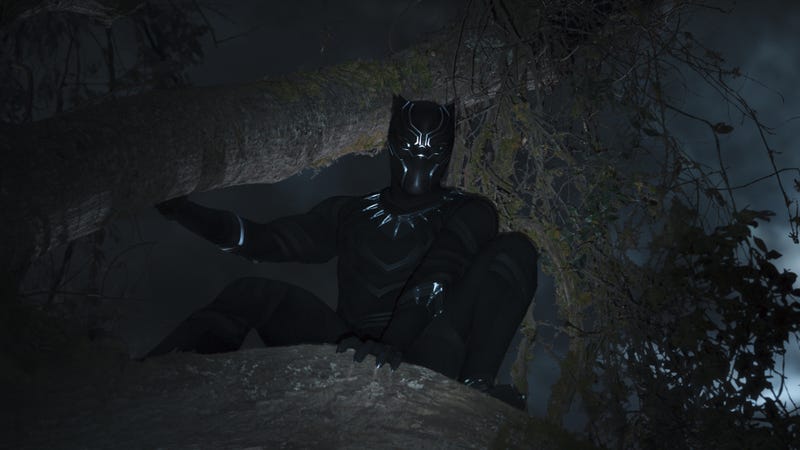
Black Panther is feline fine as he makes his way into the Marvel cinematic universe
Black Panther is feline fine as he makes his way into the Marvel cinematic universe.
Marvel Studios
Utilising this tech, Wakanda's king traditionally wears the mantle of the Black Panther. The latest in this line is T'Challa -- until he's challenged by a conspiracy involving a vicious arms dealer and a ruthless mercenary with a special interest in Wakanda's secrets.

Played by a quietly assured Chadwick Boseman, T'Challa is quite an easygoing king. It's refreshing to see a young monarch on whom the crown doesn't rest too heavily, but the script still tries to slip in the occasional "I'm not ready" speech, despite the fact that they don't ring true to the rest of Boseman's performance. He certainly has his badass superhero moments and his soulful emotional confrontations, but it's a relatively low-key rendition of a troubled king.

Watch this:Chadwick Boseman loves a good challenge

T'Challa is surrounded by an entertaining court of lively characters. From gruff bodyguard Danai Gurira and earnest spy Lupita Nyong'o to hilarious tribal leader Winston Duke, everyone in the extended cast seems to get dramatic and comedic and badass moments. It's hard to tell if a lifeless Martin Freeman is let down by the script or just doesn't know why he's there, but Andy Serkis seems to be having the demented time of his life. And mischievous Wakandan princess Letitia Wright is effervescent doling out Black Panther's gadgets like a hipper version of James Bond's armourer -- Q meets Q Tip, if you like.

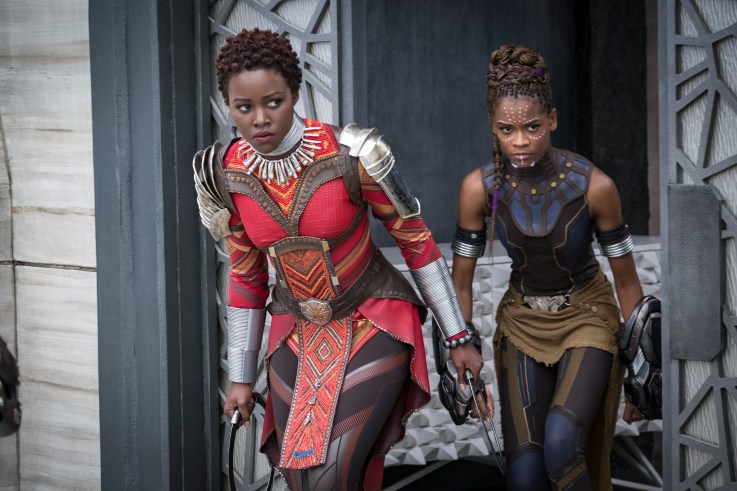
Lupita Nyong'o, Chadwick Boseman and Letitia Wright have claws for celebration
Lupita Nyong'o, Chadwick Boseman and Letitia Wright have claws for celebration.
Marvel Studios
One downside of the engaging and entertaining supporting cast is that Black Panther himself fades into the background at times. Boseman's understated performance is particularly eclipsed by the intensity just radiating off Michael B. Jordan. Jordan gives an incandescent turn as main bad guy Killmonger, a son of Africa burning with the fury of an African sun. Marvel has a history of forgettable villains, even when played by seriously weighty actors, but Jordan sears the screen with a combination of raging bitterness, muscular physicality and vitriolic wit.

Like all the best villains, the zealous Killmonger thinks he's the hero. A furious and furiously self-centred demagogue who upends the accepted order, he forces the people of Wakanda to decide whether they follow the nation, or the ideals on which the nation is meant to be founded.

Michael B. Jordan burns up the screen in "Black Panther"
Michael B. Jordan burns up the screen in "Black Panther".
Marvel Studios
He also kinda has a point: Wakanda's advanced technology could help the oppressed peoples of the world. Beneath the superheroics and the music and jokes, there's an undercurrent of anger in "Black Panther": It's a celebration of black identity from a basketball court in California to an African throne, but it also bitingly alludes to centuries of foreign meddling, violence and slavery.

Co-writer and director Ryan Coogler doesn't shy away from weighty themes in his flamboyant superhero extravaganza, but the subtext never overpowers the story. In fact it's when emotion is prioritised over action that "Black Panther" is at its best.

Which isn't to say the bit where Black Panther surfs on a car then punches through an SUV isn't cool. But for all the dizzyingly shot battles, the highlight of the action set pieces is a bludgeoning confrontation when the combatants cast off their superpowers (and their shirts).

If there's a weak link in "Black Panther", it's the source of the Wakandan hero's powers.

Vibranium is the hardest metal on Marvel's Earth, so it's great for making shields and weapons and lofty skyscrapers. That's a no-brainer. Vibranium also allowed the Wakandans to develop advanced technology like hover-trains and hologram systems. Sure, why not? And it's absorbed into the country's flora and imbues superpowers. Huh? OK, this is a comic book movie; you can have that I guess. Andit's facilitated medical advances that can basically heal anything. Wait, what? I buy the idea of keeping advanced weapons secret, but how can anybody justify keeping that from the world?

Vibranium is so advanced that a theme of the film is knowing when to dial back on the technology. Sometimes that means characters turning to tradition and spirituality, and sometimes it means literally ditching the cutting-edge visual effects for real acting. In today's computer-graphics-enhanced movie landscape, it's so, so cool to see a movie turn off the CG for the big showdowns. If you're sick of boring, weightless CG baddies in films like "Wonder Woman" and "Justice League", this is the movie for you. There's a bruising realness to the conflict, both emotionally and physically.

And there's no CGI required when your characters look this good with their shirts off.

A triumphantly fresh vision for Marvel superheroics, "Black Panther" claws its way into theatres from 12 February in the UK and 16 February in the US.

2018 sci-fi, fantasy and geek movies to get excited about


source:CNet
Commentary: Art like "Black Panther" overturns stereotypes to reclaim the past and reimagine the future. To understand the film's power, you need to understand Afrofuturism.

There's a secret at the heart of Marvel's superhero adventure "Black Panther": the African nation of Wakanda, bursting with advanced technology and hidden from the world.

Afrofuturist icon Janelle Monae at the Los Angeles world premiere of "Black Panther" in January
Afrofuturist icon Janelle Monae at the Los Angeles
world premiere of "Black Panther" in January.
Alberto E. Rodriguez
But that's not the only thing this Afrofuturist epic uncovers. By drawing directly from Africa as its source material, "Black Panther" gives us a new way to think about a past, present and future rarely seen in mainstream movies. (Here's CNET's review of the film, which opened in US theaters on Friday and earlier worldwide.)

Marvel's latest superhero flick is the perfect example of the genre and movement known as Afrofuturism. It combines elements of sci-fi, fantasy and African history and culture to create a new world to explore and escape into.

The term Afrofuturism was coined in the early 1990s to refer to an analysis of African-American sci-fi. But it's since become a method for speculative thought, imagining "what if" scenarios in fiction, music and even architecture that reclaim and reinvigorate depictions of the black experience. By re-examining historical events through an African lens, we can more deeply understand where we are today and, in sci-fi creations like the high-tech culture of Wakanda, imagine possibilities beyond the status quo.

Watch this:How did Black Panther get his accent?

"Black Panther" star Chadwick Boseman, who plays T'Challa, said he expressly thought about how he should approach his accent as Wakanda's king from a purely African perspective.

"He's the ruler of a nation," Boseman told CNET in a November interview. "And if he's the ruler of a nation, he has to speak to his people. He has to galvanize his people. And there's no way I could speak to my people, who have never been conquered by Europeans, with a European voice."

Ryan Coogler directs Chadwick Boseman on the set of Marvel's "Black Panther"
Ryan Coogler directs Chadwick Boseman on the set of Marvel's "Black Panther".
Matt Kennedy/Marvel Studios 2018
The "Afro" in the Afrofuturism of "Black Panther," isn't just evident in the predominantly black cast, also featuring Angela Bassett as T'Challa's mother, Ramonda; Michael B. Jordan as zealous villain Killmonger; and Lupita Nyong'o as spy Nakia.

It's everywhere in the aesthetics, from the vibrant design of the sets and costumes to the fictional rituals of Black Panther's home, Wakanda. Look at the ochre earth that covers the floor of the Wakandan throne room. Or the thatched roofs on the country's gleaming skyscrapers. Or gadgets in the form of traditional necklaces and beads. Even the natural landscapes of Wakanda draw on the variety of Africa's beauty, with rolling green hillsides and magnificent snowcapped mountains taking the place of the stereotypical parched desert.

King T'Challa's throne room is an example of Wakanda's combination of African heritage and comic book technology
King T'Challa's throne room is an example of Wakanda's combination of African heritage and comic book technology.
Marvel Studios
Yet Afrofuturism is more than a visual style bringing African influences into the mainstream. Even before the first (white) men walked on the moon in the 1960s, African-American writers, artists and musicians like Sun Ra looked to space and to the fantasies of science fiction to find the freedom denied them on Earth.

"Afrofuturism does a couple of things," filmmaker, author and futurist Ytasha L. Womack explained in a keynote speech at Canada's McGill University in 2015. "It affirms the agency of people who pull from aspects of the African or black experience in the future ... but it also recovers this lost history, heritage and perspectives that aren't talked about in our education system. You can pull from these different aspects to shape your present -- and the future."

Representation of the historical black experience on screen has often focused on slavery, from 1915's "The Birth of a Nation" to 2013's "12 Years a Slave." In the present, black people are regularly depicted as passive victims of police brutality and gang warfare who come from violent, impoverished communities the world over.

In sci-fi's future or fantasy settings, black people frequently don't exist: How many are there in "Blade Runner 2049", for example? In sci-fi, people of colour are often replaced by green- or blue-hued aliens or other fantastic beings as a proxy, from "Avatar," "Alien Nation" and "Bright" to "Blade Runner" and "X-Men."

Lupita Nyong'o (left) and Letitia Wright (right) fire up Wakandan high technology
Lupita Nyong'o (left) and Letitia Wright (right) fire up Wakandan high technology.
Marvel Studios
In other words, humanity has been living with a Westernised narrative. But in "Black Panther," the black people and culture we see are very different from stereotypical representations. Wakanda's past is free of colonisation and enslavement. Wakandans of the present are active citizens with agency over their country's resources. And they combine their chief resource, Vibranium, with their knowledge and ingenuity to develop futuristic technology outstripping the rest of the world.

"One of the things that we really wanted to make sure about Wakanda is the technology, and I think that that's something that all the fans want to see," the film's production designer, Hannah Beachler, told Black Girl Nerds. "The other thing that we really talked about was keeping the tradition of several different African tribes. We really delved into what that was and how we mix this new and this old."

For Beachler, Afrofuturism means taking a familiar narrative and "mixing it up and reowning it ... going back to an older time and modernizing it, and reclaiming it, and owning it in a different way."

Art meets the Afrofuture

You'll find Afrofuturism in fiction such as Octavia Butler's 1976 time-travelling slave narrative novel "Kindred", or more recently, the novel "Who Fears Death" by Nigerian-American writer Nnedi Okorafor. Set in a postapocalyptic future version of Sudan, "Who Fears Death" is scheduled to be made into an HBO series produced by "Game of Thrones" author George R.R. Martin.

Even before academic Mark Dery coined the term Afrofuturism in 1993, we saw it in the work of artists like otherworldly jazz performer Sun Ra. His experimental music, extraterrestrial-inspired cosmic philosophy and flamboyant performances produced works like the psychedelic 1974 film "Space Is the Place," in which he comes to us as a "Universal Being" not of this dimension.

Sun Ra and his Arkestra look to the future in 1978
Sun Ra and his Arkestra look to the future in 1978.
Getty Images
African-American singer, songwriter and record producer George Clinton of Parliament/Funkadelic fame shared many of the cosmic viewpoints of Sun Ra. His music was infused with an Afrofuturist vision of protest, hope, intergalactic mythology and fun, and he was one of the many who laid the groundwork for the evolution of electro. In the 1980s, hip-hop ambassador Afrika Bambaataaappeared as a being somewhere between a robot and an ancient Egyptian godhead for his influential 1982 hit "Planet Rock."

More recently, my personal favourite, Janelle Monae, adopted an android alter ego to take us on a tour of futuristic museums paying homage to rebel artists on the albums "The ArchAndroid" and "Electric Lady."

"I watched 'Metropolis' and was really inspired by it," Monae told The Irish Times. "Then I started to get into 'Alien' and 'Blade Runner', and I started to look at the android as the form of the other, all the discrimination that the android faced in these films. I could relate to that, the idea of being the minority within the majority."

Monae's next album and film will be titled "Dirty Computer" and will continue to explore sci-fi themes. No wonder she was the perfect choice to appear in "Hidden Figures," the award-winning 2016 movie reclaiming the contribution of African-American women to the space race.

By looking to both the past and the future and imagining new possibilities in stories like "Black Panther," we can inspire the present. At Afro Futures_UK, a UK-based collective of researchers, artists, programmers and activists, we explore new ways of seeing ourselves. Through seminars, workshops and social media, our black-led group aims to get more people involved in science, technology and the arts to do our bit toward self-determination and liberation.

As "Black Panther" sinks its teeth into huge box office success, Afrofuturism is now mainstream. A smash hit Marvel blockbuster made by a black cast, director and filmmakers should pave the way to change how Hollywood portrays Africa, the birthplace of humanity. That's the irresistible freedom of Afrofuturism.

Watch this:Chadwick Boseman loves a good challenge

source:CNet

9 'Black Panther' moments I can't stop thinking about

Commentary: CNET's Eric Franklin, a lifelong comics fan, will go back to the theater over and over to relive these parts of "Black Panther." Warning: Spoilers, and tears, ahead.

The more I've watched "Black Panther," the more I've come to appreciate how fantastic it is. (I've seen it four times now, about double my recent average for MCU films at this stage in their release.) I'll acknowledge that the movie isn't perfect. For starters, I really wish it was easier to see what was going on in that opening action scene. But I care less about perfection and more about how movies make me feel.

I've been a comic book fan most of my life, and I've been anticipating a Black Panther movie since I first started reading Christopher Priest's run in 1998. As a fan of the books, I couldn't wait to see how Wakanda and T'Challa would be interpreted. ("Civil War," of course, gave us a nice appetizer.)

But "Black Panther" carried an even larger expectation for me as a black person.

MORE 'BLACK PANTHER'

Glorious 'Black Panther' a Marvel blockbuster with teeth
The past, present and Afrofuturism of 'Black Panther'
Black Panther rules Marvel's world. Literally

A big-budget movie with a predominantly black cast set in a fictional country with the most technologically advanced society on Earth? All happening in what's arguably -- there is still Star Wars, after all -- the most popular current movie franchise? You wanna talk about stuff I've never seen before? Stuff I didn't think I'd ever truly see? Stuff I've been dying to see on screen since I was old enough to realize it was missing from my life?

So, yes, the movie worked for me as a film -- and as the ultimate fulfillment of this big-budget pop-culture representation I've been longing for. And the impact it's having (like the #BlackPantherChallenge to pay for underserved kids to see the movie and the push to register voters at the theater) is so great to watch.

Here are my favorite moments from "Black Panther" in the order they appear. There are at least 100 more moments that deserve to be on this list, but unfortunately the Time Stone is still tucked safely away in Kamar-Taj (last I checked), and I would rather prioritize seeing the movie another half dozen times right now.

1. Welcome to Wakanda

What happens: T'Challa, Okoye and Nakia fly into Wakanda.

Why it's on the list: This is the first time we see Wakanda in the film, and in the MCU. And it's worth the wait. As the sun rises on T'Challa and Nakia, powerful African vocals deliver Ludwig Göransson's incredible score. Okeye proudly tells T'Challa and Nakia, "We are home." The ship decloaks and flies over the Wakandan outskirts, revealing a deep majestic canyon and a taste of the film's amazing cinematography by Rachel Morrison, an Oscar nominee for "Mudbound." The ship then swoops through a valley where we see herds of animals rushing, almost as if welcoming the king back home. The herders themselves wave as the ship flies by. My favorite images from this scene, though, are the Border Tribesmen on horseback, racing along, signaling to the ship.

Drum beats reach a fever pitch, and T'Challa's line, "This never gets old," mirrors how I will likely feel about this scene even 20 years from now. Finally, the ship dives right into the hillside and climatically breaks through the holographic barrier to reveal Wakanda in all its glory as the horns come barreling into the score.

9 'Black Panther' moments I can't stop thinking about
Marvel Studios
I shed manly tears experiencing these first shots of Wakanda. The scene did not disappoint.

2. The Challenge Day ceremony

What happens: The Dora Milaje, the four tribes and T'Challa's family festively dance and drain the river in preparation for T'Challa to arrive to his coronation.

Why it's on the list: This scene, an instant classic, is the reason to see a spectacle film. Once again, the music is key. It's festive at first and then builds to a majestic high (there's a lot of majesty in this score) as T'Challa exits the ship to the sound of everyone chanting his name. T'Challa takes a moment to truly appreciate what a big deal this is as he looks around at his fellow Wakandans swaying and bobbing in celebration of their soon-to-be new king. This scene could have easily been ruined by a voiceover preemptively explaining the lore of the challenge, but the filmmakers are smart enough to just let a scene be.

9 'Black Panther' moments I can't stop thinking about
Marvel Studios
I loved every aspect of this -- from the symbolic shot of the spaceship leaving the frame to the effects when his powers are stripped away as everyone rhythmically shrugs their shoulders (god, I love that detail). This is also when you first get to see Ruth E. Carter's incredibly vibrant, eclectic costumes penetrate the screen.

It feels like nothing I've ever seen before.

3. Shuri names her new invention

What happens: Shuri introduces new footwear to her brother.

Why it's on the list: This whole Shuri as "Q" James Bond scene is one of the most entertaining, but my favorite joke is Shuri's meta sneakers joke. No, not the "What are those?!!" one, although I quite enjoyed that one even before I knew it was a Vine reference. The other shoe joke about her new "sneakers."

What sold me was not just Letitia Wright's brilliant delivery, but Chadwick Boseman's reaction and then her response to his reaction. It's subtle and easy to miss. Watch both actors next time you see it. Their performances in this scene, and especially this moment, are brilliant.

4. Killmonger walks to the throne

What happens: Yes, literally just that.

Why it's on the list: This is the best shot in the movie. Everything about it is incredibly expressive: the music, the crazy rotating camera angle, the acting (Michael B. Jordan's stylish swagger as he heads to the throne is noticeably different from the way the other Wakandans carry themselves), the sandals he's wearing. Wakanda has just been turned on its ear and this shot captures that perfectly.

5. M'Baku threatens Ross

What happens: Everett Ross, played by Martin Freeman, starts speaking, but gets cut off by Winston Duke's M'Baku.

Why it's on the list:
Winston Duke's perfect comic timing is everything here. When Freeman starts talking, I cringed. I expected that tired cliche of the outsider explaining things to an antagonist in a way the main characters can't, getting them out of a bind. "Mr. M'Baku I'm not from around here, but if there's one thing I do know is that T'Challa..." UGH, no thanks!

9 'Black Panther' moments I can't stop thinking about
Marvel Studios
But when M'Baku and the rest of the Jabbari basically bark him into submission, I was beyond relieved. And then, M'Baku threatens to feed Ross to his children. The implications of that line evoked too many "African savage" stereotypes for me. A big African black man threatening to feed the feeble white man to his assumably cannibalistic children?

But Ryan Coogler is a genius and I should have trusted him. He deftly subverted my expectation, and what followed was my favorite joke and delivery in the entire movie. It brings the house down every time I've seen it. Vegetarians, indeed.

6. T'Challa vs. Killmonger 1

What happens: T'Challa and Killmonger fight for the throne of Wakanda.

Why it's on the list: This is an incredible fight, though the first time I watched it, I wasn't really feeling it. It didn't hit me like a Winter Soldier kind of fight, which I guess is what I was expecting? But every time after that, it got better and better. I realized it tells a very specific story. The way the fight builds, T'Challa has a couple of chances to end it early, but instead shows mercy. As Erik gets the upper hand and you slowly realize T'Challa's not going to win, it's heartbreaking. The almost deafening score punctuates this.

9 'Black Panther' moments I can't stop thinking about
Faceoff.
Marvel Studios
The knee to the head, the punch to the gut. Killmonger's taunting question: "Is this your king?!" Nakia getting the Queen Mother and Shuri away. If you've watched this scene and you thought the fight was boring, watch it again and pay attention to the small details. Incredible.

This tweet perfectly mirrors my feelings on it:

7. Killmonger's vision

What happens: Erik Killmonger goes through the coronation ritual to become the new Black Panther.

Why it's on the list: This is, full stop, the best scene in the movie, from the way it's shot, again to the music, to the editing and writing choices. Namely the choice to use the kid version of Killmonger to talk to his dad. Erik has never gotten over the pain of losing his father. He's still that kid who found his father murdered by the king of Wakanda all those years ago.

Full disclosure: I've never seen an episode of "This is Us," but I'm now a huge Sterling K. Brown fan because of this movie, and mostly because of this scene. He kills it here and Michael B. Jordan is impressive, but it's child actor Seth Carr who makes this scene. His delivery of "People die ... that's just the way it is around here" is perfect. And as a guy who grew up on the west side of Chicago in the '80s and '90s, is something that's incredibly relatable for me.

8. The Dora Milaje trap Killmonger

What happens: Three members of the Dora Milaje trap Killmonger to attempt to remove his suit.

Why it's on the list:
This moment speaks directly to me. One of the things I love in superhero comics is seeing highly skilled but otherwise regular humans believably keeping up with (and sometimes even beating) superpowered individuals. (See a depowered Storm defeating Cyclops for leadership of the X-Men in "Uncanny X-Men #201.")

9 'Black Panther' moments I can't stop thinking about
Marvel Studios
In this scene, Killmonger has the powers of the Black Panther and one of his suits, yet three Dora (who don't have superpowers, just powerful weapons and know how to work as a group) are able to trap him with their spears and nearly take him out. He ultimately uses the powers of the suit to break free, but this sequence made the Dora even cooler than they already were.

I also have to believe writers Ryan Coogler and Joe Robert Cole are also wrestling fans, as this is textbook "looking good in defeat," where a character comes close to beating another, stronger character, but is ultimately defeated, yet still having earned the fans' respect.

9. The final scene

What happens: T'Challa and Shuri visit Oakland.

Why it's on the list: T'Challa, forever changed by Erik Killmonger, comes to Oakland to start to slowly, thoughtfully help struggling black and poor people out in the world.

This scene impacted me in a way I didn't expect. It speaks to the 14-year-old version of me who wrote my own stories about cool sci-fi stuff happening in my neighborhood. In my stories, the main protagonist, the guy with the coolest weapon and fighting ability, was always black, because I frankly didn't see that enough in movies. Seeing this dramatized in a movie was like seeing a dream literally come true. It was an extremely emotionally complex moment. As the credits rolled, so did my tears.

Ranking the Marvel Cinematic Universe movies

source:CNet

Wesley Snipes Reveals His '90s Black Panther Project Could Have Featured the Civil Rights Movement
While we were busy buzzing about Marvel’s big Black Panther debut last night, an interesting story came out. Before he went on to make Blade, Wesley Snipes campaigned long and hard to get the ball rolling on a live-action Black Panther adaptation in which he would have starred. Though the project never quite came to fruition, Snipes’ description of that ‘90s Black Panther film is a fascinating taste of what might have been.

Snipes spoke with The Hollywood Reporter about how his own Black Panther project actually got much farther along in the production process than most people realize (if they knew about it at all). Multiple scripts were written, Snipes himself (who was a hot commodity throughout the early-to-mid ‘90s) was attached to star, and both Mario Van Peebles and John Singleton were in the running to direct.

But for all the potential Snipes’ Panther might have had, comic books and movies based on them didn’t have the same kind of cultural cache and relevance that they do today and not everyone was on board with the idea of sticking close to the source material. Though Snipes felt it was important to emphasize Wakanda’s technological prowess—something we’ll definitely be seeing in Marvel’s film—others, like Singleton, thought it would be smarter to go in a different direction:
“John was like, ‘Nah! Hah! Hah! See, he’s got the spirit of the Black Panther, but he is trying to get his son to join the [civil rights activist] organization. And he and his son have a problem, and they have some strife because he is trying to be politically correct and his son wants to be a knucklehead.’

I am loosely paraphrasing our conversation. But ultimately, John wanted to take the character and put him in the civil rights movement. And I’m like, ‘Dude! Where’s the toys?! They are highly technically advanced, and it will be fantastic to see Africa in this light opposed to how Africa is typically portrayed.’ I wanted to see the glory and the beautiful Africa. The jewel Africa.”
Snipes also described a number of other angles for the film that would have focused on a version of T’Challa who didn’t grow up in Wakanda in the years before he became king. As odd as that may sound, bear in mind that the ‘90s were a very, very different time for Marvel and Black Panther. At the time, Marvel had recently sold off the film rights to a number of its characters in an attempt to stave off its impending bankruptcy.

Even though Columbia Pictures was interested in potentially producing Snipes’ Black Panther, technological and budgetary constraints proved to be insurmountable issues. CGI wasn’t anything close to what it’s like today and capturing the sheer grandeur of Wakanda would have called for a gargantuan budget. It’s nice to think that there was almost an OG Black Panther film that we could have been looking back on with fondness (or derision, who knows) for years, but to hear the way Snipes describes his vision for T’Challa’s vibranium suit, perhaps it’s best the movie never got made: source:Gizmodo

Black Panther rules Marvel's world. Literally

Chadwick Boseman -- known for playing characters forging new ground -- takes on another trailblazing role as Marvel's king of Wakanda.
C
hadwick Boseman has made a career playing pioneers who've had to fight to make their way in the world. In "42," he showcased the quiet dignity of baseball's first black major league player, Jackie Robinson. In "Get On Up," he gave us the man behind the music legend James Brown. And in this year's "Marshall," he brings life to Thurgood Marshall, the first black Supreme Court justice, during his crusade for civil rights early in his career.

So it's no surprise Boseman, 41, would play another trailblazer -- T'Challa or Black Panther, the first black mainstream comic book hero, created in 1966 by Stan Lee and artist Jack Kirby. In Marvel Studios' "Black Panther," which hits theaters this month, Boseman plays the king of the fictional African nation of Wakanda, the world's most technologically advanced, and secretive, country.

T'Challa rules a country grappling with whether to make its presence known to the world and whether to allow in outsiders, eager to exploit its cache of vibranium, a strong, vibration-absorbing metal used to create Black Panther's suit. At the same time, he has to fend off enemies who want to remove him from the throne.


"Everybody has heard the line, 'It's hard for a good man to be king,'" the actor tells me. "Sometimes you have to do bad things or you maybe need to do bad things so there's justice, so there's peace."

Boseman and I had two conversations this summer, in which he talked about creating a new role model for kids, how "Black Panther" may get people to rethink women in tech, and why he's a cautious fan of smart technologies. Here's an edited transcript of our conversations.

Watch this:Chadwick Boseman loves a good challenge

Q: When we saw Black Panther in "Captain America: Civil War," he had become king of Wakanda after seeking to avenge his father's death. You've called him an antihero. Why is that?

Boseman: He has the attributes of a hero, but has difficult decisions, difficult choices. Sometimes there's no right answer. Everybody has heard the line, "It's hard for a good man to be king." I think there's a sense of all the complications of being a good leader. At times it feels like "The Godfather." It's complicated to do what's right. It's complicated to follow the traditions. It's complicated to do something new. It's complicated when you have to deal with who should live and who should die.

Mark Mann

Sometimes you have to do bad things or you maybe need to do bad things so there's justice, so there's peace.

So like "The Godfather," it's a story of people trying to figure out a place for themselves in a complex world? What kind of a movie is this to you?

Boseman: It is definitely a superhero movie. There are going to be action scenes, and some stuff is going to blow up. [laughs]

The thing I love about Marvel in general is that they deal with people. They deal with the human being first: Who is inside the suit? Who is the person that obtained this power or this ability?

This movie is about how you use power. What do you do when you get power? In this case, you're talking about someone taking the throne. But all superhero movies are about a person who has extreme power. They can disappear. They do tricks or they can jump really high. Whatever it is, that ability gives them an advantage. The only difference between a hero and the villain is that the villain chooses to use that power in a way that is selfish and hurts other people.

Chadwick Boseman
Mark Mann

What do you like about this character?

Boseman: I love that he thinks about other people. He's not afraid to hear wise counsel. I think there is some fear of being wrong. I identify with that, with his plight, his personality. And I love him because the fantasy of playing a ruler -- you never get to do that. You never get to explore what that is. It's fun having power and having a say in what happens to the people around you.

Black Panther is notable for being the first black superhero in mainstream comics, and now the star of a big-budget action film. You've said this is a good moment in history for this movie to be made. Why?

Boseman: It's just this tremendous opportunity, not just for me but for all of us really to get out of our boxes. It's not just black people getting out of their boxes. Everybody is excited about the opportunity to do something that we should have already done. People are excited about seeing new stuff, but I think they're extra excited about seeing stuff they should have seen already.

It pulls from various ideologies. It pulls from the blacks-in-science idea, from a nationalist idea, it pulls from a collective-world idea. There's something that will influence people in a particular way. It took all of this time to come to fruition in a larger way, but now the world is right, the world is able to receive that. It's just a special thing.

When they call you and say, "So you want to play Black Panther?" if you know what Black Panther is, there's no way in the world you're going to say no because there's a lot of opportunity for magic to happen.

Chadwick Boseman
Mark Mann

Were you a comic book fan when you were a kid?

Boseman: Not when I was a kid. Unfortunately for some reason that didn't come into my sphere. But in college, that's when I first was put on to Black Panther. Even before I got the role, there was the idea I would love to play that one day.

Did you miss having role models like Black Panther when you were growing up?

Boseman: You don't know what you're missing if you haven't experienced it. People of African descent, most of us grew up accepting and loving Spider-Man. I still love Spider-Man. I still love the Incredible Hulk. I still have those characters that were white role models, superheroes, heroes -- whatever you want to call it. You basically had no choice but to accept those. You might have created other superheroes in sports or in politics, but there was never that renowned, widely accepted superhero in the same way.

But you don't know if you've never experienced it. In the same way, kids now [won't] say, "There will never be a black president." There are kids that that's all they know.

And now you're a role model and an action figure.

Boseman: I love it. You see how much it means. There was one kid [fighting cancer] who used the Black Panther as sort of his inspiration. He saw himself as a Wakandan, he saw himself as having the spirit of Wakanda in his fight. The fact that he chose you, that's the world he lives in. It does mean a lot.

Watch this:Stan Lee's "revolutionary spirit"

What do you think it says that Black Panther was created in 1966 by two white men -- Stan Lee and artist Jack Kirby?

Boseman: Yes, the idea came from Stan Lee, and it came at a time ironically that the totem of the panther was actually part of our revolutionary spirit. It was just something right about that time that these men were on that wavelength. What I think it speaks to is the fact that Stan Lee is just open enough to catching the revolutionary spirit, even as a white man.

Mark Mann

You spent a lot of time thinking about how the king of an advanced African nation speaks, specifically your accent, your intonation. Tell us about it

Boseman: People think about how race has affected the world. It's not just in the States. Colonialism is the cousin of slavery. Colonialism in Africa would have it that, in order to be a ruler, his education comes from Europe. I wanted to be completely sure that we didn't convey that idea because that would be counter to everything that Wakanda is about. It's supposed to be the most technologically advanced nation on the planet. If it's supposed to not have been conquered -- which means that advancement has happened without colonialism tainting it, poisoning the well of it, without stopping it or disrupting it -- then there's no way he would speak with a European accent.

If I did that, I would be conveying a white supremacist idea of what being educated is and what being royal or presidential is. Because it's not just about him running around fighting. He's the ruler of a nation. And if he's the ruler of a nation, he has to speak to his people. He has to galvanize his people. And there's no way I could speak to my people, who have never been conquered by Europeans, with a European voice.

Describe Wakanda to people who don't know anything about Black Panther.

Boseman: It's a utopia. It's not just an African utopia -- it's a utopia. It's a place where spirituality and science do not war with each other.

Black Panther is surrounded by strong women. There's a long-running debate in the tech industry about whether women are smart enough to be in tech.

Boseman: Do they really think that women are not smart enough? [laughs] Women are so much smarter than men most of the time. [laughs] It's crazy to think that you go to work and all of a sudden you get smarter. When you go home, your wife is obviously smarter than you. [laughs] She gives better directions. She can multitask better. You know you can't beat her, whatever it is. It's like, "I'm not going to argue with any of that." Your woman is always smarter. She can catch you in your lies. [laughs]

You've said that Letitia Wright, who plays your sister Princess Shuri in this movie, will change people's perception of women in tech. How?

Boseman: If anyone doesn't think there's a place for women in tech, it's completely demolished in this movie.

Her role is the most important. In the comic book, T'Challa is a scientist and a king, but my sister is the whiz kid. She is the one with that gift. She's the Tony Stark of Wakanda. She's witty, she's cool, she's funny. Now, T'Challa is good in science too, but she's the whiz. That's the way the story's been told forever. T'Challa is technologically sound. He's a scientist as well, but she's the minister of technology.

Nakia (Lupita Nyong'o, left) rounds a corner with Princess Shuri (Letitia Wright), whom Boseman calls the Tony Stark of Wakanda.
Nakia (Lupita Nyong'o, left) rounds a corner with Princess Shuri (Letitia Wright), whom Boseman calls the "Tony Stark of Wakanda."
Marvel Studios

When you think about the most technologically advanced society, what do you imagine?

Boseman: For me, technology is not about gadgets. Technology is essentially your ability to enhance your lifestyle beyond the norm. What I would love to see is for technology and nature to find a way to merge. If that happens in our society, we will have gone to a different place and we can advance the species.

What do you mean?

Boseman: If we're going to build a rocket to go to outer space and go to the moon, how do we do that in a way where it doesn't destroy the Earth? How do we build weapons that won't destroy the Earth? Or the better way, how do you live in a society that doesn't need weapons at all? How can we advance in this computer age without having landfills filled with the parts from those things? That to me, that's advanced.

Are you a gadget guy? Do you have a smart house?

Boseman: I don't have a smart house. My house is very dumb. [laughs] I do use my phone often -- I have no choice. I'm not one of those guys who walks around with a flip phone who doesn't want to be connected. There are times when I'm tech-friendly and there are times when I personally do want to shut everything off because I'm more creative when I shut off.

Looking forward to self-driving cars?

Boseman: I'm not so keen on letting my car drive itself. But I like the idea that it can catch me if I sleep. Even simple things like the fact that we have apps where we can call cars for ourselves instead of getting in the car and driving drunk. I love that. That's really dope stuff.

This story appears in the winter 2017 edition of CNET Magazine.

source:CNet

A ‘Black Panther’ moment
This week we’re bringing you a special edition of CTRL+T, the podcast that examines TechCrunch stories through a cultural lens.

You might have heard that Marvel released a film called Black Panther last week and it saw near-record crowds descend on theaters all over the world. The CTRL+T podcast team was among them.

We headed to Oakland on an unseasonably cold-for-California evening and waited in line at the Grand Lake Theater for about 90 minutes. While in that line, we talked to a few people to see how they felt about this Black Panther moment in time — with the dulcet tones of a corner trumpeter playing in the background.

More on 'Black Panther'

Black Panther rules Marvel's world. Literally
The past, present and Afrofuturism of 'Black Panther'
Black Panther 2's Bad Guy Wants To Be Kendrick Lamar

We chat about the film, what it means and its impact on comic book audiences — an interesting conversation given the fact that my co-host, Megan Rose Dickey, and I don’t read comic books on the regular (or at all, really). Also caught on tape was a little run-in we had with a sign. It wasn’t me.


source:TechCrunch

Black Panther 2's Bad Guy Wants To Be Kendrick Lamar

The famous rapper Kendrick Lamar says Erik Killmonger was "misunderstood."

Kendrick Lamar produced Black Panther's highly acclaimed musics. But he seems willing to do more than that.

During an interview with BBC Radio 1, Clara Amfo asked him if he'd be interested in a "little cameo" in the second film.

More on Black Panther

Black Panther rules Marvel's world. Literally
The past, present and Afrofuturism of 'Black Panther'
9 'Black Panther' moments I can't stop thinking about

"Come on, I got to now!" Lamar said. He went on to say he enjoyed Michael B. Jordan's character, villain Erik Killmonger. "He was a villain but he was loved and misunderstood," Lamar said. "So if I could, I'd play a Killmonger for sure."

Famous rapper said it was a "privilege" to be involved with the in such a beautiful film like this, and that the film "is something that not only stands within its moment but stands within time."

Watch this:The best (and worst) things about Marvel's 'Black Panther'...

source:CNet

All hail the king: Marvel film is on track for a $218 million debut, destroying the previous record for a February opening.

"Black Panther" rules at the box office
All hail the king: Marvel's "Black Panther" ruled the box office over the Presidents' Day weekend, Walt Disney Co. estimates showed Sunday, shattering records and earning the second biggest opening weekend for a Marvel Studios film, trailing only 2012's "The Avengers."

The film, which stars Chadwick Boseman as T'Challa/Black Panther, collected $192 million in ticket sales over the weekend, Disney estimates, for the fifth-largest film opening weekend ever and the highest-grossing February opening weekend ever, beating the $132 mark set by "Deadpool" in 2016. Estimates show it's on track for a $218 million four-day holiday weekend.

MORE ON 'BLACK PANTHER'

Black Panther rules Marvel's world. Literally
Glorious 'Black Panther' is a Marvel blockbuster with teeth

The only four films to have opened higher are some major names: "Star Wars: The Force Awakens," ''Star Wars: The Last Jedi," ''Jurassic World" and "The Avengers."

The film has demolished other records as well. It's the most-tweeted-about movie of the year so far, Twitter announced last week. It's also the fourth-biggest pre-sale movie in the history of ticket site Fandango, trailing only the last three Star Wars movies.

And numbers may continue to climb: Fandango reports that 61 percent of the "Black Panther" moviegoers it surveyed are considering a second viewing.

2018 sci-fi, fantasy and geek movies to get excited about


source:CNet

Every Marvel movie and TV show currently airing or announced -- and the absolute ideal order for watching them -- so you can check out the next Marvel movie super-prepared.

How to watch every Marvel property in the perfect order
Marvel: Will it ever stop growing?
Marvel
You've probably seen most of Marvel's films, but what about the TV shows?

If you're like me, that is to say acontinuity junkie, timelines are very important to you -- but timelines in the world of comics and movies can be more than a little confusing.

Editors' note, Dec. 31, 2017: We updated our biggest update ever to give some updates on updated dates, especially with all the new shows premiering soon (or announced, or pushed) and with even more upcoming films. Think you've found a mistake? Let me know in the comments!

Watch this:How to watch every Marvel movie in the correct order

So to either help you fill in the gaps before "Avengers: Infinity War," to just watch all the shows for fun, or even merely try to impress your friends, we've created a timeline of Marvel's Phase 1, 2 and 3 (and bits of 4) properties in the perfect viewing order.

The Marvel Cinematic Universe, as it's called, also sometimes includes connected properties such as movie tie-in comics or shorts. Here we've left out smaller properties and stuck to the big two: films in red, shows in black.

Marvel Cinematic Universe Timeline
Aaron Robinson/CNET
Also, you should definitely still note that "The Incredible Hulk" is still skippable (we even watched it recently just to confirm) and even William Hurt ("Thunderbolt" Ross himself) has admitted it. Speaking to IGN, Hurt said that "[Ross in 'Civil War'] is different because it's a different style...And what they've done is they've taken a character who was the Ross from the older film and made a new version. This is a much newer Ross. A much different Ross." After watching both, we can confirm this is indeed the case.

Ranking the Marvel Cinematic Universe movies


You'll also notice that shorts and the Marvel "One-Shots" are missing from the graphic. These are brief videos initially created as standalone stories to provide backstory for characters or things seen in the movies; two of them would later become full-fledged shows.

Continuity in the MCU

There's definitely some continuity strangeness when you have both movies and television show properties, and those listed on the graphic are no exception.

Season 1 of "Agents of S.H.I.E.L.D." saw the release of two Marvel movies and had to contend with incorporating those plots. Airing after the release of "Thor: The Dark World," episode 8 of "S.H.I.E.L.D." definitely takes place directly after those events.

"Strange" definitely does not take place before
"Winter Soldier."
Marvel
Later in the same season, episode 16 aired the same weekend as the release of "Captain America: Winter Solider," and in a neat bit of continuity, the events portrayed on "S.H.I.E.L.D." take place at almost the same time as the film. (Some people say episode 16 comes before "Winter Soldier," and you can certainly treat it as such. The *absolute* best way to watch them would be simultaneously, but have yet to see anyone make that "fan edit.")

Netflix's "Daredevil" and "Jessica Jones" also have wibbly-wobbly timelines. Early in the series, the Battle of New York is referenced as The Incident, and it's said that it occurred about two years prior. But because of the show's lack of interaction with any big-screen Marvel characters, it could take place almost anywhere on the timeline between "Thor: A Dark World" and "Avengers: Age of Ultron." In our timeline, we placed it concurrent with the second season of "S.H.I.E.L.D." so as to stay closer to the time it was actually released.

"Guardians of the Galaxy Vol. 2" is higher up than you may have expected -- that's because of the number of years the film says have passed, meaning it takes place just a few months after the first film.

Finally, many commenters feel that "Doctor Strange" should come before "Winter Soldier," and they cite the scene with Jasper Sitwell on the roof naming Stephen Strange. But to be honest, this one has a better explanation as "the algorithm was right on the money with Strange" rather than "he was already a sorcerer" by then. In fact, one IGN editor has a pretty great breakdown of why this is exactly the case here.

It could probably go either way but all signs point to "Strange" taking place afterward. (But with time manipulation up for grabs now, who really knows??)

Watch this:How did Black Panther get his accent?

Upcoming films

Marvel Studios president Kevin Feige told me is very important to Marvel: "You look at any of our films and they've been very diverse," he said. "We feel like we're just doing justice to the books by representing that fully."

And after "Thor: Ragnarok" this weekend, the slate of MCU films does look a bit more diverse. "Black Panther" comes out in February 16, 2018, and is the first Marvel film with a POC as the lead, with Chadwick Boseman as the title character. The film also stars Michael B. Jordan ("Creed"), Lupita Nyong'o ("Queen of Katwe"), Danai Gurira ("The Walking Dead"), Daniel Kaluuya ("Get Out"), Angela Bassett, Forest Whitaker -- the list goes on, but hopefully you get the idea.

Check out our CNET Magazine feature on Boseman, that accent and the power that is Black Panther.

Chadwick Boseman
Chadwick Boseman
Mark Mann
"Avengers: Infinity War" drops May 4, 2018. Directors Joe and Anthony Russo say there are some unexpected characters and, oh, it's basically a heist movie with Thanos at the center of it all.
With "Infinity War," the biggest new element to the movie is Thanos and the fact that he's entering the storytelling in a very bold, strong way, to the degree that he's almost one of the leads. We've shaped an interesting narrative around him that in some ways leans heavily on a heist film in the fact that he's going after the infinity stones in a much bolder, successful way than he has in the past. The entire movie has that energy of the bad guy being one step ahead of the heroes. We looked at a lot of movies that had that heist-style energy to them, [and] that brought some inspiration.
For more info on the next Avengers film, check out Erin Carson's interview with the brothers.

"Ant-Man & the Wasp," starring Paul Rudd and Evangeline Lily, is set for a July 2018, making it the first film to give title billing to a woman. And let's not forget that Brie Larson will be playing Carol Danvers in 2019's "Captain Marvel."

With "Avengers: Infinity War" set for a May 2018 release, what're the odds we'll see Larson's character well before her own film arrives? (I'd say pretty good.)

On the small(er) screen

Netflix's Marvel shows still rule outside of the theaters, but ABC attempted to jump back into the game with "Inhumans" this fall but poor ratings mean any whisper of a second season is gone. The fifth season of "S.H.I.E.L.D." has taken our heroes to the future (literally), but no word yet on its own.

New Marvel shows are now pretty consistently popping up, but only some are within the MCU canon. Next year, "Cloak & Dagger" is set to premiere on ABC's young adult channel Freeform -- it still has no premiere date, but there is a trailer. "Marvel's New Warriors" was originally intended for the same network next year, but in November THR revealed it was being shopped to other networks. It currently has no air date.

Also, "Marvel's Runaways" launched on Hulu recently; essentially the series centers on a group of teenagers who come together to defeat their evil parents.

As for Netflix-Marvel properties, for the most part these series have fared better than the ABC projects. Speaking to CNET Magazine, Mike Colter mentioned that the humanity of Luke Cage and The Defenders is a big part of what he thinks resonates with people.

"A big part of what separates the Netflix kind of Marvel Cinematic Universe from the films is its ability to stay away from 'quote, unquote' superheroes, mysticism and alien interference. So yeah, I feel like it's got its own audience. Our characters you know, we do tread some of the same territories as people [in real life]... We're doing something different -- not better, but just different. You can have both."

Here's where those Netflix properties stand as of now:

  • "Daredevil": Season 3 was announced... and that's about all we know for now. Well, that and a few cryptic tweets leading people to believe filming has begun.
  • "Luke Cage": Season 2 has been announced, but it's still not likely to appear until after seasons 2 and 3 of "Jones" and "Daredevil," respectively. That means we won't be seeing him solo again until the second half of 2018 at the earliest. But we have seen some new characters (villains, to be exact).
  • "Iron Fist": Season 2 has been announced, much to the chagrin of those who slogged through season 1 (not me, if I'm being honest), but that's it still.
  • "The Defenders": Season 1 aired last summer. No second season has been announced.
The growth of the Marvel universe is extraordinary (har-har), and as the comics giant introduces new fans to new characters (some people had no idea who Doctor Strange was a couple of years ago) and partners with cable television and Netflix to expand even further, we could see some pretty epic pairings, teams and characters come out of the woodwork.

So, be honest. Which characters would you want to see in Marvel's not-yet-announced-but-certainly-inevitable next phases on both the small and big screen?

How to watch every Marvel Cinematic Universe film in the right order


source:CNet

Halle Berry as Catwoman
In the highly unlikely event that anyone was still wondering whether mononymous French director Pitof’s 2004 Catwoman wasn’t actually an absolute disaster, one of the film’s writers would like you to know that he thought it was a “shit movie.” Bold words. Bold, honest words.

In response to former First Lady Michelle Obama’s glowing endorsement of Black Panther for its black representation, Federalist culture critic D.C. McAllister took to Twitter to question why there hadn’t been a similar groundswell of support around Pitof’s Catwoman. Aside from the fact that the titular leads of both films are black superheroes with feline motifs, there aren’t that many similarities between the two.

Black Panther’s black-led production team put a tremendous amount of work into realizing a version of Wakanda that was inspired by and celebratory of many of Africa’s cultures. Catwoman’s production team churned out a weird story about ancient Egyptian cat magic and fighting against an evil makeup mogul. There were some feminist elements to Catwoman to be sure, but the movie as a whole was so bad that really, it’s hard to focus on its few positive features.

That’s a charitable view of the film compared to Catwoman co-writer John Rogers’, who saw McAllister’s complaint and straight up called his own movie out for being hot garbage:
Rogers’ point about cultural relevance is likely in reference to the fact that the vast majority of Catwoman’s production team—its director, cinematographer, writers, and producers—were mostly white and male. Halle Berry’s performance was bad, to be sure, but who knows how much of that can be attributed to the fact that the creative minds behind the movie had no idea how to build a proper story for the actor to shine in?

In any case, let it now be known that Catwoman’s terribleness isn’t just the stuff of general internet nerd smugness. At least one of the folks who made the movie hates it even more than you do.

source:Gizmodo

Gold star if you can name everyone in here.
Everybody knows Robert Downey Jr. as Iron Man and Chris Hemsworth as Thor, but can you identify the other stars in this massive Marvel Cinematic Universe photo?

The Avengers and a whole ton of other Marvel movie heroes and villains left their body armor and spandex at home to participate in a mind-blowing "class photo" celebrating 10 years of Marvel Studios.

The Marvel Cinematic Universe kicked off with "Iron Man" in 2008 and has delivered a string of action blockbusters ever since. The sheer star power on display in the class photo is enough to blind you.

Marvel released the photo Thursday, and it comes from a secret photo session on Oct. 7 in Atlanta on the set of the upcoming "Avengers: Infinity War." You can go behind the scenes of the shoot in a video also released by Marvel on Thursday.

Watch this:Marvel Studios 10th Anniversary Announcement – Class Photo Video

The photo includes big-name stars like Chadwick Boseman (Black Panther), Chris Pratt (Star-Lord), Robert Downey Jr. (Iron Man), Scarlett Johansson (Black Widow) and Benedict Cumberbatch (Dr. Strange). If you can't figure out who everyone is by looking at the photo, you can check the list of participants posted by Marvel.

While the gathering is impressive, some big names didn't make it to the photo shoot. Notably missing are Natalie Portman, who played Thor's love interest Jane Foster, and Lupita Nyong'o, who stars as Nakia in the latest Marvel movie "Black Panther."

And that's not all. We're also short on Tom Hiddleston (Loki), Bradley Cooper (the voice of Rocket Raccoon), Anthony Hopkins (Odin), Idris Elba (Heimdall) and Clark Gregg (Phil Coulson on "Agents of Shield"), among others. It's not surprising so many actors are absent. Herding Marvel stars is probably more difficult than herding cats.

Gregg at least explained on Twitter why he missed the occasion:
As for the people in the photo you don't recognize, they're the behind-the-scenes movers and shakers like Kevin Feige, president of Marvel Studios, and casting director Sarah Finn.

And just in case you overlooked him, you can find Marvel legend Stan Lee near the middle in the second row up. It wouldn't be a proper MCU photo without him.

Avengers: Infinity War' is going to blow your mind


source:CNet

MKRdezign

Contact Form

Name

Email *

Message *

Powered by Blogger.
Javascript DisablePlease Enable Javascript To See All Widget